


The 15% across-the-board tariffs under Section 122 might be expiring this month, but the true cost of international procurement is rarely found on a government schedule. For many businesses, the real financial drain stems from hidden middleman markups and the lack of on-site visibility that leads to quality inconsistencies during mass production. You likely recognize that a "good enough" handshake deal is no longer a viable strategy in a landscape where Section 301 investigations into forced labor and manufacturing capacity are the new baseline. To protect your margins and your reputation, you need a rigorous onboarding a new sourcing partner checklist that functions as a physical and financial audit rather than just an administrative hurdle.
Standardizing your procurement process is the only way to eliminate hidden risks and build a truly transparent supply chain. This guide provides a comprehensive framework to help you move away from unmanaged sourcing and toward a model that prioritizes direct factory pricing and clear accountability. We'll walk you through a repeatable onboarding workflow designed to reduce operational risk and establish a regional presence that acts as a protective extension of your own team. From vetting factory ethics to securing mass production oversight, here is how you can stabilize your global operations for the remainder of 2026 and beyond.
• Transition your procurement strategy from a "lowest price" focus to a "highest transparency" model to navigate the complex 2026 trade landscape.
• Use our comprehensive onboarding a new sourcing partner checklist to verify legal business licenses and financial liquidity before committing to high-volume production.
• Eliminate quality inconsistencies by standardizing technical specification sheets and formalizing the "Golden Sample" approval process.
• Protect your margins by bypassing traditional intermediaries and establishing direct, transparent factory relationships without hidden middleman markups.
• Understand why a structured framework requires on-the-ground oversight in Asia to ensure 100% accountability and operational security.
In the current trade climate, an onboarding a new sourcing partner checklist is much more than a simple administrative task. It serves as a rigorous, structured framework designed to verify the legal, financial, and operational viability of a potential manufacturing ally. As we navigate the second half of 2026, the traditional focus on the "lowest price" has become a strategic liability. Modern procurement strategies now prioritize "highest transparency" models. This shift is driven by accelerated Section 301 investigations into forced labor and the expiration of Section 122 tariffs, which mean that a single compliance failure can halt your entire supply chain instantly.
Proactive vetting is your primary defense against brand damage. In 2026, regulatory adherence and ethical standards aren't optional line items; they're the foundation of a viable business. A structured onboarding process secures factory-direct pricing by stripping away the obscured costs associated with conventional intermediary models. It positions your business as a sophisticated partner, allowing you to negotiate from a place of data-backed confidence. By utilizing a comprehensive onboarding a new sourcing partner checklist alongside a dedicated Asia procurement team, you gain the regional expertise needed to execute this verification with absolute precision.
Failing to standardize your entry process leads to immediate financial erosion. You might encounter operational delays caused by missing documentation or technical specification sheets that aren't understood at the factory floor level. Perhaps the most damaging factor is the "Middleman Tax." Without a clear checklist to identify every player in the chain, hidden layers of intermediaries can inflate your costs by 15% or more without adding any value. This lack of direct oversight often results in "quality fade," where the first batch meets standards but subsequent mass production runs gradually decline because the initial alignment was weak.
A successful sourcing and procurement strategy aims for 100% transparency from day one. You need to know exactly who is making your product and under what conditions. Your onboarding should establish clear on-site quality control expectations, ensuring that inspections happen at the source rather than when the container arrives at your warehouse. By creating a scalable communication loop between your European headquarters and your team in Asia, you eliminate the barriers that typically lead to expensive misunderstandings and missed deadlines.
Before you commit capital to a new manufacturer, you must move beyond digital storefronts. A robust onboarding a new sourcing partner checklist begins with deep-tier verification that separates high-performing partners from risky intermediaries. While platforms like Alibaba offer a surface-level view, they cannot confirm the legal or financial stability required for high-volume mass production. Your goal in this phase is to validate that the entity on your contract is the same entity operating the machinery. This protective step ensures that your supply chain remains resilient against the volatility of the 2026 trade environment.
Legal verification requires a nuanced understanding of regional jurisdictions. In 2026, checking a business license in mainland China involves scrutinizing the "Scope of Business" to ensure the company is authorized to manufacture, not just trade. A Hong Kong registration might signal a more sophisticated financial setup, but it doesn't guarantee the physical factory's location. You need to verify that your partner has the liquidity to manage raw material procurement without asking for predatory deposit terms. This financial health audit is a critical remedy for the supplier onboarding problem that often leads to mid-production delays or sudden supplier insolvency.
Ethical standards have moved to the center of global trade strategy. With the U.S. implementing additional 12.5% tariffs on countries like Thailand due to forced labor findings as of June 2026, your vetting must include strict ESG compliance audits. You aren't just looking for a supplier; you're protecting your brand from being associated with labor violations that could trigger immediate customs seizures under Section 301. Utilizing a structured onboarding a new sourcing partner checklist allows you to document these compliance steps, providing a paper trail that satisfies both regulatory bodies and your own corporate governance.
It's vital to distinguish between a genuine factory and a trading company. Trading companies often mask their identity to add a layer of hidden costs to your unit price. Review the factory's past performance and request client references specifically for your product category. If a partner is hesitant to provide these, it's a red flag that they lack the experience they claim. We maintain a high standard for our suppliers to ensure every partner in our network is a verified, high-capacity manufacturer.
Digital profiles are never a substitute for an on-site visit. An initial factory evaluation should assess machinery condition, production capacity, and the actual size of the workforce. You should also evaluate the factory's internal quality management system (QMS) to see if they follow ISO standards or simply pay them lip service. Physical proximity is the only way to guarantee that the factory you vetted is the one actually producing your goods. If you're unsure where to start with your initial vetting, reach out to our Hong Kong office for a professional on-site assessment.
You need the factory's official legal name in their local language, their registered tax ID, and validated banking information. Don't settle for "sister company" accounts or personal wire transfers. These are classic markers of obscured costs and potential tax evasion. This is the stage where you negotiate factory-direct pricing to ensure every dollar spent contributes to your product quality rather than a middleman's commission. Direct payments to the manufacturing entity consolidate your control over the financial flow.
Establish primary points of contact for production, quality control, and finance. You need an emergency escalation path that bypasses the sales representative and reaches factory management directly. This ensures that if a production line stops or a quality issue arises, you aren't the last to know. Clear communication protocols prevent the barriers that often lead to expensive misunderstandings during high-volume runs. Without a direct line to the decision-makers, you're effectively operating in the dark.
Depending on your target market, you'll require specific certifications like CE for Europe, UL for North America, or REACH for chemical safety. Don't take a supplier's word for it. Request the actual test reports and verify the certificate numbers directly with the issuing laboratory. Following established supplier onboarding process steps ensures you don't miss these critical safety hurdles. These steps protect you from legal liability and the risk of customs officials rejecting your shipment at the border.
Standard Operating Procedures (SOPs) should define exactly how production is monitored and how defects are reported. You also need Non-Disclosure Agreements (NDAs) that are specifically tailored and enforceable in Asian jurisdictions, not just your home country. Finally, require a signed acknowledgment of your anti-bribery and corruption policy. This sets a professional standard of integrity and signals that you won't tolerate the unethical "kickback" culture that can plague unmanaged supply chains.
Define lead times, Minimum Order Quantities (MOQs), and maximum capacity limits clearly before the first PO is issued. If a factory overpromises, your delivery schedule will suffer. Establish a "Source to Contract" workflow that dictates how orders move from initial quote to final payment. This should include a logistics plan that accounts for high-volume flow, ensuring your goods aren't left sitting on a dock due to poor coordination between the factory and your freight forwarder.
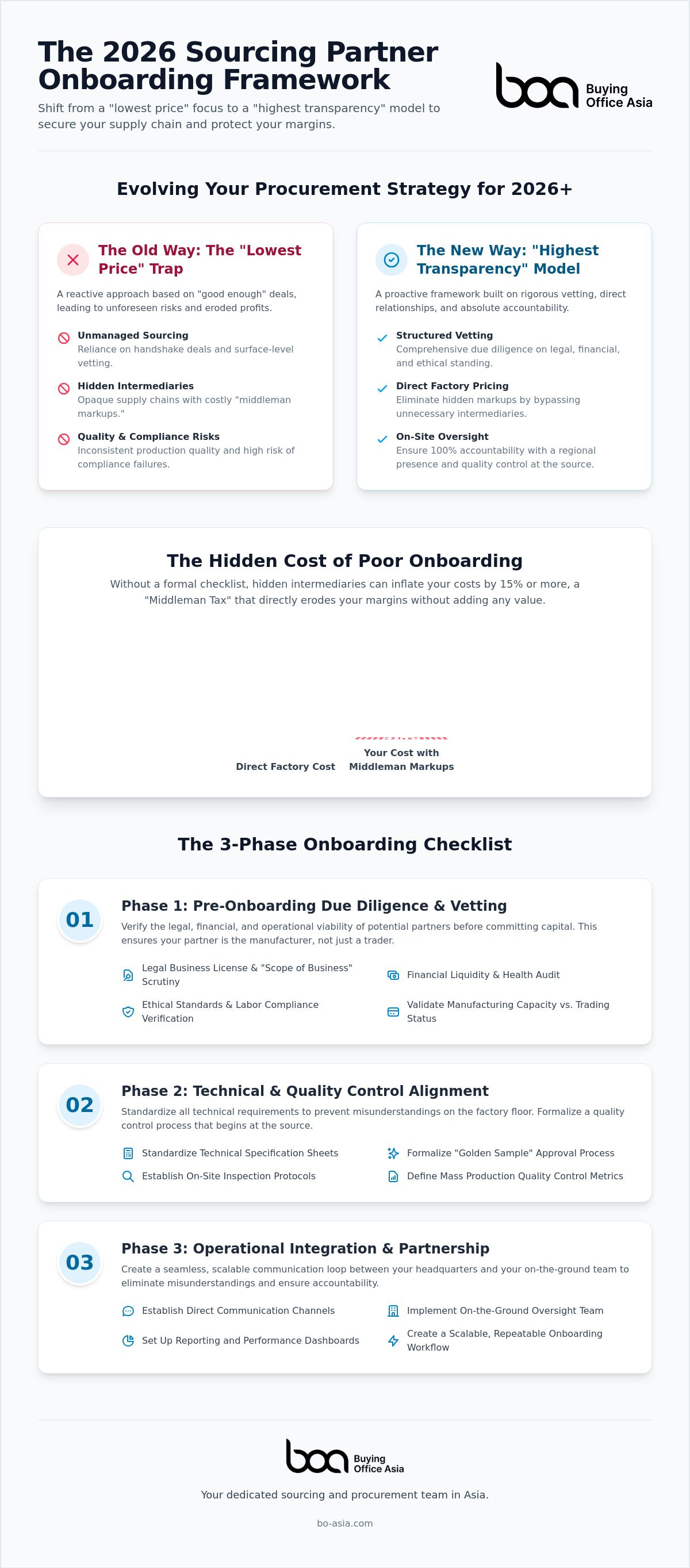
Technical integration is the stage where your strategy meets the physical reality of the factory floor. Your onboarding a new sourcing partner checklist must prioritize technical alignment to prevent the quality fade that often ruins unmanaged production runs. You need more than just a signed contract; you need a shared understanding of technical drawings, tolerances, and material specifications. If your partner cannot interpret your data sheets accurately, the risk of mass production failure increases exponentially. This phase ensures that your product vision is translated into a repeatable manufacturing process.
Every technical drawing and specification must be reviewed at the factory level to confirm feasibility. This leads to the "Golden Sample" process, which serves as the physical benchmark for your entire production history. This sample is signed by both parties and kept as the definitive reference point for all future inspections. For businesses engaged in custom product development, securing tooling and mold ownership is a critical protective measure. Your checklist should explicitly state that you retain the rights to the physical molds and the intellectual property they represent, preventing your partner from holding your production hostage or using your designs for other clients.
Establishing Quality Control (QC) standards requires defining your Acceptable Quality Level (AQL). This statistical standard dictates exactly how many minor, major, and critical defects are permissible before a batch is rejected. Without a predefined AQL, you have no objective basis to hold a factory accountable for inconsistencies. By integrating these standards into your onboarding a new sourcing partner checklist, you establish a culture of precision from the very first pilot run. This proactive alignment is what separates elite procurement from transactional buying.
Moving from a concept to a high-volume run requires a disciplined three-step approach. First, conduct a thorough technical spec review and feasibility assessment to catch design flaws early. Second, move into prototype creation with iterative sampling support to refine the product. Finally, oversee tooling development and the pilot run. This sequence ensures that any manufacturing hurdles are cleared before you commit to the full expense of mass production.
Control is maintained through physical presence at three critical milestones: pre-production, during production, and pre-shipment inspections. Standardizing the inspection report format allows for clear, data-driven decision-making rather than relying on vague factory updates. These reports should provide photographic evidence of material quality and assembly precision. To ensure your standards are met without compromise, you can utilize our mass production oversight services. If you need technical experts to audit your factory's production line, book a technical consultation with our team today.
A static onboarding a new sourcing partner checklist is a vital tool, but it's not a self-executing solution. The real strength of your supply chain doesn't lie in the document itself; it resides in the team that executes those checks on the factory floor. In the complex 2026 trade environment, paperwork can be forged and digital profiles can be polished. Genuine security comes from having a dedicated Asia procurement team that possesses the regional expertise to verify every claim in real time. Without this physical presence, a checklist is merely a list of hopes rather than a set of verified facts.
Our model bridges the gap between European professional standards and Asian manufacturing realities. With leadership based in Helsinki and an operational hub in Hong Kong, we ensure that your corporate values and quality expectations aren't lost in translation. This dual-presence strategy allows us to act as a protective extension of your own team. We don't just facilitate a transaction; we build a defense against the operational setbacks and brand risks that plague unmanaged supply chains. By positioning ourselves as your on-the-ground partner, we move your business toward a 100% transparent, middleman-free supply chain where you own the relationship with the factory.
We explicitly reject the conventional intermediary models that thrive on information asymmetry. Traditional trading agents often obscure the true factory-direct price to hide their own markups, which can silently erode your margins. By contrast, our approach prioritizes financial optimization through direct negotiation. When you use a rigorous onboarding a new sourcing partner checklist backed by professional oversight, you eliminate the hidden costs of inefficiency. This level of transparency is the only way to ensure long-term financial viability in an increasingly competitive global market.
The financial return on professional management is immediate and measurable. By bypassing trading agents and negotiating directly with manufacturers, businesses often see significant reductions in unit costs. The value of "boots on the ground" becomes clear the moment a production issue arises. Instead of waiting days for a filtered email response, our team solves problems on-site within hours. You can see the results of this hands-on approach in our work scaling brands with Asia sourcing expertise, where direct oversight led to both cost savings and improved quality consistency.
Don't wait for a quality crisis or a customs seizure to standardize your procurement. Your first step should be an internal audit of your current supplier base using our 2026 templates. Once you've identified the gaps in your current vetting process, book a consultation with our experts to review your strategy. We'll help you transition from a vulnerable, unmanaged chain to a secure, elite operation. To secure your supply chain for the future, partner with Buying Office Asia for end-to-end procurement and gain the regional advantage your business deserves.
Standardizing your entry process through a structured onboarding a new sourcing partner checklist is the first step toward long-term operational security. You've seen how rigorous physical vetting, precise technical alignment, and transparent financial terms work together to eliminate the hidden drains of unmanaged sourcing. In a trade landscape defined by shifting tariffs and strict ESG investigations, your ability to verify factory legitimacy at the source is your most valuable asset.
Buying Office Asia provides the regional expertise and physical proximity you need to turn this framework into a repeatable, high-performance workflow. As a European-managed firm with leadership in Helsinki and active Hong Kong operations, we offer a 100% transparency model that secures factory-direct pricing without hidden markups. You don't have to navigate these complexities alone. We act as a protective extension of your team, ensuring your supply chain remains resilient against global volatility.
Secure Your Supply Chain with a Dedicated Asia Team
Let's build a transparent and accountable partnership that protects your brand and your margins for years to come.
Physical verification of the manufacturing facility is the most critical component. While many items on an onboarding a new sourcing partner checklist are administrative, only an on-site audit confirms that the entity you're paying is the one actually producing your goods. This step prevents the "middleman tax" and ensures the factory has the technical capacity to meet your specific volume requirements without subcontracting to unvetted third parties.
A professional onboarding process typically requires 4 to 8 weeks. This timeline allows for comprehensive legal vetting, financial health audits, and the "Golden Sample" approval cycle. Rushing this phase often leads to expensive quality inconsistencies or regulatory delays later. A methodical approach ensures every technical specification is understood and every compliance certification is verified before capital is committed to mass production.
You definitely need distinct protocols for OEM and ODM partners. OEM onboarding focuses heavily on tooling ownership, intellectual property protection, and technical drawing alignment. ODM onboarding prioritizes existing product certifications and the partner's ability to maintain consistent quality across their own pre-designed catalog. Using a specialized onboarding a new sourcing partner checklist for each model ensures you address the unique risks associated with custom vs. off-the-shelf production.
You can distinguish a direct provider by scrutinizing their official business license and physical address. Genuine factories list "manufacturing" or "production" in their registered Scope of Business, whereas middlemen often list "trading" or "consultancy." Additionally, an on-site visit will reveal if the address belongs to a production facility with machinery and a workforce or simply a corporate office in a commercial district.
Mandatory documents for Hong Kong entities include the Business Registration Certificate (BRC) and the Certificate of Incorporation (CI). You should also request the Articles of Association to understand the company's governance structure. Verifying these documents against government databases ensures the entity is legally active and authorized to engage in international trade, protecting you from potential contract enforcement issues. For firms looking to establish or manage their own regional entities, Encor Group provides the corporate service platform necessary to facilitate international business expansion.
Quality control standards must be established during the onboarding phase, not after production begins. Defining your Acceptable Quality Level (AQL) and setting inspection milestones early creates a culture of accountability. If you wait until mass production starts to align on quality expectations, you risk receiving a container of defective goods that cannot be legally sold or easily returned.
ESG compliance is handled through documented audits and signed ethical labor practice agreements. In 2026, this involves checking for forced labor violations and environmental management certifications. Proactive vetting is essential for brand protection, especially as global trade regulations increase the penalties for unmanaged supply chains. Documenting these steps during onboarding provides the necessary paper trail for regulatory authorities.
Administrative document collection can be automated, but physical verification requires human intervention. While software can track tax IDs and certification expirations, it cannot assess the condition of factory machinery or the morale of a workforce. A successful strategy combines digital efficiency for data management with an on-the-ground team to ensure physical accountability and real-time problem solving at the source.

A factory audit can look reassuring while leaving a critical question unanswered: will the same materials, processes and controls be used for your production run? Responsible toy manufacturing in China requires more than reviewing a certificate. You need to understand factory conditions, subcontract...

A final inspection can show you what came off the production line, but it can’t change the decisions that shaped it. That’s the key distinction in standalone quality inspections vs procurement services: one checks product output at a defined point, while the other can coordinate work across supplier...

A factory quote is not a shipment plan. Sourcing products from China to USA involves more than finding a manufacturer and agreeing on a unit price. Unclear specifications, samples that differ from production, or overlooked packaging and freight details can put quality and commercial viability at ris...