


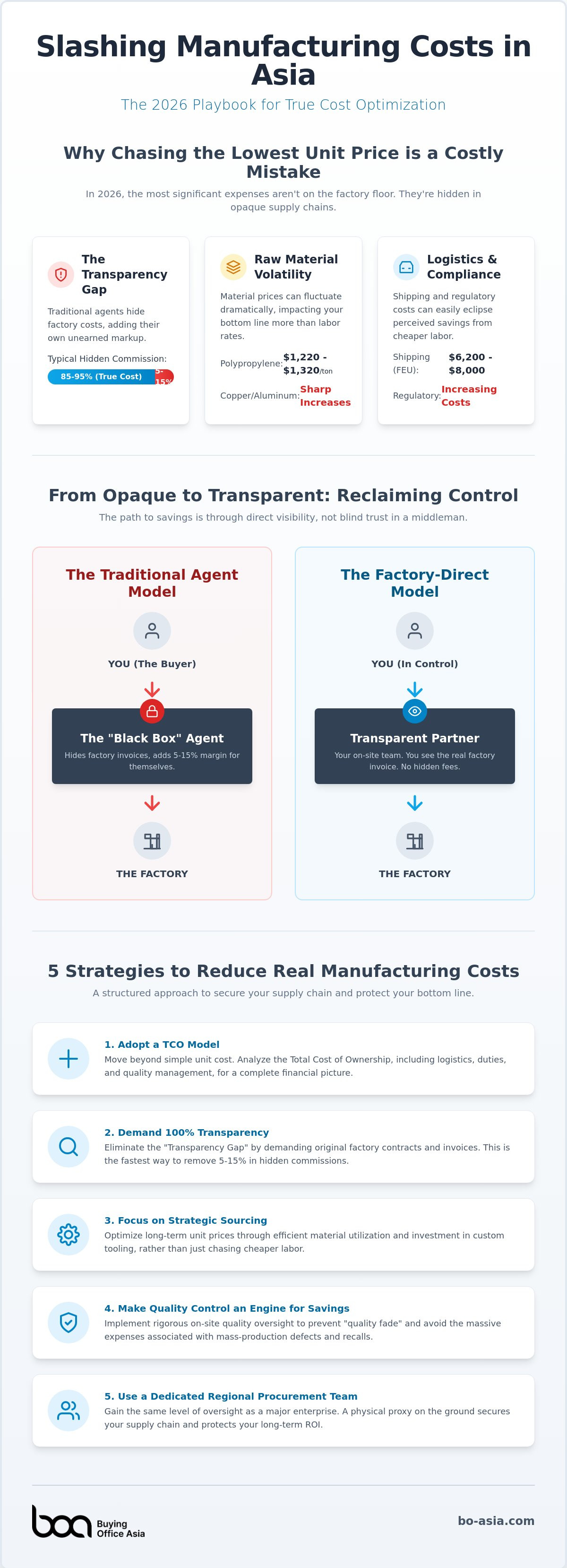
Chasing the absolute lowest labor rate is often the most expensive mistake a procurement team can make in 2026. While you're likely searching for how to reduce manufacturing costs in Asia, the most significant savings aren't found in a cheaper zip code. They're found in the elimination of opaque markups and hidden commissions. You've likely felt the pressure of rising operational expenses, with shipping rates from Asia to the U.S. West Coast currently around $6,200 per FEU and raw material prices for metals like copper and aluminum seeing sharp increases. It's a volatile environment where traditional sourcing agents often add more to your invoice than they save on the factory floor.
We agree that the lack of transparency in international procurement is a primary risk to your bottom line. This guide provides the structural strategies you need to slash production expenses without sacrificing quality. You'll learn how to secure factory-direct leverage, eliminate hidden fees, and implement the on-site oversight necessary to prevent costly mass-production defects. We'll walk through a clear roadmap for 2026 cost optimization that prioritizes both financial health and operational security.
• Transitioning from simple unit-cost comparisons to a Total Cost of Ownership (TCO) model is essential for maintaining profitability in the 2026 landscape.
• Uncovering the "Transparency Gap" allows you to identify and remove hidden commissions that often inflate production invoices by up to 15 percent.
• Discover how to reduce manufacturing costs in Asia through strategic custom tooling and optimized material utilization that lowers your long-term unit price.
• Implementing rigorous on-site quality oversight serves as a critical defense against quality fade, protecting your brand from the expenses of high defect rates.
• A dedicated regional procurement team provides the same level of oversight as a major enterprise, offering a physical proxy that secures your supply chain.
The era of viewing Asia as a monolith of cheap labor is over. In 2026, the pursuit of financial optimization requires a sophisticated understanding of Total Cost of Ownership (TCO). This metric goes beyond the ex-factory unit price to include logistics, duties, quality management, and the cost of capital. If you're analyzing how to reduce manufacturing costs in Asia, you must start by recognizing that a low labor rate in an emerging hub can be quickly eclipsed by inefficiencies elsewhere in the supply chain.
Three primary drivers now dictate your bottom line: labor, raw materials, and logistics. While China's regional wages have reached approximately ¥25 per hour, countries like Malaysia have set minimums at RM 1,700 per month. However, raw material volatility remains a global equalizer. With polypropylene prices ranging from $1,220 to $1,320 per ton and industrial metals like copper seeing significant spikes, material utilization is often a more potent lever for savings than labor arbitrage. By applying strategic sourcing principles, you can move from a transactional mindset to one that prioritizes long-term value and risk mitigation.
Diversifying production to Vietnam, India, or Thailand is a common response to geopolitical tension and rising Chinese costs. It's vital to evaluate the hidden expenses of these moves. Infrastructure gaps in emerging markets often lead to longer lead times and higher inland transport fees. You'll need to weigh these factors when deciding between nearshoring vs offshoring. Labor savings are only real if they aren't consumed by the $8,000 per FEU shipping cost to the U.S. East Coast or the management overhead of a less mature factory base.
Compliance is no longer an optional "add-on" but a structural cost of doing business. New mandates, such as Taiwan's mandatory Cosmetic Product Information Files (PIFs) effective July 1, 2026, and China's revised GMP for medical devices starting November 1, 2026, require rigorous documentation. Non-compliance leads to expensive shipment seizures and brand damage. Integrating ESG standards into your initial sourcing budget ensures you don't face unforeseen penalties. We help you vet suppliers who already meet these 2026 benchmarks, turning compliance from a financial burden into a competitive advantage.
The most pervasive obstacle to financial optimization in international trade is the "Transparency Gap." This term describes the intentional wall built between Western brands and Asian manufacturers by traditional sourcing agents. These intermediaries often present an "all-in" quoted rate, which masks hidden commissions that typically range from 5% to 15%. If you're searching for how to reduce manufacturing costs in Asia, your first step must be the dismantling of this opaque model. When you don't have direct visibility into the factory's invoice, you aren't managing a supply chain; you're simply paying a premium for a lack of control.
Traditional agents profit from your lack of direct access. By serving as the sole point of contact, they can negotiate a lower price with the factory while keeping the difference for themselves. This creates a fundamental misalignment of interests. The agent is incentivized to find the cheapest production possible, often at the risk of quality fade, just to maximize their own margin. To audit your current supply chain for hidden commissions, demand to see the original factory contract and payment receipts. If your agent refuses to provide these documents, you're likely paying a significant, unearned markup that provides zero value to your product.
True leverage in a negotiation comes from understanding the fundamental breakdown of your product. Effective factory direct price negotiations are built on the "Bill of Materials" (BOM). When you know the exact weight of the raw materials, the current market price of components, and the estimated labor time, the factory cannot inflate the price without justification. Transparency in the supply chain is the only way to ensure every dollar spent contributes to product value. This data-driven approach shifts the power dynamic from the seller back to your procurement team.
Replacing commission-based agents with a dedicated buying office model transforms your procurement from a transaction into a strategic partnership. A flat-fee structure aligns our interests with yours because our success isn't tied to the factory's invoice total. This model provides 100% visibility into factory contracts and payment flows, ensuring you pay the actual factory price without any obscured markups. You gain an integrated extension of your own team that prioritizes cost reduction and quality over intermediary profits. If you're ready to see where your capital is actually going, you might want to speak with our regional experts about a supply chain audit.
Efficiency is not accidental. It requires a disciplined analysis of how raw materials are converted into finished goods and how those goods move through your distribution network. When you look beyond the surface level of labor rates, you find that the most sustainable ways for how to reduce manufacturing costs in Asia lie in process optimization. High-volume production often suffers from material waste and inefficient cycle times that quietly erode your margins. By shifting your focus to operational excellence, you transform your supply chain from a cost center into a competitive advantage.
Scalability is a primary concern for growing brands. Utilizing OEM manufacturing allows you to leverage existing factory expertise while maintaining strict control over your intellectual property and cost structures. This approach reduces the need for heavy capital expenditure on your own facilities while providing the flexibility to ramp production up or down based on market demand. Additionally, reducing lead times is a critical lever for lowering inventory carrying costs. Every day your capital is tied up in transit or warehouse shelves, it's not working for your business.
Investing in custom tooling is often the most effective way to prevent material waste during mass production. High-quality, precision-engineered molds ensure that every unit is consistent, which drastically reduces the volume of scrap material. Optimized tooling design can reduce cycle times by up to 15%, allowing you to produce more units in the same timeframe with lower energy consumption. To protect this investment, professional sampling support is essential. Rigorous prototyping prevents mass production errors that can lead to entire batches of unsellable goods, ensuring your ROI is protected from the earliest stages of development.
Control over your cargo begins with the right commercial terms. Transitioning from EXW (Ex Works) to FOB (Free on Board) terms gives you better control over the inland transport and loading process, preventing factories from inflating local handling fees. For businesses sourcing from multiple suppliers, consolidation is a powerful cost-reduction tool. By shipping high volumes from various vendors through a single hub, such as Hong Kong, you can fill containers more efficiently and reduce the per-unit shipping price. Utilizing professional logistics management allows you to plan shipments well in advance, helping you avoid the predatory peak-season surcharges that often plague unmanaged supply chains.
Quality control is often mischaracterized as a post-production expense. In reality, it's the most effective way for how to reduce manufacturing costs in Asia by preventing waste before it occurs. Consider the financial delta between a 2% defect rate and a 0.1% defect rate. On a high-volume order, that 1.9% difference represents thousands of dollars in lost materials, wasted shipping fees, and administrative labor for returns. By implementing a "Golden Sample" protocol, you establish a physical and financial benchmark that the factory must meet before mass production begins. This sample serves as the legally binding standard for your entire order.
Quality Fade is the gradual, unauthorized substitution of cheaper components that destroys long-term brand value and increases returns. It's a quiet margin-grab used by factories to offset their own rising costs. To counter this, on-site inspections at the "During Production" (DUPRO) stage are essential. Catching a material error when only 20% of the order is completed saves you from the catastrophic cost of reworking or scrapping an entire batch. It's about moving from a reactive "catch the mistake" mindset to a proactive "prevent the loss" strategy that secures your capital.
Proper supplier vetting prevents the catastrophic cost of factory bankruptcy or fraud. A 2026 factory audit must be comprehensive, covering financial stability, technical capability, and social compliance. Relying on "self-inspection" by the factory is the most expensive mistake a brand can make. Without a neutral third party on the ground, you have no defense against the factory's internal bias to ship every unit produced, regardless of defects. A robust audit ensures your partner has the technical rigor to maintain your standards over long-term production cycles.
Maintaining control over a distant production line requires real-time data. We implement specific KPIs to track production speed and defect occurrences as they happen. On-the-ground inspectors provide the mass production oversight necessary to verify that the factory isn't cutting corners when the pressure to meet deadlines increases. This physical proximity acts as a deterrent to quality fade and ensures your specifications are followed to the letter. If you're ready to secure your production line against hidden defects and unauthorized material swaps, contact our inspection team for a professional consultation.
Managing a supply chain from a headquarters thousands of miles away is inherently inefficient. Flying your own staff to Asia for factory visits involves high travel costs, jet lag, and significant lost productivity. A dedicated Asia procurement team acts as your physical proxy, providing the daily oversight that a digital connection cannot replicate. This presence ensures that your interests are protected every hour the factory is running, rather than just during a quarterly visit. It's the most reliable method for how to reduce manufacturing costs in Asia while maintaining absolute control over the production environment.
The financial logic of a local team is grounded in risk mitigation and cost avoidance. When you combine European management standards with local Asian market intelligence, you create a stabilizing force in your supply chain. You gain the professional rigor of a Western corporate consultant with the boots-on-the-ground network required to navigate complex regional regulations and language barriers. Reviewing savings examples from managed procurement models reveals that the cost of a dedicated team is often a fraction of the capital lost to unmanaged quality issues and intermediary markups.
Our model centers on direct access to factory-direct pricing with zero hidden commissions. Unlike agents who profit from your lack of visibility, we integrate into your internal team to manage the entire sourcing lifecycle. This partnership approach ensures that our goals are perfectly aligned with your financial health. In one documented case, a client achieved a 20% reduction in landed costs by transitioning from a commission-based agent to our managed procurement model, proving that transparency is a powerful engine for profitability.
If you're ready to dismantle the inefficiencies in your current supply chain and secure your margins for 2026, the time to act is now. You can contact Buying Office Asia to schedule a comprehensive supply chain cost audit. We'll help you identify where your capital is being lost and provide a clear, actionable roadmap for how to reduce manufacturing costs in Asia through transparency and rigorous on-site management.
The transition to a more profitable manufacturing model is a strategic necessity. You now have the roadmap for how to reduce manufacturing costs in Asia by focusing on Total Cost of Ownership rather than just unit price. By eliminating the 5 to 15 percent markups common in traditional sourcing models and implementing "During Production" inspections, you protect your capital from the hidden risks of quality fade and intermediary inefficiency. True optimization is found in the details of material utilization and the removal of opaque commissions.
Secure your margins with a dedicated Asia procurement team today. We look forward to helping you build a more resilient and financially viable supply chain that supports your long-term growth objectives.
The most effective method is eliminating hidden intermediary commissions through a 100% transparency model. By securing factory-direct pricing, you ensure your capital is spent on materials and labor rather than unearned markups. This approach allows you to maintain quality because your budget is no longer being squeezed by a middleman's margin. It shifts the focus from chasing the lowest price to optimizing the actual production process.
Switching to a dedicated procurement team often results in a 5% to 15% reduction in unit costs by removing the obscured markups built into traditional agent quotes. Beyond the initial price, you save through significantly lower defect rates and the elimination of expensive travel for HQ staff. This model aligns the team's interests with your financial health rather than a commission-based transaction that rewards higher factory invoices.
Hidden costs often include higher inland transport fees and longer lead times due to infrastructure gaps in less mature markets. While labor may be cheaper, the lack of a local component supplier base often requires importing raw materials, which adds duties and complexity. You must calculate the Total Cost of Ownership to ensure these logistical hurdles don't negate the initial labor savings. Shipping rates, such as the $8,000 per FEU for Asia to U.S. East Coast routes, must be factored into every decision.
On-site quality control identifies defects during the production stage rather than after the shipment arrives at your warehouse. Catching a material error when only 20% of an order is complete prevents the catastrophic loss of an entire batch. This proactive oversight is a primary strategy for how to reduce manufacturing costs in Asia, as it eliminates the massive expense of international returns and rework.
Quality Fade is the gradual, unauthorized substitution of cheaper components by a factory to increase their own profit margins over time. You prevent this by using a "Golden Sample" as a legally binding benchmark and conducting unannounced on-site inspections. Without a physical presence to verify material specifications at every production stage, factories may slowly degrade product quality, leading to increased returns and brand damage.
Negotiating factory-direct is superior for cost control and long-term scalability. Intermediaries often obscure the true cost of production to protect their own margins, which limits your leverage during material price fluctuations. Direct access to the factory's Bill of Materials allows for precise negotiations based on actual market data rather than an agent's "black box" quote. This transparency is the only way to ensure you're paying a fair market rate.
Logistics can account for a massive portion of your total landed cost, especially during periods of geopolitical volatility. Efficient management, such as consolidating shipments from multiple suppliers into a single hub like Hong Kong, reduces the per-unit transport price. Failing to optimize shipping terms or plan for peak-season surcharges can quickly erode the savings achieved on the factory floor. Proper planning ensures that shipping costs don't become a variable that destroys your margins.
Managing cost reduction remotely is a high-risk strategy that often results in unforeseen expenses and quality failures. A physical presence in Asia provides the real-time accountability needed to prevent quality fade and ensure production deadlines are met. This on-the-ground oversight is a cornerstone of how to reduce manufacturing costs in Asia, as it allows for immediate problem-solving and negotiation leverage that digital communication simply cannot provide.

What if the factory’s lowest quote isn’t the lowest-cost option? A lower unit price can hide differences in materials, tooling, packaging, quality checks or production terms. Understanding how sourcing agents negotiate factory prices starts with making those differences visible, not simply asking a...

A factory audit can look reassuring while leaving a critical question unanswered: will the same materials, processes and controls be used for your production run? Responsible toy manufacturing in China requires more than reviewing a certificate. You need to understand factory conditions, subcontract...

A final inspection can show you what came off the production line, but it can’t change the decisions that shaped it. That’s the key distinction in standalone quality inspections vs procurement services: one checks product output at a defined point, while the other can coordinate work across supplier...