

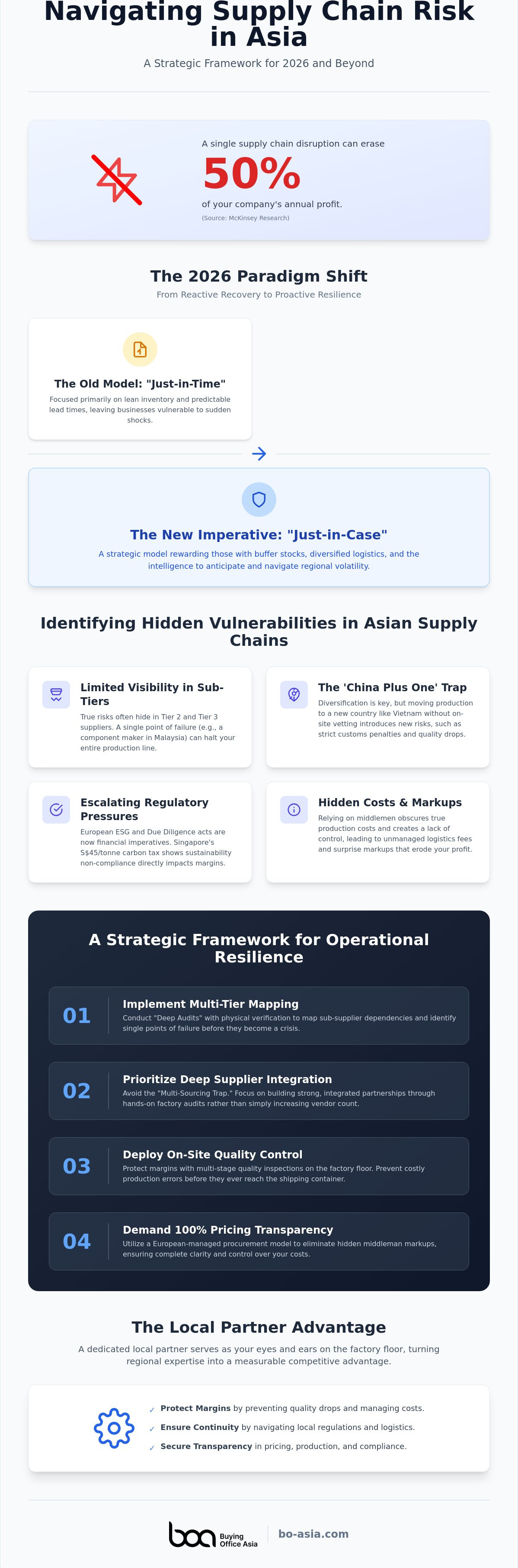
A single supply chain disruption can erase 50% of your company's annual profit according to McKinsey research. In 2026, the complexity of regional trade has reached a tipping point where distant oversight isn't enough to protect your capital. Executing effective supply chain risk management strategies Asia requires more than digital dashboards; it demands a physical presence to navigate shifts like Singapore's S$45 carbon tax or Vietnam's strict new customs penalties. You're likely already feeling the strain of limited visibility into Tier 2 suppliers and the constant threat of quality drops during mass production.
We recognize that hidden middlemen costs and unmanaged logistics are significant risks to your financial health. This guide provides a strategic framework to help you navigate the Asian manufacturing landscape with proven methods that protect your margins and ensure operational continuity. We'll examine how to build a resilient chain that survives geopolitical volatility while securing 100% transparency in your pricing. By the end of this briefing, you'll understand how a dedicated local partner serves as your eyes and ears on the factory floor, turning regional expertise into a measurable competitive advantage.
• Adapt to the 2026 transition from "Just-in-Time" to "Just-in-Case" to protect your lead times from regional volatility.
• Master supply chain risk management strategies Asia by implementing multi-tier mapping that uncovers hidden vulnerabilities in your Tier 2 and Tier 3 suppliers.
• Avoid the "Multi-Sourcing Trap" by focusing on deep supplier integration and hands-on factory audits rather than simply increasing the number of vendors.
• Protect your margins with on-site, multi-stage quality inspections that prevent production errors before they reach the shipping container.
• Gain 100% pricing transparency through a European-managed procurement model that eliminates hidden middleman markups.
In 2026, the definition of supply chain risk management has shifted from reactive recovery to proactive resilience. It's no longer enough to track shipments on a screen; you must understand the physical and political geography of your production. The era of "Just-in-Time" manufacturing has largely been replaced by a "Just-in-Case" model. This shift is a direct response to the volatility that characterizes Asian trade routes this year. Lead times that were once predictable now fluctuate based on regional energy costs and shifting labor availability. Brands that succeed are those that treat 100% transparency as a baseline requirement rather than a luxury. By utilizing Hong Kong as a stabilizing hub for trade finance and logistics, European businesses maintain a steady hand over their operations.
Implementing robust supply chain risk management strategies Asia requires a shift in mindset from simple procurement to strategic partnership. The transition toward "Just-in-Case" logistics has fundamentally altered lead time expectations across the continent. In previous years, lean inventory was the primary goal, but today's market rewards those with buffer stocks and diversified logistics routes. This change isn't just about buying more warehouse space. It's about having the intelligence to know when a policy change in Indonesia might stall your goods. By integrating these insights into your operational model, you turn potential bottlenecks into moments of stability.
Diversifying your manufacturing footprint is a standard move in 2026, but the "China Plus One" strategy carries its own set of hazards. Moving production to Vietnam doesn't automatically lower your risk. Vietnam's Decree 169/2026/ND-CP, which took effect on July 1, 2026, introduced new administrative penalties in the customs sector. Without a local team to vet these facilities on-site, you risk facing hidden costs and sudden quality drops. Effective supply chain risk management strategies Asia involve more than picking a new location; they require a deep understanding of local regulations and supplier reliability. Relying on middlemen often leads to obscured pricing and a lack of direct control over production schedules.
Compliance is no longer a peripheral concern for procurement teams. European regulations now mandate strict oversight of Asian factories, making brand damage a real threat for the unprepared. You must ensure that your partners adhere to international ESG standards to avoid legal liabilities. Singapore's carbon tax, which hit S$45 per tonne in early 2026, proves that sustainability is now a financial imperative. By auditing for environmental and ethical standards today, you protect your margins and your reputation. This isn't just about avoiding fines; it's about building a supply chain that is commercially viable in a stricter global market.
Identifying risk in a modern Asian supply chain requires looking beyond the surface of your Tier 1 suppliers. While most brands manage their direct factory relationships, the true vulnerabilities often reside in the second and third tiers of the network. Effective supply chain risk management strategies Asia must include a comprehensive mapping of sub-suppliers, raw material sources, and logistics providers. A single point of failure (SPOF) at a sub-tier level, such as a specialized component manufacturer in Malaysia or a raw material processor in Indonesia, can halt your entire production line. Quantifying the financial impact of a 30-day delay is essential; for many high-volume brands, such a disruption leads to millions in lost revenue and permanent shelf-space loss.
We advocate for a "Deep Audit" approach that prioritizes physical verification over digital reporting. In 2026, the reliance on automated dashboards has created a false sense of security. Real resilience comes from knowing which factory actually owns the tooling and which one is merely outsourcing the work. By mapping these dependencies, you can develop contingency plans before a crisis occurs. This level of oversight ensures that your margins remain protected even when regional logistics face sudden shifts, such as the new e-invoicing mandates in Malaysia or updated trade governance in Indonesia. If you're concerned about hidden vulnerabilities in your current setup, it's time to request a professional supply chain health check.
Digital certificates and ISO stamps are often insufficient for high-volume sourcing. Paperwork can be easily manipulated or outdated. On-site presence is the only way to gauge a factory's true stability. High labor turnover or neglected machine maintenance are red flags that no digital report will capture. These operational tremors often precede a total quality collapse or production halt. You can read more about our rigorous Supplier Vetting process to understand how we verify these critical details on the ground.
Hidden markups from trading companies posing as manufacturers are a silent drain on your capital. These intermediaries often obscure the true cost of raw materials and tooling, adding layers of expense without adding value. Identifying these entities requires a seasoned insider who knows how to trace financial flows and verify ownership. Securing factory-direct pricing through direct negotiations isn't just about saving money; it's about establishing a clear line of accountability. When you remove the middleman, you gain 100% transparency into where your money goes and how your products are made.
Diversification is often presented as the ultimate cure for supply chain fragility, yet adding more vendors can actually heighten your exposure. This "Multi-Sourcing Trap" occurs when a brand spreads its volume across multiple factories without the resources to manage them. Instead of one reliable partner, you end up with several mediocre ones. Each of these vendors provides less transparency and grants you lower priority during peak seasons or material shortages. Effective supply chain risk management strategies Asia in 2026 favor deep supplier integration over broad, unmanaged diversification. By focusing on Supplier Management and Development, you move beyond transactional orders to create a resilient, integrated partnership that survives market shocks.
The middleman risk is particularly rampant in this fragmented landscape. Intermediaries often encourage diversification because it obscures their lack of control over any single facility. Genuine resilience is built through direct factory relationships where you have clear visibility into the production floor. You must also evaluate the ROI of your manufacturing location. While nearshoring offers shorter lead times, the specialized manufacturing ecosystems in Asia often provide superior quality and scale that closer alternatives cannot match. Deciding between these models requires a sober look at the total cost of ownership, including the 2026 carbon taxes and updated customs office codes in Vietnam. You can explore our detailed analysis on Nearshoring vs Offshoring to determine which geographic strategy aligns with your 2026 financial targets.
Bridging the gap between European standards and Asian manufacturing realities requires more than occasional emails. A Dedicated Asia Procurement Team acts as a physical extension of your headquarters. This team eliminates the time zone and language barriers that often lead to "silent" quality drops or missed deadlines. By having experts on the ground, you shift from transactional buying to strategic management. This presence ensures that your interests are protected during every production run, providing the steady oversight that major enterprises use to maintain their margins.
Protecting your intellectual property and physical assets is a critical component of risk mitigation. During product development, you must ensure that you legally and physically own your custom tooling and molds. Many factories attempt to hold tooling "hostage" to prevent clients from moving production. Effective supply chain risk management strategies Asia include strict contracts and physical verification of tooling storage. This oversight is vital for successful OEM Manufacturing. Owning your assets gives you the leverage to pivot production if a supplier's performance begins to degrade.
While geopolitical shifts and tariff barriers dominate headlines, the most common "silent" disruption in your supply chain is a failure in product quality. A production run that arrives with a 20% defect rate is just as damaging to your bottom line as a port strike. Implementing robust supply chain risk management strategies Asia requires a shift from distant trust to rigorous, multi-stage verification. By utilizing On-site Quality Control, you catch errors while the goods are still in the factory. This proactive approach eliminates the nightmare of discovering batch defects only after the container has been cleared through customs and delivered to your warehouse.
Operational resilience is built on a specific protocol of inspections. This includes During Production (DuPro) checks to catch systemic errors early, Final Random Inspections (FRI) to verify the finished lot, and Container Loading Supervision to ensure your goods are packed securely and match the manifest. This "on-the-ground" presence serves as your final defense against financial loss. It ensures that every dollar spent on manufacturing translates into sellable, high-quality inventory. Catching a production error at the source is significantly cheaper than managing returns and brand damage later.
Quality Fade is the subtle, gradual degradation of product standards that often occurs after the initial "golden sample" or the first successful order. Factories might substitute cheaper raw materials or skip minor finishing steps to increase their own margins once they feel the client relationship is secure. You prevent this by setting rigid Acceptable Quality Level (AQL) standards and enforcing them through regular audits. ISO 2859-1 standards define the Acceptable Quality Level as the maximum percent defective that, for purposes of sampling inspection, can be considered satisfactory as a process average.
The factory gate is not the finish line. Managing the "last mile" of Asian production involves coordinating the movement from the factory to the port of departure, a phase often rife with transit risks and documentation errors. In 2026, navigating updated customs office codes in Vietnam or the digital tax reporting requirements for freight in Malaysia requires precise oversight. Professional Logistics Management ensures that your goods don't sit idle due to port congestion or missing paperwork. This integrated approach to shipping coordination protects your schedule and prevents the hidden costs of storage and demurrage. To secure your next production run with a dedicated inspection team, get in touch with our Hong Kong office today.
Building a resilient procurement network requires more than just identifying hazards; it demands an active defense on the ground. Buying Office Asia (BOA) provides this protection by combining European leadership with deep Hong Kong operational expertise. This dual presence allows us to implement supply chain risk management strategies Asia that are grounded in both Western standards and Eastern manufacturing realities. Our model is built on 100% transparency, ensuring that you receive factory-direct pricing without the hidden commissions or markups that often plague unmanaged sourcing. We act as an integrated extension of your own team, scaling our support as you move from initial sampling into high-volume mass production.
Our clients have navigated the mid-2020s disruptions by leveraging our ability to pivot production and verify supplier claims in real-time. Whether it was managing the sudden customs shifts in Vietnam or the carbon tax implementations in Singapore, our regional presence provided the stability they needed to maintain their margins. By removing the layers of obscured costs typical of traditional intermediaries, we ensure that your capital is invested directly into product quality and operational continuity. For financial professionals looking to further safeguard these assets, Exclusive Insurance Brokerage provides customized product design and carrier selection advice. This results-oriented approach transforms your supply chain from a source of anxiety into a scalable engine for growth.
The psychological impact of having a local representative present during production cannot be overstated. Factories prioritize orders when they know a professional team is monitoring the floor, effectively eliminating the risk of quality fade. Through our Helsinki-HK bridge, you receive real-time reporting and accountability that digital dashboards simply cannot replicate. This physical proximity is the only way to ensure that factory-direct negotiations remain honest and that your specifications are followed to the letter. It's about providing you with the steady confidence that your interests are being protected at every stage of the process.
The landscape of international manufacturing is increasingly complex, but it doesn't have to be a source of constant anxiety. Successful supply chain risk management strategies Asia rely on the shift from distant oversight to hands-on, regional accountability. By prioritizing multi-tier mapping and on-site quality inspections, you eliminate the hidden vulnerabilities that often derail production schedules and erode margins. Relying on digital dashboards is no longer enough; true resilience requires a physical presence to verify factory claims and maintain steady production flow.
As a European-managed firm with over 15 years of HK presence, we provide the stabilizing force your business needs. We offer 100% transparency and factory-direct pricing; this ensures your capital is invested in results rather than hidden commissions. Our comprehensive on-site audits and inspections act as your eyes and ears on the factory floor, providing the security that digital tools alone cannot deliver. We're ready to help you turn these strategic frameworks into a reliable foundation for long-term growth. Secure your supply chain with a Dedicated Asia Procurement Team.
Your brand deserves the same level of protection and oversight usually reserved for major global enterprises. By choosing a partner that integrates directly with your team, you gain the regional expertise and networks required to navigate 2026 with confidence.
The primary risks in 2026 include geopolitical fragmentation and tightening environmental regulations like Singapore's S$45 per tonne carbon tax. You must also account for sudden regulatory shifts such as Vietnam's Decree 169/2026/ND-CP which introduced new customs penalties. These macro factors combine with "Quality Fade" to create a volatile environment. Managing these requires a physical presence to vet sub-tier suppliers and ensure compliance with European standards.
A sourcing agent acts as your physical eyes and ears to execute supply chain risk management strategies Asia effectively. We provide continuous due diligence that digital tools simply cannot match. By vetting factories on-site and managing the "last mile" of logistics, we prevent the silent quality drops that often happen after the first order. This presence ensures your interests are protected during every production run.
A factory audit assesses the systemic health of a supplier; while a quality inspection focuses on the specific production lot. Audits evaluate financial stability, production capacity, and ESG compliance to ensure long-term viability. Inspections use AQL standards to catch physical defects before goods leave the port. Both are essential; one secures your partnership while the other protects your immediate inventory.
Protecting your intellectual property requires a combination of legal contracts and physical control over custom tooling. You must ensure your agreement explicitly states that you own all molds and dies used in production. We verify this by conducting on-site checks to confirm your assets are stored securely. This physical verification prevents factories from holding your production "hostage" or using your designs for other clients.
Using a single strategic partner is often safer than falling into the "Multi-Sourcing Trap". While diversification sounds logical, it frequently dilutes your leverage and obscures transparency. A deeply integrated relationship with a vetted manufacturer allows for better communication and higher priority during peak seasons. Focusing your volume with a reliable partner makes it easier to enforce strict quality and ethical standards.
Financial stability is verified through on-site audits of business licenses, bank records, and operational red flags. High labor turnover or neglected machine maintenance often signal underlying financial distress. We look for these physical indicators during our factory visits because paperwork alone can be misleading. A stable supplier is one that consistently invests in its facility and maintains a steady, experienced workforce.
Hong Kong remains a critical stabilizing hub for regional trade finance and logistics coordination in 2026. Its legal system provides a familiar jurisdiction for European leadership to manage Asian manufacturing realities. As a central trade hub, it offers superior connectivity for shipping and acts as a gateway for managing operations across Vietnam, Malaysia, and Indonesia. This positioning allows for efficient oversight of complex regional networks.
We ensure 100% transparency by conducting factory-direct price negotiations and eliminating hidden middleman markups. Our model is based on a clear management fee rather than obscured commissions. You see the true cost of raw materials and labor; this gives you full visibility into your margins. This approach removes the conflict of interest inherent in traditional sourcing models and aligns our goals with your financial health.

A factory audit can look reassuring while leaving a critical question unanswered: will the same materials, processes and controls be used for your production run? Responsible toy manufacturing in China requires more than reviewing a certificate. You need to understand factory conditions, subcontract...

A final inspection can show you what came off the production line, but it can’t change the decisions that shaped it. That’s the key distinction in standalone quality inspections vs procurement services: one checks product output at a defined point, while the other can coordinate work across supplier...

A factory quote is not a shipment plan. Sourcing products from China to USA involves more than finding a manufacturer and agreeing on a unit price. Unclear specifications, samples that differ from production, or overlooked packaging and freight details can put quality and commercial viability at ris...