

With ocean freight rates from Asia to Northern Europe reaching $7,000 for a 40-foot container and U.S. East Coast spot rates hitting $8,000 this July, the era of unmanaged sourcing is over. You've likely felt the sting of opaque pricing from middlemen or the anxiety of inconsistent product quality that arrives months late. These aren't just logistical hurdles; they're direct threats to your financial viability. Utilizing professional Asia supply chain management services is no longer a luxury for the elite. It's a strategic defense for any business that values transparency and predictable lead times in an increasingly volatile market.
You deserve a partner who acts as your boots on the ground, dismantling communication barriers and securing direct factory relationships. This guide will show you how to master the complexities of Asian manufacturing using a framework designed for risk mitigation and verified quality standards. We'll examine the impact of new 2026 trade regulations, rising labor costs in regions like Thailand and Vietnam, and the specific mechanics of a 100% transparency model. By the end of this briefing, you'll have the tools to lower your total cost of ownership and stabilize your operations for the years ahead.
• Transition from transactional sourcing to an integrated partnership model that provides end-to-end oversight from initial production to final delivery.
• Secure your profit margins through factory-direct negotiations that bypass the hidden markups and opaque pricing common in traditional trading company relationships.
• Implement professional Asia supply chain management services built on a service-fee model to eliminate the risk of kickbacks and ensure 100% financial transparency.
• Protect your brand reputation by utilizing on-site quality control inspections, including DUPRO and Final Random Inspections, to catch defects before they leave the factory floor.
• Scale your operations efficiently by integrating a dedicated regional procurement team that functions as a seamless, protective extension of your own business.
Traditional sourcing is dead. In the past, companies relied on sourcing agents who operated on hidden commissions and offered little more than a directory of factory names. Today, Asia supply chain management services have evolved into an end-to-end strategic function. This discipline involves the total oversight of a product's journey from the raw material stage through production and final delivery. It represents a fundamental shift from transactional buying to a comprehensive Supply chain management framework that prioritizes your financial health and brand security.
Operating from a strategic trade hub like Hong Kong allows for a unique combination of Western legal standards and direct proximity to Asian manufacturing heartlands. It's about being on the ground when a production line stalls. Having a regional presence means your interests are protected by experts who speak the language and understand the local business culture. This proximity transforms your supply chain from a black box into a transparent, manageable asset. It's the difference between receiving a surprise invoice and having a predictable, optimized cost structure.
A professional supply chain partner manages every variable of the procurement process. This starts with rigorous supplier identification and vetting, ensuring that a factory's technical capacity matches your specific volume requirements. It extends into mass production oversight, where real-time reporting replaces the "hope for the best" approach. Finally, it involves logistics coordination and customs compliance. You need a partner who can navigate the complex web of tariffs and peak season surcharges that define the current market without adding hidden markups.
The manufacturing landscape has fragmented. The "China Plus One" strategy is now the standard for risk mitigation, pushing production into Vietnam, Thailand, and Malaysia. However, diversification brings new challenges. You're now facing increased regulatory pressure, such as mandatory sustainability reporting in Japan and South Korea starting in 2026. You need digital transparency throughout the "Source-to-Contract" lifecycle to prove compliance and ethical sourcing. Relying on outdated intermediary models is no longer just inefficient; it's a liability that can lead to 40% circumvention tariffs or ESG-related legal penalties. A dedicated Asia procurement team provides the oversight necessary to navigate these specific 2026 hurdles while maintaining your competitive edge.
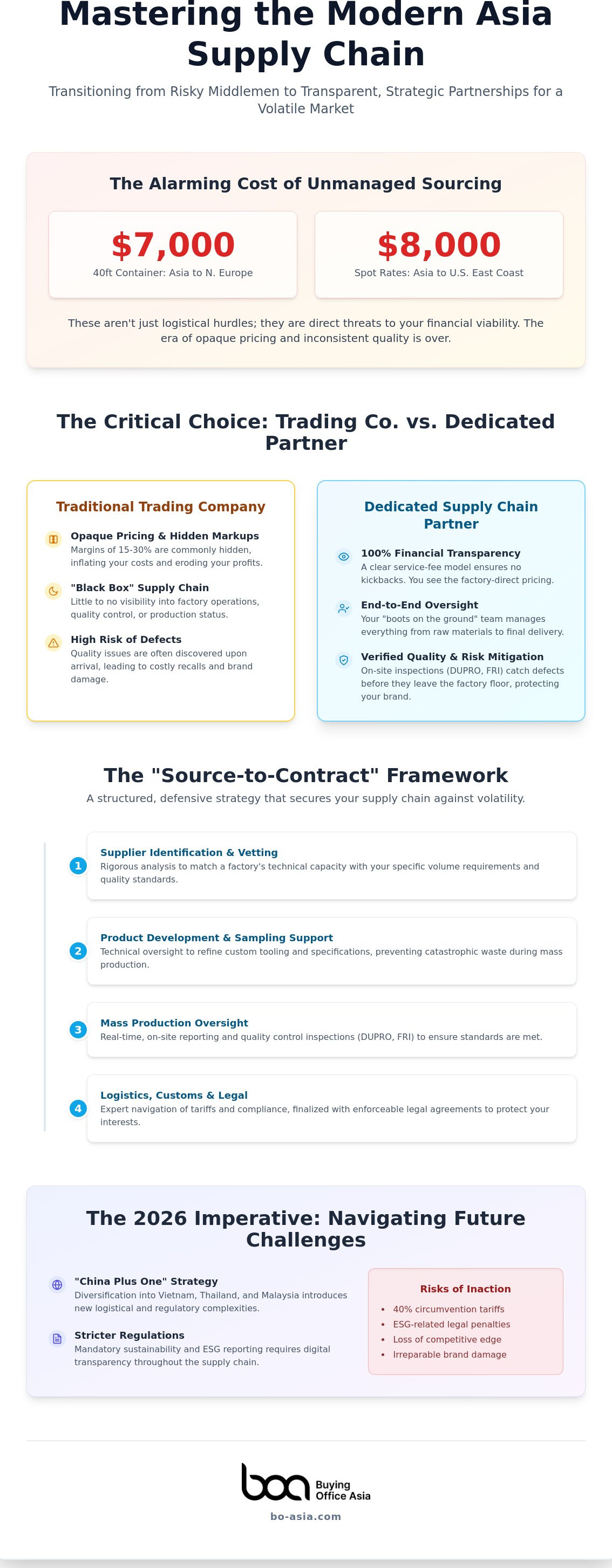
High-performance procurement in the Asian market requires a shift from opportunistic buying to a structured "Source-to-Contract" (S2C) framework. This methodology isn't just a sequence of steps; it's a defensive strategy that secures your supply chain against volatility. A professional approach to Asia supply chain management services integrates every phase of the lifecycle, from initial market analysis and supplier identification to the finalization of enforceable legal agreements. By formalizing this process, you eliminate the ambiguity that often leads to price hikes and production delays. You can learn more about our sourcing and procurement services to see how this framework applies to high-volume operations.
A critical, yet often overlooked, pillar of this framework is product development and sampling support. Errors made during the prototyping phase are amplified during mass production, leading to catastrophic waste. A dedicated partner provides the technical oversight needed to refine custom tooling and specifications before the first production run begins. This hands-on involvement ensures that the factory's output aligns perfectly with your quality standards, significantly reducing the total cost of ownership (TCO) by preventing expensive rework or product recalls.
Trading companies and traditional agents often present themselves as cost-saving intermediaries. In reality, they frequently obscure their true margins with hidden markups ranging from 15% to 30%. They thrive on information asymmetry. To protect your margins, you must insist on factory-direct negotiations. This requires a deep understanding of the psychology of negotiation within Asian manufacturing cultures, where building long-term rapport is as vital as the data on the spreadsheet. We advocate for an "Open Book" pricing model. This ensures 100% financial transparency, allowing you to see exactly where your capital is going and ensuring that you pay for manufacturing excellence, not an intermediary's commission.
Digital storefronts and Alibaba reviews are easily manipulated and rarely reflect the reality on the factory floor. True vetting requires physical, on-site audits. You must assess a potential partner's financial stability, technical capability, and their commitment to ethical compliance. In 2026, a supplier's failure to meet ESG standards is a direct risk to your brand's reputation and legal standing. Our approach goes beyond a simple checklist; we conduct deep-dive investigations into a factory's operational health. For a comprehensive breakdown of this process, read our guide on Mastering Supplier Vetting in Asia. To secure your own manufacturing base, you can contact our regional experts for a tailored assessment of your current supplier network.
Choosing the right structural model for your Asia supply chain management services is a decision that dictates your long-term financial health. Most businesses initially gravitate toward trading companies because the entry cost appears low. However, these intermediaries typically operate on a "Commission-Based" model. When an agent is paid by the factory rather than the client, a fundamental conflict of interest arises. Their loyalty lies with the party providing their commission, not with the buyer seeking the best price and quality. This often leads to the industry's open secret: the "kickback" system, where agents receive undisclosed payments to overlook production shortcuts or price inflation.
In contrast, a dedicated supply chain partner operates on a transparent "Service-Fee" model. This structure aligns the partner's incentives entirely with yours. Instead of acting as a third-party gatekeeper, they function as an integrated extension of your own procurement team. Their objective is to drive down your total cost of ownership and eliminate waste, as they don't profit from higher factory prices. You can see why a dedicated sourcing team is the ultimate ROI when you consider that every dollar saved through negotiation and efficiency stays in your pocket rather than being siphoned off by an intermediary.
The "free" sourcing services offered by many agents are often the most expensive option in the long run. Since these agents don't charge an upfront fee, they must recover their costs through hidden markups on raw materials or by allowing factories to sub-contract production to unvetted, lower-tier facilities. You lose all visibility into the actual production environment. This lack of control over the sub-contracting chain is a primary driver of inconsistent quality and ethical compliance failures. Without a dedicated team to monitor the floor, you're essentially flying blind, relying on the word of someone whose paycheck depends on the factory's approval.
True accountability requires a physical presence and a leadership structure that understands both Western business expectations and Asian manufacturing realities. Our hybrid model, combining European management in Helsinki with operational headquarters in Hong Kong, provides a protective shield for your interests. This regional presence ensures that communication is seamless and that your intellectual property remains secure. When you own the direct relationship with the factory, you also maintain absolute ownership of your tooling and custom molds. This prevents the common "hostage" situation where a trading company refuses to release tooling if you attempt to move production, ensuring your supply chain remains agile and under your total control.
Mass production is where theoretical plans meet the hard reality of the factory floor. Without consistent oversight, even the most promising samples can devolve into defective batches. Professional Asia supply chain management services provide the critical layer of protection needed to ensure that the 10,000th unit matches the quality of the first. This isn't just about catching mistakes. It's about maintaining the integrity of your brand's promise to your customers. On-site mass production oversight serves as your primary defense against "quality fade," which is the gradual decline in material standards or workmanship that often occurs during long-term manufacturing runs.
By placing experts directly in the facility, you gain real-time visibility that a simple email update can never provide. This proactive presence allows for immediate course correction if production deviates from the agreed specifications. It secures your investment by ensuring that manufacturing stays on schedule and within the established quality parameters. You no longer have to wait for the shipping container to arrive to discover a systemic defect.
Effective quality control relies on a rigorous, two-stage inspection process. During Production (DUPRO) inspections occur when approximately 20% to 30% of the order is completed. This stage is vital for identifying systemic issues early enough to rectify them without scrapping the entire batch. The process concludes with a Final Random Inspection (FRI). Here, goods are sampled based on customized AQL (Acceptable Quality Level) standards tailored to your specific product requirements. While some firms rely on generic third-party inspectors, an integrated in-house team offers a deeper understanding of your brand's unique tolerances and long-term goals.
The regulatory landscape of 2026 has fundamentally changed the requirements for international trade. Compliance is no longer just about shipping documents; it's about proving the ethical and environmental integrity of your entire network. Mandatory sustainability reporting, such as the SSBJ standards in Japan starting in April 2026 and South Korea’s KSDS framework beginning in January 2026, requires precise data on carbon footprints and labor practices. Professional management ensures your supply chain is audit-ready at all times. This includes rigorous verification of labor rights and environmental impact at the factory level.
You can explore our commitment to ESG and ethical sourcing to understand how we protect our clients from the legal and reputational risks associated with non-compliance. As you refine your global footprint, it's also worth considering the broader strategic implications discussed in our analysis of Nearshoring vs Offshoring in 2026. To ensure your production meets these rigorous new standards, book a quality control consultation with our on-site team today.
Scaling a brand requires more than just increasing order volumes. It demands a structural shift from reactive sourcing to proactive management. Integrating a dedicated team into your business model provides the stability needed to handle high-volume growth without sacrificing quality or transparency. Professional Asia supply chain management services deliver a measurable ROI by reducing material waste, securing better factory-direct pricing, and eliminating the hidden commissions of intermediaries. You gain the operational leverage of a major enterprise while maintaining the agility of an independent business. This transition isn't just about efficiency; it's about building a resilient foundation that can withstand the logistical shocks of 2026.
Western brands often struggle with the cultural and operational gap between their headquarters and Asian factories. This is why European-led management is a critical advantage. Having leadership in Helsinki and operations in Hong Kong ensures that your quality standards and ethical requirements are communicated clearly and enforced strictly. This hybrid model acts as a protective shield. It filters out regional complexities and delivers only the results that matter to your bottom line. You can explore our contract manufacturing solutions to see how this oversight applies to complex product development and custom tooling projects.
Success at scale begins long before the first container is loaded. It starts with meticulous sampling and custom tooling development. A dedicated team manages these technical phases to ensure that mass production is viable and cost-effective. Once production is underway, the focus shifts to logistics and shipping coordination. We handle the complexities of container allocation and customs compliance. This ensures your high-volume orders reach global distribution centers without unforeseen delays. You can review how we scale brands in Asia through our documented success stories and performance history.
The transition to a managed supply chain follows a strategic roadmap. During the first 90 days, the priority is a comprehensive audit of your current supplier network. We identify immediate cost-saving opportunities and potential risks in your existing contracts. This phase involves establishing clear KPIs for quality standards, lead times, and total cost reduction. These metrics serve as the baseline for all future growth. By setting these benchmarks early, you create a culture of accountability that drives performance across your entire manufacturing base. This systematic approach ensures that every supplier is aligned with your financial goals and quality expectations. To begin this process, contact Buying Office Asia for a supply chain audit and secure your manufacturing future in 2026.
The manufacturing landscape is no longer a place for trial and error. The transition from opaque middlemen to a dedicated partnership model is the only way to safeguard your margins and brand reputation. By implementing a professional framework for Asia supply chain management services, you replace the anxiety of "quality fade" and hidden markups with the steady assurance of on-the-ground factory audits and 100% financial transparency. It's about moving away from transactional interactions and toward a long-term strategy that prioritizes your financial health.
Operating with European-managed oversight from Helsinki and operational headquarters in Hong Kong, Buying Office Asia acts as a protective extension of your own team. We don't just find suppliers; we build resilient, ESG-compliant supply chains that scale with your ambitions. You now understand the mechanics of high-performance sourcing and the necessity of real-time production oversight. It's time to stabilize your operations and eliminate the unforeseen expenses that hinder your growth. Your path to a more predictable and profitable manufacturing future starts with a partner who values accountability as much as you do.
Request a Transparent Quote from Buying Office Asia and secure the regional expertise your business deserves.
A sourcing agent usually focuses on finding a supplier for a commission, while Asia supply chain management services provide end-to-end oversight. We manage the entire lifecycle from vetting and procurement to production oversight and logistics. This integrated approach replaces the transactional, often opaque nature of agents with a transparent, results-driven partnership that prioritizes your financial health and long-term stability.
Costs are reduced by bypassing the hidden markups of trading companies, which often range from 15% to 30%. We secure factory-direct pricing through "Open Book" negotiations and rigorous mass production oversight to prevent expensive batch defects. By optimizing the total cost of ownership rather than just the unit price, you achieve predictable margins and significantly lower operational waste across your entire network.
Hong Kong serves as the ideal strategic trade hub because it combines Western legal standards with direct proximity to manufacturing heartlands. It offers a more secure environment for intellectual property and financial transactions than Mainland China alone. For firms establishing a regional foothold or hosting procurement summits, E11 SPACE offers professional office and event facilities in the city. Operating from Hong Kong while maintaining a physical presence in factory regions provides the necessary "boots on the ground" to manage production without the legal risks of a mainland-only entity.
We act as your eyes and ears on the ground through a structured inspection protocol. This includes DUPRO (During Production) and Final Random Inspections conducted by our in-house team. You receive detailed, real-time reports and high-resolution documentation of every production stage. This level of mass production oversight ensures that your quality standards are met even when you're thousands of miles away from the facility.
Trading companies often hide their true margins and may sub-contract your order to unvetted, lower-tier factories to increase their own profits. This creates a high risk of "quality fade" and ethical compliance failures that you cannot easily detect. Additionally, trading companies often claim ownership of your custom tooling, effectively holding your supply chain hostage if you ever decide to move production to a different facility.
By 2026, the landscape has shifted toward the "China Plus One" strategy and mandatory ESG reporting. New regulations in Japan, South Korea, and India now require verifiable data on carbon footprints and labor rights. Professional management is now essential to navigate these fragmented markets and ensure your supply chain remains audit-ready. You must account for rising labor costs in ASEAN and increased shipping volatility in your strategic planning.
Independent businesses often benefit most from professional services because they lack the internal resources to manage regional complexities. Utilizing expert oversight allows you to access the same level of factory-direct pricing and quality control usually reserved for major enterprises. It prevents the costly mistakes, such as unvetted supplier failures or shipping delays, that can be catastrophic for a growing brand's cash flow and reputation.
IP protection is managed through direct factory contracts and the maintenance of tooling ownership. We ensure that your custom molds and intellectual property are clearly defined as your assets in every agreement. By having a physical presence on-site, we prevent unauthorized production runs and ensure that your tooling remains under your control. This defensive strategy is critical for maintaining your competitive advantage in a crowded global market.

A factory audit can look reassuring while leaving a critical question unanswered: will the same materials, processes and controls be used for your production run? Responsible toy manufacturing in China requires more than reviewing a certificate. You need to understand factory conditions, subcontract...

A final inspection can show you what came off the production line, but it can’t change the decisions that shaped it. That’s the key distinction in standalone quality inspections vs procurement services: one checks product output at a defined point, while the other can coordinate work across supplier...

A factory quote is not a shipment plan. Sourcing products from China to USA involves more than finding a manufacturer and agreeing on a unit price. Unclear specifications, samples that differ from production, or overlooked packaging and freight details can put quality and commercial viability at ris...