


Why does a factory quote you $200 for a prototype when the mass production unit price is only $2? It's a question that often stalls procurement projects, leaving buyers to wonder if they're being hit with hidden markups. Understanding product sampling costs in china is not about accepting every invoice; it's about recognizing that these fees are a strategic insurance premium for your mass production ROI. You've likely felt the anxiety of unpredictable shipping surcharges or received custom samples that completely ignored your technical drawings. These operational setbacks aren't just frustrating; they're expensive threats to your brand's stability.
We agree that the lack of transparency in early-stage development is the greatest risk to your supply chain's financial health. This guide provides a clear framework to justify and negotiate every dollar, from basic stock samples to complex prototype molds that often cost between $1,000 and $3,000. You'll learn how to navigate the 2026 tariff landscape, where plastic injection molds now face a combined rate of 48.1%, and how to leverage the $800 U.S. de minimis threshold to your advantage. By the end of this briefing, you'll have the tools to secure a "Golden Sample" that guarantees mass production quality and serves as a definitive defense against factory bait and switch tactics.
• Understand why prototype unit prices are often 5x to 10x higher than mass production rates to better qualify your manufacturing partners.
• Master the breakdown of product sampling costs in china by distinguishing between one-off unit fees and long-term tooling investments.
• Identify hidden logistics surcharges and the impact of 2026 VAT rebate shifts to prevent shipping costs from eroding your development budget.
• Implement the "Sample Refund" clause in your supplier agreements to recover initial prototyping expenses once you move to mass production.
• Leverage on-the-ground transparency and physical verification to eliminate agent markups and ensure your "Golden Sample" is truly production-ready.
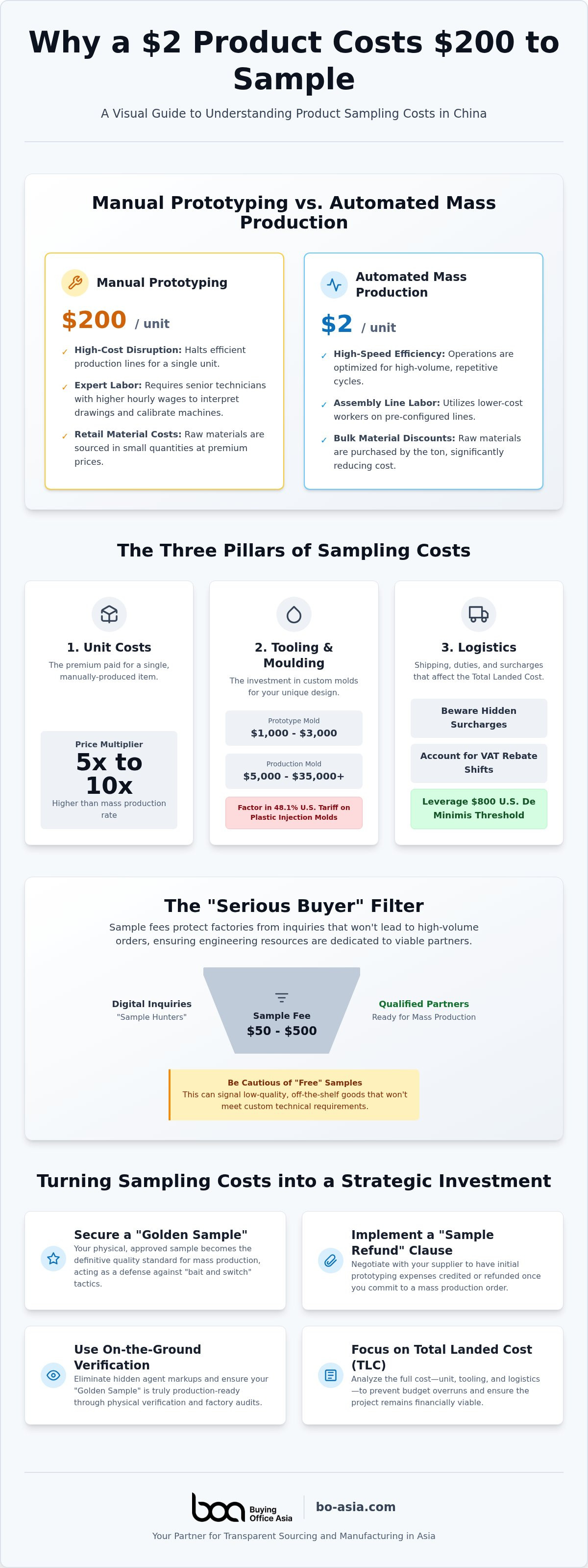
Factories in China produce over 28% of the world's manufactured goods. Their profitability depends on high-speed automation and repetitive cycles. When you request a single unit, you aren't just paying for material. You're paying for the total disruption of that efficiency. This "sampling penalty" is a core component of product sampling costs in china because it covers the transition from a macro production environment to a micro development lab. Prototyping requires a complete reversal of the factory's standard operating procedure.
Mass production lines are rigid. Stopping a high-speed assembly line to run a single piece is a financial disaster for a supplier. To solve this, reputable factories maintain a separate sample room. This department is staffed by senior technicians whose hourly wages are significantly higher than assembly line workers. These experts must manually interpret technical drawings and calibrate machinery for a single run. Using product samples as prototypes is your primary defense against catastrophic design errors. For custom OEM and tooling development, this phase requires intensive engineering hours. You're essentially hiring a factory's best minds to troubleshoot your product before it ever touches the main floor.
Suppliers use sample fees as a "Serious Buyer" filter to protect their operations. In the 2026 global trade environment, factories are inundated with digital inquiries. Many come from "sample hunters" who lack the capital for high-volume orders. By charging between $50 and $500 per unit, a factory ensures they only dedicate their engineering resources to viable partners. Paying these fees isn't a loss; it's a strategic investment that secures your place in the production queue. It establishes a professional baseline. If a factory offers "free" samples without a clear reason, be cautious. This often signals off-the-shelf goods or low-quality stock that won't meet your technical requirements. Investing in fair development costs builds a foundation of transparency and sets the stage for successful sourcing and procurement cycles. It proves you're a partner who understands the economics of the supply chain.
Calculating the true product sampling costs in china requires looking past the unit price on a proforma invoice. Professional buyers focus on the Total Landed Cost (TLC). This metric encompasses the unit fee, tooling investments, and the often underestimated logistics surcharges. Understanding how these three pillars interact prevents budget overruns and ensures your development phase remains financially viable.
Custom designs typically require a prototype mold, which generally costs between $1,000 and $3,000 in the Chinese market. This is distinct from multi-cavity production molds that can range from $5,000 to over $35,000. When navigating market challenges in China, IP protection is paramount. You must verify that your tooling quote includes full ownership of the physical mold and the associated design files. Without this, you risk being "locked in" to a single supplier who holds your production hostage. We prioritize 100% transparency in custom product and tooling development to ensure your assets remain your own. You should also factor in the 48.1% combined tariff rate currently applied to plastic injection molds entering the U.S. when calculating your initial investment.
Typically $50 to $500 depending on complexity.
One-time prototype mold fee for custom shapes.
Express courier rates of $5 to $15 per kilogram.
Note that packages valued below the $800 U.S. de minimis threshold generally enter duty-free.
By aggregating these figures, you avoid the "hidden" cost of international shipping, which can easily double the price of a single prototype. If you need a detailed breakdown for your specific project, our team can help you assess your sampling budget with precision.
Logistics spend is the most volatile variable in product sampling costs in china. In 2026, express courier rates between $5 and $15 per kilogram are merely the baseline. Beyond these weight-based fees, buyers face a complex web of surcharges that can inflate a development budget by 30% or more if unmanaged. These expenses are often obscured until the final invoice, creating significant friction in the procurement process.
Hidden costs often stem from shifting regulatory environments. The 2026 adjustments to VAT rebate statuses for specific export categories mean factories can no longer offset their own production taxes as easily. This loss is frequently passed directly to the buyer as a "handling fee." Additionally, improper documentation is the leading cause of "sample seizures" at customs. Even if your package falls below the $800 U.S. de minimis threshold, failing to clearly mark the shipment as a commercial sample can trigger manual inspections and storage fees that far exceed the value of the prototype itself.
The rise of "green" shipping levies has introduced a new layer of complexity to express air freight. Major couriers now apply environmental surcharges to account for carbon offset requirements in 2026. These fees fluctuate weekly. Consolidation is your most effective defense. Instead of paying individual shipping fees for three different prototypes from three different suppliers, use a dedicated Asia procurement team to collect and verify all samples at a single regional hub. This approach allows you to ship one consolidated package, significantly reducing the logistics footprint and the associated fuel surcharges.
Managing product sampling costs in china requires a shift from passive acceptance to strategic leverage. You shouldn't view these fees as fixed liabilities. Instead, frame them as a deposit on your future production. By applying sophisticated procurement tactics, you can protect your capital while ensuring the factory remains fully committed to your quality standards. Negotiating from a position of regional expertise allows you to dismantle the "sampling penalty" often applied to foreign buyers.
Standard industry terms often allow for a 100% refund of the sample unit fee once a specific order volume is reached. This is a critical component of factory direct price negotiations. If a supplier refuses to credit these fees against your first bulk order, it's often a signal that they prioritize transactional gains over long-term partnership. For projects involving custom tooling, you can negotiate a "tooling amortization" plan. This spreads the cost of the mold over the first 10,000 or 20,000 units, significantly reducing your upfront capital requirements. We recommend linking these refunds to specific approval milestones to keep the factory focused on accuracy from the first iteration.
Another effective tactic is leveraging "off-the-shelf" components for non-essential parts of your prototype. If a standard internal housing or connector meets your technical requirements, don't pay for custom engineering. This approach minimizes the need for expensive prototype molds and keeps your development budget focused on the unique features that define your brand.
Logistics often consume a disproportionate share of your development budget. Shipping five individual samples from different provinces can be up to 70% more expensive than sending a single consolidated shipment. By utilizing a local hub in Hong Kong or Shenzhen, you can aggregate prototypes from multiple suppliers into one express package. This doesn't just save money; it provides a final opportunity for on-the-ground verification. Our teams inspect the prototypes before they leave China, filtering out "duds" that don't match your technical drawings. This prevents you from paying $15 per kilogram to ship a sample that is fundamentally flawed.
To finalize your quality defense, always utilize the "Sealed Sample" strategy. Once a prototype meets every specification, two identical units are signed and sealed by both parties. One remains at the factory as a physical production standard, and the other stays with you. This creates an indisputable benchmark for mass production quality. If you are ready to optimize your development cycle and eliminate hidden markups, reach out to our procurement experts for a professional assessment of your project.
Controlling product sampling costs in china requires more than a spreadsheet; it demands a physical presence at the point of origin. Traditional sourcing models often fail because they rely on intermediaries who obscure the true cost of development. At Buying Office Asia (BOA), we operate as an integrated extension of your own team. Our model is built on 100% transparency, ensuring that the factory-direct prices we negotiate for tooling and prototypes are passed to you without hidden agent markups. This financial clarity allows you to allocate your budget toward innovation rather than administrative friction.
The most dangerous phase of manufacturing is the transition from a perfect prototype to the first mass production run. We prevent the "bait-and-switch" by maintaining a continuous presence on the factory floor. Our team ensures the "Golden Sample" isn't just a one-off masterpiece but a replicable standard for thousands of units. Through rigorous quality control and inspections, we verify that the materials and tolerances used in your samples are identical to those in the final batch. This oversight extends to your intellectual property; we physically secure your molds and tooling, preventing unauthorized use or the loss of proprietary assets. By protecting these physical assets, we ensure your product sampling costs in china result in long-term production security.
The BOA advantage lies in our unique structure: European leadership based in Helsinki paired with a strategic headquarters in Hong Kong. This bridges the communication gap that often leads to expensive sampling errors. Unlike traditional agents who simply relay messages, we act as strategic procurement partners. Our proximity to manufacturing hubs in Shenzhen and Dongguan allows us to speed up the feedback loop, often cutting weeks off the development cycle. This regional expertise is vital for navigating the complex logistics and VAT rebate shifts of 2026. By filtering out non-compliant prototypes before they are exported, we excel at reducing sunk costs in product development. You gain the steady confidence of an established expert, moving your project from a technical drawing to a market-ready product with total financial and operational security.
Managing product sampling costs in china is a defensive necessity for any serious procurement project. We've established that these fees aren't just penalties; they are strategic investments that qualify your partners and protect your mass production ROI. By understanding the interaction between manual prototyping labor and long-term tooling amortization, you can dismantle the hidden markups that often plague unmanaged supply chains. You now have the tactical framework to navigate 2026's volatile logistics landscape and high-tariff environment with total confidence.
Success in global trade isn't found in avoiding development expenses; it's found in achieving 100% transparency. Our European-managed model and physical presence in Hong Kong and China provide the steady oversight your brand requires to eliminate risk. We don't just bridge the communication gap; we offer a protective defense for your custom OEM and tooling development. Secure your production future with a Dedicated Asia Procurement Team and move your project from a technical drawing to a market-ready reality. Your vision deserves a supply chain built on reliability, financial rigor, and the steady hand of an established expert.
Factories charge a premium for samples because producing a single unit disrupts their automated, high-volume production cycles. This requires stopping main lines or engaging a separate sample room staffed by highly skilled technicians whose hourly rates are significantly higher than assembly workers. These fees also function as a filter to identify serious buyers. By paying for development, you secure the engineering resources necessary to translate technical drawings into a functional prototype.
You can typically secure a refund for your sample unit fees by negotiating a credit against your first bulk order. Most professional suppliers will agree to this if you meet their specific Minimum Order Quantity (MOQ) requirements. It is essential to include this "Sample Refund" clause in your initial proforma invoice. This arrangement ensures that your initial product sampling costs in china function as a temporary deposit rather than a permanent sunk expense.
In 2026, shipping a sample via express couriers like DHL or FedEx typically costs between $5 and $15 per kilogram. For larger consolidated sample orders, air freight is a more economical alternative with rates ranging from $4 to $8 per kilogram. You should also account for 2026 fuel surcharges and green levies. Remember that packages valued under the $800 U.S. de minimis threshold generally enter duty-free, helping you control logistics spend.
A "Golden Sample" is the final, approved version of your product that serves as the definitive quality benchmark for all future mass production. It is critical because it functions as your primary defense against factory bait and switch tactics. By holding a signed and sealed version of this prototype, you establish an indisputable standard for materials, tolerances, and finishes. Without this physical reference, you lack the leverage needed to hold a factory accountable for quality deviations.
You can verify a tooling quote by comparing it against 2026 industry averages for prototype molds, which generally range from $1,000 to $3,000. Multi-cavity production molds for plastic injection typically start at $5,000 and can reach $35,000 for complex designs. If a quote lacks a detailed breakdown of materials and IP ownership, it likely contains hidden markups. Professional product sampling costs in china should always include 100% transparency regarding mold ownership and design files.
Western Union is generally unsafe for business transactions as it offers no buyer protection or recourse in the event of a dispute. For professional procurement, you should utilize Alibaba Trade Assurance or direct bank transfers to a verified corporate account. These methods provide a documented paper trail and better security. Using a dedicated procurement team ensures that your payments are directed to vetted suppliers, eliminating the risk of sending funds to fraudulent or unverified entities.
You should realistically budget for two to three iterations of a sample for any custom OEM project. Reaching a production-ready "Golden Sample" on the first attempt is rare for complex designs. Each iteration allows you to refine technical drawings and correct functional errors identified during physical testing. Planning for multiple rounds prevents the frustration of unexpected delays and ensures that the final design is fully optimized for efficient, high-volume mass production.
A sourcing company reduces costs by consolidating samples from multiple suppliers into a single international shipment, which can save up to 70% on logistics. On-the-ground teams physically verify prototypes before they leave China, preventing you from paying for the export of defective units. Professional procurement partners negotiate factory-direct prices that eliminate agent markups. This ensures your development budget is spent on engineering quality rather than obscured administrative fees and inefficient shipping practices.

As of July 2026, the average effective tariff rate on Chinese imports has climbed to 22.8%, but is the cost on the invoice really your biggest financial risk? You likely feel the mounting pressure of managing a supply chain where the rules of engagement change every quarter. The challenges of sourci...

Is your current China manufacturing management strategy robust enough to survive the regulatory shifts of 2026? With the recent implementation of Decree 834 and the new "Made in China" procurement standards, the distance between a successful product launch and a costly supply chain failure has never...

What if your final quality check isn't just a formality, but the only thing standing between a successful product launch and a container full of unsellable defects? For many businesses, the fear of receiving substandard goods from overseas is a constant anxiety, often compounded by communication bar...