

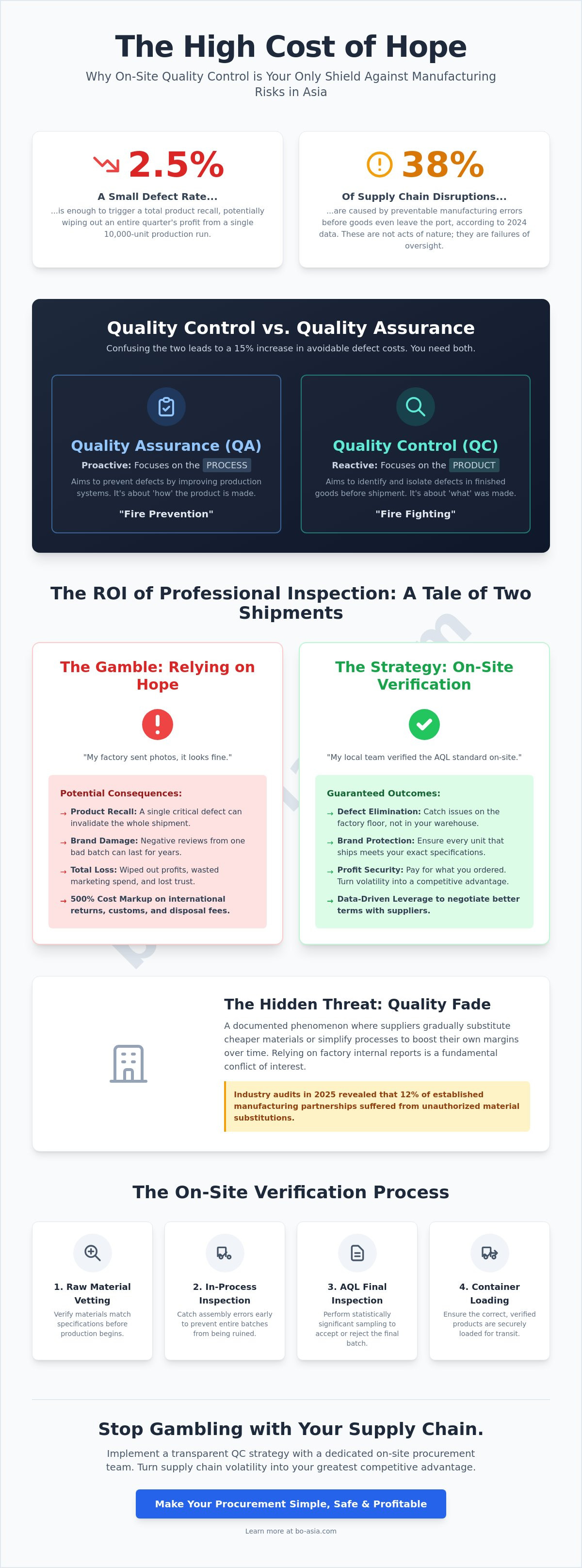
A 2.5% defect rate in a production run of 10,000 units can trigger a total product recall, effectively wiping out your entire quarterly profit. You understand that quality control isn't just a checklist; it's the only shield protecting your brand from the hidden costs of opaque middlemen and factory shortcuts. Relying on remote promises or unverified photos in 2026 is no longer a viable business strategy for serious wholesalers. Data from 2024 shows that 38% of supply chain disruptions are caused by preventable manufacturing errors that occur before the goods even leave the port.
It's frustrating to face unpredictable shipping delays because a factory failed to meet your specifications at the final hour. You already know that distance shouldn't mean a lack of oversight, yet managing mass production from across the globe often feels like a gamble. This guide shows you how to implement a rigorous, on-the-ground strategy that eliminates defects and protects your hard-earned brand reputation. We'll detail the exact on-site protocols and local networks required to make your Asian procurement simple, safe, and profitable. From vetting raw materials to final container loading, you're about to see how we turn supply chain volatility into a measurable competitive advantage.
• Discover why a rigorous quality control strategy serves as your primary shield against defective shipments and long-term brand erosion.
• Distinguish between product-oriented and process-oriented standards to eliminate the costly risks associated with mismanaged manufacturing expectations.
• Master the AQL sampling tables and inspection methods required to maintain elite-level oversight during high-volume production runs.
• Stop leaving money on the table by calculating the real ROI of professional inspections versus the devastating cost of a single defective batch.
• Learn how a dedicated on-site procurement team replaces opaque middlemen to ensure your supply chain remains simple, safe, and profitable.
In the competitive manufacturing landscape of 2026, sourcing from Asia requires more than a digital handshake. It demands a rigorous, boots-on-the-ground strategy that prioritizes data over promises. Technically, quality control is a reactive process. It acts as a definitive filter, identifying and isolating defects before your goods ever reach a shipping container. While quality assurance focuses on the process, QC focuses on the product. It's the final gatekeeper that ensures the physical reality of your shipment matches the technical specifications of your purchase order.
Most wholesalers operate on a hope-based model. They pay their deposit and hope the factory follows the golden sample. This approach is a gamble that scales poorly. A verification-based model replaces this anxiety with objective evidence. By implementing a strict quality control protocol, you secure factory-direct pricing without the risks usually associated with bypassing traditional trading companies. You don't need a middleman to protect your interests; you need a local presence that verifies compliance at the source.
The biggest threat to your margin isn't the unit price; it's quality fade. This is a documented phenomenon where a supplier gradually substitutes cheaper materials or simplifies processes over successive production runs to increase their own profit. In 2025, industry audits revealed that 12 percent of established manufacturing partnerships suffered from unauthorized material substitutions. Relying on factory internal reports is a fundamental conflict of interest. A factory's priority is meeting their shipping deadline, not highlighting their own mistakes. Quality control is the final barrier between a profitable shipment and a total loss.
Early detection is your most effective cost-saving tool. Catching a batch of faulty components while they're still on the factory floor prevents the 500 percent markup associated with international returns, customs duties, and disposal fees. Beyond the immediate savings, rigorous QC fosters long-term supplier development. When a factory knows an independent inspector will verify every AQL (Acceptable Quality Level) standard, they prioritize your production line over less disciplined clients.
100 percent transparency in the inspection process ensures you aren't paying for "safety buffers" added by agents.
Preventing a single defective batch from reaching Amazon or retail shelves saves thousands in potential "reputational damage."
Use inspection failure rates to negotiate better terms or pivot to more capable suppliers before a crisis occurs.
Stop leaving money on the table by assuming your supplier's interests align with yours. True control comes from physical presence and uncompromising verification. This isn't just about catching mistakes; it's about building a simple, safe, and profitable supply chain that operates with the same oversight used by global corporations.
Many procurement managers at the mid-market level treat these terms as interchangeable. They aren't. Confusing the two is a strategic error that leads to a 15% increase in avoidable defect costs, according to 2024 industry benchmarks. While Quality Assurance (QA) focuses on the "how" of the manufacturing process, quality control focuses on the "what" of the finished product. To build a resilient supply chain, you must understand that one cannot replace the other.
Relying solely on a factory's reputation is a risk you don't need to take. The industry standard definition of Quality Assurance vs. Quality Control highlights that QA is proactive while QC is reactive. If you only invest in QA, you're trusting a system without verifying the output. If you only invest in QC, you're catching fires rather than preventing them. A balanced approach is the only way to ensure your operations remain simple, safe, and profitable.
A common objection we hear is: "My factory is ISO 9001 certified, why do I need QC?" This is a dangerous misconception. An ISO 9001 certificate proves a factory has a documented management system; it doesn't guarantee the worker on the line followed those steps during your specific production run. 2025 supply chain data shows that even certified facilities can experience a 22% variance in batch quality due to seasonal labor shifts or raw material fluctuations. You don't need a certificate; you need a dedicated sourcing team that verifies the reality on the ground.
QA happens before the first machine turns on. It involves rigorous factory audits and supplier vetting to ensure the facility is capable of meeting your standards. By setting technical specifications and compliance guardrails early, you reduce the likelihood of production stalls. Effective QA acts as a shield, preventing 60% of common manufacturing errors by addressing them at the process level before they manifest as physical defects.
This is the physical proof of compliance. Quality control involves on-site inspections where inspectors verify that the final goods match your approved gold sample. It's the "boots-on-the-ground" reality check that catches issues like incorrect packaging or structural flaws. Testing raw materials before production begins is a critical QC step, as material substitutions account for 35% of product failures in unmanaged Asian supply chains. QC ensures you stop leaving money on the table by rejecting sub-par goods before they ship.
Effective quality control in 2026 requires more than a checklist; it demands a digital-first approach that integrates local boots-on-the-ground with real-time data. High-volume manufacturing in Asia often fails not because of bad intentions, but due to a lack of technical oversight. Modern QC relies on the Acceptable Quality Limit (AQL) standard, specifically the ANSI/ASQ Z1.4 table. This statistical tool allows your team to determine the maximum number of defects allowed in a batch before it's rejected. For example, in a 5,000-unit order, an AQL of 2.5 for major defects means the lot fails if more than 14 units are found non-compliant. This mathematical precision keeps your supply chain predictable and profitable.
Adopting a formal framework for Quality Risk Management ensures that your team identifies potential failure points before they reach the assembly line. By integrating custom tooling support and pre-approved sampling, you eliminate the guesswork that leads to 15% wastage rates in unmanaged factories. Digital reporting now provides on-site photos and GPS-tagged data within minutes of an inspection. This allows you to make "go/no-go" decisions without the delays of traditional agents, ensuring you don't leave money on the table due to slow communication.
The In-Process Inspection occurs when 10% to 20% of your order is finished. This is your first line of defense against systemic errors. Our on-site teams verify that the raw materials match your gold sample exactly. If a factory uses a lower-grade alloy or a different pantone shade, we catch it here. Correcting an error at the 15% mark is a simple adjustment; finding that same error at 100% completion results in a total loss of the batch and months of reputational damage. We ensure the process is simple, safe, and profitable from the first unit produced.
The Final Random Inspection (FRI) is the ultimate gatekeeper for your supply chain. This happens when at least 80% of the goods are packed. We check everything from functional performance to the accuracy of shipping marks for customs compliance. Opaque middlemen often ignore packaging standards, leading to a 5% increase in transit damage. We verify that every carton meets your specifications. Finally, Container Loading Supervision ensures your goods are packed securely and the container is sealed in our presence. This prevents theft or the "bait and switch" of approved goods with inferior stock before they leave the factory gate.
Stop viewing quality control as a line-item expense. It's a profit protection strategy. When you pay for an inspection, you aren't just buying a report; you're buying insurance against a total loss. Smart importers in 2026 recognize that the cost of a single man-day is negligible compared to the catastrophic failure of a $50,000 shipment. You don't just find defects; you gain leverage. By documenting every minor and major defect, you build a data-backed case for factory-direct price negotiations. If a factory knows you have boots on the ground, their attention to detail increases. This "Seasoned Insider" approach moves you from a passive buyer to a dominant partner who demands better terms based on proven performance metrics.
A defective batch costs far more than the initial purchase price. If a shipment reaches your warehouse with a 15% defect rate, you face a logistical nightmare. Return shipping frequently costs 2x to 3x the original freight price; disposal fees eat into remaining margins. On platforms like Amazon, a sudden spike in "item not as described" returns can trigger an account suspension within 48 hours. Research shows that a drop from a 4.5-star to a 3.5-star rating can slash conversion rates by 50% or more. Identifying errors on-site via quality control costs roughly $300 per day. Fixing those same errors after they cross the ocean can cost tens of thousands of dollars in lost sales and reputational damage.
Supply chain transparency is no longer optional. With the 2022 International Labour Organization report estimating that 28 million people are in forced labor globally, the stakes for your brand are high. Professional audits ensure your factory adheres to ethical manufacturing and environmental standards. You cannot manage what you do not measure. By implementing rigorous on-site checks, you protect your business from the legal and social fallout of labor violations. This level of oversight provides the steady confidence needed to scale. It transforms an opaque supply chain into a resilient, compliant asset that attracts high-value retail partners and conscious consumers alike.
Protect your margins and secure your supply chain with a dedicated on-site team. Explore our professional inspection services at Buying Office Asia.
Traditional sourcing agents often operate in shadows, collecting kickbacks from factories while charging you a service fee. This lack of clarity erodes your margins and compromises your supply chain. Buying Office Asia (BOA) replaces this opaque middleman system with an end-to-end procurement model designed for the complexities of 2026. We act as your physical presence on the factory floor, ensuring every dollar you invest is accounted for. By combining European leadership from our Helsinki office with the operational speed of our Hong Kong hub, we provide a sophisticated shield for your business interests.
Our approach to quality control goes beyond simple inspections. We vet factories through a rigorous 50-point criteria checklist before a single contract is signed. This process allows us to negotiate factory-direct prices without the 10% to 15% markups typically hidden by local agents. You gain the same level of oversight as a multinational corporation, but with the agility of a dedicated partner who understands the local landscape.
Transparency isn't a buzzword; it's a measurable standard. BOA eliminates hidden margins by providing you with direct factory access and unedited on-site inspection reports. While other agencies might filter bad news to protect their relationship with a supplier, we provide raw video proof and high-resolution imagery from the production line. This data-driven approach ensures you make decisions based on reality rather than filtered updates. Our dual presence in Hong Kong and Helsinki means your communication stays seamless across time zones, preventing the 24-hour delays that often stall production cycles during critical phases.
Transactional sourcing is a gamble that leads to quality fade. When a factory realizes you aren't watching, they often swap high-grade components for cheaper alternatives to save 5% on production costs. Our team prevents this by moving from transactional checks to strategic supplier management. We don't just find problems; we prevent them. As your on-site procurement team, we manage the entire lifecycle of your order, acting as a barrier against delays and compliance risks. This hands-on management style is why 92% of our long-term clients report more stable landing costs year-over-year. You can protect your production with a professional Asia procurement team that prioritizes your bottom line. Our goal is to make your overseas manufacturing simple, safe, and profitable through expert quality control and localized oversight.
As you scale your manufacturing for 2026, the physical distance between your desk and the factory floor shouldn't become a strategic liability. Protecting your brand requires a rigorous quality control strategy that eliminates the risks of reputational damage and production delays. By moving beyond basic definitions and implementing European-managed on-site inspections, you stop leaving money on the table. Since 2010, Buying Office Asia has operated from its Hong Kong headquarters to provide the 100% transparency that traditional agents with hidden margins often lack. This approach ensures your inspections are grounded in professional rigor rather than opaque promises. You gain the high-level oversight typical of a global corporation while keeping your specific operations lean and efficient. Transitioning to a model with zero hidden margins ensures your supply chain remains simple, safe, and profitable. It's time to replace the anxiety of overseas sourcing with the steady confidence of a seasoned insider who acts as your shield. Secure your supply chain with Buying Office Asia’s on-site quality control. You've built a strong brand; now you can finally give it the protection it deserves.
Quality assurance focuses on the manufacturing process to prevent defects, while quality control inspects the final product to identify them. QA involves setting up protocols like ISO 9001 standards during the planning phase. QC is the reactive step where a technician checks 125 units from a 3,000 piece batch to ensure they meet your specific requirements. Both are essential to eliminate production errors before they reach your warehouse.
Professional quality control is vital in Asia because it acts as your physical presence when you're 5,000 miles away from the factory floor. Without on-site oversight, you risk quality fade, where a supplier gradually swaps components for cheaper alternatives to increase their margins. A 2023 industry report showed that 25% of uninspected shipments from overseas suppliers contained defects that required costly local rework or total disposal.
The three most common methods are Initial Production Inspection (IPI), During Production Inspection (DUPRO), and Pre-Shipment Inspection (PSI). IPI checks raw materials when 10% of the order is ready to prevent early errors. DUPRO occurs when 50% is finished to catch mid-stream issues. PSI is the final gate, occurring when 80% of goods are packed, ensuring the total order meets your standards before you release the final payment.
A professional quality inspection in China typically costs between $200 and $300 per man-day according to 2024 market data from major global inspection firms. This fee usually covers the inspector's travel, the detailed report, and the physical testing of products. It's a small investment to protect a $50,000 purchase order. You should always demand a fixed fee to avoid the hidden kickbacks often associated with low-cost local agents.
You must stop the shipment and issue a formal rejection report if your goods fail a pre-shipment inspection. The factory is then responsible for sorting the defective units and performing a total rework at their own expense. You shouldn't release the final 70% balance payment until a follow-up inspection confirms that the factory corrected all critical and major defects identified in the initial report.
You can't rely on Alibaba reviews because they often lack the technical depth required for industrial procurement. A 2022 study found that 30% of online supplier ratings are influenced by sample-only experiences rather than mass production reality. Reviews don't account for the current state of a factory's machinery or their staff turnover. Only a physical on-site audit provides the transparency needed to secure your supply chain.
AQL uses the ISO 2859-1 standard to determine the maximum number of defects allowed in a sample size before a lot is rejected. For example, in a batch of 1,000 units, an inspector might check 80 pieces. If they find more than 2 major defects, the entire shipment fails. This statistical method allows you to make data-driven decisions without checking every single item in the container, often utilizing resources like the-inspection-company.com to calculate precise sample sizes.
A dedicated procurement team is superior to a sourcing agent because it eliminates the conflict of interest inherent in commission-based models. Traditional agents often take hidden margins from the factory, which compromises their loyalty to you. A dedicated team acts as your on-site office, providing total transparency and 100% alignment with your profitability. This approach ensures your quality control protocols are never traded for a supplier kickback.

What if the first clear sign of a production problem arrives after the goods are packed? Manufacturing risk management in Asia works best when controls are connected from the start, not left to a final inspection or occasional supplier update. You need visibility into factory activity, early warning...

What if the lowest unit quote isn’t the lowest-cost way to make your board game? Board game manufacturing costs depend on more than the number of boxes ordered. Component materials, custom tooling, assembly, packaging and delivery scope can all change what a quote covers, making headline prices diff...

What if the factory’s lowest quote isn’t the lowest-cost option? A lower unit price can hide differences in materials, tooling, packaging, quality checks or production terms. Understanding how sourcing agents negotiate factory prices starts with making those differences visible, not simply asking a...