


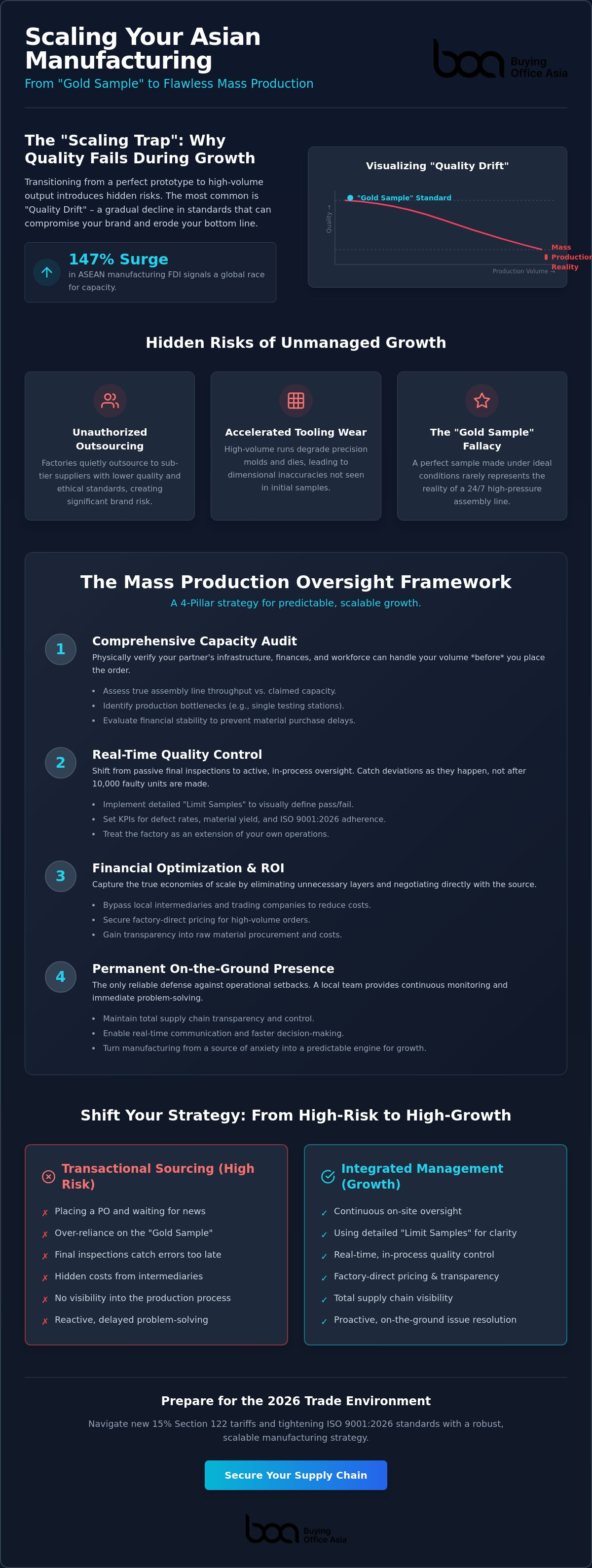
With manufacturing FDI into ASEAN surging by 147% recently, the global race for capacity has reached a fever pitch. You've likely experienced the frustration of a perfect "gold sample" followed by a bulk order plagued by quality drift. Successfully scaling production with your Asian manufacturer requires more than just increasing your purchase order; it demands a fundamental shift from transactional sourcing to rigorous, on-the-ground oversight. We understand the pressure of managing the 2026 trade environment, including the new 15% Section 122 tariffs and tightening ISO 9001:2026 quality standards.
You deserve a supply chain that grows with you, not one that breaks under pressure. This strategic guide provides the blueprint for transitioning from small-batch sampling to high-volume mass production without compromising on quality or your bottom line. We'll detail how to secure factory-direct negotiations, implement zero-defect quality controls, and maintain total transparency as your operations expand across the Asia-Pacific region. By the end of this briefing, you'll have the framework needed to transform your manufacturing from a source of anxiety into a predictable engine for growth.
• Identify the "Scaling Trap" and learn how to prevent quality drift before it compromises your brand reputation during mass production runs.
• Discover how to conduct a comprehensive capacity audit to ensure your supply chain can handle the transition to high-volume output.
• Master the oversight framework required for scaling production with your Asian manufacturer by shifting from final inspections to real-time, in-process quality control.
• Secure your ROI by bypassing local intermediaries and negotiating factory-direct pricing to capture the true benefits of economies of scale.
• Understand why a permanent on-the-ground presence is the only reliable defense against the operational setbacks and hidden costs of international manufacturing.
Scaling production with your Asian manufacturer often reveals a critical threshold where factory capacity meets operational friction. This phase, known as the Scaling Trap, occurs when the systems used for small batches fail to support the rigors of high-volume output. Many brands mistakenly believe that a successful prototype guarantees a seamless mass production run. In reality, the transition from hundreds to tens of thousands of units introduces variables that can compromise your brand's integrity if left unmanaged.
The most common symptom of this trap is "Quality Drift." This is the gradual, often imperceptible decline in product standards across a large production cycle. While the first 500 units might meet every specification, unit 5,000 may show slight deviations in material thickness or finish. Without a rigorous quality control framework, these minor issues compound until the final shipment no longer resembles your approved gold sample. Moving beyond the Scaling Trap requires three specific pillars: verified factory capacity, continuous on-site oversight, and total supply chain transparency.
Successful scaling requires you to move away from transactional ordering. Placing a purchase order and waiting for a shipping notification is a high-risk strategy in a 2026 market defined by rapid shifts and tightening regulations. Instead, you must adopt an integrated supply chain management model. This approach treats the factory as an extension of your own operations, ensuring that every stage of production is visible and controlled.
When a factory reaches its internal capacity, it may quietly outsource portions of your order to sub-tier suppliers. These smaller shops rarely operate with the same quality standards or ethical certifications as your primary partner, creating significant brand risk. Additionally, high-volume runs accelerate tooling wear and tear. Precision molds and dies degrade over time, leading to dimensional inaccuracies that won't appear during the sampling phase. You cannot rely on a "Gold Sample" produced under idealized conditions to represent the reality of a 24/7 assembly line. Real-world production units require constant monitoring to ensure they stay within the established tolerances.
A prototype proves a concept, but it doesn't prove a process. To scale safely, you need robust sampling support that defines the exact manufacturing standards for mass production. This includes creating detailed limit samples that show the factory what is acceptable and what is a "fail." Before the first high-volume run begins, you must set realistic KPIs that focus on more than just the delivery date. Metrics should include defect rates, material yield, and adherence to the latest ISO standards. By establishing these benchmarks early, you create a defensive perimeter around your product quality as you begin scaling production with your Asian manufacturer.
Placing a high-volume order without a physical capacity audit is a gamble with your capital. You need to verify that your partner possesses the infrastructure required for overcoming scalability barriers. It's not enough to rely on past performance with smaller batches. Scaling production with your Asian manufacturer demands a deep dive into their assembly line throughput and raw material procurement cycles. If their machines are running at 95% capacity for other clients, your "big" order will likely face delays or be outsourced to a less capable facility.
Identifying bottlenecks is the first step in securing your supply chain. If a factory has ten assembly lines but only one specialized testing station, that station becomes a failure point for your entire project. You must also evaluate the financial stability of the firm. A manufacturer with cash flow issues might delay purchasing raw materials for your bulk order, leading to sudden lead time extensions that disrupt your entire retail calendar. Workforce stability is another indicator of health. High turnover rates in technical roles often lead to inconsistent assembly and higher defect rates during peak production periods.
Marketing materials often highlight the newest parts of a facility while hiding aging machinery. A physical inspection verifies the actual state of the production lines and their maintenance schedules. You must also map the factory’s sub-supplier network. If they source critical components from unvetted third parties, your quality is only as strong as that weakest link. Using rigorous supplier vetting identifies partners who can grow alongside your brand without operational collapse. If you're unsure whether your current partner is ready for the next level, our team can provide a comprehensive factory audit to secure your investment.
Rapid scaling often tempts factories to overwork staff or ignore safety protocols to meet aggressive deadlines. This creates a massive brand risk. In 2026, the USTR has already proposed tariffs of 10% to 12.5% on several Southeast Asian countries related to labor allegations. Implementing ESG standards isn't just a moral choice; it's a strategic defense against regulatory penalties. You must ensure that labor standards are maintained even during peak production. A factory that cuts corners on ethics is likely cutting corners on your product quality too.
Once you've confirmed factory capacity, the focus must shift to active management. Passive trust is a liability when scaling production with your Asian manufacturer. To protect your investment, you need a permanent on-the-ground presence that moves beyond simple spot checks. High-volume runs require a transition from final inspections to a rigorous In-Process Quality Control (IPQC) framework. By monitoring the assembly line in real time, you identify and correct defects at the source before they compromise thousands of units.
Every new batch, regardless of previous successes, must begin with a First Article Inspection (FAI). This step ensures that machine settings, raw material batches, and worker instructions remain aligned with your approved gold sample. Standardizing your reporting formats is equally critical. You shouldn't have to decipher vague emails; instead, demand structured data that provides 100% transparency into defect rates, production speeds, and material yields. This data-driven approach removes ambiguity and allows for objective decision-making during the heat of a production cycle.
Effective oversight follows a three-stage chronological defense. It begins with pre-production meetings where your standards are hard-coded into the factory’s daily workflow. This alignment prevents the "assumptions" that often lead to quality drift. During-production inspections (DUPRO) occur when approximately 20% to 30% of the order is complete. Catching a finish error or a dimensional deviation at this stage saves the remaining 70% of the run from the same fate. Finally, the Pre-shipment Inspection (PSI) acts as the ultimate gatekeeper, ensuring that only zero-defect goods leave the factory floor.
Discovering non-compliance shouldn't result in a total production shutdown. A sophisticated management strategy focuses on immediate corrective actions that keep the line moving while fixing the root cause of the error. This level of conflict resolution and technical negotiation is where a dedicated Asia procurement team becomes indispensable. We act as your eyes and ears, bridging the cultural and linguistic gaps that often obscure the truth in unmanaged supply chains. Documenting this batch history isn't just about accountability; it creates a detailed roadmap for long-term supply chain traceability. When you have a clear record of every production hiccup and its resolution, you build a more resilient partnership that can handle even higher volumes in the future.
Many executives assume that increasing order volume automatically leads to lower unit costs. This "Economy of Scale" myth often blinds businesses to the reality of the "Middleman Tax." In a transactional model, traditional agents and trading companies hide their margins within your unit price, ensuring that as you grow, their profits grow faster than your savings. Successfully scaling production with your Asian manufacturer requires a rejection of these obscured cost models. You must gain visibility into the factory's actual cost structure, from raw material procurement to labor and energy rates, to negotiate from a position of authority.
In 2026, financial optimization is further complicated by shifting trade dynamics. With the US implementing a 15% across-the-board tariff under Section 122, your margin for error has narrowed significantly. You can't afford to leave money on the table through inefficient payment terms or unmanaged currency fluctuations. Moving toward "open book" pricing allows you to see exactly where your capital is going. This transparency is the only way to ensure that the financial benefits of high-volume production actually reach your bottom line rather than being absorbed by an unmanaged supply chain.
Negotiating effectively requires deep regional expertise and access to real-time data. For instance, knowing that industrial power rates in Vietnam are approximately $0.085 per kWh compared to $0.114 in China allows you to challenge a factory's overhead claims with precision. By eliminating local intermediaries, you secure factory-direct pricing that reflects true market conditions. Reviewing our savings examples demonstrates how high-volume procurement, when managed correctly, can significantly reduce unit costs through direct negotiation and volume leveraging. This process often includes securing better payment terms, such as moving from 100% upfront to milestone-based payments that improve your operational cash flow.
As your volume increases, logistics becomes a major component of your total landed cost. Consolidating shipments from multiple sub-suppliers into single high-volume containers reduces freight expenses and simplifies the customs clearance process. In the 2026 landscape, regulatory compliance is a critical financial pillar. You must navigate the complex web of Section 301 and Section 232 duties while managing the logistics of a "China+1" strategy. Strategic logistics planning ensures that your goods don't just arrive, but arrive at the lowest possible cost. If you are ready to audit your current manufacturing costs and identify hidden inefficiencies, contact our procurement experts today for a professional briefing.
Digital platforms and remote communication have simplified initial sourcing, but they reach their functional limit when you begin scaling production with your Asian manufacturer. A digital dashboard cannot walk the factory floor, inspect raw material stockpiles, or sense the operational friction of a facility reaching its capacity. In a high-stakes scaling environment, managing by email is a high-risk strategy. You need a physical proxy who understands the local manufacturing landscape and can intervene before minor deviations become systemic failures.
Local expertise bridges the cultural and linguistic gaps that often lead to "Yes" culture masking production delays. When your representatives are physically present, they move beyond the role of a third-party inspector and become a strategic extension of your brand. This proximity changes the factory's incentive structure. A manufacturer is far more likely to prioritize an order when they know a dedicated Asia procurement team is arriving for an unannounced in-process check. This level of oversight is the only reliable defense against the brand risks and unforeseen expenses of unmanaged international growth.
We reject the traditional intermediary model that thrives on obscured costs. Our 100% transparency model ensures there are no hidden commissions or kickbacks from factories; your financial health is our only priority. With European management deeply rooted in Hong Kong and China, we provide the elite oversight usually reserved for major enterprises. We don't just facilitate a connection; we build a secure, scalable infrastructure for your business. You can see how we help brands grow by reviewing our documented history of successful mass production transitions.
Scaling production with your Asian manufacturer is a management transition that requires a methodical roadmap. You shouldn't jump into high-volume orders without a clear understanding of your current supply chain's strengths and weaknesses. We recommend a structured approach to growth:
: Conduct an initial audit to identify immediate vulnerabilities in your current manufacturing and logistics setup.
: Define a long-term strategy with an expert consultant to align your production capacity with your sales projections.
: Deploy a dedicated team to manage the transition from sampling to zero-defect mass production.
Success in 2026 demands more than just a supplier; it requires a protective, hands-on partner who is invested in your long-term viability. To begin your journey toward a predictable and profitable high-volume production line, contact Buying Office Asia today for a professional briefing.
Successfully scaling production with your Asian manufacturer is a complex transition that demands more than distant oversight. It requires a rigorous framework of in-process quality control, verified factory capacity, and a complete rejection of the traditional intermediary model. By establishing a physical presence and optimizing your cost structure, you transform your supply chain from a source of risk into a stabilized engine for growth. You don't have to face the complexities of international trade alone.
Buying Office Asia provides the defense you need against operational setbacks and quality drift. With over 15 years of experience managing mass production in Asia, our European leadership combines regional expertise with a 100% transparency model. We eliminate hidden commissions and obscured costs, functioning as an integrated extension of your own team rather than a third-party entity. Secure your high-volume supply chain with Buying Office Asia to begin your transition to zero-defect mass production today. Your brand's expansion is within reach when you have a partner who prioritizes your financial health and operational security.
You determine scalability through a comprehensive capacity audit that evaluates actual production lines versus brochure claims. A manufacturer's ability to handle small batches doesn't guarantee success at high volume. You must verify their raw material procurement cycles and machine uptime. If their equipment is already running at near-peak capacity for other clients, your bulk order will likely face delays or be outsourced to an unvetted sub-supplier.
The primary risk is quality drift, where the standards of the approved gold sample are gradually abandoned during long production runs. As volume increases, tooling wear and tear accelerate and worker fatigue sets in. Without on-site mass production oversight, these minor deviations compound into high defect rates. This lack of control often leads to expensive rework or total shipment rejection, severely impacting your bottom line and brand reputation.
You capture substantial savings by eliminating local intermediaries and trading companies that hide margins in your unit price. While exact percentages vary by industry, factory-direct negotiations reveal the true cost of materials and labor. This transparency allows you to leverage your volume for better payment terms and "open book" pricing. By removing the middleman tax, you ensure that economies of scale benefit your company rather than an unmanaged agent.
Diversification is the superior strategy for long-term resilience in the 2026 trade environment. While scaling production with your Asian manufacturer in one location offers simplicity, it leaves you vulnerable to regional disruptions and tariff shifts. Adopting a "China+1" model allows you to maintain capacity in secondary markets like Vietnam or Malaysia. This approach provides a necessary defense against geopolitical instability and ensures your supply chain remains operational during localized crises.
Mass production requires a shift from final spot checks to In-Process Quality Control (IPQC). In small runs, you might wait until the end to inspect goods; however, scaling demands real-time monitoring of the assembly line. This framework includes First Article Inspections for every batch and During-Production Inspections. By catching errors when only 20% to 30% of the order is complete, you prevent defective units from multiplying throughout the high-volume cycle.
Hong Kong remains a critical strategic hub for managing Asian manufacturing due to its sophisticated legal framework and tax advantages. In 2026, the region offers a 0% tax rate on offshore profits, making it an ideal location for a regional buying office. Its proximity to the Greater Bay Area allows for rapid on-site intervention while providing a stable, international base for contract enforcement and financial optimization in a complex global market.
You can successfully scale production without frequent travel by utilizing a dedicated Asia procurement team as your on-the-ground proxy. Digital-only sourcing has significant limitations in a high-stakes environment. A local partner provides the physical oversight and technical expertise needed to manage the factory floor in real time. This presence ensures accountability and transparency, allowing you to focus on business growth while your interests are protected by seasoned insiders.
Protecting intellectual property requires a layered defense that combines robust legal contracts with strategic operational fragmentation. You should utilize NNN agreements that are enforceable in the local jurisdiction. Additionally, vetting your suppliers for ethical compliance and long-term stability reduces the risk of IP theft. By fragmenting production across multiple vetted partners, you ensure that no single entity possesses the complete blueprint for your proprietary technology.

A supplier listing can open a door, but it can’t show whether a factory is right for your order. Choosing a ningbo sourcing agent means looking beyond access to local suppliers: you need clear oversight of supplier vetting, production follow-up, and quality checks. Without defined responsibilities,...

What if the supplier with the strongest online profile isn’t the factory best suited to your shoes? In footwear manufacturing in China, a directory listing can start your search, but it can’t confirm who will make your product, whether the factory can handle its construction and materials, or how cl...
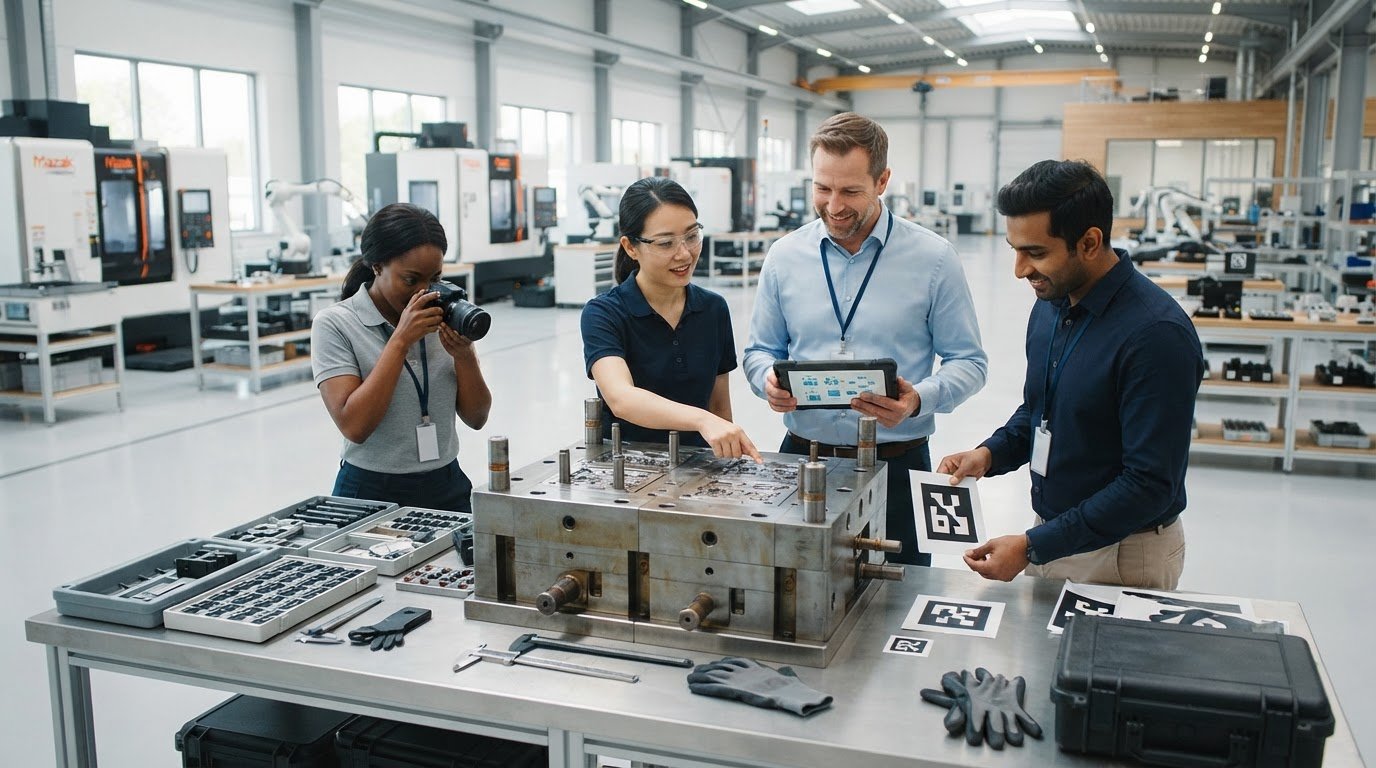
What if the mold you paid to develop couldn’t be released when you needed to change suppliers? Managing tooling and molds with a foreign factory means more than tracking where production equipment is stored. Payment alone may not establish clear ownership, access, or transfer rights. Without visibil...