

The most expensive mistake a US importer can make isn't paying a higher factory price; it's assuming that a final inspection report is enough to protect their brand. By the time a third-party inspector flags a defect, your capital is often already trapped in a container of unsellable goods. Effective quality control services in China for US companies must function as a rigorous management strategy rather than a simple checklist. You need to see past the factory gate to ensure that technical errors and "quality fade" don't erode your margins before the product even leaves the wharf.
We understand the anxiety of managing a supply chain from 7,000 miles away, especially when language barriers and a lack of transparency lead to unexplained price hikes or sub-tier supplier risks. It's frustrating to feel like a spectator in your own production cycle while your financial health is on the line. This guide provides a strategic blueprint to regain control, offering on-the-ground QC strategies to eliminate defects and secure your brand's reputation. You'll learn how to achieve 100% transparency on the production floor and navigate the complex 2026 regulatory environment, ensuring your imports meet US consumer expectations without the risk of costly recalls or delays.
• Learn why effective quality control services in China for US companies function as a management strategy to prevent capital from being trapped in defective inventory.
• Identify the critical inspection stages, including Pre-Production and During Production, to catch systemic errors before they impact your entire shipment.
• Recognize the risks of the Middleman Trap and how direct oversight eliminates the obscured costs of factory-led inspections and agent kickbacks.
• Master the use of Acceptable Quality Levels and the Golden Sample protocol to ensure your manufacturing outputs consistently meet US technical specifications.
• Discover the benefits of integrating an on-the-ground procurement team to maintain 100% transparency and protect your brand from quality fade.
Quality control services in China for US companies represent an active management function designed to ensure that every unit rolling off a production line matches your precise technical specifications. It's a comprehensive oversight mechanism that bridges the 7,000-mile gap between your headquarters and the factory floor. This process isn't merely about ticking boxes at the end of a production run. It involves a strategic combination of factory audits, continuous production monitoring, and final inspections. By establishing a physical presence on-site, you transition from a passive buyer to a proactive partner with 100% transparency into the manufacturing process. Effective Quality Control ensures that the product your customers receive is exactly what you promised them.
Your risk profile as a US importer is unique due to extreme time zone differences and the high expectations of the American consumer base. In the 2026 trade environment, the focus has shifted from simply catching broken items to preventing "quality fade" before it erodes your brand equity. Relying on a factory's internal reporting is a high-risk strategy that often leads to technical errors or material substitutions that you won't discover until the container is opened in your warehouse. Utilizing professional on-site quality control & inspections allows you to identify systemic issues when they are still fixable, protecting your capital and your reputation.
The financial impact of a defective shipment goes far beyond the cost of the goods themselves. For US companies, a high defect rate can trigger devastating consequences for Amazon rankings or jeopardize hard-won retail partnerships. You also face the "hidden" expense of paying ocean freight and customs duties on items that cannot be sold. Quality Fade is the gradual decline in material standards over time. If left unmanaged, this subtle degradation eventually leads to mass product recalls, lost sales velocity, and a permanent stain on your brand's credibility. It's far more cost-effective to invest in prevention than to manage the fallout of a failed production cycle.
Compliance isn't a suggestion; it's a legal requirement for entering the US market. You must ensure your products adhere to ASTM, CPSC, and FDA requirements directly at the source. US Customs and Border Protection (CBP) has significantly increased scrutiny in 2026, particularly regarding valuation and compliance with the Uyghur Forced Labor Prevention Act (UFLPA). Independent verification is your best defense against costly seizures or delays at the port of entry. Factory-issued certificates often fail US legal scrutiny because they lack the objective rigor required by American regulators. Real security comes from having a dedicated team that understands both Chinese manufacturing culture and US regulatory demands.
Deploying comprehensive quality control services in China for US companies involves four distinct operational checkpoints. Each stage is designed to protect your capital by identifying risks before they compound into financial losses. Relying solely on a final inspection is a reactive strategy that often leads to "dead stock" or missed market windows. To maximize margins, you must treat quality as a continuous management process rather than a one-time event. This multi-layered approach ensures your production remains on schedule and within technical tolerances.
The Pre-Production Inspection (PPI) is your first line of defense against "quality fade." It focuses on vetting raw materials and components before the assembly line even moves. Factories occasionally attempt to offset rising costs by using scrap materials or unauthorized substitutions that look identical but fail under stress. Verifying tooling and mold accuracy at this stage prevents thousands of defective units from being produced in the first place. Successful PPI is built on a foundation of rigorous supplier vetting, ensuring that the factory actually possesses the equipment they claimed during the negotiation phase.
A During Production Inspection (DUPRO) occurs when roughly 20% to 50% of your order is complete. This is the only way to identify systemic issues while there's still time to correct them. If a technician discovers a recurring error in the first batch, they can work with factory managers to adjust the process immediately. This prevents the "all-or-nothing" shipping dilemma where you're forced to choose between a defective shipment or a three-month delay. On-the-ground presence during the critical first 24 hours of mass production provides the real-time troubleshooting necessary to maintain your sales velocity in the US market.
The final two stages, Pre-Shipment Inspection (PSI) and Container Loading Supervision (CLS), function as the ultimate gatekeepers. During PSI, inspectors verify that the finished goods meet your specific AQL standards and comply with FDA import regulations or other relevant US safety codes. Finally, CLS prevents "switch" scams, where a factory might present high-quality goods for inspection but load inferior units into the container once the inspector leaves. This level of oversight ensures that what you paid for is exactly what arrives at your warehouse. If you're unsure which stage is most critical for your specific product category, consult with our procurement experts to design a tailored inspection protocol.
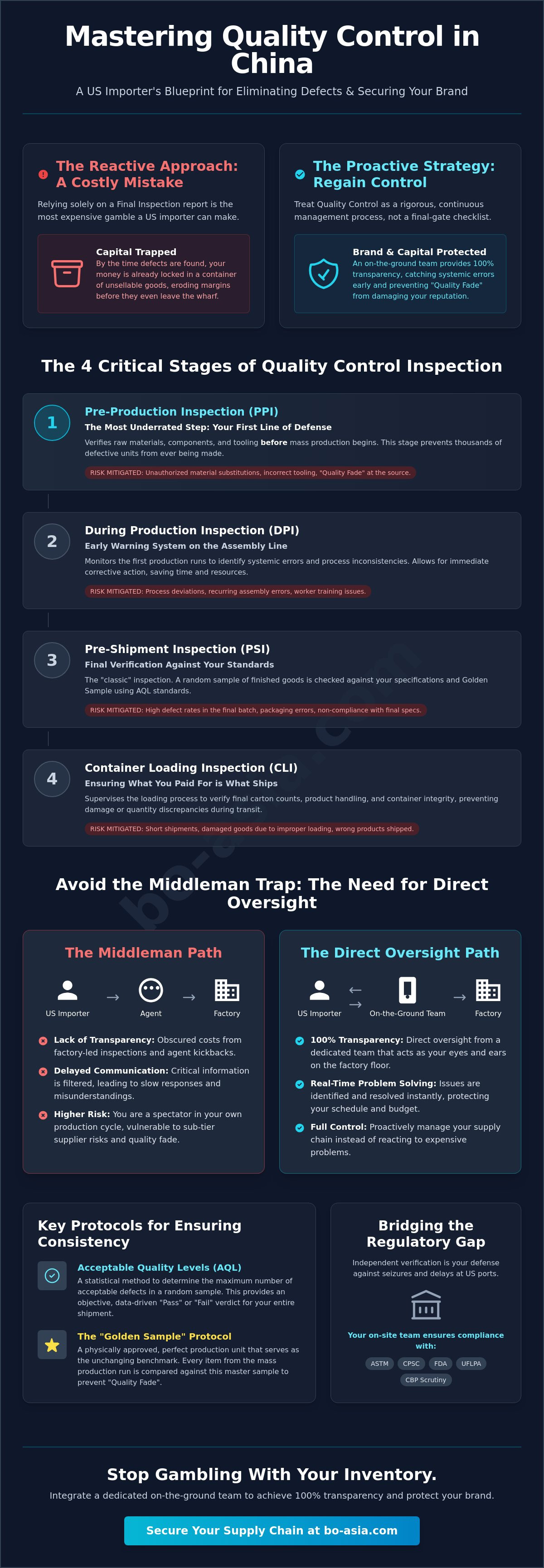
The "Middleman Trap" refers to the hidden layer of conflicting interests that often exists between a US buyer and a Chinese manufacturer. Many sourcing agents claim to provide oversight, yet they secretly accept kickbacks from the factories they're supposed to monitor. This creates a transparency deficit where critical defects are ignored to maintain the agent's relationship with the supplier. When you rely on these intermediaries, you aren't just losing money on commissions; you're losing the ability to protect your brand from the operational setbacks discussed in previous sections. Utilizing dedicated quality control services in China for US companies ensures that your interests always come first.
Factories often offer "free" internal quality control as an incentive. In reality, this obscures the true cost of production and removes the objective layer necessary for rigorous compliance. A factory will rarely report its own failures. To maintain healthy margins, you need an inspection report that serves your interests, not the factory's production schedule. Direct factory-to-client communication eliminates the "telephone game" where technical errors are lost in translation.
Achieving total visibility into the production floor requires a partner that adheres to Western ethical standards. Helsinki-based leadership ensures that your procurement process is never a "black box." By utilizing Buying Office Asia, you gain an integrated extension of your own team rather than a detached third party. We structure our fees to align directly with your financial outcomes; this ensures that our success is tied to your product's quality and delivery timeline. This model provides the regional expertise you lack while maintaining the accountability you demand.
Many importers fall into the trap of hiring the cheapest available third-party inspector, often paying between $130 and $180 per man-day. However, low-cost inspectors are frequently susceptible to "social bribery," where factory managers provide small incentives to overlook minor defects. This is why the safest value zone for quality control services in China for US companies typically falls between $199 and $250 for all-inclusive rates. A higher rate often reflects a more rigorous ethical standard and better training for the personnel on-site.
A dedicated procurement team offers a significantly higher ROI than a one-off inspector. While an inspector only records failures, a dedicated Asia procurement team manages the entire relationship to prevent those failures from occurring. For instance, direct oversight recently helped a US client reduce their defect rates by 15% across three production cycles by identifying tooling wear before it reached a critical threshold. This proactive approach transforms quality control from a cost center into a margin-protection strategy.
Success in international manufacturing isn't found in a contract; it's found in the specific technical protocols you enforce on the factory floor. A robust quality plan serves as your operational defense against ambiguity. By utilizing professional quality control services in China for US companies, you establish a clear set of performance benchmarks that the factory must meet before you release payment. This proactive structure eliminates the guesswork that often leads to container-sized disappointments and protects your brand from the financial drain of defective inventory.
The industry benchmark for quality inspections is often AQL 2.5, which sets the threshold for major defects at 2.5%. You must categorize defects into three tiers: Critical, Major, and Minor. Critical defects involve safety or legal issues that could lead to recalls. Major defects are functional failures that make the product unsellable. Minor defects are cosmetic flaws that don't affect performance. Choosing the right inspection level is equally vital; while Level II is the standard for most consumer goods, Level III offers a more rigorous sample size for high-value or complex products. Zero defects is a statistical myth in mass production. Your goal is to manage realistic tolerances that protect your margins without stalling production.
A "Golden Sample" is the definitive physical reference that has been signed, dated, and sealed by your QC team. Never allow the factory to hold the only copy of your approved prototype. Managing the logistics of the Master Sample between the US and China ensures that your on-site team has a tangible benchmark to compare against the mass production run. This sample acts as a legal benchmark in any payment dispute, providing undeniable proof of whether the factory met your technical requirements. If the output deviates from the Master Sample, the production is failed by default.
Your quality plan must also specify rigorous testing protocols tailored to your product category. This includes:
to ensure packaging integrity during the rigors of international shipping.
for textiles or wood products to prevent mold growth during ocean transit.
that verify electronic components under sustained use.
documented within your manufacturing agreement to ensure the factory bears the cost of rework.
Establishing these standards early is especially critical during OEM/ODM tooling development, where technical errors can be baked into the mold itself. If you're ready to secure your supply chain with a customized quality plan, reach out to our on-the-ground team today to discuss your specific requirements.
Buying Office Asia provides the sophisticated oversight and regional expertise usually reserved for major multinational enterprises. We bridge the gap between US technical requirements and Chinese manufacturing reality through a hybrid management model. By combining Helsinki-based leadership with deep local roots in Hong Kong and Mainland China, we offer the security of Western business ethics alongside the hands-on presence required to navigate complex supply chains. Our quality control services in China for US companies are designed to move beyond the limitations of transactional inspections, functioning instead as a stabilizing force for your entire procurement strategy.
Relying on transactional agents often leads to the "Middleman Trap" where your interests are secondary to factory relationships. In contrast, a dedicated Asia procurement team acts as an integrated extension of your own office. We prioritize long-term financial viability by managing the factory relationship from the initial negotiation through to the final container loading. This comprehensive approach to End-to-End Sourcing and Procurement ensures that quality fade and supply chain volatility don't erode your margins or threaten your brand's reputation in the US market.
Our mass production oversight goes significantly deeper than a simple pass/fail checklist. We maintain a consistent on-site presence that allows us to identify process deviations before they result in mass defects. When an issue is flagged, our team provides a detailed root-cause analysis to ensure the factory implements a permanent fix rather than a cosmetic patch. We focus on long-term supplier development, working with factory managers to improve material standards and operational efficiency. This level of transparency transforms the manufacturing process from a "black box" into a manageable, predictable asset for your business.
Transitioning from unmanaged sourcing to professional procurement is the most effective way to reduce your total cost of ownership. By eliminating the hidden fees of intermediaries and the high cost of quality failure, you secure the sales velocity required for growth. We invite you to review our pricing and savings examples to see how our management model protects your capital across multiple production cycles. Professional oversight is not an additional expense; it is a fundamental defense against the operational setbacks that affect unmanaged supply chains. Contact Buying Office Asia today to discuss a tailored China QC strategy that meets your specific brand requirements.
Securing your manufacturing future in China requires a shift from reactive inspections to proactive management. By implementing the four critical stages of oversight and establishing a rigorous quality plan, you protect your capital from the hidden costs of defects and quality fade. You've seen how direct oversight dismantles the Middleman Trap, ensuring that your technical specifications remain the priority on the factory floor. These results-oriented quality control services in China for US companies transform your supply chain into a stable, predictable asset.
Buying Office Asia provides the regional expertise and Helsinki-based leadership necessary to navigate the complex trade environment of 2026. With our 100% Transparency Guarantee and an on-the-ground presence maintained since 2010, we act as a protective extension of your team. It's time to replace uncertainty with the calm assurance of professional procurement. Secure your margins now.
Schedule a Strategic Procurement Briefing with our European Leadership to secure your next production cycle. Your brand's growth depends on the steady oversight of a partner who understands the high stakes of global trade.
Industry standards for quality control services in China for US companies typically follow a "man-day" rate model plus applicable travel expenses. These rates vary depending on the technical expertise required and the geographic location of the factory. You should prioritize providers who offer all-inclusive value and ethical oversight rather than searching for the lowest possible price, as cheaper options often lack the rigor needed to protect your brand.
A truly independent inspection firm maintains no financial ties or undisclosed commission agreements with the manufacturers they monitor. You can verify independence by selecting partners with Western management structures and transparent reporting protocols that align exclusively with the buyer's interests. It's vital to avoid factory-recommended agents, as these intermediaries often operate within a system of kickbacks that compromises the integrity of your quality reports.
Alibaba's Trade Assurance functions as a transactional safety net for payment protection but doesn't serve as a comprehensive quality control strategy. While it offers a mechanism for dispute resolution, it rarely provides the granular, on-site oversight necessary to prevent technical errors or material substitutions. You need a dedicated team on the ground to verify that goods meet your specific technical requirements before you release the final payment.
A factory audit evaluates a supplier's manufacturing capabilities, machinery, and ethical standards before you commit to a purchase order. Product inspections focus on the physical units of a specific production run to ensure they meet your established AQL standards. Both are essential quality control services in China for US companies to ensure you are working with a reliable partner and receiving high-quality goods.
You should schedule a Pre-Shipment Inspection when the order is 80% to 100% produced and packed, typically 3 to 5 days before the shipping date. This window is critical because it allows enough time for the factory to perform necessary rework or sorting if the inspector identifies major defects. Conducting the inspection too close to the vessel departure date creates unnecessary pressure to ship defective goods to avoid logistics delays.
If a production run fails inspection, the factory is responsible for sorting the defective units and performing rework at their own expense. You should never release the final payment or authorize the shipment until a follow-up inspection confirms that all issues are resolved. Professional manufacturing agreements usually stipulate that the factory must also cover the costs of any necessary re-inspections following a failed report.
You don't need to be physically present in China if you hire a dedicated procurement team to act as your eyes and ears on the factory floor. This on-site presence provides the same level of accountability as your own staff while eliminating the need for expensive international travel. Modern reporting tools and video evidence keep you informed of the production status in real-time, allowing you to manage your supply chain from your US office.
Quality fade often manifests as the subtle substitution of high-quality components with cheaper, inferior materials over several production cycles. A factory might start using recycled plastics instead of virgin resin or reduce the weight of packaging to save on costs without informing you. Regular inspections and consistent comparisons against a "Golden Sample" are the only effective ways to detect these gradual declines in standard before they result in mass product failures.

What if the first clear sign of a production problem arrives after the goods are packed? Manufacturing risk management in Asia works best when controls are connected from the start, not left to a final inspection or occasional supplier update. You need visibility into factory activity, early warning...

What if the lowest unit quote isn’t the lowest-cost way to make your board game? Board game manufacturing costs depend on more than the number of boxes ordered. Component materials, custom tooling, assembly, packaging and delivery scope can all change what a quote covers, making headline prices diff...

What if the factory’s lowest quote isn’t the lowest-cost option? A lower unit price can hide differences in materials, tooling, packaging, quality checks or production terms. Understanding how sourcing agents negotiate factory prices starts with making those differences visible, not simply asking a...