


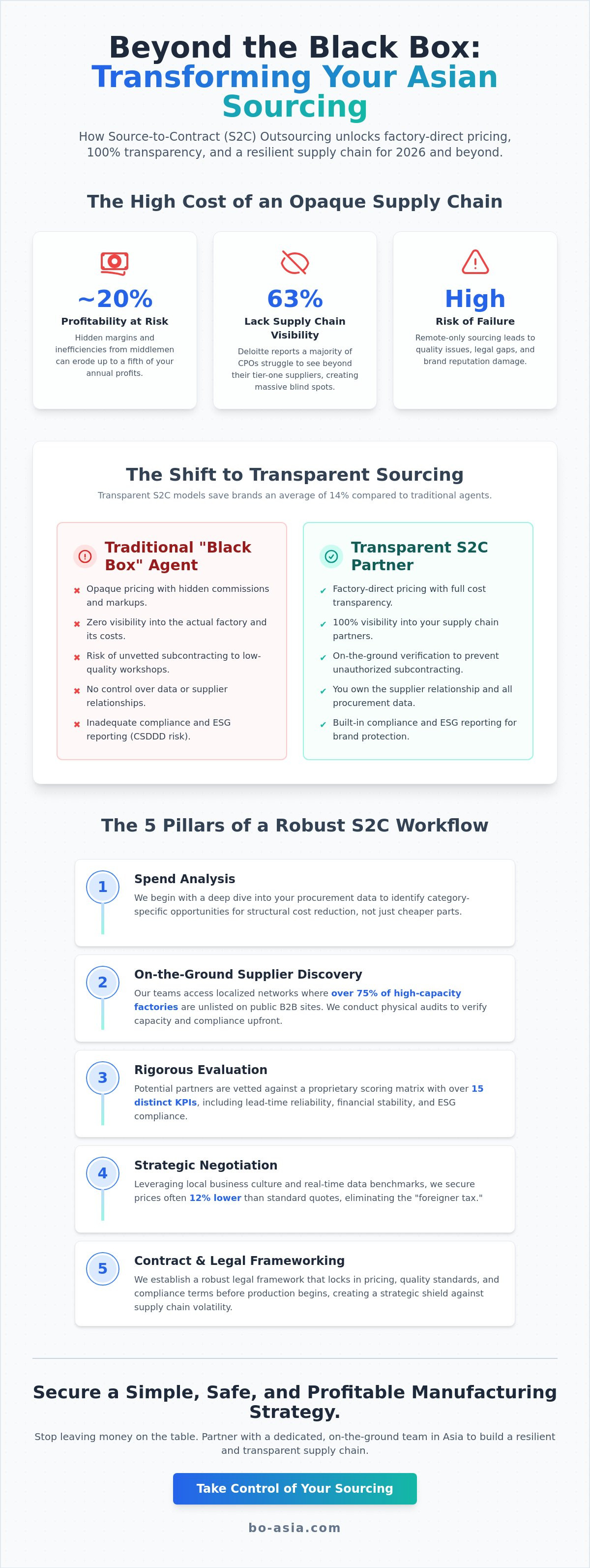
What if the hidden margins taken by your current middlemen are the only thing standing between your brand and a 20% increase in annual profitability? Many wholesalers realize too late that source to contract outsourcing isn't just about saving time; it's about reclaiming control over a supply chain that has become opaque and expensive. The 2024 Deloitte Global Chief Procurement Officer Survey highlights that 63% of leaders find visibility beyond their tier one suppliers to be a critical challenge. You likely feel the same pressure. You know that managing mass production from a different time zone leads to quality inconsistencies and legal gaps that put your reputation at risk.
It's a reality that the old way of remote sourcing is no longer enough to stay competitive. This guide will show you how to transform your operations by outsourcing the source-to-contract process to a dedicated, on-the-ground partner in Asia. You'll learn how to achieve factory-direct pricing, ensure 100% transparency, and significantly reduce your procurement cycle times. We'll explore the strategic framework that makes Asian procurement simple, safe and profitable heading into 2026.
• Understand how the upstream procurement phase sets the foundation for long-term cost-efficiency and rigorous quality control in your Asia supply chain.
• Master the five essential pillars of source to contract outsourcing to transform raw spend analysis into powerful, data-driven supplier negotiations.
• Identify the critical risks of "digital-only" vetting and why physical, on-site verification is the only way to avoid factory manipulation and hidden delays.
• Learn to evaluate your procurement categories and select a partner that acts as a dedicated on-the-ground team rather than an opaque middleman.
• Discover how to secure a simple, safe, and profitable manufacturing strategy by leveraging local expertise that eliminates hidden margins and protects your brand reputation.
Source to contract outsourcing represents the upstream segment of your procurement lifecycle. It's the disciplined process of identifying, evaluating, and securing the right manufacturing partners before production begins. While many managers conflate this with Source-to-Pay (S2P), the two are distinct. S2P handles the transactional flow of money, but source to contract outsourcing focuses on the strategic heavy lifting: category management, supplier qualification, and legal frameworking. It's the stage where you win or lose your profit margin.
This phase is the foundation for every downstream success. Without a robust Strategic Sourcing strategy, your quality control and cost-savings initiatives will fail. You can't fix a bad contract with good logistics. By 2026, the industry is moving away from the "black box" agent model toward transparent outsourcing. This shift ensures you own the relationship and the data, rather than being held hostage by a middleman's opaque markup.
Asia’s manufacturing landscape in 2026 requires more than just a software login. Digital platforms can't verify if a factory in Vietnam is subcontracting your order to an unvetted workshop next door. Genuine S2C outsourcing provides a physical presence to audit facilities and verify certifications in person. This on-site oversight is essential to eliminate the hidden margins that unvetted agents often bake into your unit price. A 2024 industry survey found that transparent procurement models saved brands an average of 14% compared to traditional commission-based agents. Source to contract outsourcing serves as a strategic shield against supply chain volatility by locking in pricing and compliance before a single dollar leaves your account.
The traditional agent model is often a "black box" where you have zero visibility into the actual factory cost. You pay a flat fee or a commission, but you don't know who is actually making your goods. The transparent S2C model flips this. You gain full visibility into the supply chain, which is now a legal requirement for European brands under the Corporate Sustainability Due Diligence Directive (CSDDD). This integration provides the ESG and compliance reporting you need to protect your brand's reputation. By moving toward a dedicated sourcing team, you stop leaving money on the table and start building a resilient, compliant network. Mastering End-to-End Sourcing and Procurement in Asia starts with choosing transparency over secrets.
Effective source to contract outsourcing isn't a simple checklist; it's a rigorous lifecycle designed to reclaim the 20 percent to 30 percent margin often lost to opaque middlemen and supply chain inefficiencies. In 2026, relying on digital storefronts is a high-risk strategy. Professional procurement requires a shift from superficial discovery to a data-driven, five-phase workflow that prioritizes safety and profitability. This structured approach moves beyond the frantic energy of remote sourcing and toward the steady confidence of an established expert presence.
The process begins by identifying category-specific opportunities for cost reduction through a deep dive into your current procurement data. We don't just look for cheaper parts; we look for structural savings. Finding the right partner means moving beyond Alibaba. Industry data suggests that over 75 percent of high-capacity factories in industrial hubs like Dongguan or Hai Phong don't advertise on public B2B platforms. They rely on established, localized networks. Our boots-on-the-ground teams conduct initial factory audits to verify capacity and compliance before a single dollar is committed. This physical presence is the only way to move from a potential lead to a vetted partner.
We use a proprietary scoring matrix to evaluate supplier performance across 15 distinct KPIs, including lead-time reliability and ESG compliance. Negotiation in Asia is a nuanced art. It requires respecting local business culture while aggressively protecting your interests. We use "Recent Wins" from our 2025 procurement data as a benchmark for factory-direct pricing, ensuring you don't pay the "foreigner tax." This approach allows us to secure prices that are often 12 percent lower than those offered to remote buyers. By negotiating directly with factory owners, we eliminate the hidden markups common with traditional agents and ensure total transparency.
A contract is only as strong as its enforceability. We ensure all agreements are legally binding in the appropriate local jurisdictions, often utilizing Hong Kong law for its international recognition or Mainland China courts for local leverage. We integrate Quality Control (QC) milestones directly into the legal agreement. Payments are tied to these specific milestones, preventing the scope creep or mid-production price hikes that plague unmanaged projects. This level of oversight ensures your supply chain remains simple, safe and profitable. Our dedicated sourcing team acts as your shield, managing the contract lifecycle to maintain professional rigor and stop you from leaving money on the table.
Many procurement leaders mistakenly believe that a robust SaaS subscription is enough to manage an Asian supply chain. This digital-first mindset creates a dangerous blind spot. While software excels at data aggregation, it cannot detect the nuances of a factory's operational reality. Digital profiles are easily manipulated; a supplier can present a polished online presence while operating out of a substandard facility that violates safety or environmental codes. You can't see a leaking roof or a lack of safety gear through a web portal.
Physical presence is mandatory for high-volume sourcing and custom tooling projects. When you invest in proprietary molds or complex components, you can't afford to rely on a "verified" status that was granted thousands of miles away. Local expertise acts as the final mile of digital procurement solutions, turning abstract data into verified facts. Our team serves as a shield against the reputational damage that stems from unmanaged, remote partnerships.
Relying solely on B2B platforms for source to contract outsourcing often leads to expensive failures. In 2024, a survey of enterprise procurement cycles found that 18% of projects sourced via remote platforms faced significant delays due to misrepresented production capacity. "Verified" badges on these sites are frequently just paid memberships or surface-level document checks that don't account for current factory conditions. A factory might have passed an audit two years ago, but today they could be subcontracting your order to an unvetted workshop down the street. Data is only as good as the physical inspection that validates it.
We combine the speed of digital tools with the security of a local team. Buying Office Asia uses on-the-ground staff to validate every claim made by potential suppliers during the source to contract outsourcing process. This creates a protective barrier against the "opaque middlemen" who often hide behind sophisticated websites. Our model provides the same level of oversight that large corporations enjoy, ensuring your supply chain remains resilient. Our hybrid approach focuses on:
We visit the site to confirm that the machinery and workforce match the digital RFP responses.
You get the true factory price without the hidden margins typical of traditional agents.
We identify potential bottlenecks before they impact your bottom line.
By integrating local oversight into your procurement strategy, you stop leaving money on the table. This methodology ensures your operations are simple, safe, and profitable. Understanding why local presence matters for global supply chain companies is the first step toward securing your 2026 production goals.
Implementing source to contract outsourcing isn't a simple hand-off. It's a strategic shift. You don't just outsource tasks; you outsource risk and complexity. Successful implementation starts with a cold assessment of your current supply chain. Identify categories where you lack transparency or where margins are slipping. These are your prime targets for the first phase of transition.
Most companies fail because they choose a generic outsourcer. These firms often operate from a distance, relying on digital portals rather than physical presence. A seasoned insider is different. They act as your boots on the ground, conducting on-site audits and managing factory relationships directly. Start with a pilot program. Select one product line and run a 90-day trial. This proves the model's ROI before you scale to your entire portfolio. It's a low-risk way to demonstrate that a dedicated team can outperform a remote agent.
Integration is the final hurdle. Your internal procurement department shouldn't feel threatened. Instead, position the outsourced team as an extension of their capabilities. The internal team sets the high-level strategy and compliance standards, while the outsourced partner handles the heavy lifting of supplier discovery, negotiation, and contract management. This synergy ensures that your strategy is actually executed on the factory floor.
The right partner acts as a trust bridge. European leadership combined with local Asian operations, like those at Buying Office Asia, provides the professional rigor you expect and the local access you need. Use this checklist to vet potential candidates:
Can they be at the factory in 24 hours to resolve a crisis?
Do they understand local contract law to protect your intellectual property?
Do they offer an open-book fee structure with no hidden kickbacks?
Ask potential partners direct questions about their factory relationships. If they accept commissions from suppliers, they aren't working for you. You need a partner who eliminates opaque middlemen and stops you from leaving money on the table.
Numbers don't lie. Track your progress with specific metrics to ensure the partnership delivers. A successful transition should yield a 12% to 15% reduction in total landed costs within the first 12 months. Monitor lead times, aiming for a 20% improvement as communication bottlenecks disappear. Quality is the ultimate metric. Your defect rate should stay below 1% if your partner is conducting proper pre-shipment inspections.
Don't ignore the hidden ROI. When your internal team stops chasing late shipments, they can focus on growth. This reduces burnout and lowers reputational risk. Once the pilot succeeds, scale by moving one category at a time until your entire procurement process is simple, safe and profitable.
Buying Office Asia acts as your dedicated on-the-ground team, not a middleman. We operate with a dual-presence model that sets us apart from traditional sourcing firms. Our Hong Kong headquarters provides direct access to Asian manufacturing hubs, while our Helsinki leadership office ensures Western business standards and strategic communication. This structure allows us to manage your source to contract outsourcing with the precision of an internal department. We protect your interests at every stage of the procurement cycle.
Our philosophy is built on three pillars: simple, safe, and profitable. We simplify the complexity of cross-border trade. We make your supply chain safe by implementing rigorous compliance checks. Finally, we ensure your operations are profitable by removing the inefficiencies that plague traditional sourcing models. By 2026, the global trade environment will demand this level of specialized oversight to maintain a competitive edge and avoid costly disruptions.
We eliminate hidden margins by providing 100% visibility into factory costs. Most traditional agents add secret markups that inflate your COGS by 12% to 18%. We reject this model. Instead, we offer a transparent fee structure that aligns our success with your savings. Our team manages the "Contract" phase of the source to contract outsourcing lifecycle to ensure long-term production stability. This includes negotiating fixed pricing agreements and strict penalty clauses for quality deviations or shipping delays.
On-site quality control is a non-negotiable component of our service. We don't trust remote reports or factory-provided samples. Our inspectors conduct physical audits during the production process to catch errors before they leave the port. This proactive approach prevents the reputational damage caused by defective goods. We manage the entire lifecycle so you can focus on scaling your brand while we handle the technical rigors of manufacturing.
The cost of inaction is high. Businesses that rely on unmanaged sourcing often lose up to 22% of their potential margin to hidden fees, quality issues, and logistics mismanagement. Strategic procurement is the only way to reclaim these profits. If your current process lacks transparency, you're leaving money on the table every month. It's time to move toward a more sophisticated, results-oriented model.
We invite you to book a discovery call to audit your current sourcing process. Our team will review your vendor contracts and identify immediate opportunities for cost reduction and risk mitigation. Don't let another production cycle pass with unmanaged risks. It's time to secure your bottom line with a partner who understands the local terrain. Consult with our Asia Procurement Team to start your transition to a professional procurement model today.
Success in 2026 requires more than just digital tools; it demands strategic rigor and physical presence. As global supply chains become more complex, relying on remote platforms or opaque middlemen is no longer a viable option. Source to contract outsourcing provides the framework you need to reclaim control over your margins and quality standards. By integrating on-site factory audits with professional price negotiations, you eliminate the risks that typically plague unmanaged production cycles. You don't have to navigate these complexities alone.
Buying Office Asia acts as your protective shield in the region. We are a European-managed firm with direct Hong Kong operations, ensuring 100% transparency with zero hidden margins. Our team conducts on-site audits and factory-direct negotiations to keep your operations simple, safe, and profitable. It’s time to move beyond the traditional agent model and secure the same level of oversight used by the world's largest corporations. Scale your production with a dedicated Asia Procurement Team and build a resilient supply chain that drives long-term growth.
S2C focuses on the strategic selection and legal formalization of supplier relationships, while S2P includes the subsequent transactional steps of purchasing and payment. Source to contract outsourcing concludes when a binding agreement is signed. S2P continues through the lifecycle of every individual purchase order and final invoice reconciliation. This distinction is vital for businesses that need to separate high-level strategy from daily clerical tasks.
Outsourcing provides you with an immediate on-site presence that eliminates the 15% to 20% efficiency loss caused by time zone gaps and language barriers. You gain 10 years of localized network intelligence without the high cost of maintaining a physical office in Asia. This approach allows your team to focus on sales while we act as your protective shield on the ground. It's the fastest way to professionalize your procurement.
It removes the opaque middlemen who often hide 10% markups within their "all-in" quotes. We negotiate directly with factory owners to break down bill-of-materials costs. This transparency ensures you aren't overpaying for raw materials. By using local market data from 2024, we secure pricing that reflects actual manufacturing costs rather than inflated export rates. You get the factory-direct price without the usual communication risks.
Source to contract outsourcing is designed specifically to give wholesalers and brand owners the same elite oversight that global corporations enjoy. You don't need a billion-dollar budget to benefit from professional risk mitigation. Small businesses use this model to scale safely, ensuring that 100% of their production meets international quality standards. It protects your bottom line from the 5% annual cost increases that unmanaged supply chains often face.
The greatest risks are unenforceable contract terms and the use of unauthorized sub-contractors for 30% of your order volume. Without a local expert to verify the official company chop, your contract might not hold up in a regional court. We mitigate this by conducting on-site audits and ensuring every clause is legally binding within the specific local jurisdiction. This stops you from being vulnerable to the "bait and switch" tactics of dishonest suppliers.
You ensure transparency by choosing a partner that rejects the traditional agent model and its hidden commissions. Demand a clear "open-book" policy where you see the original factory invoices and inspection photos. We provide real-time reporting and direct communication channels, so you're never left wondering about the true status of your supply chain. This approach eliminates the "black box" of traditional sourcing and keeps your interests at the center of every deal.
Yes, because our on-site teams verify that 100% of your suppliers adhere to the latest ESG regulations, such as the German Supply Chain Due Diligence Act. We don't just take the factory's word for it. We conduct physical inspections to confirm fair labor practices and waste management protocols. This protects your brand from the 40% loss in market value that often follows a public compliance scandal or an environmental violation.
Most clients realize a 12% to 18% reduction in total procurement costs during the first 12 months of implementation. This return on investment comes from lower defect rates, optimized shipping routes, and the elimination of hidden agent fees. By stabilizing your supply chain, you stop leaving money on the table and start building a simple, safe, and profitable manufacturing operation. It's a strategic move that pays for itself through increased operational efficiency.

What if the first clear sign of a production problem arrives after the goods are packed? Manufacturing risk management in Asia works best when controls are connected from the start, not left to a final inspection or occasional supplier update. You need visibility into factory activity, early warning...

What if the lowest unit quote isn’t the lowest-cost way to make your board game? Board game manufacturing costs depend on more than the number of boxes ordered. Component materials, custom tooling, assembly, packaging and delivery scope can all change what a quote covers, making headline prices diff...

What if the factory’s lowest quote isn’t the lowest-cost option? A lower unit price can hide differences in materials, tooling, packaging, quality checks or production terms. Understanding how sourcing agents negotiate factory prices starts with making those differences visible, not simply asking a...