


A factory quote is not a shipment plan. Sourcing products from China to USA involves more than finding a manufacturer and agreeing on a unit price. Unclear specifications, samples that differ from production, or overlooked packaging and freight details can put quality and commercial viability at risk.
If you’re comparing factories or working out what must be in place before a product reaches its U.S. destination, that caution is justified. A controlled procurement process sets decision points before you commit: define product requirements, assess supplier evidence, approve samples, check production, and coordinate delivery.
This checklist lays out that sequence in practical terms. It covers what to include in a product brief, how to compare manufacturers against the same requirements, and how to set sample, quality, packaging, and shipping checkpoints. It also explains how tooling, order quantities, and import responsibilities affect the plan. The goal isn’t to eliminate every risk. It’s to make key decisions visible, documented, and manageable before they become costly surprises.
• Turn your product brief into clear requirements before requesting quotes, so manufacturers price and plan against the same scope.
• Compare suppliers on more than unit price: tooling, order quantities, packaging, inspection scope, and logistics assumptions all affect viability.
• For sourcing products from China to USA, map quality checkpoints and delivery responsibilities before production begins.
• Use samples and documented acceptance criteria to reduce the risk of differences between approved prototypes and mass production.
• Decide whether your project needs a single inspection or coordinated support across supplier selection, production, and delivery.
Uncertainty about factory visibility, production quality, handoffs, and control is a practical concern, not a reason to abandon a viable product. Risk grows when decisions are split across separate conversations: the buyer approves a sample, production begins, and packaging or delivery details are settled later. A managed process connects those decisions and clarifies requirements and responsibilities before work moves to the next stage.
For a standard finished product, the key work may be identifying a suitable supplier, agreeing on the exact model and packaging, and coordinating production and delivery. A custom product adds development decisions. New tooling, materials, dimensions, decoration, or multiple components may require prototypes and additional approvals. Buying Office Asia’s sourcing and procurement support connects these steps while keeping commercial decisions with the buyer.
China-to-U.S. product sourcing is the coordinated process of defining product requirements, selecting and managing a supplier, overseeing production, and planning delivery to the U.S. It starts with a brief and supplier search, then moves through specifications, quotations, sample approval, production follow-up, quality checks, and logistics coordination.
The manufacturer makes the product. You retain commercial decisions, such as what to buy and on what terms, as well as your business’s import responsibilities. The Global Sourcing Overview describes the broader practice of sourcing across national borders. In practice, clear ownership between buyer and supplier helps prevent assumptions from filling gaps. Product category and intended use also shape the relevant requirements and checks. Promotional merchandise, a collectible, a toy, and an electrical product shouldn’t be treated as interchangeable simply because each is made to order.
Vague requirements leave room for different interpretations. “Premium finish” doesn’t specify a surface treatment, and “complete set” doesn’t define component count, assembly, or packaging. Without those details in writing, a supplier may deliver something that matches its understanding but not your intended product.
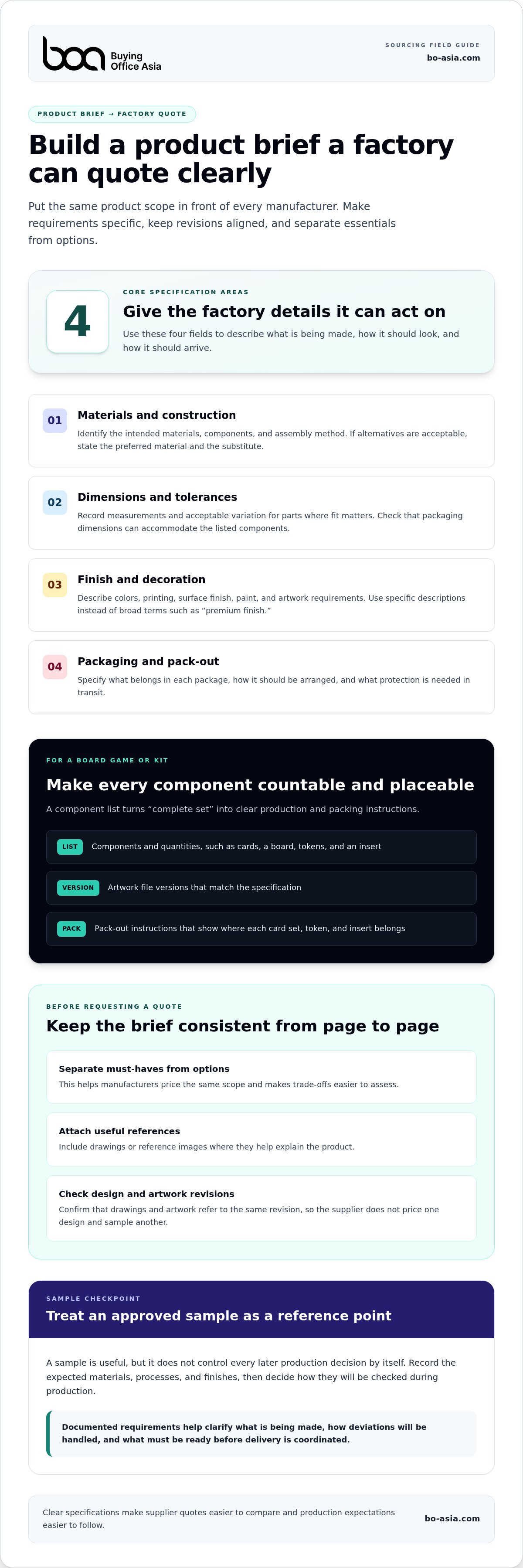
Approving a sample remotely is useful, but the sample is a reference point, not control over every later production decision. Materials, processes, or finishes may not carry through consistently unless expectations are recorded and production is followed up. For example, a board game may include cards, a board, tokens, and an insert. A change to one component’s size or material can affect fit inside the box, assembly, or the finished presentation.
Set clear requirements for materials, dimensions, tolerances, finishes, components, and packaging, then decide how they’ll be checked during production. For products involving age grading, small parts, licensed artwork, food contact, or electrical functions, determine relevant requirements based on intended use and destination rather than assuming one universal rule. This gives your team a clearer view of what is being made, how deviations will be handled, and what must be ready before delivery is coordinated.
A clear brief turns a product idea into something a factory can quote, sample, and make consistently. For sourcing products from China to USA, document decisions instead of relying on informal descriptions or a sample photo alone. The level of detail should match the project: a standard finished item may need a confirmed model and packaging requirements, while a custom product may call for drawings, development samples, and tooling decisions.
Start with must-haves and list optional features separately. This helps manufacturers price the same scope and makes trade-offs easier to assess. Include drawings or reference images where useful, and specify:
Identify the intended material, components, and assembly method.
Record measurements and acceptable variation for parts where fit matters.
Describe colors, printing, surface finish, and paint or artwork requirements.
State what belongs in each package, how it should be arranged, and what protection is needed in transit.
For a board game or kit, add a component list with quantities, artwork file versions, and pack-out instructions. Define where each card set, token, and insert belongs in the specification. Identify essential features and acceptable alternatives, such as a preferred material and a substitute. This lets the supplier propose options without silently changing the product.
Before requesting a quote, check that the specification is internally consistent. Confirm that the packaging dimensions accommodate the listed components and that drawings and artwork refer to the same revision. Clear version control reduces the chance that a supplier prices one design and samples another.
Samples serve different purposes, and a project may not need every type. A prototype helps assess form, fit, or concept while the design is still developing. A pre-production sample demonstrates the proposed materials and production method. An approved reference sample records the agreed appearance and construction for production follow-up. Document what has been approved and any remaining changes. Approval of a sample alone doesn’t establish that every mass-produced unit will match.
Some custom products require tooling, such as a mould for an injection-moulded part. Treat tooling as a separate project decision: development has upfront implications, while the production process may affect unit cost. Compare the tooling scope and production assumptions before authorizing it.
Keep client files controlled. For licensed artwork, identify the approved version, limit access to files needed for production, and record approval before releasing artwork for manufacture.
• Issue the dated specification and have the supplier quote against that version.
• Review the sample against the requirements and document requested changes.
• Approve the production reference and tooling direction before authorizing mass production.
• Keep product approval separate from export and import planning. For China-side customs information, consult China Customs Regulations from Trade.gov.
For support turning a brief into a sample and production plan, discuss your product development requirements.
A low unit price tells you only one part of what a project may cost. To compare sourcing products from China to USA fairly, first confirm that every supplier is quoting against the same specification, order quantity, packaging, and service scope. Otherwise, a lower offer may simply exclude work another supplier has included.
Look for evidence that a supplier can make your product as specified, not just a general claim that it can. Review relevant process experience, equipment or production arrangements, quality controls, communication, and its approach to managing changes. A trading company may coordinate production through factories, while direct factory engagement may provide another route to production information. Neither relationship is automatically right or wrong. Assess who is responsible for decisions, updates, and corrective action. BOA’s supplier identification and vetting supports evidence-based supplier assessment.
Ask each candidate to respond to the same brief. Compare what each can demonstrate, the assumptions it has made, and what remains outside its offer. A quote that doesn’t identify the specification version, quantity basis, or exclusions isn’t ready for a fair comparison.
Use a comparison table to expose gaps before choosing an offer. Keep unknowns visible rather than treating them as included.
| Scope item | What to compare |
|---|---|
| Unit price | Specified product, quantity basis, and quoted production scope |
| Tooling | Whether required, its scope, and how it is charged |
| Minimum order quantity | Required volume and any price differences by quantity |
| Packaging | Included components, print or finish, and pack-out scope |
| Inspection | Checkpoints, inspection scope, and any excluded tests |
| Logistics | Shipment method assumptions, freight, insurance, and delivery responsibilities |
Then build a project-cost view that separates the product quote from tooling, samples, packaging, inspection, freight, insurance, and import charges. Total landed cost depends on the product, contract, shipment, classification, and current trade requirements. Verify relevant trade measures and import requirements using current U.S. primary sources, such as U.S. Customs and Border Protection and the U.S. International Trade Commission. Don’t rely on an old quote or an unverified assumption.
Order volume changes the economics. A minimum order quantity can leave you holding more stock than planned, while multiple components or assembly steps can add cost and coordination needs. Tooling may create an upfront project expense while affecting unit price, so compare options against the expected production plan rather than focusing on one line item.
Use the comparison to identify unanswered questions and align the commercial scope before committing. Discuss your sourcing requirements if you need support assessing suppliers, quotes, and procurement assumptions.
Quality and delivery control depend on decisions made before goods leave the factory. For sourcing products from China to USA, set inspection criteria, assign responsibilities, and identify import questions early. This gives your team time to address a production deviation or documentation gap before it becomes a shipment delay.
Use the approved reference and written specification to define what passes, what fails, and how findings will be recorded. A sampling inspection checks selected units against agreed criteria. It provides a snapshot, not a guarantee that every unit is defect-free. A standalone inspection can identify issues at a defined stage; ongoing production follow-up adds supplier coordination and corrective-action tracking.
Use a staged checklist:
Confirm the approved reference, current artwork, materials, component list, tolerances, and packaging instructions are available to the factory.
Review production against agreed criteria, including dimensions, paint or decoration consistency, assembly, and emerging deviations. Record findings with clear photographs and identify affected components or batches where possible.
Check the agreed inspection scope, defect categories, sample selection, packaging, labeling, and order quantities. State the acceptance criteria in advance, including how critical, major, and minor defects are classified for the project.
Document each issue, assign a responsible party, agree on a remedy, and review evidence that the action was completed before the next production or shipment decision.
AQL-based sampling can help structure an inspection plan, but it doesn’t establish the condition of every unit. Reporting should state the inspection date and location, scope, method, sample reviewed, findings, photographs, and recommended action. BOA provides standalone inspections that can start from one inspector-day, with same-day reporting. Product scope, factory access, inspection location, sampling or tests, and timing are part of planning the booking.
Match product checks to what the item is and how it will be used. Promotional merchandise, toys, collectibles, food-contact goods, and electrical products can involve different considerations. Intended use, age group, product design, and destination all matter. Check applicable U.S. requirements with the relevant official regulator, such as the Consumer Product Safety Commission business guidance. Don’t assume a category is exempt or that one test or approval applies universally.
Before dispatch, identify who is responsible for product classification, country-of-origin information, shipping documents, and import-related decisions. Requirements can vary with the product and transaction. Use U.S. Customs and Border Protection’s import guidance and the U.S. International Trade Commission tariff search as primary-source starting points, then verify current requirements for the shipment.
Build a handoff plan around cargo readiness, document review, consolidation decisions, carrier coordination, and the receiving location. Consolidating goods may change shipment planning; separate shipments may create different arrival and receiving tasks. Account for those dependencies without treating a carrier estimate as a guaranteed delivery date. Clear owners for each handoff help keep factory release, freight coordination, and U.S. receipt aligned.
For coordinated production checks and delivery planning, discuss your quality and logistics coordination needs.
Your internal team may already own product design, budgets, and market decisions. A sourcing partner can add practical capacity where supplier communication, production decisions, and delivery coordination require regular attention in Asia. Buying Office Asia is headquartered in Hong Kong, with European leadership based in Helsinki. It supports international companies with sourcing and procurement while keeping project decisions and commercial priorities aligned with the buyer’s team.
The right support depends on where your project has a gap. A first-time supplier relationship may call for help assessing factory capability and communication. A product still in development may need sample coordination and clear approvals. An established production process may instead need defined quality checks or help coordinating shipping arrangements. Match support to the decisions your team needs to manage rather than adding steps that don’t address a real risk.
Buying Office Asia connects supplier vetting, product development and sampling, production oversight, inspections, and logistics coordination according to project needs. Its sourcing and procurement service supports the buyer’s team across related stages, helping maintain consistent requirements as work moves between supplier selection, production, and delivery planning.
A standalone inspection may fit when your team has already managed supplier selection and production and needs an assessment at a particular stage. For a broader project, coordinating supplier communication, sample decisions, production follow-up, and quality checks can help keep changes and responsibilities visible. The choice depends on what your team already covers internally and where it needs more oversight.
Custom merchandise may involve printed components, decorative finishes, and packaging that must align with approved artwork. A board game may involve many pieces with specific assembly and pack-out needs. These examples show why support should reflect the actual production process, not just a generic checklist. BOA can help coordinate relevant requirements while your business retains product and commercial decisions.
A focused project brief helps establish scope and priorities. Bring the information your team already has and identify what remains undecided:
Provide the specification, drawings or reference images, target quantities, and known materials or processes.
Note sample requirements, tooling considerations, approvals completed, and open design decisions.
Identify the current artwork version, approval status, file-handling needs, and intended U.S. use.
Share the receiving destination, known shipping assumptions, and handoffs your team needs to coordinate.
If you need an inspection, define the product scope, factory access, inspection location, sampling or tests, and timing. These details make the assignment specific and help align the report with your decision needs. For wider procurement support, identify which tasks your team wants coordinated and which decisions remain under its control.
Discuss your China-to-U.S. sourcing project to identify a practical scope for your product, supplier, and delivery needs.
Turn open questions into decisions with clear owners. Before committing, identify what your team still needs to resolve, whether that’s a product requirement, supplier evidence, an approval point, or a delivery handoff. This keeps sourcing products from China to USA tied to your commercial priorities instead of letting a quote or production schedule drive decisions by default.
You don’t need every detail settled before starting a discussion. A product brief, current quantity assumptions, known constraints, and a short list of uncertainties can establish a practical starting point. From there, decide whether the immediate need is a defined inspection or coordinated support across more of the procurement process.
Discuss your China-to-U.S. sourcing requirements to identify the next decisions for your project and a practical scope for support.
Define the product’s intended use, target customer, and who can approve design or commercial changes. Rank priorities such as appearance, durability, and target selling price so the team can resolve trade-offs consistently. If a decorative feature conflicts with a production constraint, for example, a clear priority order helps you decide whether to revise the design or adjust another requirement before development proceeds.
There’s no dependable universal figure. For a useful budget, ask for a dated estimate and identify assumptions that could change, such as order volume, currency, quote validity, payment milestones, and excluded services. You can model different order quantities or design options internally without treating an early estimate as a final commitment. Verify current import charges and trade measures for the specific goods through authoritative U.S. sources.
There isn’t one timeline that fits every product. Start with your required arrival window, then work backward with the parties responsible for development, production, and transport. Set internal deadlines for decisions and approvals too, since supplier progress can depend on timely buyer input. Ask for milestone dates and update the plan when a decision slips. Don’t treat an initial schedule or carrier estimate as a guaranteed arrival date.
The answer depends on the transaction and shipping arrangements, so make the responsible party explicit in your purchase and logistics documentation. Check that the named party and shipment instructions are consistent across the records used by the supplier and logistics parties. Don’t assume another party has accepted the role. For current import guidance, consult U.S. Customs and Border Protection or qualified trade counsel.
Document requirements vary, so prepare a record set for the specific product and transaction rather than relying on a generic checklist. Maintain a document register showing each record’s owner, current version, and status. Before dispatch, reconcile product descriptions and quantities across the relevant records. A consistent file also helps your team answer questions about what was ordered, approved, and shipped if a discrepancy arises later.
No inspection can establish the condition of every unit unless every unit is assessed, and an inspection report shouldn’t be treated as an automatic release decision. Before inspection, agree who reviews findings and who can authorize a hold, rework, or other disposition under the purchase terms. This avoids confusion if the report identifies a serious issue close to shipment and keeps the decision with the responsible commercial parties.
Yes. A standalone inspection can suit a business that already manages its supplier relationship and needs a defined assessment for a particular order. To make the result useful, give the inspection team the current acceptance criteria and identify who will review findings and decide what happens next. If your team also needs help managing supplier communication or follow-up actions, consider whether a wider scope would better support the project.

Trade Assurance can help protect a transaction, but it can’t prevent a delayed or defective order from disrupting your production schedule. When a claim doesn’t resolve the problem as expected, you still need to manage cash flow, customer commitments, and the next steps in your supply chain.If you’r...

A supplier listing is a lead, not proof that a factory can deliver. If you’re wondering how to find suppliers not on Alibaba, the answer isn’t simply to switch platforms. You need a repeatable process to identify manufacturers, distinguish factories from trading companies, and check whether each sup...

A supplier update that isn’t tied to an owner, a decision, and a next action can create more uncertainty than it removes. If you’re figuring out how to improve communication with your supplier, the answer isn’t simply to send more messages. It’s to make each exchange clear, accountable, and useful f...