


A digital dashboard and a signed contract don't equal control; they often just provide a false sense of security while your margins bleed through hidden middleman markups. As we move through 2026, relying on sourcing agents who obscure factory identities and inflate unit costs is no longer a viable business model. You've likely felt the sting of quality inconsistencies during mass production or the frustration of having zero real-time visibility into factory operations. Implementing modern supplier management best practices requires moving beyond transactional interactions and toward a model of radical transparency and physical proximity.
We understand that your supply chain should be a source of strength, not a constant drain on your resources. This strategic guide provides a roadmap to mastering Asian procurement by eliminating intermediaries and securing factory-direct pricing. You'll learn how to establish predictable quality standards through on-site inspections and how to bridge the intent-capability gap in AI deployment. With the U.S. Federal interest rate holding steady between 3.50% and 3.75%, protecting your financial health through operational efficiency is critical. This briefing gives you the framework to build a resilient, high-volume supply chain that functions as a genuine competitive advantage.
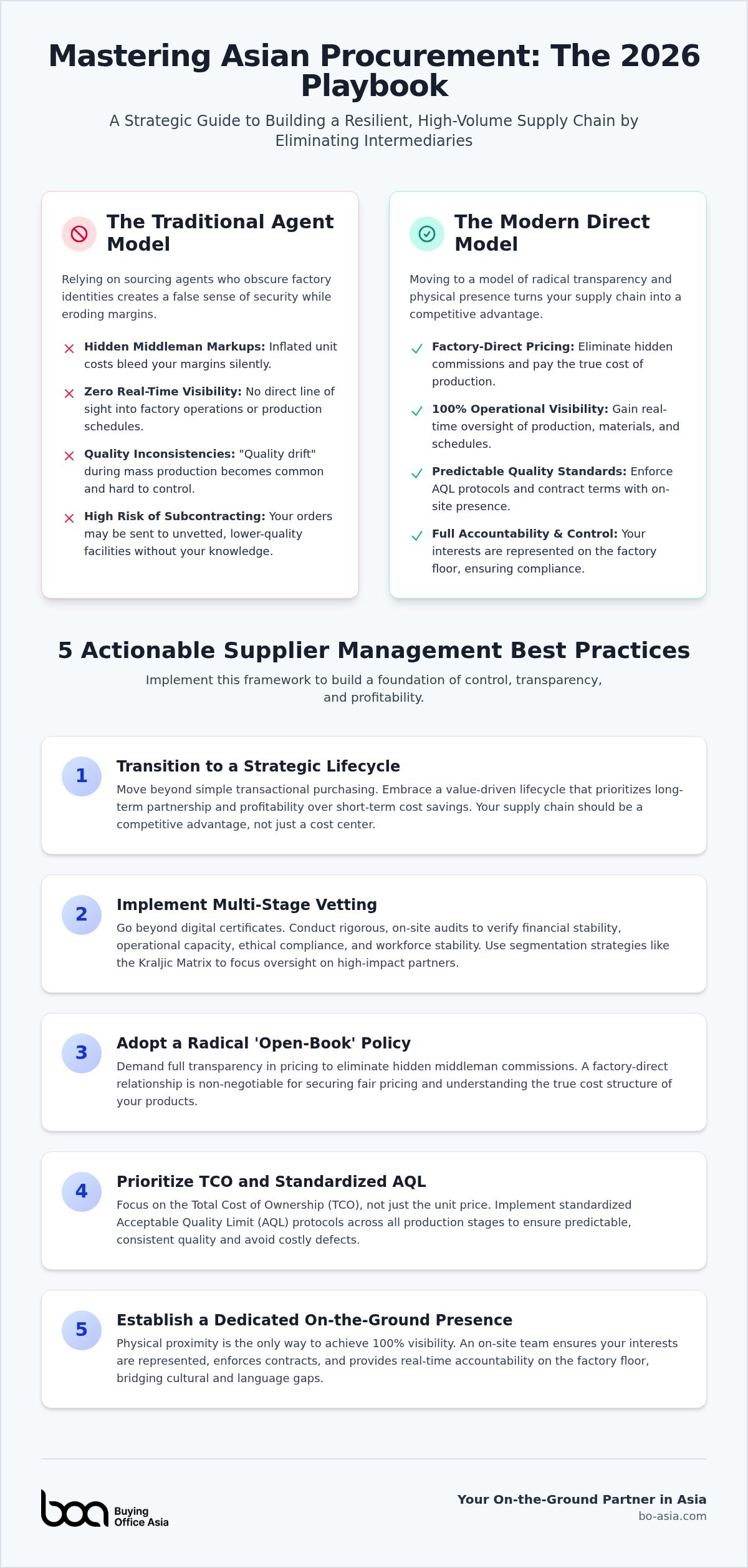
• Learn how to transition from transactional purchasing to a strategic value-driven lifecycle that secures your long-term profitability.
• Implement multi-stage vetting and segmentation strategies to mitigate operational risks and identify high-impact manufacturing partners.
• Master supplier management best practices by adopting a radical open-book policy that eliminates hidden middleman commissions.
• Prioritize Total Cost of Ownership (TCO) and standardized AQL protocols to ensure predictable quality standards across all production stages.
• Discover why a dedicated, on-the-ground presence in Asia is the only way to achieve 100% visibility into your factory operations.
Supplier management is often misunderstood as the simple act of placing orders and receiving goods. It represents a comprehensive strategic lifecycle that begins long before a contract is signed and continues through every production cycle. Effective Supplier relationship management moves beyond the narrow focus of "purchasing" to prioritize long-term value creation. Your supply chain shouldn't just be a cost center. It must function as a competitive advantage that protects your brand and your capital.
Managing manufacturers across borders, specifically in Asia, requires a significantly more rigorous framework than local sourcing. Cultural nuances, language barriers, and physical distance create natural blind spots that opportunistic intermediaries often exploit. True supplier management best practices rely on radical transparency and a physical presence that ensures your interests are represented on the factory floor. This shift from transactional buying to integrated partnership is essential for businesses looking to scale without losing control over their operational integrity.
Sourcing is the act of identifying a partner, but management is the discipline of ensuring they perform over time. Many businesses successfully find a factory only to watch their margins disappear as production begins. Without active oversight, suppliers often succumb to "quality drift." This happens when standards slowly erode as factories look for ways to offset their own rising costs or material price fluctuations. Quality drift is a quiet profit killer. In 2026, disciplined supplier management serves as the singular bridge between theoretical profit projections and actual realized margins.
Leaving an Asian supply chain unmanaged exposes your business to severe risks that can derail your growth. These include intellectual property theft, unauthorized subcontracting to lower-tier facilities, and regulatory non-compliance. When you lack direct visibility, you often pay a "middleman markup" hidden within opaque quotes from agents who don't actually own the production assets. You can learn more about professionalizing these processes in our guide on Mastering Sourcing and Procurement in Asia. By eliminating these layers, you reclaim control over your financial health and ensure that every dollar spent contributes directly to product quality.
Real-time oversight of production schedules and material sourcing.
On-the-ground presence to enforce contract terms and quality standards.
Direct factory pricing without the "hidden taxes" of traditional agents.
A robust supply chain begins with a foundation of uncompromising vetting. You can't rely on digital certifications alone; a PDF of an ISO 9001 certificate doesn't tell you if a factory is subcontracting your order to an unvetted facility down the street. Implementing supplier management best practices requires a multi-stage audit process that covers financial stability, operational capacity, and ethical compliance. We utilize the Kraljic Matrix to segment partners based on their impact on your profit and the level of supply risk they present. This allows you to focus your oversight where it matters most, ensuring your high-value components aren't left to chance.
Factory-direct relationships must be your non-negotiable standard. Middlemen often hide their lack of control behind a wall of vague promises. By vetting for direct ownership, you secure the pricing transparency and operational visibility necessary for long-term success. Adopting these supplier management best practices ensures your procurement strategy remains resilient against market volatility.
Physical presence is the only way to verify a facility's health. During an on-site audit, we look for workforce stability and machinery maintenance schedules. High employee turnover is a leading indicator of upcoming quality failures. You should also watch for red flags like blocked fire exits or poor raw material storage, which suggest a lack of discipline that will eventually manifest in your products. Our approach to Supplier Vetting in Asia prioritizes these tangible indicators over paperwork.
Not every vendor requires the same level of management. Strategic partners, those providing unique or high-impact goods, need deep integration and frequent communication. Transactional vendors can be managed with more automated protocols. In 2026, over-reliance on a single supplier is a critical risk. You should diversify your base while maintaining a clear path for high-performers to move from "Trial" to "Preferred" status. This transition should be based on documented performance data. If you're ready to professionalize your vetting process, you can speak with our regional experts to secure your production lines.
Establishing this level of clarity isn't possible through emails alone. Physical proximity is the only way to verify financial claims and ensure your capital is being used efficiently. By integrating Factory Direct Price Negotiations into your standard operating procedures, you eliminate the layers of obscured costs that traditional intermediaries rely on. This proactive approach ensures your pricing remains competitive and your supply chain stays resilient.
There's a fundamental difference between a traditional sourcing agent and a dedicated buying office. Sourcing agents often operate on a transactional basis, sometimes collecting undisclosed kickbacks from factories that inflate your costs. A buying office functions as an integrated extension of your own team. This direct relationship improves communication speed and ensures technical specifications aren't "lost in translation" by a third party. You can see the tangible impact of this model in our documented Savings Examples, which highlight the financial benefits of direct factory engagement over indirect sourcing methods.
Relying on "estimated ship dates" is a recipe for logistical failure. Modern supplier management best practices demand milestone-based production tracking. This involves verifying that raw materials have arrived, tooling is complete, and mass production has actually commenced. Utilizing on-site quality control provides the objective data you need to make informed decisions. Transparency serves as a critical risk mitigation tool by identifying potential delays or quality failures before they become expensive, irreversible problems. When your team is physically present on the factory floor, "surprises" are replaced by predictable, manageable outcomes.
Executing supplier management best practices requires a shift from passive observation to active operational control. You shouldn't evaluate a partner based on unit price alone. Instead, you must measure the Total Cost of Ownership (TCO). This calculation includes the hidden expenses of logistics, the financial impact of quality failures, and the cost of capital tied up in extended lead times. Standardizing Quality Inspection Protocols using precise Acceptable Quality Levels (AQL) ensures that every partner understands your threshold for excellence before the first machine starts.
Implementing a Continuous Improvement Program (CIP) transforms your manufacturers from mere vendors into high-performing assets. By investing in their operational development, you secure better yields and more predictable outcomes over long production runs. Success also hinges on a formal communication cadence that includes local-language support. This bridges the gap between your international headquarters and the factory floor, ensuring that technical nuances are never lost in translation. These actions protect your margins and insulate your brand from the volatility of unmanaged sourcing.
Data drives accountability in a professional procurement environment. You should track On-Time In-Full (OTIF) rates, defect percentages, and lead time variability with clinical precision. These metrics form the objective backbone of your Quarterly Business Reviews (QBRs). Instead of relying on gut feelings, use this performance data to reward high-performing factories with increased order allocations. This creates a meritocratic supply chain where the best partners are incentivized to maintain your standards while underperformers are systematically phased out.
The 2026 landscape has made ESG and Sustainability a core commercial requirement. Regulatory shifts in carbon reporting and international labor standards mean that ethical audits are now a necessity for market access. Protecting your brand reputation requires a physical presence to verify that factories comply with these evolving standards in real time. Documentation is not enough; you need on-the-ground verification to ensure your supply chain remains resilient and compliant. If you're ready to implement these supplier management best practices and secure your production lines, reach out to our regional experts for a comprehensive strategy briefing.
Managing a high-volume supply chain in Asia from a western headquarters presents inherent limitations. Time zone differences, language barriers, and cultural nuances create a friction that digital tools cannot resolve. While software provides data, it doesn't provide the physical leverage needed to resolve production bottlenecks or enforce contract terms. Transitioning to a professionalized buying office model is the natural evolution for businesses that have outgrown unmanaged sourcing. By establishing a Dedicated Asia Procurement Team, you gain an integrated extension of your own staff that operates with your specific financial interests in mind.
This model fundamentally differs from traditional third-party agencies. A dedicated team offers the speed and technical expertise required to navigate complex regional networks without the hidden agendas of commission-based agents. Implementing supplier management best practices at this level ensures that your team is physically present to vet factories, negotiate directly with owners, and oversee mass production. This proximity builds a foundation of trust and accountability that is impossible to replicate remotely.
The financial argument for a regional partner is clear when you calculate the true cost of oversight. Frequent international travel, lost time, and the expense of managing quality failures from afar quickly exceed the cost of a permanent regional presence. You can explore the detailed metrics in our sibling guide on The ROI of a Dedicated Asia Procurement Team. Beyond the hard numbers, having a seasoned insider on the ground significantly reduces the "anxiety gap" often associated with international manufacturing. You no longer have to wonder if production is on schedule; you have objective, real-time verification.
Moving toward a more sophisticated model begins with a critical audit of your current supplier base. Identify where hidden middlemen may be inflating your costs and obstructing your visibility. Once these vulnerabilities are identified, you can request a formal Sourcing and Procurement assessment to map out a more transparent path forward. Professionalizing your supply chain isn't just about cost savings; it's about securing your operational future. If you're ready to modernize your approach and adopt advanced supplier management best practices, you can Contact Buying Office Asia to discuss a tailored 2026 procurement strategy that aligns with your growth objectives.
Mastering supplier management best practices is no longer just an operational goal; it's a financial necessity in a volatile global market. By prioritizing radical transparency and eliminating the obscured costs of intermediaries, you reclaim direct control over your manufacturing ROI. Success in 2026 demands more than digital oversight. It requires a physical presence that bridges the gap between your high-level strategy and the daily realities of the factory floor. This transition from transactional buying to strategic partnership is what separates market leaders from those struggling with quality drift.
Our European-managed leadership, rooted in Finland with a central operational hub in Hong Kong, provides the on-the-ground accountability your business deserves. We operate with 100% transparency and zero hidden middleman fees, ensuring that your capital is always protected and your quality standards are never compromised. This hands-on approach transforms your supply chain from a source of anxiety into a stabilized, competitive asset. It's time to move beyond the limitations of unmanaged sourcing and build a legacy of operational excellence.
Transform your Asia supply chain with a dedicated procurement team.
Take the first step toward a more resilient and profitable future today. Your team in Asia is ready to execute.
Strategic sourcing is the process of finding and vetting the right partners, whereas supplier management is the ongoing oversight of those relationships. One is a transaction; the other's a lifecycle. In the modern economy, sourcing without a management framework leads to quality drift and margin erosion. You need a system that monitors performance long after the contract's signed. This ensures the strategic advantages identified during sourcing are maintained throughout every production run.
Performance measurement relies on objective data points like On-Time In-Full (OTIF) rates, defect percentages, and lead time variability. These metrics should be tracked in real-time and reviewed during formal quarterly sessions. Avoid vague assessments that rely on supplier self-reporting. A standardized scorecard allows you to compare partners across different regions. By basing your future order allocations on documented performance, you create a meritocratic supply chain that rewards excellence and phases out underperforming vendors.
Intellectual property theft and unauthorized subcontracting remain the most significant threats. When a factory moves production to a lower-tier facility without your knowledge, quality standards inevitably collapse. Hidden middleman markups also pose a financial risk, quietly eroding your manufacturing ROI. Cultural nuances and language barriers can further obscure these operational failures. Implementing supplier management best practices involves identifying these risks early through rigorous vetting and maintaining a constant on-the-ground presence to ensure your contract terms are enforced.
Transparency is secured by implementing an "Open Book" policy and engaging in direct negotiations with factory owners. You must demand visibility into the cost of raw materials and the specific margins the factory earns. Traditional sourcing agents often hide their fees within your unit price, which makes it impossible to calculate your true ROI. By removing these intermediaries and verifying financial claims through on-site audits, you'll ensure your capital's used efficiently and your pricing remains competitive.
Physical inspections are the only way to obtain objective data regarding your production status. Digital reports can be easily sanitized, but on-site quality control identifies defects at the source before they become expensive, irreversible issues. This best practice involves checking raw materials and monitoring various production stages in person. It ensures your Acceptable Quality Levels (AQL) are strictly enforced. In a high-volume environment, this level of oversight is your best defense against quality drift and shipping delays.
A dedicated team improves ROI by acting as your eyes and ears on the ground, securing factory-direct pricing without hidden commissions. They eliminate the communication delays that plague remote management, ensuring that technical specifications are followed precisely. By preventing quality failures and optimizing lead times, they reduce the total cost of ownership for every SKU. This model provides the same level of oversight usually reserved for major enterprises, allowing you to scale your operations with confidence and financial security.
In 2026, you should expect comprehensive data on carbon emissions, waste reduction, and fair labor practices. Ethical compliance is now a mandatory requirement for market access, driven by both consumer demand and strict regulatory frameworks. Suppliers must demonstrate they aren't just meeting local laws but adhering to global ESG benchmarks. Integrating these criteria into your supplier management best practices protects your brand reputation. This verification requires physical audits to ensure your supply chain remains resilient and ethical.
Software provides a useful framework for tracking milestones, but it can't replace the physical reality of a factory floor. Digital tools rely on data input, which can be manipulated by a supplier looking to hide delays or quality issues. An ERP system won't see a broken machine or an unsafe work environment. True supplier management requires a human presence on the factory floor to ensure the data in your software matches the reality of your production.

What if your signed OEM agreement protects the product on paper but leaves the factory unclear about what to make, when to deliver it, or how quality will be judged? That gap is where an oem manufacturing agreement china project can lose control: responsibilities blur between buyer, sourcing interme...

What if the safest payment deal isn’t the one that delays the most cash, but the one that releases it only when progress is verifiable? Payment terms negotiation with Asian suppliers is about balancing your working capital with the supplier’s need for confidence, not simply pushing for a smaller dep...

What if your biggest supply chain risk isn’t the supplier you chose, but what you can’t see after the order is placed? Asia procurement services can connect supplier selection with factory follow-through, giving you clearer visibility into production, product quality, and responsibilities along the...