


By July 19, 2026, the EU's Ecodesign for Sustainable Products Regulation will officially ban the destruction of unsold clothing and footwear, transforming circularity from a marketing choice into a strict legal mandate. You likely recognize that relying on opaque middlemen and unverified digital certificates is the single greatest threat to your brand's longevity. These hidden layers often mask the very labor or environmental scandals that trigger massive reputational damage and production delays. Achieving genuine sustainable sourcing in Asia is a physical, on-site reality that simply cannot be managed through a computer screen.
We understand the complexity of navigating India’s BRSR Core requirements and Thailand’s new 2026 human rights due diligence laws. This article delivers a comprehensive, on-the-ground checklist to ensure your supply chain meets these global ESG standards without sacrificing your profitability. You'll gain a clear framework for vetting suppliers directly, reducing your operational risk, and implementing the "simple, safe and profitable" model that keeps your business secure. We'll show you how to move beyond the traditional agent model to build a procurement strategy that prioritizes transparency and direct factory oversight.
• Master the regulatory shifts of 2026, including the Corporate Sustainability Due Diligence Directive, to ensure your business remains compliant and competitive.
• Eliminate the "hidden margins" of traditional agents by uncovering how opaque supply chains mask ethical violations and inflate your procurement costs.
• Implement a rigorous sustainable sourcing framework that prioritizes on-site reality over easily manipulated digital certificates.
• Follow our practical 2026 checklist to verify factory legal standing and environmental performance directly on the production floor.
• Transition to a transparent, factory-direct model that protects your brand from reputational damage while improving your bottom line.
The manufacturing world is undergoing a tectonic shift. In 2026, Sustainable sourcing is no longer a PR exercise; it's a core operational requirement for any brand manufacturing in Asia. The European Union’s Corporate Sustainability Due Diligence Directive (CS3D) has fundamentally altered the landscape. This regulation mandates that companies with over 1,000 employees and a turnover exceeding €450 million identify and mitigate adverse human rights and environmental impacts within their global value chains. While the first reporting phase begins in 2027, 2026 is the critical implementation year where your procurement data must be flawless. If your data is missing, your access to the European market is at risk.
Transitioning from voluntary initiatives to legal mandates creates a new reality for wholesalers and brand owners. If your supply chain remains opaque, you're leaving money on the table through hidden risks and operational inefficiencies. Sustainable practices don't just protect the planet; they stabilize your costs. By optimizing energy use and reducing material waste, factory-direct partners often achieve higher efficiency than those operating in the shadows. We view sustainable sourcing as a stabilizing force that eliminates the frantic energy of reactive procurement and replaces it with the steady confidence of an established expert.
To build a resilient supply chain, you must address three distinct areas. Environmental factors focus on carbon footprints, wastewater management in textile hubs, and raw material traceability. Social pillars ensure fair wages and safe working conditions, specifically targeting the eradication of forced labor in second and third-tier suppliers. Finally, governance demands anti-corruption measures and ethical, factory-direct negotiations. Our approach at Buying Office Asia ensures these pillars are integrated into your procurement from the start. This structured oversight prevents the production delays that plague unmanaged supply chains.
Digital certificates like ISO or SA8000 are often used as shields by traditional agents to hide factory flaws. These "paper-only" compliance documents are easily manipulated in complex Asian markets where middlemen thrive on secrecy. Real transparency requires on-site verification to ensure the factory named on the certificate is the one actually producing your goods. Many businesses discover too late that their primary supplier has outsourced production to an unvetted, sub-standard facility. For ethical brands, sustainable sourcing is a comprehensive risk-mitigation strategy designed to shield your business from the legal and reputational fallout of non-compliance in 2026.
Traditional sourcing agents often operate as a black box. They intentionally hide factory identities to protect their hidden margins, ensuring you remain dependent on their services. From the perspective of a seasoned insider, this lack of transparency is the single greatest obstacle to sustainable sourcing. If you don't know the exact floor where your goods are produced, you cannot verify compliance. You're effectively flying blind while global regulators, such as those enforcing India's BRSR Core requirements in the 2026-27 fiscal year, demand absolute clarity on every tier of your supply chain.
Opaque supply chains are breeding grounds for ethical violations. When a middleman takes a cut, they often squeeze the factory's margin to a breaking point. To survive, factories may bypass environmental regulations or cut corners on safety to maintain their own thin profits. This creates a dangerous loop where your brand's reputation is tied to practices you don't even know exist. True sustainable sourcing requires a shift to factory-direct relationships. This isn't just about ethics; it's about having the data necessary for mandatory sustainability reporting, which is becoming a standard for Prime Market-listed companies in Japan as of April 2026.
The Asian Development Bank highlights several pathways for Sustainable Procurement in Asia, emphasizing that transparency is the foundation of any resilient system. Without it, you're not just risking a scandal; you're likely overpaying. Middlemen often mark up costs by 15% to 30% without adding any measurable value to the production process. By removing these layers, you reclaim control over both your budget and your brand's integrity.
Unauthorized sub-contracting is the primary cause of sustainability failures in Asian manufacturing. When an agent places an order, the primary factory might outsource portions to smaller, unvetted workshops to meet tight deadlines or lower costs. These shadow factories rarely follow environmental or labor laws. Middlemen often look the other way to protect their delivery schedules. You can learn how to eliminate middlemen via Factory Direct Pricing to ensure every unit is made in a facility you've personally vetted.
Ethical manufacturing is fundamentally more efficient. Vetted, factory-direct partners prioritize long-term reliability over short-term shortcuts. This leads to reduced material waste and better energy efficiency, which directly lowers your unit costs. When you build transparent relationships, you stop leaving money on the table through "hidden" agent fees and production errors. You can see our ESG approach for sustainable growth to understand how we turn compliance into a competitive advantage. If you're ready to secure your supply chain before the 2026 deadlines, it's time to speak with our on-site team.
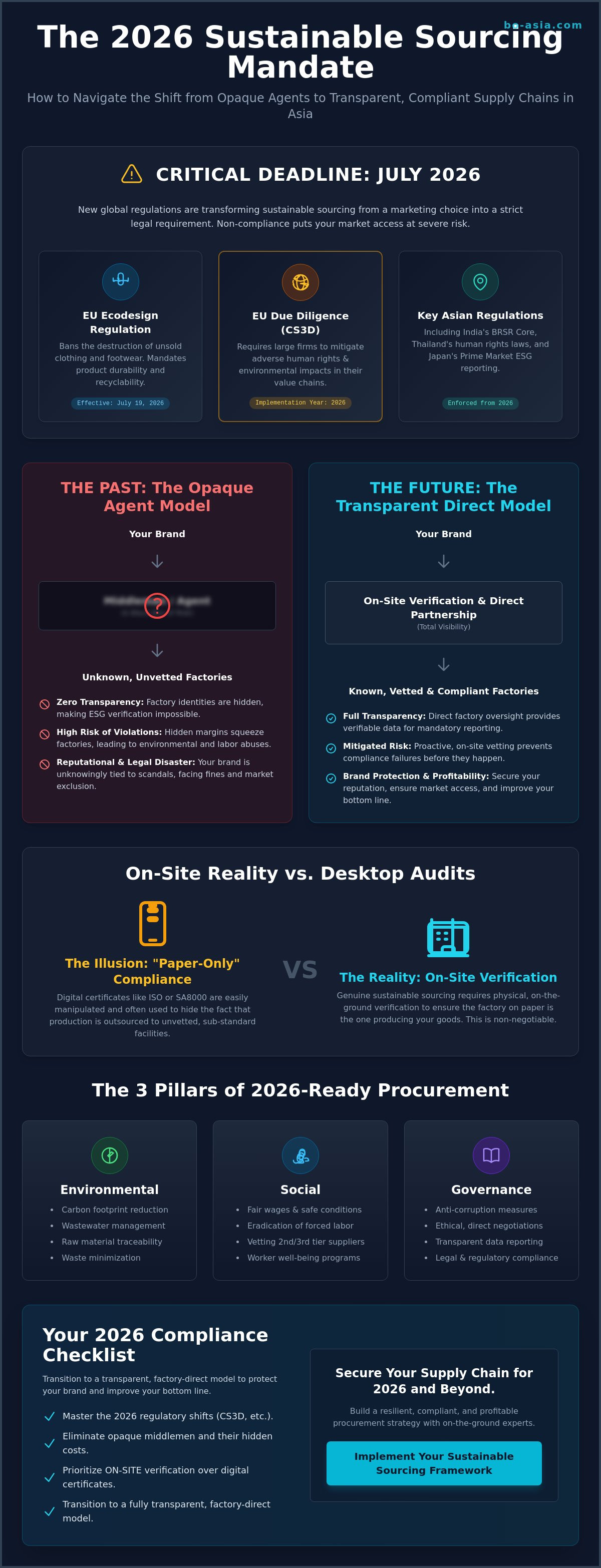
Relying on a PDF certificate to prove sustainable sourcing is a gamble you can't afford in 2026. While many digital platforms offer sustainability ratings based on self-assessment questionnaires, these remote audits often fail to reflect the actual conditions on the production floor. In a market where procurement orders are projected to exceed 60% in Southeast Asia by 2027, the gap between what a factory reports and what it does is widening. You need a shield against the "paper-only" compliance that satisfies a computer screen but fails a real-world legal inspection. Desktop vetting is a starting point; it's never the finish line.
Physical inspections are the only way to verify labor safety and waste disposal protocols. A remote auditor won't see the chemical runoff behind a facility or the lack of fire exits in a secondary workshop. These are the details that lead to the "reputational damage" and "production delays" that plague unmanaged supply chains. A dedicated Asia procurement team acts as your protective partner, catching red flags before they turn into costly scandals. By having boots on the ground, you stop leaving money on the table through the hidden risks of unverified suppliers. This proactive oversight is what makes your manufacturing simple, safe and profitable.
Falsified social compliance records are a common reality in remote vetting. Opaque middlemen often provide "staged" factory photos or certificates belonging to a different facility entirely. This "Ghost Factory" phenomenon occurs when an audited facility acts as a showroom, while the actual production happens in an unvetted, sub-standard workshop nearby. Without a physical presence, you're essentially trusting a salesperson's word over verifiable facts. To protect your brand from these hidden layers, you should read our guide on Quality Control in Asia to understand the strategic necessity of on-site oversight.
Local language skills and unannounced visits are the only way to ensure factory compliance. A remote auditor sees what the factory wants them to see; a local team sees the reality of the production line. Verifying the origin of raw materials at the source is critical for maintaining "Made in" integrity and meeting the strict 2026 ESG disclosure requirements. It's about moving from the frantic energy of reactive fixes to the steady confidence of a managed supply chain. For a deeper look at our vetting process, explore The Insider's Guide to Supplier Vetting. Our local experts ensure that sustainable sourcing is a physical reality, not just a digital claim.
Your transition to sustainable sourcing requires a shift from passive observation to active, on-site verification. By 2026, the regulatory floor has been raised; you need a rigorous protocol that moves beyond the front office and onto the factory floor. This checklist serves as your operational blueprint for navigating the complexities of Asian manufacturing while maintaining the profitability your business requires. We prioritize a proactive approach that identifies risks before they manifest as production delays or legal liabilities.
Effective pre-selection begins with a deep dive into a factory’s legal standing and historical ESG performance. You must verify business licenses directly with local authorities, such as the Ministry of Commerce in Thailand or the SAMR in China, to ensure the entity is authorized for the specific goods you are procuring. Governance audits are equally critical. You should review financial transparency and anti-bribery policies to ensure you aren't unknowingly funding the "hidden margins" of corrupt middlemen. Once a supplier passes this initial hurdle, the focus shifts to the physical reality of their operations.
Post-audit management is where long-term value is created. We don't just identify failures; we implement Corrective Action Plans (CAP) that drive continuous supplier development. This methodical approach ensures that your supply chain evolves alongside global standards, protecting your brand from the volatility of non-compliance. If a factory cannot meet these standards through a structured improvement plan, they are a risk to your business continuity.
Environmental compliance in 2026 is defined by measurable data. You must verify hazardous waste disposal contracts with local government-approved facilities to ensure chemicals aren't being dumped into local waterways. In textile or heavy manufacturing hubs, look for "closed-loop" water systems that recycle process water to minimize environmental impact. During your inspection, look for the implementation of Variable Frequency Drives (VFDs) for industrial motors, heat recovery systems for boiler units, and high-efficiency LED lighting arrays to reduce total energy consumption.
Social audits must move beyond the surface. You should cross-reference punch-card records with actual floor activity to spot excessive overtime, which is a primary indicator of labor exploitation. Inspect safety equipment and fire exits to ensure they are unblocked, functional, and that workers are actually trained to use them. It's also vital to conduct private worker interviews and verify age and identity documents to eliminate the risk of forced or child labor. To ensure this level of detail is maintained across your entire supply chain, you should Partner with a dedicated sourcing team for on-site oversight. This physical presence acts as a shield for your brand. If you're ready to secure a transparent manufacturing partner, contact our team today to begin your audit process.
Executing a 2026-compliant procurement strategy requires more than a checklist; it requires a partner who understands that sustainable sourcing is a boots-on-the-ground operation. Buying Office Asia (BOA) provides the stabilizing force your brand needs in an increasingly regulated market. We bridge the gap between high-level EU standards and the practical manufacturing reality in Asia. With our local teams in Hong Kong and our European headquarters in Helsinki, we provide the same elite oversight that large corporations enjoy, tailored specifically for the growth of wholesalers and brand owners.
Our process is designed to eliminate the anxieties of overseas manufacturing. It begins with rigorous pre-vetting and moves into unannounced audits during mass production to ensure continuous compliance. We don't just act as a bridge; we act as a shield against the reputational damage and production delays that plague unmanaged supply chains. This methodical oversight ensures your ESG reporting is backed by hard data from the factory floor, making your procurement simple, safe and profitable. Professional procurement is the only way to protect your bottom line while meeting the mandatory sustainability standards of 2026.
We have explicitly rejected the traditional agent model because it thrives on secrecy and "hidden margins." Most agents hide factory identities to protect their commissions, which inherently prevents you from verifying ethical standards. We act as your dedicated on-site procurement department, not a commission-based middleman. This gives you 100% transparency and direct access to factory-direct pricing. By removing these opaque layers, you stop leaving money on the table and gain full control over your production environment. You can view our case studies on sustainable scaling to see how this transparency translates into measurable business wins.
The transition to a sustainable model must begin now to meet the July 19, 2026, EU deadline for unsold goods and the upcoming human rights due diligence laws in Thailand. Transitioning your current supply chain requires a strategic audit of your existing suppliers and a clear plan for corrective action. Whether you need to vet a new manufacturer or overhaul your current sourcing network, our team is ready to provide the local expertise you lack. We offer the steady confidence of a seasoned insider to help you navigate these changes without sacrificing your margins. Get a transparent quote for your Asia procurement needs and secure your brand's future today.
The shift toward mandatory ESG transparency is no longer a distant projection; it's an immediate operational reality for 2026. You've seen how opaque middlemen and digital-only audits leave your brand vulnerable to the legal risks of the Corporate Sustainability Due Diligence Directive (CS3D). By transitioning to a factory-direct model, you eliminate hidden margins and gain the verified data necessary for CSRD compliance. This isn't just about avoiding penalties. It's about building a procurement strategy that is simple, safe and profitable.
Buying Office Asia acts as your protective shield in this complex environment. As a European-managed firm with on-the-ground operations in Hong Kong, we provide 100% transparency without the hidden margins of traditional agents. We ensure your sustainable sourcing efforts are verified on the factory floor, not just on paper. You don't have to navigate these regulatory shifts alone. Stop leaving money on the table and start building a resilient supply chain that aligns with your brand's values. We are ready to help you grow with confidence.
Secure Your Supply Chain: Contact Buying Office Asia Today to begin your transition to a transparent, factory-direct future.
Sustainable sourcing is broader than green sourcing because it integrates social and governance factors alongside environmental protection. While green sourcing focuses strictly on ecological impact, a sustainable approach ensures fair labor practices and ethical business conduct. It’s a holistic strategy that protects your brand from a wider range of supply chain risks beyond just carbon footprints.
Sustainable sourcing doesn't have to be more expensive when you eliminate the 15% to 30% markups typically charged by opaque middlemen. By moving to a factory-direct model, you offset the costs of compliance with direct savings. Ethical factories are often more efficient, reducing material waste and energy costs that would otherwise be passed on to your unit price.
You can verify claims through third-party platforms like Sedex or EcoVadis, but these digital reports are only the starting point. For absolute certainty in 2026, you should request unannounced audits from a local procurement team. Relying on self-reported data is a major risk factor that often leads to reputational damage when discrepancies are uncovered by regulators.
Unauthorized subcontracting and falsified wastewater records are the most prevalent risks in Chinese manufacturing today. Many factories present a compliant "showroom" while shifting actual production to unvetted secondary workshops. This "Ghost Factory" phenomenon is a primary cause of ESG failures that can lead to your goods being seized under new global trade regulations.
improves profitability by increasing supply chain efficiency and reducing the risk of catastrophic production delays. Companies that prioritize transparency often see a reduction in waste-related costs and benefit from more stable, long-term supplier pricing. It's a strategy that moves you away from the frantic energy of crisis management toward steady, predictable growth.
Look for globally recognized certifications such as SA8000 for social accountability or GOTS for organic textiles. While these documents are valuable, they must be cross-referenced with on-site reality. Ensure your suppliers are also registered on platforms like the IPE (Institute of Public and Environmental Affairs) to track their real-time environmental compliance records in Asia.
In 2026, the German Supply Chain Act (LkSG) requires companies with at least 1,000 employees to conduct due diligence across their entire supply chain, including indirect suppliers. This means you are legally responsible for violations occurring at any tier of production. This regulation has moved ethical procurement from a voluntary choice into a strict legal requirement for anyone selling into the German market.
Transparency is the foundation of sustainable procurement because it eliminates the secrecy that hides ethical violations and hidden margins. Without a direct line of sight to the factory floor, you cannot verify if your ESG standards are actually being met. True transparency ensures that your brand remains simple, safe and profitable by removing the "black box" of traditional sourcing agents.

A technical drawing isn't just an engineering reference; it's your primary legal baseline against cost-driven supplier compromises. When sourcing abroad, vague manufacturing product specification sheets inevitably invite unauthorized material substitutions, delayed timelines, and sudden quotation in...

The traditional commission-based sourcing agent in India is no longer an asset; they're often your greatest financial risk in a market rapidly scaling toward a $2 trillion export target. You likely recognize the inherent conflict when an agent's income rises alongside your factory costs, or the anxi...

If your current sourcing agent claims their services are free, you're likely paying a hidden tax of 10% to 30% through inflated unit prices and factory kickbacks. This lack of transparency doesn't just erode your margins; it creates a dangerous barrier between you and the factory floor. Finding a re...