

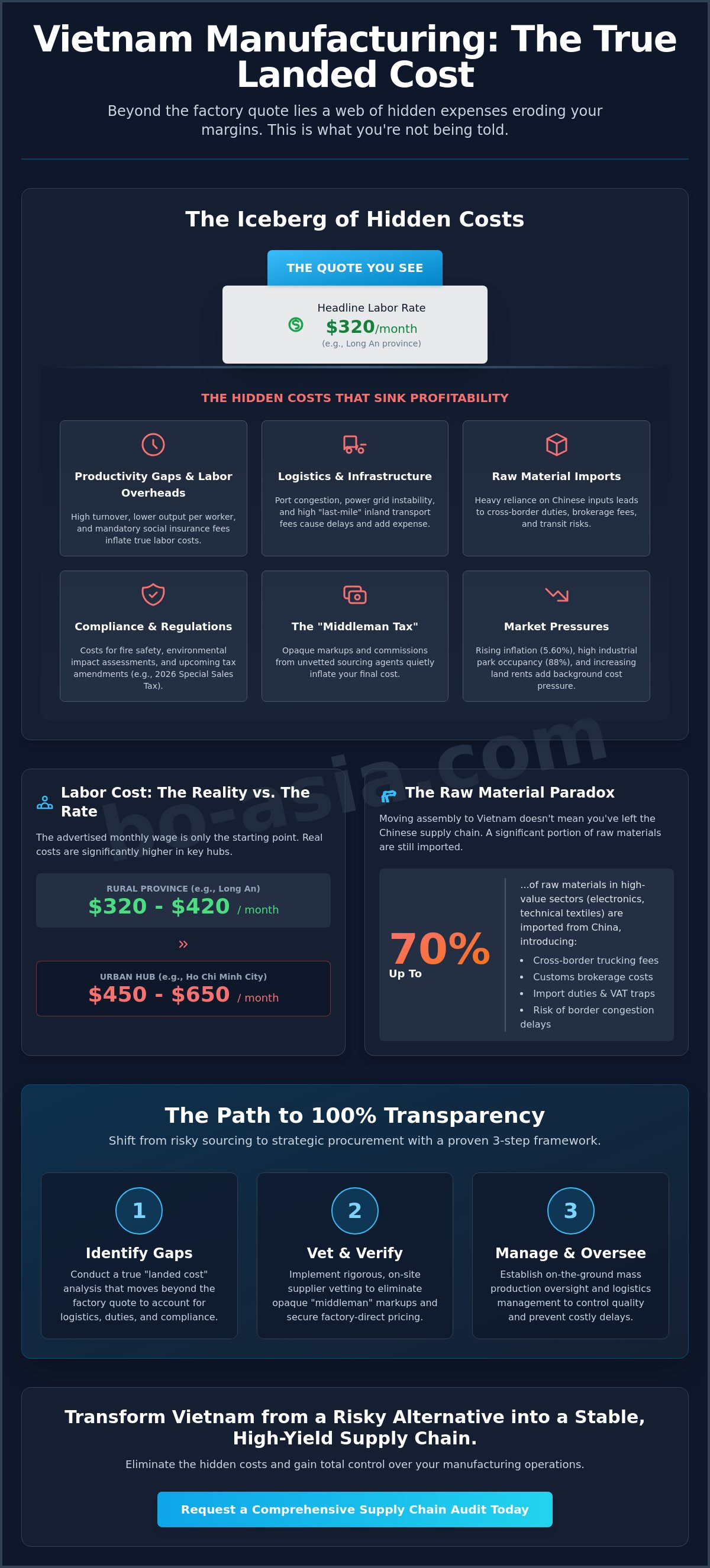
Moving production to Southeast Asia based on headline labor rates alone is a strategy that often backfires. While the $320 monthly base pay in provinces like Long An looks attractive on paper, the hidden costs of manufacturing in Vietnam frequently reside in the gaps between the initial quote and the final delivery. You recognize the massive potential of the "China Plus One" shift, but you're likely frustrated by unpredictable logistics delays and the opaque markups of unvetted intermediaries that quietly erode your bottom line.
It's understandable to feel a lack of control when navigating a market where industrial park occupancy has hit 88% and annual inflation sits at 5.60%. This guide uncovers the invisible expenses that threaten your margins, from labor productivity variances to the complexities of the 2026 Special Sales Tax amendments. You'll learn how to move beyond transactional sourcing and secure true factory-direct pricing through rigorous supplier vetting. We'll outline a strategic framework for on-site mass production oversight and logistics management that transforms Vietnam from a risky alternative into a stable, high-yield component of your global supply chain.
• Learn to calculate the true landed cost of your goods by looking beyond the initial factory quote to identify secondary supply chain gaps.
• Discover how to manage the "Raw Material Paradox" where heavy reliance on imported Chinese inputs can inflate your logistics and duty expenses.
• Quantify the hidden costs of manufacturing in Vietnam related to productivity variances and mandatory compliance standards like fire safety and environmental impact.
• Eliminate opaque markups and "middleman taxes" by shifting from unmanaged sourcing agents to a transparent, factory-direct procurement model.
• Apply a proven three-step framework to audit manufacturing quotes and secure the same level of oversight typically reserved for major enterprises.
The attractiveness of Vietnam as a manufacturing hub is undeniable. Registered FDI reached $38.4 billion in 2025, signaling a massive shift in global supply chains. However, many procurement teams fall into the trap of equating a low factory quote with high profitability. The sticker price on an invoice is only the beginning. To protect your margins, you must account for the hidden costs of manufacturing in Vietnam, which often manifest through logistical inefficiencies, regulatory compliance gaps, and a shallow domestic supply chain.
As of June 2026, the industrial landscape has become more competitive and expensive. Average asking rents for industrial land in the Southern Key Economic Region have reached approximately $186.6 per square meter per cycle. When you add the 5.60% annual inflation rate to rising utility costs, the initial financial model often requires a significant adjustment. For a deeper Overview of manufacturing in Vietnam, it's clear that while the country offers strategic advantages, the landed cost of your goods depends on on-the-ground management rather than just a favorable exchange rate. True financial viability requires looking at three primary categories: logistics, compliance, and supply chain depth.
Labor costs vary significantly by geography. While you might find operators in Long An for $320 to $420 per month, the market rate for standard operators in Ho Chi Minh City has climbed to between $450 and $650. But the hourly wage is a deceptive metric. Lower productivity levels and high turnover rates mean you may need more workers to match the output of a more established hub. Additionally, mandatory social insurance and benefits add a substantial percentage to your gross payroll. Without end-to-end sourcing and procurement oversight, these incremental costs can quickly erode the savings you expected from lower wages.
Logistical friction remains a primary source of unforeseen expenses. Port congestion at Cat Lai continues to drive up drayage fees and cause delays that ripple through your production schedule. In Northern Vietnam, power grid stability during peak summer months remains a concern for high-volume manufacturers. If your factory doesn't have adequate backup power or priority grid access, a single outage can result in thousands of dollars in lost productivity and missed shipping windows. Moving goods from remote provinces to major ports adds another layer of complexity. The inland transport costs for these "last mile" connections are often higher than the international ocean freight itself.
Vietnam's reputation as a manufacturing powerhouse is built on its assembly capabilities, but the reality of its upstream supply chain tells a different story. Many businesses transition production from China only to discover that they haven't actually left the Chinese ecosystem. In high-value sectors like electronics and technical textiles, industry data suggests that up to 70% of raw materials and components are still imported, primarily from Southern China. This dependency introduces significant hidden costs of manufacturing in Vietnam that don't appear in a standard factory quote.
The logistical umbilical cord between China and Vietnam is expensive to maintain. Cross-border trucking involves more than just freight rates; you're responsible for customs brokerage fees, transit insurance, and the risk of seasonal congestion at border gates like Lang Son. If your components are delayed at the border, your Vietnamese production line sits idle while your fixed overhead costs continue to mount. According to Vietnam's economic overview, while the country is integrating rapidly into global value chains, these trade dependencies require sophisticated management to remain profitable. You can request a comprehensive supply chain audit to identify where these transit risks live in your specific model.
The "Made in Vietnam" label on your packaging doesn't automatically grant you duty-free access to global markets. To leverage Free Trade Agreements like the EVFTA or CPTPP, your products must meet strict Rules of Origin thresholds. If your supply chain relies too heavily on imported Chinese inputs, you may find your goods disqualified from preferential tariffs, suddenly inflating your landed costs by 10% or more. Additionally, managing duty-free import schemes for Export Processing Zones (EPZs) requires meticulous administrative oversight. A single HS code misclassification can lead to unexpected customs fines and VAT complications that erode your quarterly margins.
Inventory carrying costs are the silent killers of profitability in Southeast Asia. A 14-day delay in raw material delivery isn't just a scheduling inconvenience; it's a drain on your working capital. To mitigate the risk of border closures or port congestion, you're often forced to maintain higher levels of safety stock. In an environment with 5.60% inflation, holding excess inventory is an expensive insurance policy that ties up cash you could be using for product development. Supply chain fragmentation in 2026 refers to the geographic and operational disconnect between upstream raw material suppliers in China and downstream assembly plants in Vietnam.
Beyond physical logistics, the regulatory environment presents a steep learning curve for international brands. The hidden costs of manufacturing in Vietnam frequently stem from compliance delays and a significant productivity gap between the local workforce and more established manufacturing hubs. While the 2025 GDP growth of 8% highlights the country's momentum, it also masks the administrative friction that can stall your production timelines and inflate your unit costs.
Navigating the local regulatory landscape is often where the most significant financial leaks occur. Fire safety (PCCC) certifications and environmental impact assessments are no longer mere formalities; they're rigorous requirements that can halt production for months if not managed correctly. These Vietnam market challenges represent a substantial risk for companies without an on-site presence to manage the documentation and inspection process. A delay in licensing doesn't just push back your launch; it consumes capital while your inventory sits in a state of regulatory limbo.
Using unvetted sub-tier suppliers is a liability that many businesses overlook until it's too late. Fines for environmental violations have increased in 2026, and the government is more proactive in enforcing factory shutdowns for non-compliant facilities. Protecting your brand reputation requires deep diligence into every level of your supply chain. You can find a comprehensive framework for managing these risks in our insider's guide to safe, profitable sourcing. Ethical sourcing audits are no longer optional if you intend to maintain a stable, long-term presence in the region.
A low hourly wage is an irrelevant metric if the output doesn't meet global standards. Industry benchmarks in 2026 suggest that one seasoned Chinese worker can often out-produce 1.5 Vietnamese workers in high-complexity assembly tasks. This productivity math means your "Unit Labor Cost" might actually be higher in Vietnam than in more expensive markets. Lower levels of automation in secondary provinces like Long An or Binh Duong exacerbate this issue, leading to higher rates of re-work and quality inconsistencies. This is why expert on-site quality control and mass production oversight are non-negotiable. Without active management, the savings you gain on wages are quickly lost to the high cost of defective goods and production delays.
Transparency is the foundation of a resilient supply chain, yet it's frequently the first casualty when engaging with unmanaged intermediaries. In the Vietnamese market, the "middleman tax" represents a significant portion of the hidden costs of manufacturing in Vietnam. Many unvetted sourcing agents present what they claim is factory-direct pricing, but they often conceal markups ranging from 10% to 20%. This practice doesn't just inflate your unit costs; it creates a conflict of interest where the agent's loyalty lies with the supplier rather than your bottom line.
The risk of kickbacks between agents and factory managers is a pragmatic reality that you must address through rigorous oversight. When an agent receives an undisclosed commission from the factory, they're less likely to hold that factory accountable for quality defects or production delays. This lack of transparency extends to logistics. Without visibility into the actual freight contracts, you may be paying inflated shipping rates where the intermediary pockets the difference. Transitioning to a dedicated Asia procurement team eliminates these obscured layers by aligning the team's incentives directly with your financial health.
Signs of a lack of transparency are often subtle but impactful. If your sourcing partner refuses to allow direct communication with the factory floor or provides vague responses regarding material origins, you're likely paying a hidden premium. Another common pitfall is the "Tier 2" supplier trap. This occurs when a factory, overwhelmed by volume or seeking higher margins, outsources your order to a smaller, unvetted workshop without your consent. This practice compromises quality and introduces ethical risks that can damage your brand reputation. Auditing your manufacturing quotes requires a deep understanding of local material costs and labor rates to ensure no hidden commissions have been added to the final figure.
Managing a Vietnamese supply chain from a headquarters thousands of miles away is arguably the most expensive way to manufacture in Southeast Asia. Remote management leads to a lack of control that manifests as expensive dispute resolutions and missed deadlines. Having a physical presence on the ground allows for immediate intervention when production issues arise, preventing minor errors from becoming catastrophic financial losses. Professional sourcing and procurement delivers a measurable return on investment by eliminating obscured markups and securing authentic factory-direct pricing through on-site verification. To ensure your margins are protected from these invisible leaks, you can connect with our team for a transparent fee structure analysis.
Securing a competitive advantage in Southeast Asia requires a fundamental shift in how you view your supplier relationships. Moving from transactional sourcing to integrated supply chain management is the only way to permanently eliminate the hidden costs of manufacturing in Vietnam. A transactional approach relies on faith in an intermediary's quote; an integrated approach relies on verifiable data and on-site oversight. By treating your procurement team as a physical extension of your own office, you gain the same level of control over a factory in Binh Duong that you'd expect from a facility in your home country.
To protect your margins, we recommend a three-step framework for auditing manufacturing quotes. First, verify raw material inputs against current market rates in Southern China and Vietnam to identify hidden markups. Second, adjust labor cost projections based on actual productivity metrics rather than just base wages. Finally, quantify the total compliance and logistics overhead, including the 2026 VAT and Special Sales Tax adjustments. This methodical approach ensures that the price you're quoted is the price you'll actually pay when the goods reach your warehouse.
Our model is designed to dismantle the opaque intermediary structures that traditionally drain profitability. By leveraging European management standards with local Vietnamese execution, we provide a stabilizing force in a complex market. We don't just connect you to a factory; we manage the entire production lifecycle. This includes factory direct price negotiations and on-site quality control that functions as a tool for continuous cost optimization. You can review our BOA savings examples to see how this level of oversight translates into measurable ROI and reclaimed margins. Maintaining these ethical standards isn't just about risk mitigation; it's a financial strategy that secures your brand's long-term viability.
Success in the first 12 months of production depends on setting realistic, data-driven KPIs. Focus on lead time consistency and defect rates rather than just the initial unit cost. A resilient supply chain is one that can survive regional volatility, such as power grid fluctuations or port congestion. Building this resilience requires a partner who possesses the regional networks and physical proximity to intervene before a delay becomes a disaster. We move you away from the risks of unmanaged sourcing and toward a steady, predictable manufacturing outcome. If you're ready to secure your supply chain and eliminate the invisible expenses eroding your bottom line, contact Buying Office Asia for a transparent quote today.
Vietnam offers a powerful "China Plus One" alternative, but success depends on your ability to look past the base factory quote. You've seen how logistical bottlenecks, productivity gaps, and imported raw material dependencies can erode your margins if left unmanaged. Successfully navigating the hidden costs of manufacturing in Vietnam requires more than just a remote connection; it demands a strategic partner who operates as a physical extension of your own team. By shifting from transactional sourcing to integrated oversight, you transform regional volatility into a manageable business variable.
Buying Office Asia provides the stability and professional rigor you need to thrive in this complex market. As a European-managed firm with Helsinki leadership, we maintain a strict 100% transparency policy with absolutely no hidden markups or undisclosed commissions. Our on-the-ground presence in key Asian manufacturing hubs ensures that your production remains on schedule and your quality standards are never compromised. You can move forward with the calm assurance that your interests are protected by seasoned insiders who prioritize your financial health. It's time to reclaim your margins and build a resilient supply chain that supports your long-term growth.
Secure 100% Transparency with Your Dedicated Vietnam Sourcing Team
While headline wages in Vietnam remain lower, the answer depends on your specific product complexity and volume. Lower labor productivity and higher inflation, which hit 5.60% in May 2026, can result in higher unit labor costs compared to automated Chinese facilities. You must calculate the total landed cost, accounting for the hidden costs of manufacturing in Vietnam, rather than relying on base salary comparisons.
Inland transport and drayage fees often exceed international ocean freight rates, especially for factories in remote provinces. Port congestion at Cat Lai continues to drive up storage costs and cause shipping delays. You should also budget for transit insurance and customs brokerage fees associated with the heavy reliance on imported raw materials from neighboring regions.
Physical proximity is the only reliable method for verification. You should implement a strategy of unannounced on-site quality control and mass production oversight to ensure your order isn't being outsourced to unvetted Tier 2 workshops. This protective measure maintains your quality standards and prevents the ethical risks associated with unauthorized subcontracting.
Importing essential components from Southern China typically adds 7 to 14 days to your production schedule. This lead time can fluctuate based on seasonal congestion at border gates like Lang Son. You'll need to maintain higher levels of safety stock to mitigate these transit risks, which increases your inventory carrying costs and ties up working capital.
Yes, you can often transfer existing tooling, but it requires a professional technical assessment to ensure compatibility with local machinery. You must also account for the costs of maintenance and potential modifications. Expert product development and tooling support can prevent expensive downtime caused by equipment mismatches or improper calibration during the initial setup phase.
The most frequent hurdles involve fire safety (PCCC) certifications and environmental impact assessments. These regulations have become much stricter in 2026, and missing documentation can lead to immediate factory shutdowns. Navigating these requirements without an on-site team to manage the administrative process often results in expensive launch delays and unexpected regulatory fines.
You should view quality control as a non-negotiable risk mitigation investment rather than a discretionary expense. Budgeting for regular on-site inspections prevents the catastrophic financial impact of defective goods and mass re-work. While costs vary based on production volume, this oversight ensures that you secure the factory-direct quality you've paid for without expensive surprises after shipping.
The EVFTA provides significant tariff reductions for goods exported to European markets, which can improve your overall margins. However, these benefits are only accessible if you meet strict Rules of Origin requirements. This often necessitates shifting from imported components to more expensive local sourcing, which can offset some of the initial tax savings provided by the agreement.

What if the first clear sign of a production problem arrives after the goods are packed? Manufacturing risk management in Asia works best when controls are connected from the start, not left to a final inspection or occasional supplier update. You need visibility into factory activity, early warning...

What if the lowest unit quote isn’t the lowest-cost way to make your board game? Board game manufacturing costs depend on more than the number of boxes ordered. Component materials, custom tooling, assembly, packaging and delivery scope can all change what a quote covers, making headline prices diff...

What if the factory’s lowest quote isn’t the lowest-cost option? A lower unit price can hide differences in materials, tooling, packaging, quality checks or production terms. Understanding how sourcing agents negotiate factory prices starts with making those differences visible, not simply asking a...