


What if a shipping document could affect who controls your cargo, not just confirm that it was loaded? If you’re asking “what is a bill of lading,” the answer matters well beyond paperwork. A bill of lading can serve as a receipt for the goods, evidence of the contract of carriage, and, depending on its type, a document of title. Mistaking it for another shipping document can create costly uncertainty when it’s time to release cargo.
Importers need clear answers because document details pass between suppliers, freight partners, and carriers. A mismatch in a party name, carton count, or destination can complicate a handoff or delay cargo release. Reviewing the draft before it is finalized gives the responsible parties a chance to resolve discrepancies while the shipment details are still being confirmed.
This 2026 guide explains what a bill of lading does, how common types differ, and which details to verify before shipment. It also covers why paper and electronic formats may be treated differently depending on the route and parties involved, and when to ask a freight or procurement professional to clarify responsibilities under your shipment terms.
• Knowing what is a bill of lading helps you understand how a shipping document can affect cargo control and delivery.
• Compare straight bills, order bills, and sea waybills against your payment terms and the level of control your shipment requires.
• Before finalization, check party names, cargo details, route, and consignee instructions against your shipping and purchase records.
• Confirm who prepares and issues the document. If shipment terms are unclear, clarify responsibilities with your freight or procurement professional.
• Coordinate supplier readiness and confirm cargo information before handoffs to reduce avoidable documentation issues.
A bill of lading is a transport document that records a carrier’s receipt of cargo, provides evidence of the contract of carriage, and, for certain document types, can serve as a document of title. In practical terms, it does more than acknowledge that goods were handed over. It helps identify the cargo and the carriage arrangement. Its legal effect depends on the document type, governing rules, and shipment terms. Not every bill of lading transfers ownership or gives its holder the right to claim the goods. The Bill of Lading overview explains these commonly recognized functions and document variations.
A bill of lading typically identifies the shipper, consignee, and carrier, along with relevant vessel or transport details and the destination. It also records shipment information such as package count, cargo description, and shipping marks. Compare these details with the supplier’s final shipping records. For example, if the packing list shows a different carton count or shipping marks, ask the responsible party to clarify the discrepancy before the document is finalized.
The bill of lading serves a different purpose from a commercial invoice or packing list. The invoice records the sale and its commercial details; the packing list itemizes how the goods are packed. The bill of lading focuses on transport and cargo handoff. Cross-checking the documents helps ensure each part of the shipment record refers to the same goods and parties.
For importers, the document provides a record of cargo entering the carrier’s custody, subject to the terms and details shown. It can support shipment tracking, document review, and the processes required to claim or release cargo. This makes accurate party names, cargo particulars, and consignee instructions operationally important, not just administrative details.
A bill of lading does not guarantee customs clearance or delivery. Release can depend on the document type, carrier procedures, shipment terms, and other required records. If a field is unclear or inconsistent, confirm the correct information with the responsible supplier, freight forwarder, or carrier before the document is finalized. Responsibilities and requirements can vary by shipment, so check the governing arrangements rather than assuming one document works the same way on every route.
A bill of lading is generally issued by the carrier or its authorized agent after cargo is received for transport, but the timing, issuer, and wording depend on the booking and shipment arrangement. In the shipment process, it follows the cargo handoff and helps govern later transport and release steps.
The shipper or its representative arranges transport and provides shipping instructions, including party names, cargo details, and destination.
The goods are delivered to the carrier or an agreed receiving point. The receipt notation may state that cargo is “received for shipment,” meaning it has been received for transport but may not yet be loaded on the vessel.
The issuer prepares the bill using the submitted details. Compare the draft with the booking and sales terms before it becomes final.
An “on-board” notation indicates that the cargo has been loaded onto the named vessel. This differs from a received-for-shipment notation. Confirm which status and wording your transaction requires.
The consignee follows the carrier’s instructions for document presentation or another agreed release process, as applicable.
The shipper supplies shipping instructions and hands over the cargo. The carrier transports it and generally issues the bill, directly or through an authorized agent. The consignee is the party named to receive the goods, while a notify party is designated to receive arrival or shipment notifications. These roles can differ by transaction. A freight forwarder may issue a house bill when acting in the relevant capacity. Confirm who the issuer is and check every named party against your booking and sales terms.
There is no single release process for every shipment. Depending on the bill type, carrier, route, and governing terms, the consignee may need to present a document or follow an agreed electronic or other release procedure. Confirm the steps with the carrier before cargo arrives, including which party must act and what documentation is required. Do not assume that having a copy of a bill is enough to claim the goods.
Clear handoffs between the supplier, buyer, forwarder, and carrier help keep instructions and document details aligned. For support coordinating procurement and shipping documentation as part of production in Asia, see sourcing and procurement support.
Choosing a document type affects how cargo is claimed and whether the document can be transferred, but not every bill of lading transfers ownership. The right choice depends on your sales contract, payment arrangement, carrier procedures, and the rules that apply to the shipment. Before goods move, confirm that the document requested by your buyer, bank, and carrier is consistent across the transaction.
These documents differ mainly in whether they are negotiable and what process may be used to release the goods. The document’s label alone does not settle every legal or operational question, so confirm the terms that govern your shipment.
| Document type | Typical purpose | Control and release considerations |
|---|---|---|
| Straight bill | Names a specific consignee to receive the cargo. | Generally non-negotiable. Delivery arrangements depend on applicable terms and carrier procedures. |
| Order bill | Made out to the order of a named party or another specified order. | May be negotiable if its form and governing law support transfer, often through endorsement and delivery. This does not automatically mean that ownership transfers in every case. |
| Sea waybill | Records the carriage of goods by sea without functioning as a negotiable document of title. | Generally non-negotiable; release may be handled without presentation of an original negotiable bill, subject to carrier rules and route-specific practice. |
In short, a sea waybill is generally non-negotiable and may allow cargo release through a carrier’s agreed process without surrendering an original negotiable bill. Confirm the procedure for your route and shipment. Do not choose a document based only on familiarity. The consignee details and release method still need to match the agreed arrangement.
Payment conditions can determine which document wording is acceptable. For example, a documentary credit may specify a particular bill type, consignee wording, or presentation requirement. If the credit incorporates UCP 600, check its terms alongside the credit’s specific instructions. Do not assume those rules apply unless the credit says so.
Before booking, align the sales contract, payment instructions, and carrier documentation requirements. If a bank, buyer, or carrier requests different wording, resolve the discrepancy before the document is issued. This helps prevent a document that appears correct to one party from failing another party’s requirements. Where the legal effect is unclear, verify it with the relevant trade, banking, or freight professional for the applicable contract and jurisdiction.
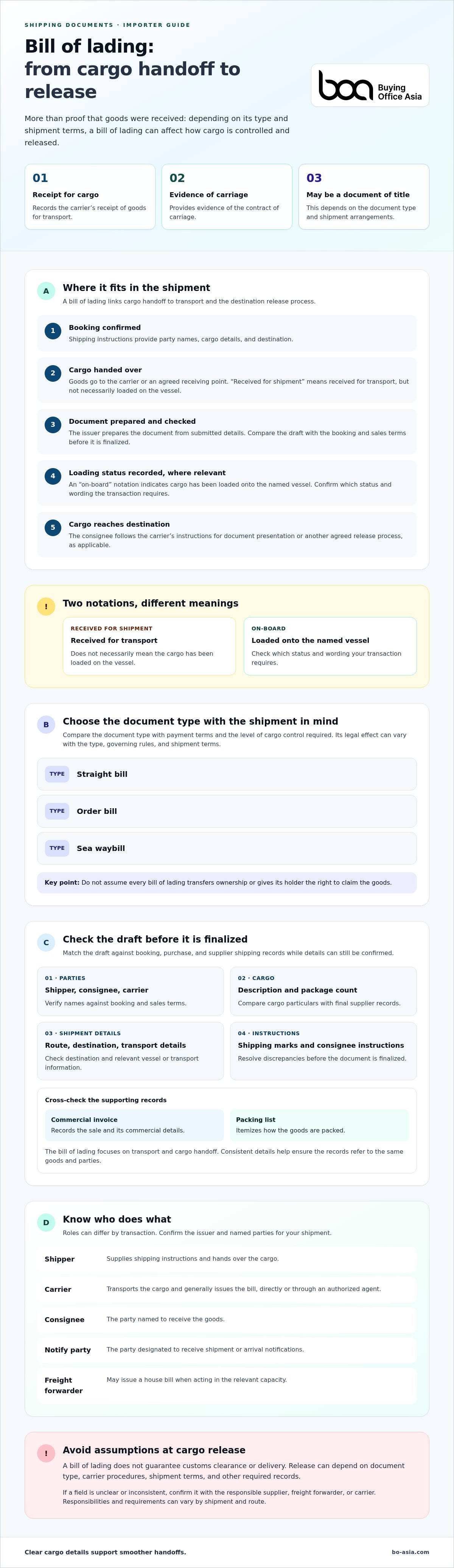
Knowing what is a bill of lading is only the first step. Before approving the document, compare its details with the records that define the order, cargo, and transport arrangement. A focused review can catch inconsistencies while there is still time to ask the responsible party to correct them.
Review the draft against the purchase order, commercial invoice, packing list, booking confirmation, shipping instructions, and agreed terms. Use this checklist:
Check the shipper, consignee, notify party, and carrier names. Confirm legal entity names and addresses against the contract and shipping instructions.
Compare the description and package count with the packing list and other shipment records. Make sure the information identifies the goods accurately and consistently.
Check recorded weights and shipping marks against supporting records. For example, clarify a difference between the carton count on the packing list and the bill of lading instead of assuming it is a harmless typo.
Confirm the ports or other transport points, destination, and relevant vessel or transport details against the booking confirmation.
Check that freight terms match the agreed arrangement. Compare any condition notation with the handover or inspection records, and query wording that does not reflect the available evidence.
Confirm the consignee details and any release-related instructions align with the agreed terms and document type.
The bill of lading supports the transport record; it does not replace the commercial invoice or packing list. Each document serves a different purpose. Resolve discrepancies with the party responsible for the relevant information.
Flag it promptly with the issuer, usually the carrier, its authorized agent, or a forwarder acting in the relevant capacity. Identify the specific field, provide the exact corrected wording, and attach or reference the supporting record. A general request to “fix the document” can leave the issuer unsure what needs to change.
Before requesting an amendment, ask about the document’s current status. A draft may be handled differently from an issued bill, an original that has been surrendered, or an electronic record under the carrier’s process. Amendment steps and release instructions depend on that status and the carrier’s procedures. Keep written approval and confirm that the corrected version reaches the buyer, supplier, forwarder, carrier, and any other relevant party.
For information about procurement coordination and document handoffs, see Buying Office Asia’s contact page.
A bill of lading starts with information gathered well before cargo reaches a carrier. Supplier readiness, production completion, final packing details, and shipping instructions all feed into the document. If a handoff is missed, details such as package count, cargo description, or destination may need clarification just as the shipment is being prepared to move.
Build the document review into the move from production to dispatch. Once goods are packed and any final inspection information is available, confirm the cargo details with the supplier and the logistics parties handling the shipment. Then compare the shipping instructions and draft document with the confirmed information before issuance. For example, if packing is complete, use the confirmed package count rather than an earlier estimate. This helps prevent preliminary or outdated details from being treated as final. For broader context on coordinating suppliers and procurement in the region, see Asia sourcing and procurement support.
Each handoff should make clear who confirms the information and who passes it on. The buyer agrees the shipment requirements; the supplier confirms production and packing details; the forwarder or carrier provides transport instructions and documentation; and the consignee checks its receiving details. Responsibilities vary by shipment, so confirm who is preparing, reviewing, and approving the document rather than relying on assumptions.
Additional coordination can be useful when shipments recur, several suppliers contribute cargo, or it is unclear who owns a document handoff. A procurement partner can connect supplier readiness and production oversight with logistics and shipping coordination as part of broader procurement support. Buying Office Asia coordinates these activities; it is not a carrier or a standalone shipping provider. See its logistics and shipping coordination services for more information.
For practical control, keep one current set of shipping instructions, record who approved changes, and make sure the final document reaches the relevant shipment parties. These checks help your team see which details are confirmed and where questions still need to be resolved. Buying Office Asia also provides information about sourcing and shipping coordination.
Knowing what is a bill of lading means understanding its role in documenting cargo receipt, carriage terms, and, for some document types, control over release. The right format depends on the shipment and agreed payment terms. Checking party names, cargo details, route, and consignee instructions can catch mismatches before they create avoidable friction. Before approval, confirm whether the document is negotiable, who must receive it, and what release process the carrier requires.
Document accuracy is also a coordination task. Supplier readiness, final packing information, buyer instructions, and carrier requirements need to reach the right parties. Buying Office Asia integrates logistics coordination with broader sourcing, procurement, and production oversight. It has its headquarters and on-the-ground operations in Hong Kong, alongside a European leadership office in Helsinki. Buying Office Asia is a procurement and coordination partner, not a carrier. Verify requirements against the applicable contract, carrier terms, and jurisdiction.
If document handoffs or supplier coordination are creating uncertainty, contact Buying Office Asia to discuss sourcing and shipping coordination. Clear responsibilities and consistent shipment information can help you move forward with greater confidence.
A bill of lading is a transport document that records a carrier’s receipt of cargo and key details about its carriage. It also provides evidence of the carriage contract and, for some types, may function as a document of title. In practical terms, it connects the goods handed over with the transport arrangement and the process for claiming them. Its exact effect depends on the document and shipment terms.
Not automatically. Some bills of lading, such as certain order bills, may be negotiable documents of title, but that does not mean every bill transfers ownership. A straight bill is generally non-negotiable, and a sea waybill does not function as a negotiable document of title. Ownership can depend on the sales contract and applicable rules, so check those terms rather than treating possession of any bill as conclusive proof.
A carrier or its authorized agent generally issues the bill after receiving cargo for transport. A freight forwarder may issue a house bill when acting in the relevant capacity, while the carrier may issue a separate master bill. The shipper typically provides the shipping instructions and cargo information; the consignee is named to receive the goods. Check the booking and sales terms to confirm the expected issuer and named parties.
A sea waybill is generally non-negotiable and does not function as a document of title. Depending on carrier rules and the shipment arrangement, cargo may be released through an agreed process without presenting an original negotiable bill. A bill of lading’s control and release implications depend on its type and wording. Confirm the route-specific procedure with the carrier, since release practices are not identical for every shipment.
A bill of lading commonly identifies the shipper, consignee, carrier, destination, and relevant vessel or transport details. It also records cargo particulars such as the description, package count, shipping marks, and weights where applicable. Check these against the purchase order, commercial invoice, packing list, booking confirmation, and shipping instructions. Consistent records help the parties identify the shipment and review its transport details without confusing the bill with other commercial documents.
Often, a correction can be requested, but whether and how it can be made depends on the document’s status and the issuer’s procedures. Contact the carrier, authorized agent, or relevant forwarder promptly with the exact field to amend and supporting information. Ask whether the bill is still a draft, has been issued, or has been surrendered. Confirm that the approved correction is distributed to all relevant shipment parties.
It can be, but legal recognition and operational acceptance depend on the applicable jurisdiction, shipment terms, and the systems used by the parties. For example, the UK Electronic Trade Documents Act has been in force since September 20, 2023, and China’s revised Maritime Code recognizing eBLs took effect May 1, 2026. Confirm that the route, carrier, and trading partners accept the electronic format and platform.

The lowest freight quote can carry the highest operational risk if supplier readiness, documentation, and exception handling are left outside the plan. If you’re asking how to choose a freight forwarder for Asia, look beyond the headline rate. A smooth shipment depends on who coordinates each handof...

What if your signed OEM agreement protects the product on paper but leaves the factory unclear about what to make, when to deliver it, or how quality will be judged? That gap is where an oem manufacturing agreement china project can lose control: responsibilities blur between buyer, sourcing interme...

What if the safest payment deal isn’t the one that delays the most cash, but the one that releases it only when progress is verifiable? Payment terms negotiation with Asian suppliers is about balancing your working capital with the supplier’s need for confidence, not simply pushing for a smaller dep...