


The standard Western NDA you rely on at home is effectively a piece of scrap paper once it crosses into the Chinese market. You have likely felt that knot of anxiety when sending proprietary designs to a new factory, wondering if they will use your own intellectual property to become your biggest competitor. It is a valid fear. Traditional confidentiality agreements fail to account for the specific legal landscape of Chinese manufacturing, often leaving your designs vulnerable to exploitation. To truly protect your business, you must understand what is an NNN agreement for China and why it serves as your primary defense against intellectual property theft.
This strategic guide explores how a robust NNN agreement secures your designs, prevents factory back-channeling, and protects your bottom line. With the Revised Foreign Trade Law and new Trade Secret regulations now effective in 2026, the legal framework has shifted in favor of those who prepare correctly. We'll show you how to leverage these updates to ensure your contract is enforceable in Chinese courts. You will gain a clear understanding of the NNN components and the practical steps to secure a signed agreement that stops suppliers from bypassing you to reach your customers.
• Learn why a standard NDA is unenforceable in Chinese courts and discover what is an NNN agreement for China to secure your proprietary designs.
• Understand the three critical pillars of Non-Disclosure, Non-Use, and Non-Circumvention that prevent factories from becoming your competitors or selling directly to your clients.
• Identify the essential legal requirements for 2026, including the necessity of Chinese-language governing text and jurisdiction within the People's Republic of China.
• Master the operational steps to integrate NNN agreements into your sourcing process as a non-negotiable prerequisite before sharing any RFQ data.
• Discover how local oversight and on-the-ground presence ensure your agreements are correctly executed with authentic company seals and signatures.
Understanding what is an NNN agreement for China is the first step toward building a secure, scalable supply chain. An NNN is a specialized tripartite contract designed specifically for the Chinese legal jurisdiction. It addresses three critical risks: non-disclosure, non-use, and non-circumvention. In 2026, this document is the baseline for any serious OEM manufacturing engagement. While many businesses believe a standard Non-Disclosure Agreement (NDA) provides protection, they often fall into the "NDA Trap." Western NDAs focus on preventing information from reaching the public, but in China, the threat is rarely the public; it's the factory itself.
A standard NDA is often unenforceable in Chinese courts because it doesn't address the specific ways IP is compromised in the region. When defining what is an NNN agreement for China, it's best to view it as a comprehensive shield against internal factory theft. If your contract doesn't explicitly forbid a factory from using your designs for their own benefit, you've left the door wide open for them to become your competitor. The NNN acts as a strategic vetting tool. It filters out bad actors before you ever place a purchase order. A factory that refuses to sign a fair NNN is a factory you cannot trust with your brand's future.
An NDA's primary focus is protecting secrets from the general public. However, when you work with a Chinese manufacturer, the most significant risk isn't that they'll tell the world about your design. The risk is that they will use your design to manufacture their own version of your product or bypass you to sell directly to your customers. An NNN agreement is designed to protect your secrets from the factory itself. It establishes that the supplier cannot use your IP for anything other than fulfilling your specific orders. In the Chinese market, disclosure is often the least of your worries; unauthorized use is the real profit killer.
You must present an NNN before sharing any sensitive data during the Request for Quotation (RFQ) phase. This protects your Product Development & Sampling Support efforts from being copied before a single unit is even produced. It prevents "copycat" prototypes from appearing on wholesale platforms during the bidding phase. Establishing this professional boundary early ensures that price negotiations begin with mutual respect and clear legal accountability. It's about setting the rules of engagement before the factory has any leverage over your designs. By securing the agreement upfront, you ensure that your proprietary information remains your competitive advantage.
A comprehensive NNN agreement is built on three essential pillars that go far beyond a simple confidentiality agreement. To truly understand what is an NNN agreement for China, you must see how these components interact to form a cohesive defense. While a standard NDA stops a factory from talking, an NNN stops them from acting. These pillars create a 360-degree protective bubble around your brand, ensuring that your manufacturing partner remains a dedicated supplier rather than a direct competitor. By addressing disclosure, use, and circumvention simultaneously, you eliminate the legal loopholes that factories often exploit when they see a high-value product succeeding in the market.
The first pillar, Non-Disclosure, ensures that your proprietary information remains restricted to the factory's essential internal team. It prevents the supplier from leaking your designs to sub-suppliers or other manufacturers in their network. However, as many experienced importers discover, disclosure is rarely the primary threat. The real risk lies in the factory using your hard-earned IP for their own profit. This is why the subsequent pillars are the most critical elements of what is an NNN agreement for China. They provide the "teeth" necessary to enforce your rights within the Chinese legal system, where foreign plaintiffs win over 80% of contested IP cases in Shenzhen courts when their contracts are drafted correctly.
Non-Use is where the real protection begins. This clause prevents the factory from using your IP to manufacture their own products or any products for third parties. Without this, a supplier could take your research and start their own brand using your exact specifications. It is particularly vital for custom product and tooling development, where you have invested significant capital into unique molds. You must define "use" broadly to prevent the factory from selling "slightly modified" versions that capitalize on your engineering. As Forbes highlights in their guide to Protect Your IP From China With An NNN Agreement, this clause is what keeps a factory from competing directly against you.
The final pillar is Non-Circumvention. This is the most overlooked component in high-volume procurement. It stops the factory from bypassing you to reach your distributors or retailers. Factories often feel tempted to cut you out once they see your sales volume and customer list. A strong non-circumvention clause secures your role as the brand owner. Integrating this protection into your supplier management strategy is essential for long-term stability. If you're concerned about your current supplier's integrity, you can reach out to our team for a professional assessment of your contract security.
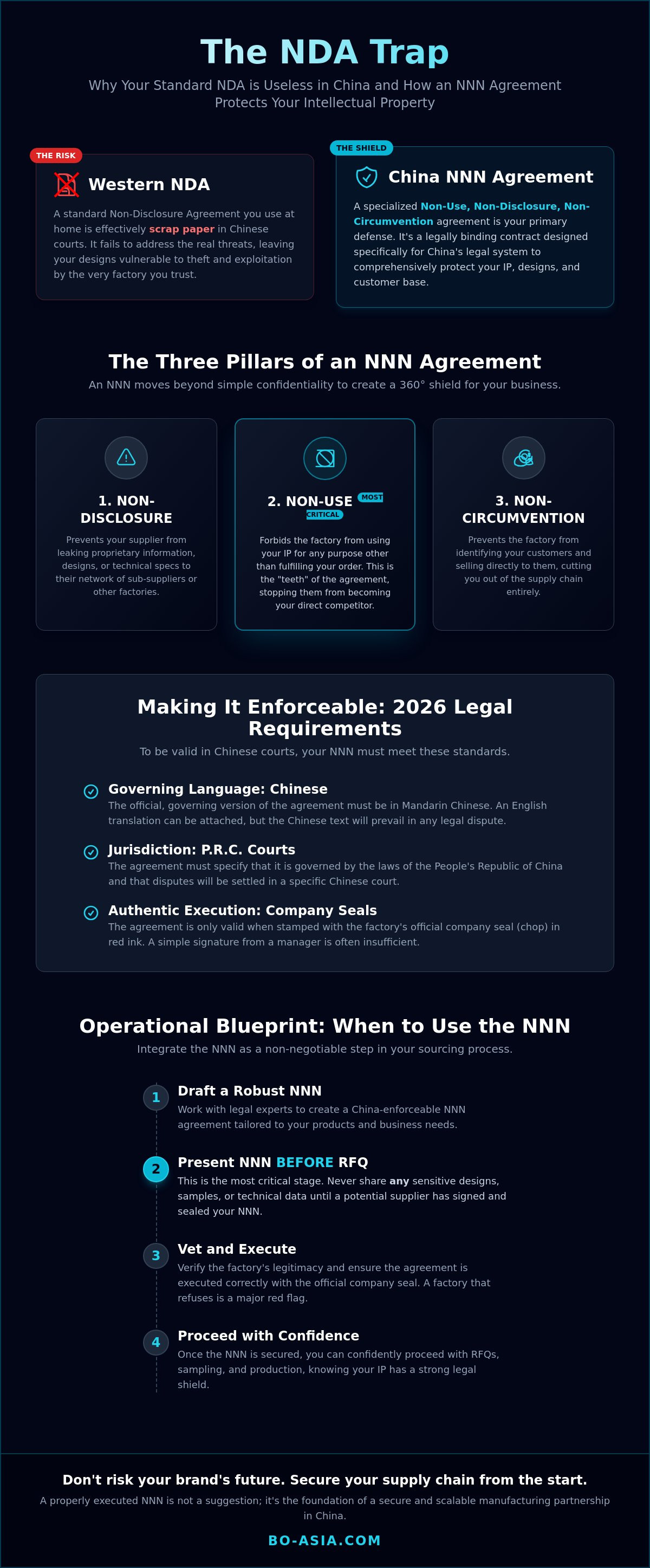
The effectiveness of your intellectual property protection hinges entirely on its enforceability within the Chinese legal system. When determining what is an NNN agreement for China, you must prioritize the governing language. While bilingual contracts are common, the Chinese version must be the prevailing text in court. Chinese judges will not rely on English translations to interpret your rights; they require a document written in their native legal terminology. Similarly, the governing law must be the laws of the People's Republic of China, specifically the PRC Civil Code. Selecting a jurisdiction like the Shenzhen or Shanghai IP courts ensures your case is heard by specialists who understand modern trade secret regulations. For a deeper look at these requirements, Understanding NNN Agreements in China provides an excellent technical breakdown.
In the 2026 manufacturing landscape, a contract is only as strong as the person signing it. Western-style signatures carry little weight in a Chinese courtroom; the only mark that truly binds a company is the "Company Chop" or official red seal. Without this seal, your document is merely a suggestion, not a mandate. When you are finalizing what is an NNN agreement for China, you must ensure the official seal is applied to every page to prevent the factory from swapping out terms later. This physical mark of authority is what allows the Chinese court system to recognize the agreement as a valid corporate commitment.
In the Chinese legal system, proving the exact monetary loss from an IP breach is notoriously difficult. Liquidated damages solve this by naming a specific, pre-agreed sum that the factory must pay upon any violation. This allows you to seek a court order to freeze the factory's bank accounts or seize assets without waiting for a lengthy valuation process. A $500,000 penalty clause acts as a massive deterrent because it creates a predefined financial catastrophe that the factory cannot easily litigate away. It shifts the risk back to the supplier, making a breach far more expensive than any potential profit from stealing your design.
Verifying that the person applying the chop is the registered Legal Representative is a critical component of rigorous supplier vetting. Scammers often use "departmental chops" or fake seals that look authentic but hold no legal authority. You need on-the-ground verification to ensure the seal matches the one registered with the local Bureau of Industry and Commerce. If the chop is not legitimate, the contract will be dismissed in court. Our regional presence allows us to verify these seals in person, ensuring that your agreement is backed by the full weight of the factory's corporate assets.
Transitioning from legal theory to operational reality requires a disciplined workflow. Even the most robust contract is useless if it isn't integrated into your daily procurement habits. When you understand what is an NNN agreement for China, you realize it's not just a document; it's a gatekeeping mechanism that dictates who enters your supply chain. Implementing this strategy effectively means moving away from digital-only interactions and embracing a physical presence that demands accountability. You must treat the NNN as the first filter in a multi-stage vetting process that protects your brand from the moment of initial contact.
To secure your intellectual property during the 2026 manufacturing cycle, follow these operational steps:
Identify high-potential suppliers through a professional China sourcing company to ensure you're starting with legitimate entities.
Present the NNN as a non-negotiable prerequisite before releasing your Request for Quotation (RFQ) package. This defines what is an NNN agreement for China in the context of your specific project.
Cross-reference the factory's official business license against the signatures and company names provided on the agreement.
Secure physical, 'chopped' copies of the contract through local agents who can verify the seal's authenticity in person.
Maintain the agreement's relevance by referencing its terms throughout the lifecycle of mass production and subsequent orders.
A factory's reaction to your NNN request is a critical data point. If a supplier refuses to sign or attempts to substitute your document with a weak Western NDA, it's a major red flag for your factory audits. Legitimate manufacturers who value long-term partnerships understand the necessity of these protections. You must differentiate between a factory negotiating specific liquidated damages and one evading protection entirely. Using the NNN as a baseline allows you to build a partnership founded on 100% transparency, where risks are acknowledged and mitigated upfront.
Protection doesn't end once the ink is dry. Continuous on-site quality control reinforces the NNN by ensuring that production output matches your proprietary specifications and stays within authorized channels. Your management team should regularly remind factory leadership of their obligations during site visits to maintain legal leverage. A dedicated Asia procurement team acts as your eyes and ears on the ground, ensuring that compliance isn't just a contractual promise but a daily operational reality. If you're ready to secure your supply chain with professional oversight, contact our procurement experts today.
Buying Office Asia (BOA) functions as an integrated extension of your own team, providing the regional oversight necessary to enforce complex legal protections. While understanding what is an NNN agreement for China is vital for any brand owner, the actual execution of these documents requires a physical presence that most businesses simply lack. We manage the entire NNN process as a core component of our end-to-end sourcing service. This means we don't just provide a template; we ensure the document is correctly localized, signed, and chopped by the authorized legal representative. Our proximity to manufacturing hubs in Mainland China and our headquarters in Hong Kong allow us to verify every seal in person, removing the guesswork from your IP security.
By establishing direct factory relationships, we eliminate the risks associated with unmanaged intermediaries and trading companies. Fewer hands touching your intellectual property means fewer opportunities for leakage or unauthorized "back-channeling." We combine these legal safeguards with rigorous factory audits to ensure that your manufacturing partner is both legally bound and operationally capable of meeting your standards. This multi-layered approach transforms your procurement from a series of risky transactions into a strategic supply chain defense. When you partner with us, you gain a clear, actionable perspective on what is an NNN agreement for China and how it functions as a live shield for your business.
Our European leadership team understands the specific intellectual property anxieties that international brand owners face. We bridge the gap between Western legal expectations and Asian operational realities. Our teams on the ground execute the protection strategies that keep your designs safe, while our consultants provide the high-level oversight usually reserved for major enterprises. You can see the impact of this approach in our documented cases, where we have successfully secured production for high-volume clients across diverse industries. We move your business beyond transactional sourcing and into a partnership defined by reliability and financial viability.
Securing your 2026 manufacturing strategy starts with a clear understanding of your current risks. We invite you to contact us for a professional consultation to evaluate your procurement security and contract enforceability. You can also review our pricing and savings examples to see how managed procurement optimizes your bottom line while protecting your most valuable assets. Don't leave your brand's future to chance in a complex global market. Secure your intellectual property with Buying Office Asia today.
Protecting your proprietary designs requires more than just legal text; it requires a proactive defense strategy. You've learned that a standard NDA is insufficient and that the three pillars of Non-Disclosure, Non-Use, and Non-Circumvention are non-negotiable for safe manufacturing. Having a clear understanding of what is an NNN agreement for China ensures you can filter out high-risk suppliers before they ever see your proprietary data. By implementing these contracts correctly, you transition from a vulnerable importer to a protected brand owner with real legal leverage.
As a European-managed firm with our headquarters in Hong Kong, Buying Office Asia provides the physical proximity needed for authentic signature verification and rigorous on-the-ground factory audits. Our deep expertise in OEM/ODM contract manufacturing allows us to manage these complex legal requirements as a seamless part of your procurement lifecycle. It's time to secure your supply chain with the professional oversight your business deserves. Protect your IP and start sourcing with 100% transparency. Your brand's growth depends on the security of its innovations, and we're here to ensure those innovations stay yours.
Yes, an NNN agreement is highly enforceable in Chinese courts if it's drafted according to local legal standards. Foreign plaintiffs win over 80% of IP cases in Shenzhen when their contracts are properly localized. You must ensure the contract is in Chinese and governed by the PRC Civil Code to be recognized by a domestic judge. Without these elements, you're essentially holding an unenforceable document.
No, a bilingual NDA is insufficient because it typically only addresses the disclosure of information. To understand what is an NNN agreement for China, you must recognize that it also prevents the unauthorized use of your designs and stops the factory from circumventing you to reach your clients. A standard NDA leaves two out of three major risk doors wide open for a supplier to exploit.
You should treat a refusal to sign as an immediate signal to terminate negotiations and walk away. A factory that won't commit to non-use and non-circumvention is likely planning to use your IP for their own gain. Legitimate manufacturers who value long-term partnerships won't hesitate to sign a fair agreement. Walking away early saves you from the catastrophic costs of future intellectual property theft.
You should set liquidated damages at a specific sum that is high enough to deter a breach but reasonable enough for a court to uphold. Common amounts range from $100,000 to $500,000 depending on the project's value. Because proving actual loss is difficult in China, this pre-agreed penalty allows you to freeze assets quickly without a lengthy valuation process.
An NNN protects your trade secrets and designs, but it doesn't replace a Chinese trademark registration. Trademark rights in China are awarded to the first person to file, not the first to use. While the NNN stops your factory from stealing your design, a trademark prevents them or anyone else from registering your brand name and seizing your products at the border.
Yes, you need a signed agreement before sharing any proprietary information with any potential supplier. This includes technical drawings, unique material requirements, or custom tooling specifications. Presenting the contract during the RFQ phase clarifies what is an NNN agreement for China in the context of your specific project. Never share your "secret sauce" without a signed and chopped document.
The 'Company Chop' is the official red seal that serves as the legal signature of a Chinese corporation. In the Chinese legal system, a person's handwritten signature is often insufficient to bind a company. You must ensure the official seal is applied to the agreement to make it enforceable. This physical mark of authority is what a court uses to verify a contract's validity.
Most NNN agreements remain effective for two to five years, though the non-disclosure obligations should last as long as the information remains a trade secret. You want the protection to cover the entire lifecycle of your product development and mass production phases. It's standard practice to include a clause that extends these protections even after your active manufacturing relationship with the factory ends.

What if the first clear sign of a production problem arrives after the goods are packed? Manufacturing risk management in Asia works best when controls are connected from the start, not left to a final inspection or occasional supplier update. You need visibility into factory activity, early warning...

What if the lowest unit quote isn’t the lowest-cost way to make your board game? Board game manufacturing costs depend on more than the number of boxes ordered. Component materials, custom tooling, assembly, packaging and delivery scope can all change what a quote covers, making headline prices diff...

What if the factory’s lowest quote isn’t the lowest-cost option? A lower unit price can hide differences in materials, tooling, packaging, quality checks or production terms. Understanding how sourcing agents negotiate factory prices starts with making those differences visible, not simply asking a...