


In 2026, relying solely on digital vetting for your supply chain is not just risky; it's a gamble with your brand's financial health. You likely understand that China offers unparalleled manufacturing scale, yet the anxiety of receiving a shipment of defective products or falling victim to "ghost factories" remains a constant burden. These common mistakes when sourcing from China often stem from a lack of physical presence and oversight in an increasingly complex regulatory environment.
We recognize that hidden middleman markups and sudden shifts, such as the new export licensing for 300 steel products or the full implementation of EU CBAM, can erode your margins overnight. This article provides a roadmap to dismantle those risks. You'll discover the critical pitfalls that derail sourcing projects and learn the professional strategies our on-the-ground experts use to ensure quality and transparency. We'll preview ten fatal errors, ranging from mismanaged logistics to failed factory audits, and show you how to transform your procurement into a stabilized, factory-direct operation that functions as a seamless extension of your own team.
• Learn why shifting from a "lowest price" mindset to a "best cost" strategy is essential for navigating the sophisticated Chinese manufacturing landscape of 2026.
• Identify and neutralize common mistakes when sourcing from China by replacing unmanaged digital platforms with physical, on-the-ground accountability.
• Protect your margins by calculating total landed costs and utilizing a 100% transparent pricing model that eliminates hidden middleman markups.
• Establish a rigorous four-stage inspection framework to ensure product quality remains consistent from the first sample through to final container loading.
• Discover how a dedicated Asia procurement team acts as a stabilizing force, providing the regional expertise and oversight needed to secure a risk-free manufacturing process.
China's industrial sector has undergone a fundamental transformation that renders previous playbooks obsolete. If you're still following a procurement roadmap from a decade ago, you're likely walking into a series of common mistakes when sourcing from China. The era of "cheap and simple" has been replaced by a landscape of sophisticated manufacturing clusters and advanced automation. While China's exports exceed $3.5 trillion annually, the nature of these goods has shifted toward high-end manufacturing materials and complex components. Following outdated global sourcing strategies that prioritize the lowest unit price above all else often leads to catastrophic quality failures and supply chain disruptions.
Modern Chinese factories now utilize robotics and AI-driven production lines to maintain their competitive edge. This shift means that the "cheapest" factory in 2026 often lacks the technological infrastructure to meet modern precision standards. Rising labor costs have forced legitimate manufacturers to invest in efficiency; those who haven't are frequently the ones cutting corners on raw materials or workplace safety. You shouldn't view China as a single manufacturing entity but as a network of specialized hubs. Selecting a partner based on proximity to these clusters is a hallmark of successful end-to-end procurement. When you bypass these established hubs for a lower quote, you're usually trading long-term stability for an immediate, and likely temporary, discount.
Compliance is no longer a secondary concern. On January 1, 2026, the EU’s Carbon Border Adjustment Mechanism (CBAM) entered full operation, directly impacting the cost of steel, aluminum, and electricity-heavy goods. These regulations can increase your landed costs by 12-20% if your supply chain isn't optimized for carbon efficiency. If your supplier isn't providing transparent data on their carbon footprint or ethical labor practices, your brand faces significant legal and reputational risk. Relying on "paper audits" or unverified certificates is one of the most dangerous common mistakes when sourcing from China. You need an integrated team on the ground that conducts physical audits to vet Tier 2 and Tier 3 suppliers, ensuring every link in your chain meets modern ESG standards.
Geopolitics has also fundamentally changed the risk profile of unmanaged supply chains. The Amended Foreign Trade Act, which took effect on March 1, 2026, expanded the authority for export controls on core minerals and dual-use goods. In this environment, a digital-only connection to a factory isn't enough. You require a seasoned ally with regional expertise who can pivot your operations in response to sudden regulatory shifts. Buying Office Asia functions as your own office in the region, moving you away from transactional interactions toward a stable, professional partnership that protects your financial health.
Many businesses fall into the trap of thinking a "Verified" badge on a B2B platform is a guarantee of operational excellence. It isn't. These platforms are advertising hubs where visibility is purchased, not earned through performance. Relying solely on a chat window for your procurement is one of the most common mistakes when sourcing from China. It leaves you vulnerable to "ghost factories" and trading companies that possess no manufacturing equipment of their own.
Digital directories prioritize their revenue models over your procurement security. A "Gold Supplier" status simply means the entity paid for a premium membership. It doesn't confirm that the factory exists or that they can maintain quality across a high-volume order. Middlemen frequently masquerade as manufacturers by renting booth space in shared offices or using stock factory photos. 5-star ratings can be bought or manipulated through systematic review services, making them a poor metric for reliability. Without a physical audit, you can't distinguish a three-person trading office from a 500-employee production facility. This lack of verification is why many importers encounter common mistakes when sourcing, such as unmanaged markups and zero technical support when things go wrong.
The "golden sample" is a classic industry tactic. Factories use their most skilled technicians to hand-craft a single, perfect unit to secure your deposit. Once mass production begins, the process shifts to the main floor where lower-grade materials or less experienced workers are utilized. You're then left with a shipment of defective products and no recourse because the factory has already been paid. The Accountability Gap is the distance between a digital promise and physical reality.
A quote that is 20-30% below the market average often signals this exact type of quality compromise. You can't manage what you can't see. Avoiding these common mistakes when sourcing from China requires a partner with a regional presence who can walk the factory floor on your behalf. If you're concerned about the transparency of your current suppliers, reach out to our team to learn how we provide the physical oversight your brand deserves.
Focusing exclusively on the lowest unit price is a high-risk strategy that often backfires. One of the most common mistakes when sourcing from China is failing to calculate the Total Landed Cost (TLC). Your factory quote is only a fraction of your actual investment. In 2026, you must account for shifting variables like the EU’s Carbon Border Adjustment Mechanism (CBAM), which can inflate costs by 12-20% for energy-intensive goods, or the 10-50% tariff hikes recently implemented by countries like Mexico. If you don't calculate these regulatory and logistics expenses upfront, your projected margins will vanish before the shipment reaches your warehouse.
Traditional sourcing agents frequently present themselves as low-cost facilitators while operating on obscured kickback models. They may claim to charge a nominal service fee of 3-5%, yet they’ve already negotiated a 10-30% markup hidden within the factory’s unit price. This lack of transparency is a constant drain on your capital. We operate as your own office in Asia, ensuring 100% transparency where you pay the factory-direct price without any hidden padding. You can review our pricing and savings examples to see the measurable ROI of a transparent procurement model versus unmanaged intermediary structures.
The financial impact of poor quality extends far beyond the cost of a single defective unit. Consider the "Cost of Poor Quality" (COPQ) for a high-volume order with even a 5% defect rate. You aren't just losing the product; you're paying for the shipping, import duties, and warehousing of unsellable inventory. These defects often lead to customer returns, expensive air-freight for replacement batches, and long-term brand damage. When navigating China's eCommerce landscape, the ease of finding suppliers can mask these deep-seated operational risks. It's easy to get distracted by cheap digital quotes that don't account for mass production stability.
Pre-shipment is the only moment you retain financial leverage. Once the container is on the water and the balance is paid, your ability to negotiate a resolution for defects is virtually zero. Unmanaged delays also eat into your profitability through lost sales and the necessity of rush shipping to meet seasonal demands. By positioning an integrated team on the ground, you shift from reactive damage control to proactive risk mitigation. This ensures that mass production quality remains consistent and your financial health is protected from the common mistakes when sourcing from China that affect unmanaged supply chains.
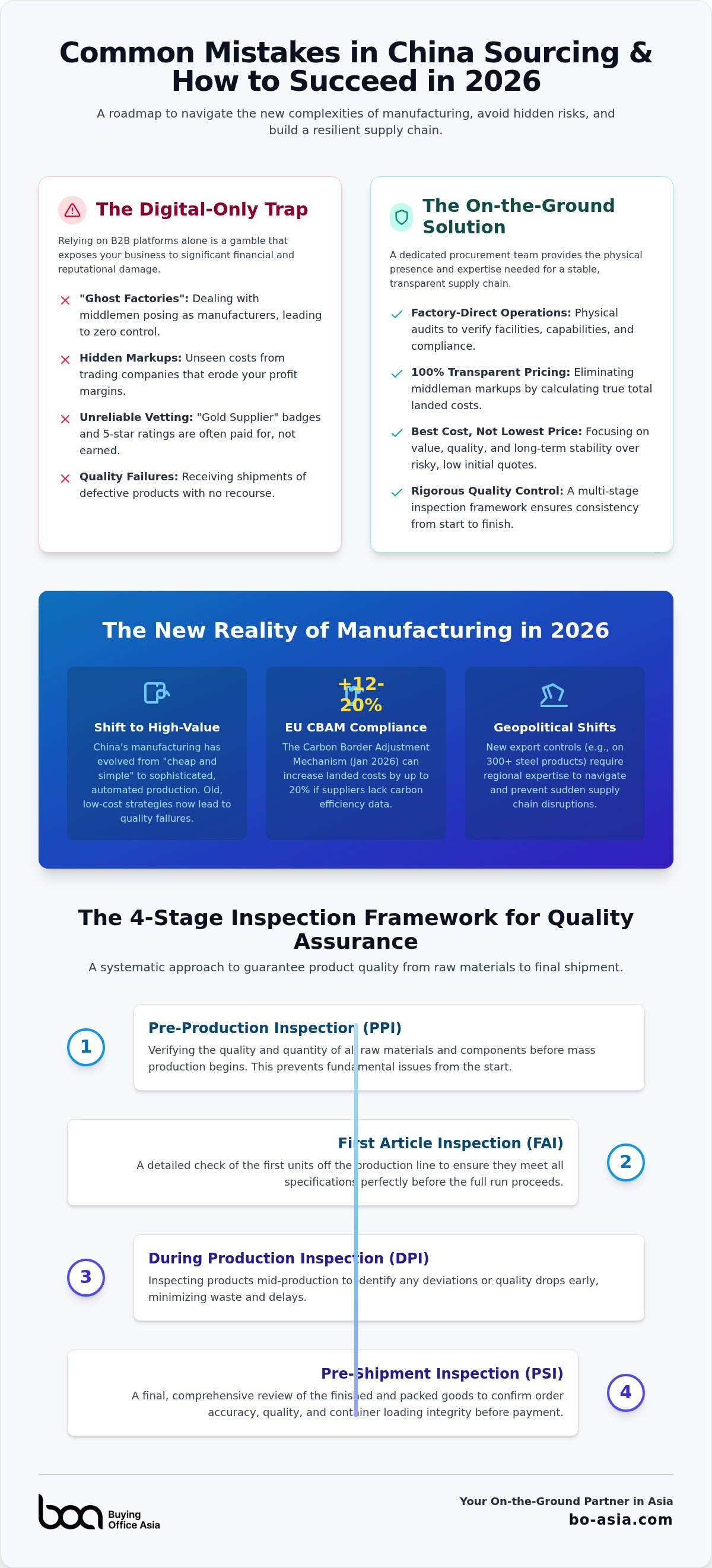
Successful procurement in 2026 requires moving far beyond the surface-level checks that lead to common mistakes when sourcing from China. You need a systemic approach to supplier management that spans the entire production lifecycle. This roadmap shifts your role from a passive buyer to an active overseer, ensuring your investment is protected by physical verification rather than digital promises. By implementing a multi-stage vetting and oversight strategy, you eliminate the ambiguity that often results in shipment delays or quality failures.
Vetting is not a one-time event; it's a layered process of elimination. You must first verify that a factory’s documentation, such as business licenses, export permits, and ISO certifications, is current and authentic. Many common mistakes when sourcing from China occur when importers accept scanned documents at face value without cross-referencing them with local government databases. Once the paperwork is cleared, on-site factory audits are mandatory to verify actual production capacity and machinery standards. We also conduct financial health assessments to protect you from "mid-production bankruptcy," a growing risk in a volatile global market where unmanaged factories may hide significant debt or operational instability.
Waiting for a final inspection before the container is loaded is a tactical error. If defects are discovered at the finish line, your lead times are already destroyed. You should prioritize "During Production" (DUPRO) inspections, which occur when roughly 20-30% of the order is completed. This allows our on-the-ground team to identify and correct quality drifts before they affect the entire batch. Establishing a robust Quality Management System (QMS) ensures the factory follows your specific technical requirements rather than their own internal shortcuts. For a deeper look at these frameworks, you can explore our Supplier Vetting in Asia guide.
Protecting your Intellectual Property (IP) and ensuring ethical standards are also critical in a collaborative manufacturing environment. IP protection involves more than just a contract; it requires controlling access to custom tooling and proprietary blueprints on the factory floor. Additionally, on-site audits verify that your suppliers meet the rigorous ESG standards required by modern international regulations. If you're ready to secure your supply chain with a partner that acts as your own office in Asia, contact our procurement experts today to discuss your project requirements.
In the high-stakes manufacturing environment of 2026, the distinction between a third-party service provider and a dedicated procurement partner is the difference between a transactional gamble and a scalable asset. Many businesses struggle with common mistakes when sourcing from China because they treat procurement as an external task to be outsourced rather than a core function to be managed. A dedicated team functions as an integrated extension of your own office, providing the physical oversight and regional networks that digital platforms simply cannot replicate. This shift from "unmanaged" to "integrated" allows you to scale from your first order to high-volume procurement without losing control over quality or costs.
Finnish leadership in our Helsinki headquarters ensures that your strategic alignment and ethical standards are never compromised. This Western management layer provides a foundation of trust and clear communication, while our on-the-ground presence in Hong Kong and Mainland China ensures an immediate response to factory floor issues. You won't face the "lost in translation" effect that often derails complex technical OEM or ODM projects. Instead, you gain a team that understands your technical specifications and can enforce them directly with factory management, moving you away from the vulnerabilities of unmanaged supply chains.
Long-term profitability in international trade depends entirely on 100% transparency. Traditional models that obscure factory-direct pricing through kickbacks or hidden markups are a significant drain on your financial health. A Dedicated Asia Procurement Team pays for itself by mitigating the risks of fraud, defects, and regulatory non-compliance. You receive direct access to factory-negotiated prices, ensuring your margins remain protected as you grow. This model replaces the uncertainty of traditional intermediaries with the steady confidence of an established expert.
As global trade regulations like CBAM and updated export controls continue to reshape the market, having a stabilizing force on the ground is no longer optional. You need an ally who prioritizes your financial viability and brand security. Schedule a consultation with Buying Office Asia to secure your 2026 supply chain and eliminate the risks that lead to common mistakes when sourcing from China.
The landscape of international manufacturing has moved beyond the simple search for the lowest unit cost. Success now requires a strategic shift toward physical oversight and total cost transparency. You've seen how common mistakes when sourcing from China, like relying on unverified digital profiles or ignoring the total landed cost, can jeopardize your brand's financial health. By implementing a rigorous four-stage vetting process and maintaining a physical presence on the factory floor, you transform your supply chain into a stabilized and predictable asset.
We provide the defense you need against operational setbacks and obscured expenses. With European-managed oversight from our Helsinki headquarters and a dedicated regional presence in Hong Kong and China, we act as a seamless extension of your own team. Our 100% transparency model ensures you receive factory-direct pricing with no hidden markups, giving you full control over your margins. You don't have to navigate these complexities alone. Secure your supply chain with a Dedicated Asia Procurement Team and build a manufacturing partnership rooted in reliability, ethics, and long-term profitability. Your business deserves the steady confidence of an established expert on the ground in Asia.
The most frequent error is prioritizing the lowest unit price without calculating the total landed cost. This oversight leads to common mistakes when sourcing from China because it ignores critical variables like import duties, logistics, and quality risks. You must evaluate the "best cost" rather than the "lowest price" to ensure your margins aren't eroded by sudden regulatory shifts or defective shipments.
Alibaba functions as an advertising directory, not a vetting service; it should be used with extreme caution for high-volume orders. While it's a valuable starting point, badges like "Gold Supplier" are paid memberships rather than proof of operational excellence. You require on-the-ground verification to distinguish legitimate manufacturers from trading companies that manipulate digital profiles to secure your deposit.
You can identify a middleman by examining their business license and the breadth of their product range. Legitimate factories usually specialize in specific materials or production processes, whereas trading companies offer a vast, unrelated catalog. On-site audits are the only definitive way to verify if the entity owns the machinery or is simply adding unmanaged markups to your unit price.
A professional contract must include precise technical specifications, a clear dispute resolution clause enforceable in Chinese courts, and a penalty schedule for late delivery. It should also mandate that final payment is contingent upon a successful pre-shipment inspection. Without these regional legal protections, your agreement is often unenforceable once the goods leave the factory floor and your financial leverage vanishes.
You cannot effectively manage quality standards from a distance. Relying on factory-sent photos or "golden samples" is one of the most common mistakes when sourcing from China. You require an integrated team on the ground to perform "During Production" (DUPRO) and final random inspections to ensure mass production matches your approved specifications before you pay the final balance.
A sourcing and procurement partner acts as an integrated extension of your own team with 100% pricing transparency. Traditional agents often survive on hidden markups and kickbacks from factories, which creates a significant conflict of interest. Our model prioritizes your financial health through European leadership and physical accountability, ensuring your interests are protected at every stage of the supply chain.
Skipping an on-site audit leaves you vulnerable to "mid-production bankruptcy" and ethical violations that can destroy your brand reputation. Without a physical check of the machinery, management, and labor conditions, you're gambling with your investment. A professional audit provides a factual baseline of a supplier's capacity to meet your high-volume requirements while adhering to modern ESG standards.
Protecting your IP requires a combination of NNN agreements (Non-use, Non-disclosure, Non-circumvention) and physical control over custom tooling. You should register your trademarks locally in China and use a partner on the ground to monitor factory floors for unauthorized production. Physical oversight ensures your proprietary blueprints and designs remain secure within a controlled and managed manufacturing environment.

As of July 2026, the average effective tariff rate on Chinese imports has climbed to 22.8%, but is the cost on the invoice really your biggest financial risk? You likely feel the mounting pressure of managing a supply chain where the rules of engagement change every quarter. The challenges of sourci...

Is your current China manufacturing management strategy robust enough to survive the regulatory shifts of 2026? With the recent implementation of Decree 834 and the new "Made in China" procurement standards, the distance between a successful product launch and a costly supply chain failure has never...

What if your final quality check isn't just a formality, but the only thing standing between a successful product launch and a container full of unsellable defects? For many businesses, the fear of receiving substandard goods from overseas is a constant anxiety, often compounded by communication bar...