


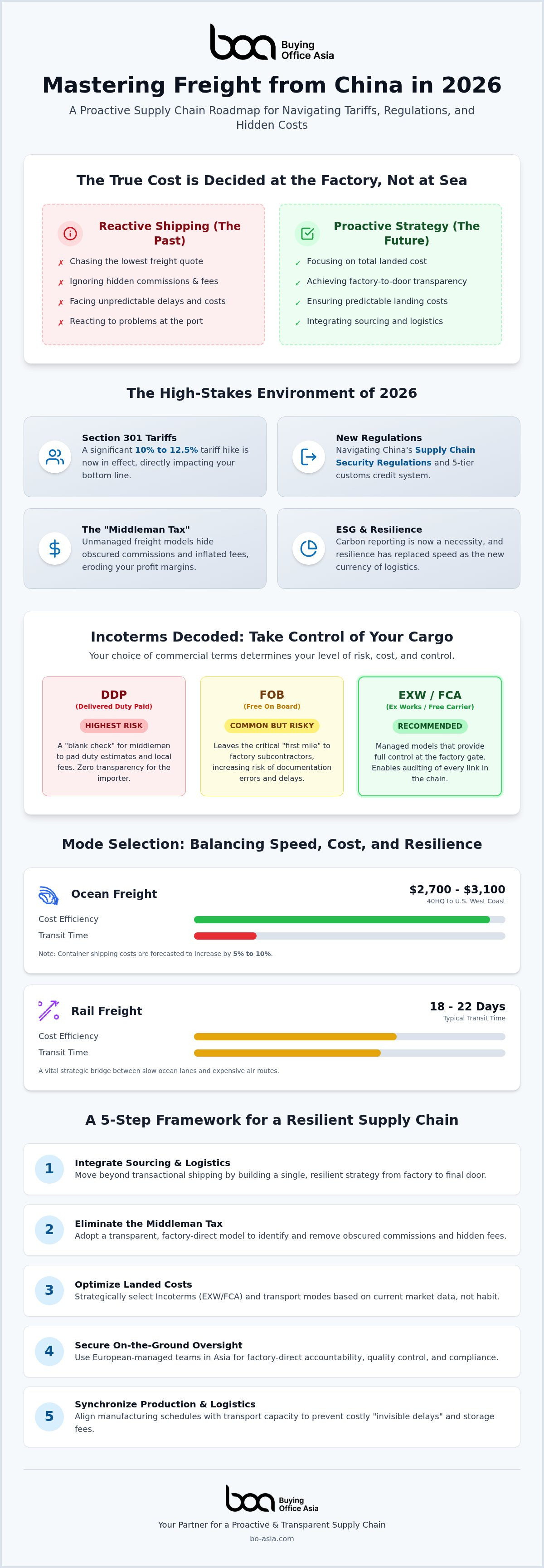
The true cost of your 2026 shipment isn't decided on the open water; it's determined the moment your goods leave the factory floor. If you've felt the sting of the 10% to 12.5% Section 301 tariff hikes that took effect in July, you already know that traditional shipping models are failing high-volume importers. We understand that managing freight from China has become a high-stakes game of regulatory chess where hidden fees and unpredictable delays threaten your bottom line.
This guide will show you how to regain control by moving your oversight directly to the source. You'll learn how to navigate the new Supply Chain Security Regulations and China's revised five-tier customs credit system to ensure your cargo moves without friction. By the end of this briefing, you'll have a roadmap for achieving predictable landing costs and factory-to-door security. We'll break down the shift toward digitized declarations and the strategic moves necessary to eliminate middleman markups for good. It's time to transition from a reactive shipping posture to a proactive, transparent supply chain that functions as an extension of your own team.
• Move beyond transactional shipping by integrating sourcing and logistics into a single, resilient strategy to navigate 2026's volatile regulatory environment.
• Identify and eliminate the hidden "middleman tax" that inflates costs; learn to master managing freight from China through a transparent model that removes obscured commissions.
• Optimize your landed costs by selecting the most efficient Incoterms and transport modes based on current 2026 market data and shipping trends.
• Secure your supply chain with on-the-ground European management to ensure factory-direct accountability and quality control before your cargo leaves the port.
• Implement a production-aligned logistics framework that synchronizes manufacturing schedules with transport capacity to prevent costly "invisible delays."
Managing freight from China in 2026 has evolved from a simple administrative task into a high-stakes strategic operation. High-volume importers can no longer rely on the transactional model of chasing the lowest freight quote. This "lowest-cost" mentality often ignores the expensive reality of hidden commissions, port storage fees, and the financial fallout of unpredictable lead times. A true strategy requires a total landed cost perspective. This means factoring in the 10% to 12.5% Section 301 tariffs that took effect in July 2026 and the administrative burden of China's new digitized customs declarations. Resilience is the new currency of the global supply chain, and it requires a seamless bridge between your sourcing decisions and your logistics execution.
Control over your cargo begins at the factory floor, not the shipping terminal. If you wait until production is finished to think about logistics, you're reacting to problems instead of preventing them. Integrating supplier vetting with your logistics planning ensures your partners are capable of meeting the strict 2026 documentation standards. A core part of this process involves understanding Incoterms to establish clear boundaries of risk and cost. When you negotiate factory-direct, you gain the transparency needed to eliminate the "middleman tax" that often inflates unmanaged freight. By managing the process at the gate, you secure your supply chain against the damage and documentation errors that typically occur when logistics are treated as an isolated event.
Managing freight from China successfully now requires navigating the "Regulations on the Security of Industrial and Supply Chains," which became effective on March 31, 2026. The current market demands a shift in focus from speed to structural resilience. We're seeing a significant move toward multimodal transport and port diversification to mitigate geopolitical volatility. Additionally, the rise of ESG requirements means that carbon reporting for China-to-Europe shipping lanes is no longer optional; it's a business necessity. Utilizing a European-managed firm with a physical presence in Asia provides a defense against these operational risks. This on-the-ground presence ensures that your shipments comply with the latest rules, such as the updated Dual-Use Item Export Catalog, providing the calm assurance that your goods will arrive as planned.
Efficiency in 2026 isn't just about speed; it's about the precision of your logistics architecture. Managing freight from China requires a cold, analytical look at how your product type interacts with current market volatility. With container shipping costs forecasted to increase by 5% to 10% this year, high-volume importers must move beyond the habit of defaulting to sea freight. A 40HQ container to the U.S. West Coast now ranges between $2,700 and $3,100, making the margin for error thinner than ever. Your choice of transport mode and commercial terms will either protect your profit or erode it through "invisible" administrative costs.
High-volume importers are increasingly moving toward managed EXW (Ex Works) or FCA (Free Carrier) models. While FOB (Free on Board) has been the industry standard for decades, it often leaves the critical first mile in the hands of the factory's chosen sub-contractors. This lack of transparency can lead to documentation errors that trigger customs delays later. DDP (Delivered Duty Paid) is even riskier for sophisticated buyers; without on-the-ground oversight, you're essentially handing a blank check to middlemen who pad duty estimates and local delivery fees. By defining a clear transfer of risk at the factory gate, you gain the ability to audit every link in the chain. If you're looking to tighten your oversight, you can speak with our Helsinki-led team to review your current agreements.
The 2026 landscape has elevated rail freight to a primary strategic tool rather than a niche alternative. Rail freight serves as the strategic middle ground by offering transit times of 18 to 22 days, providing a vital bridge between slow ocean lanes and expensive air routes. For high-volume clients, LCL (Less than Container Load) consolidation has also become more sophisticated. Instead of waiting for a full container from a single vendor, we're seeing a shift toward regional consolidation centers where goods from multiple vetted suppliers are combined to maintain a steady flow of inventory. Air freight should be strictly reserved for high-value sampling or emergency stock recovery to avoid the extreme premiums that currently define the 2026 air corridors. Integrating these modes into a cohesive plan through our logistics management services ensures that your lead times remain predictable even when global lanes are disrupted.
Unmanaged logistics from Asia often harbor financial leakages that high-volume importers overlook. Many traditional freight forwarders operate on a commission-based structure that incentivizes them to obscure the actual carrier costs. This "middleman tax" can quietly erode your margins, particularly when freight rates are volatile. Managing freight from China effectively requires a shift away from these opaque models toward a system of absolute transparency. When you rely on "all-in" quotes, you lose the ability to audit the individual components of your landed cost, such as local handling fees or documentation charges.
Traditional agents frequently hide their margins within the lump sum of a freight quote. This lack of clarity makes it nearly impossible to achieve meaningful pricing and savings over the long term. By contrast, a flat-fee service model treats your logistics team as an extension of your own company. Our physical presence in Hong Kong and Helsinki eliminates the "telephone game" that typically plagues international trade. Instead of messages passing through multiple intermediaries, you get direct coordination between the factory floor and the shipping lane. This proximity ensures that documentation is accurate the first time, preventing the "invisible delays" that occur when customs officials flag inconsistent paperwork.
Freight is a significant investment, yet many businesses unknowingly pay to ship defective products across the globe. Discovering a batch defect at your destination port is a financial disaster; you've already paid the manufacturing cost, the 2026 tariffs, and the high freight rates for goods you cannot sell. Implementing on-site quality control before the container is sealed is the only way to prevent this waste. Beyond basic quality, on-the-ground oversight ensures optimal container utilization. "Shipping air" due to poor packaging or inefficient stacking can increase your per-unit freight cost by 15% or more. Managing freight from China with a protective, hands-on partner means every cubic meter of your container is utilized effectively, securing your supply chain against both physical defects and financial inefficiency.
Optimizing your logistics requires a shift from reactive booking to a structured, data-driven framework. Managing freight from China successfully in 2026 hinges on your ability to synchronize manufacturing timelines with global transport capacity long before the cargo is ready. This five-step process provides the operational rigor needed to protect your margins and eliminate administrative friction.
Start planning at least 30 days before production ends. This allows for securing space on preferred lanes and avoids the premium costs of last-minute bookings.
We verify the cargo and the integrity of the packaging at the factory. This prevents damage during transit and ensures container space is not wasted on air.
We prepare all 2026-mandated filings, including digital declarations, before the vessel departs.
Our teams manage the transition from the port to your warehouse, ensuring local haulage is ready the moment the container is discharged.
Every shipment is a data point. We analyze transit times and landing costs to identify further efficiencies for your next order.
The 2026 regulatory environment is unforgiving. Accuracy in HS Codes and valuation is critical to avoid the "Customs Trap," where minor errors lead to expensive port storage fees. Since July 2026, China has moved toward paperless trade, making digital submission the default for all customs declarations. Your checklist must now include verified ESG certificates to comply with evolving European sustainability reporting requirements. Ensuring these documents are consolidated at the source prevents the bottlenecks that typically occur when paperwork is managed by distant third parties. Managing freight from China with this level of precision ensures that your goods move through customs without unnecessary scrutiny.
High-volume importers often source from multiple vendors across different OEM/ODM manufacturing hubs. Instead of shipping multiple LCL orders, we consolidate these into a single Full Container Load (FCL). This strategy significantly reduces your cost per unit and simplifies the customs entry process. By leveraging regional consolidation centers, you gain the same level of control over small-batch production that major enterprises enjoy. It's about maximizing every cubic meter of space you've paid for. If you need assistance building a more resilient logistics framework, contact our Helsinki office to discuss your specific volume requirements.
Scaling a high-volume import business requires a shift in perspective. You can't manage a complex 2026 supply chain through a web portal alone. True ROI comes from having a physical presence in the manufacturing hub, where problems are solved before they reach the water. Managing freight from China at this level means moving away from transactional shipping and toward a fully integrated procurement model. Buying Office Asia functions as a direct extension of your own company, providing the same level of oversight usually reserved for major multinational corporations. We don't just book space; we protect your financial interests at every stage of the manufacturing process.
The primary barrier to efficiency is often the communication gap. Our Helsinki-led leadership provides the security and cultural alignment you expect from a European partner, while our Hong Kong office delivers deep operational expertise. This bridge eliminates the time zone friction that often causes delays in document approval and production oversight. While generic forwarders treat your cargo as a commodity, dedicated sourcing teams focus on the entire lifecycle of the order. This includes on-site factory inspections and direct price negotiations, ensuring your landed costs remain predictable even when market rates fluctuate. You gain the steady confidence of an established expert without the overhead of maintaining your own regional office.
As we move through the complexities of 2026, resilience is built on partnerships, not just platforms. A resilient strategy requires a final audit of your current vulnerabilities. Ask yourself if you have 100% transparency into your service fees or if you're still paying a hidden middleman tax. A secure strategy must include:
• Factory-direct accountability from the start of production.
• On-site quality control to prevent shipping defective units and wasting freight costs.
• Consolidation of multiple vendors to maximize container utilization.
• Strict adherence to the latest 2026 ESG and digital customs regulations.
The transition from unmanaged shipping to a strategic partnership is the most effective way to protect your brand and your bottom line. Managing freight from China shouldn't be a source of anxiety; it should be a stabilized, predictable component of your growth. If you're ready to secure your operations and eliminate hidden inefficiencies, consult with our experts to audit your current freight strategy and discover how we can function as your on-the-ground ally in Asia.
The 2026 trade landscape demands more than just a booking agent; it requires a strategic defense against rising tariffs and regulatory complexity. By moving your oversight to the factory floor and eliminating the middleman tax, you transform your supply chain from a source of anxiety into a stabilized financial asset. We've explored how a structured framework and the right choice of Incoterms can protect your margins while ensuring factory-to-door security.
Managing freight from China is most effective when your logistics partner functions as an integrated extension of your own team. With European leadership and over 15 years of regional expertise in Hong Kong, Buying Office Asia provides 100% transparency with zero hidden commissions. We provide the end-to-end oversight necessary to navigate digitized customs and ESG reporting with absolute confidence.
Secure your supply chain; contact our procurement experts today to audit your current strategy and lock in a more resilient future. Your growth depends on the stability we provide.
Expect a 5% to 10% average increase in container costs throughout 2026 due to geopolitical volatility and peak season demand. While specific China-to-Europe rates fluctuate, current trends mirror the global projections that see 40HQ container costs rising steadily from 2025 levels. Managing freight from China requires budgeting for these escalations and securing vessel space at least 30 days in advance to mitigate the impact of spot market spikes.
Opt for EXW (Ex Works) or FCA (Free Carrier) when you have a dedicated procurement team on the ground to manage the first mile. While FOB is common, it allows the factory to control local transport and documentation, often hiding commissions in the price. High-volume importers gain more transparency and control by taking over the logistics at the factory gate, ensuring every handling fee is audited and every document is accurate.
Customs clearance in 2026 requires a digital-first approach with the Bill of Lading, Commercial Invoice, and Packing List submitted via electronic platforms. You must also include the correct HS Codes and, increasingly, ESG certificates for sustainability compliance. Since July 2026, paper forms are no longer the default in China. Failure to provide accurate electronic data can trigger audits under the new five-tier customs credit management rules.
Yes, a sourcing agent reduces costs by consolidating shipments from multiple vendors and negotiating factory-direct pricing that removes hidden middleman markups. By eliminating the all-in quote model used by traditional forwarders, you pay only the actual carrier rates plus a transparent service fee. This approach leads to measurable improvements in your total landed costs through better container utilization and a significant reduction in expensive documentation errors.
Chinese New Year begins on February 17, 2026, and typically causes a total production standstill for two to three weeks. You should finalize your shipments at least four weeks before this date to avoid the pre-holiday cargo rush and extreme rate hikes. Managing freight from China during this window requires a buffer inventory strategy to prevent stockouts while factories and ports operate at reduced capacity during the festive period.
On-site inspections prevent the financial waste of shipping defective goods that would otherwise be discovered only at the destination port. By verifying product quality and packaging integrity before the container is sealed, you eliminate the need for expensive return logistics or disposal fees. Proper packaging verification also ensures that your container space is fully optimized, which directly reduces your freight cost per unit and prevents transit damage.
Rail freight is a highly viable middle ground in 2026, offering transit times of 18 to 22 days compared to 35 or more days for sea freight. It's particularly effective for high-value electronics or seasonal goods that require faster turnarounds than ocean lanes allow. While more expensive than sea transport, it remains significantly cheaper than air freight, providing a strategic balance between speed and your total landed cost.
Use your carrier's primary data and digital declarations to calculate CO2 emissions based on the weight, distance, and transport mode of each shipment. In 2026, European sustainability regulations require high-volume importers to document the environmental impact of their supply chains. A managed procurement team provides the transparency needed to collect this data directly from the source, ensuring your ESG reporting is accurate, verifiable, and compliant with current EU standards.

As of July 2026, the average effective tariff rate on Chinese imports has climbed to 22.8%, but is the cost on the invoice really your biggest financial risk? You likely feel the mounting pressure of managing a supply chain where the rules of engagement change every quarter. The challenges of sourci...

Is your current China manufacturing management strategy robust enough to survive the regulatory shifts of 2026? With the recent implementation of Decree 834 and the new "Made in China" procurement standards, the distance between a successful product launch and a costly supply chain failure has never...

What if your final quality check isn't just a formality, but the only thing standing between a successful product launch and a container full of unsellable defects? For many businesses, the fear of receiving substandard goods from overseas is a constant anxiety, often compounded by communication bar...