


The fastest option isn't automatically the best-value option. Air freight usually shortens the international transport leg, while sea freight often offers better economics for larger shipments with flexible delivery dates. Actual door-to-door timing and cost depend on the route, service, capacity, cargo-ready date, customs handling, and final destination, so compare current quotations on the same scope.
It’s understandable to focus on freight cost, but the right choice also depends on when your goods are needed, how much cargo you’re moving, and what a delay would mean for your business. When comparing air freight vs sea freight from China, a lower transport quote may not mean a lower overall cost if slower delivery ties up inventory or leaves you short of stock.
This comparison explains how urgency, shipment volume, cost, schedules, handling, and cargo safety affect the decision. You’ll also learn when splitting a shipment can balance speed and budget, and what to compare before choosing air or sea for your next import.
• Match the freight mode to shipment volume and delivery urgency, rather than relying on weight alone.
• Compare chargeable weight and total shipment costs, not just the quoted rate per kilogram.
• Consider LCL for smaller ocean shipments and compare it with FCL as volume grows.
• Weigh schedule flexibility, handling, and cargo protection against transit time and freight cost.
• Consider splitting a shipment when some goods are urgent but the remaining stock can travel by sea.
Choose air for urgent, compact shipments; sea often suits larger volumes with more flexible delivery dates. US customs duties, import taxes, and clearance fees depend on the product and shipment details, not simply on whether it travels by air or sea.
Shipment volume measures how much space the cargo occupies, while weight measures how heavy it is. Both affect the freight decision. Small ocean shipments can carry minimum and handling charges, while air pricing is sensitive to chargeable weight. There is no reliable universal volume or weight threshold at which one mode becomes cheaper. Compare shipment-specific air, LCL, and FCL quotations using the final packed dimensions, weight, route, and delivery scope.
Delivery urgency changes the calculation. A delayed launch shipment or stockout can make speed more valuable than the freight savings from sea transport. Regular importers can send planned base stock by sea and use air for urgent replenishment. Shipment value and frequency matter too: for valuable goods or recurring orders, weigh the cost of faster arrival against the business impact of inventory tied up in transit.
For air freight, physical weight is not the only pricing measure. Bulky packaging can occupy substantial aircraft space despite a low scale weight, so carriers may use volumetric weight to calculate chargeable weight. Conversion methods can differ by carrier and service. Ask each provider to state the divisor or conversion factor used and confirm which dimensions and weight support the quotation.
For example, a light but oversized carton may be billed by the space it occupies rather than its scale weight. A dense shipment may instead be charged by actual weight. Ask the freight forwarder to show the shipment dimensions, actual weight, volumetric calculation, and chargeable weight separately. This helps you assess the premium for urgent transport against the cargo’s size and delivery deadline.
| Option | Urgency | Shipment size and weight | Frequency and value |
|---|---|---|---|
| Air freight | Fits urgent delivery needs | Often suited to compact shipments | Useful for high-value replenishment |
| Sea freight | Fits planned delivery dates | Often suited to larger volumes | Useful for regular base stock |
| Split shipment | Prioritizes urgent units | Divides urgent and bulk cargo | Balances replenishment and planned stock |
Compare the shipment as packed, not just the product dimensions. Cartons, protective materials, and palletization can change total volume and chargeable weight. A compact sample order may suit air; a larger production run of the same product may make sea freight more economical.
Choose by matching the delivery deadline, packed volume, chargeable weight, and stock plan. If only part of an order is urgent, send that portion by air and the rest by sea.
Air freight may offer shorter transit and more frequent departures on some routes, while sea freight can be affected by port congestion, labour disruption, weather, and route changes. Both modes can face delays or cargo damage, so compare the actual service schedule, route, packaging, handling plan, customs process, and insurance terms.
Air freight transports goods by aircraft. It often offers frequent departures and more flexibility to reroute than sea freight, which can help when delivery dates are tight. Air cargo is a broader term that can include smaller packages and courier shipments, as well as freight carried on cargo aircraft or in passenger-plane holds.
Aircraft schedules are not immune to disruption. Capacity constraints, weather, or missed connections can still affect a shipment. Protect products with packaging suited to their weight, shape, and fragility. For example, a product with a delicate finish needs protection from movement and contact during handling, not just a fast route from China.
Sea freight moves cargo in a dedicated container load or shared container space. Shared LCL shipments involve more handling, which can increase exposure to scuffs, shifting, or packaging damage. Container transport can also be affected by port congestion, strikes, weather, and geopolitical disruption.
For finished goods, match carton strength and internal protection to stacking and transit conditions. Keep a record of packing details and the cargo’s condition before dispatch. Sea freight can suit planned imports, but a longer route and fewer departure options leave less flexibility when disruptions occur.
Air and sea services differ in the cargo and space they can accommodate. Aircraft capacity is constrained by available space and cargo characteristics; container freight is organized around container dimensions, weight limits, and loading arrangements. A freight forwarder can assess the shipment’s dimensions, gross weight, packaging, and handling needs against the selected service.
Some goods need special handling or may face carrier restrictions. Provide an accurate product description and packaging details when arranging transport from China. This helps the forwarder identify service limits before booking, rather than after the cargo reaches a terminal.
Review insurance separately. Compare the policy’s covered risks, exclusions, valuation basis, and claim-document requirements with the shipment’s value and route. Keep commercial documents, packing records, and evidence of cargo condition together. Customs clearance and transport insurance are separate considerations; neither mode removes the need to understand the coverage arranged for the shipment.
To assess packaging and movement risks before production, discuss your shipment requirements with Buying Office Asia.
Choose air for time-sensitive cargo and sea for planned shipments where freight economy matters more than speed. Common US gateways include Los Angeles International Airport (LAX), Chicago O’Hare International Airport (ORD), and John F. Kennedy International Airport (JFK) for air cargo, and the Ports of Los Angeles, Long Beach, and New York and New Jersey for ocean freight. Your destination and onward transport affect delivery time and total cost.
Air freight suits urgent cargo, including electronics needed for replenishment or a production schedule. Its international leg is generally faster than ocean transport, but the final delivery estimate also depends on pickup, customs clearance, handling, and the US destination. A shipment arriving at LAX may require substantial inland transport for delivery to the East Coast, affecting both timing and total logistics cost.
Ocean freight is often more economical for larger shipments when delivery dates allow a longer journey. A West Coast arrival through the Port of Los Angeles or Port of Long Beach may suit cargo destined for western states. For an East Coast destination, the Port of New York and New Jersey may reduce inland distance, depending on the final address and available service.
Compare routes using the same starting point and final destination. An airport or seaport is an intermediate gateway, not the delivery endpoint. The air freight vs sea freight from China decision should account for customs, terminal handling, and onward transport, not just the international leg. A cheaper gateway can lose its advantage if inland delivery adds time or cost.
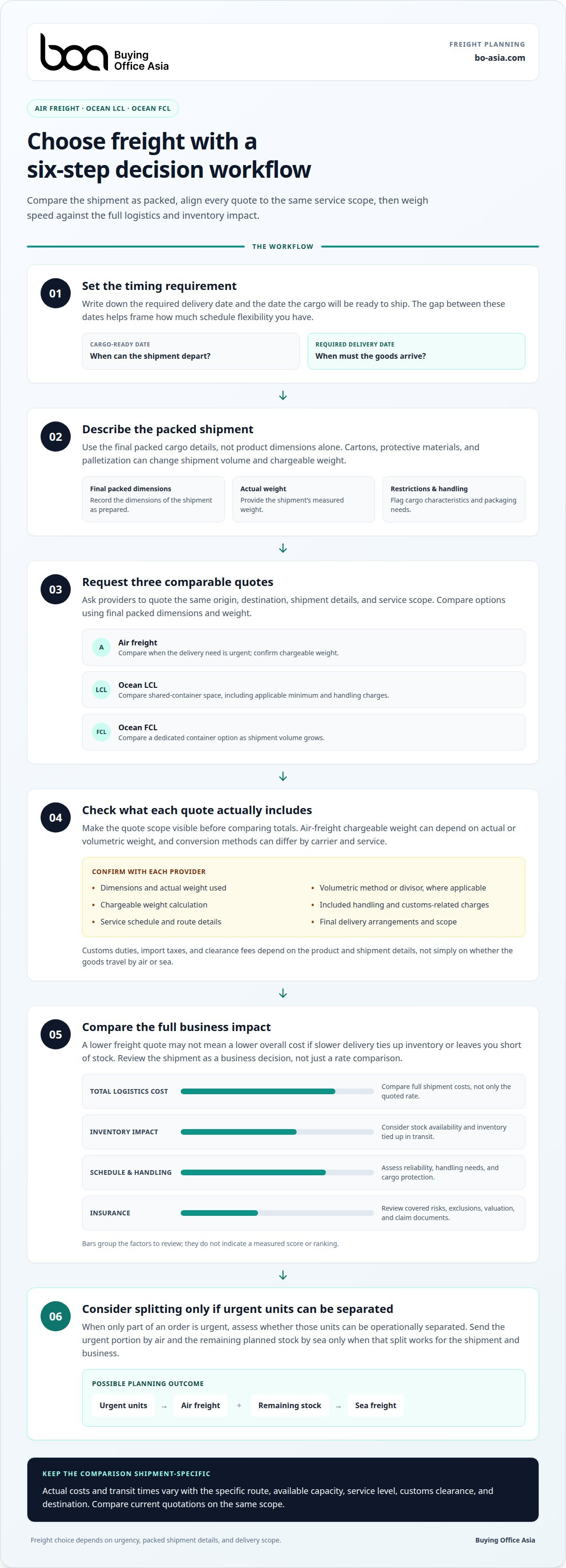
Use this decision sequence:
Work backward from the launch, production, or sales deadline.
Compare the international route and inland movement to the delivery address.
Weigh inventory tied up in transit against the impact of a stockout.
If only part of the order is urgent, send that portion by air and the rest by sea. This can protect a launch while keeping planned inventory on a slower schedule.
Compare the full import cost, not just the headline freight rate. Shipment size, service type, handling, inland transport, and timing can all affect which option is the better financial fit.
To arrange either mode, provide cargo dimensions, packed weight, product details, pickup location, delivery address, and the date the goods will be ready. Compare quotations with the same service scope, then account for booking, documentation, customs clearance, and final delivery. This helps distinguish a rate for one transport leg from the cost of moving the shipment to its destination.
Live freight rates can change quickly. Use current quotations for the specific route and cargo, and record the quote date, validity period, included services, and delivery basis before comparing options.
A small LCL shipment can cost more than expected because it includes shared-container handling and shipment-specific charges. At higher volumes, compare LCL with full container load (FCL) pricing. That figure alone doesn’t establish the cheaper option: the cargo must use enough container capacity to make a dedicated load practical.
Often fits urgent cargo when a delay would disrupt sales, production, or a launch.
Shares container space and can suit smaller, non-urgent shipments, with additional handling and longer transit.
Uses a dedicated container; compare its total quoted cost with LCL for the actual shipment volume.
Rates and schedules can change. Port congestion and seasonal conditions may affect ocean freight, while last-minute air bookings can cost more than advance bookings. Ask for an itemized quotation that identifies transport, origin and destination handling, customs-related charges, and delivery to the same address. Compare the same service scope, rather than an airport or port rate with a door-to-door quote.
Include inventory impact in the decision. Slower sea transport may reduce freight spending, but a delay can tie up stock or affect sales. Air’s speed may justify higher transport costs when goods are needed for a launch or replenishment. For planned imports, sea can offer better value when shipment size and delivery schedule suit the mode.
Use the comparison to weigh shipment size and total logistics cost against speed, stock availability, and exposure to delays.
Treat this as a reference, not a fixed tariff: billable weight, route, service level, booking timing, and included charges can change the final amount.
Start by identifying the shipment’s chargeable weight. Carriers may price by actual weight or volumetric weight, whichever is higher. This matters for light, bulky cartons: a shipment that weighs less on a scale can still occupy enough aircraft space to be billed at a higher chargeable weight. Provide final packed dimensions and weight for a useful quotation.
Then compare the rate basis. A per-kilogram figure may cover the air transport leg but exclude origin handling, destination handling, customs-related charges, or delivery to your US address. A door-to-door quotation covers a broader movement. Ask for an itemized scope so you don’t mistake an airport-to-airport rate for the full import cost.
Service type also affects the comparison. Standard air freight, express courier, and other air services can have different pricing structures, volumetric-weight formulas, and delivery arrangements. Ask each provider to show the applicable calculation and compare quotations using the same packed dimensions, actual weight, origin, destination, and service scope.
Before accepting a quote, line up these details across options:
Confirm whether the rate uses actual or volumetric weight and what dimensions the calculation uses.
Separate air transport from pickup, handling, customs clearance, and final delivery.
Check the quote’s validity and whether the service is standard or urgent.
Air freight’s advantage is speed, particularly for urgent, compact cargo or replenishment that protects a launch or prevents a stockout. Weigh its higher per-kilogram cost against the business impact of waiting for slower ocean transport. For recurring imports, a planned sea shipment for base stock and air for urgent units can balance timing and inventory needs.
Use the same packed dimensions, destination, and service scope when comparing quotes. Discuss freight planning for your import with Buying Office Asia.
Buying Office Asia connects freight decisions with the wider sourcing and procurement plan. When shipment timing, order volume, and supplier coordination all affect your US delivery schedule, an end-to-end view can help bring those decisions together.
For larger import programs, high-volume sourcing and procurement, factory-direct price negotiations, and a dedicated Asia procurement team can support clearer coordination from supplier discussions through production planning. This context helps you weigh air, sea, or a split shipment alongside order readiness and replenishment needs, rather than treating freight as an isolated cost.
Turn to Buying Office Asia when you need sourcing and procurement support in Asia alongside practical planning for your import flow. Contact Buying Office Asia to discuss your requirements.
Make the next shipment decision before production is complete. Set a clear arrival requirement, identify which goods cannot miss it, and align the freight plan with your sales or production calendar. This turns the air freight vs sea freight from China decision into a repeatable procurement step, rather than a last-minute response to stock pressure.
For your next purchase order, document the delivery destination, packed shipment details, and business impact of a delay. Keep that information alongside the supplier’s readiness date so the transport plan reflects the goods you will actually ship. When timing or volume changes, revisit the plan before booking instead of relying on an outdated estimate.
For support connecting freight planning with your wider sourcing requirements, contact Buying Office Asia. A well-prepared import plan gives your team a stronger basis for making the next decision with confidence.
Air freight is often practical when missing a delivery date would interrupt a specific commitment. For example, a manufacturer facing a production stoppage may prioritize replacement components and send unrelated stock separately. Before choosing, identify the goods tied to the deadline and confirm their production release date. Cargo that is not ready for collection cannot benefit from an earlier flight booking, so readiness is central to an urgent shipment plan.
Air freight may cost less for a small shipment when the ocean option has minimum charges, separate handling, or other fixed costs that outweigh its lower transport rate. The comparison depends on packed dimensions, weight, service scope, and destination. Request comparable quotations for the actual consignment, including collection and delivery arrangements. A low per-kilogram figure alone won’t show which option has the lower total cost.
The better fit depends on how your business replenishes stock and fulfills commitments. A company supplying components to a continuous production line may prioritize continuity, while a business with planned seasonal releases may align imports with its purchasing calendar. Consider whether goods are interchangeable, whether customers can accept staggered delivery, and how much flexibility the launch or production plan allows. These operating realities help turn a mode choice into a repeatable shipping policy.
Use a consistent comparison process for each shipment. Confirm when the supplier will release the packed goods, define the delivery point, and request quotations using identical cargo details and service boundaries. Then record the reason for the choice, such as a customer deadline or planned replenishment. Comparing that record with actual arrival and invoice details can help refine future procurement decisions without treating one shipment as a universal rule.
Splitting can work when different products in one order have different arrival priorities. Separate the urgent SKUs from the rest, assign each group its destination and required delivery date, and prepare clear carton identification and shipment documents for both consignments. Account for the extra coordination involved in receiving and reconciling separate deliveries. This approach is less useful when the order must arrive together for assembly, bundling, or a single customer commitment.
Air and ocean services both depend on accurate cargo information, suitable packaging, carrier acceptance, and coordinated handoffs. Cargo characteristics can affect available services, while a missed connection, port disruption, or documentation issue can alter the planned movement. Insurance terms matter too: review covered events, exclusions, and claim-evidence requirements before dispatch. Build these operational checks into the shipment plan, especially for fragile, regulated, or high-value goods.
Request an ocean groupage quotation based on the shipment’s packed dimensions, weight, origin, and final destination. Then compare the full service scope with other suitable options, paying attention to minimum charges, handling, and delivery arrangements. Small orders may also be consolidated with later production if the supplier can hold them and the schedule allows. This can change the shipping economics, but it must fit inventory needs and supplier readiness.
Air generally has a shorter transport interval, while ocean takes longer in transit. For an operational estimate, distinguish the supplier’s cargo-ready date from carrier departure, arrival, customs processing, and final delivery. A quote based on port-to-port movement won’t represent the full receiving schedule. Ask for the expected milestones and include internal receiving, inspection, and inventory-release steps in the date your team uses for planning.

Supplier coordination works best when everyone knows when decisions will be made, what can happen asynchronously, and which local time zone applies to each deadline. Managing different time zones with suppliers means setting a practical window for live discussions, documenting updates for people who...

A shipment can be ready to move and still be held at the border. The customs clearance process for imports determines whether goods can enter their destination market, which documents are reviewed, and what duties or fees may be due. The exact requirements depend on the goods and the country they’re...

Distance can turn a small production issue into a coordination problem. The benefits of having a team on the ground in Asia include closer alignment between regional operations and your wider business. Local presence can connect strategy with supplier activity, product decisions, and day-to-day coll...