


Distance can turn a small production issue into a coordination problem. The benefits of having a team on the ground in Asia include closer alignment between regional operations and your wider business. Local presence can connect strategy with supplier activity, product decisions, and day-to-day collaboration. Instead of treating Asia as a distant sourcing location, companies can build clearer ways to coordinate work across teams.
You may have clear manufacturing goals and capable colleagues, but still need a stronger link between activity in Asia and your business priorities. The benefits of having a team on the ground in Asia include more responsive supplier coordination, better local context, and clearer compliance planning. This article explains how local presence can help international and regional colleagues work toward shared objectives, when dedicated procurement support makes sense, and what to consider before choosing its scope. Asian markets and supplier relationships are not interchangeable. Assess where proximity adds useful context, where coordination needs attention, and how a regional partner could make your manufacturing strategy more informed and manageable.
• Local presence can help resolve supplier questions faster by improving communication and visibility into production issues.
• Regional insight can inform product decisions by bringing local market context and customer preferences into sourcing discussions.
• Compliance requirements differ across Asian countries, so assess the destination market and product requirements as part of sourcing strategy.
• Clear roles, reporting lines, and escalation paths help connect local supplier coordination with your internal team’s decisions.
• A dedicated procurement team can support supplier coordination, sourcing decisions, and factory-direct negotiations when managing production across Asia.
An on-the-ground team can shorten the gap between a supplier update and your next decision. Its value goes beyond faster messaging: local staff can clarify factory responses, gather missing production details, and explain an issue with enough context for your team to act. This is especially useful when a drawing, sample, or production instruction needs clarification before work continues.
Time zones can complicate routine support. Your procurement team may finish its workday just as a supplier in Asia starts theirs, leaving questions unresolved until the next overlapping window. A regional team can follow up during local working hours and send a documented update to the right decision-makers. It cannot eliminate time-zone differences, but it can reduce unanswered handoffs.
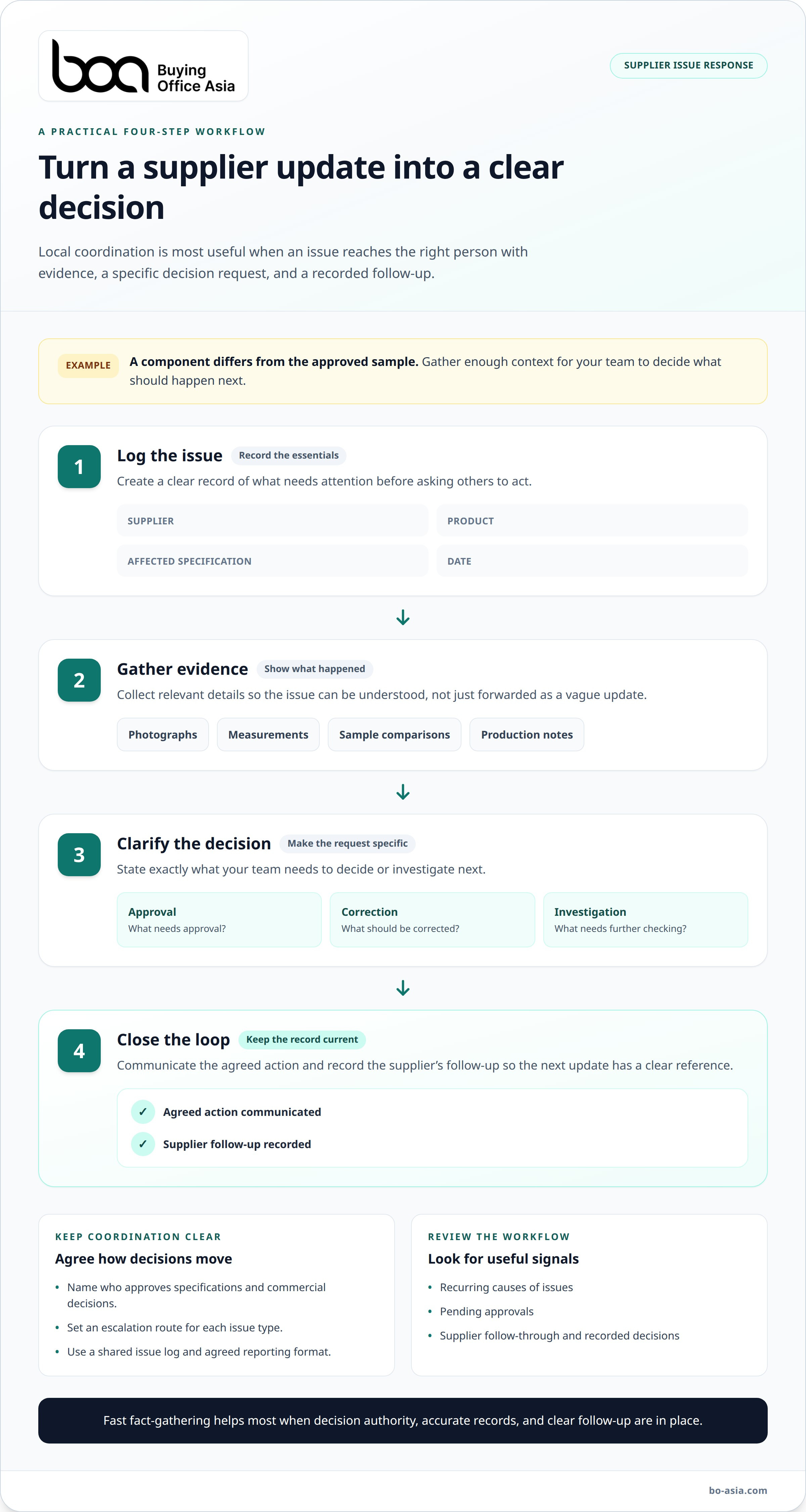
Responsiveness depends on a clear escalation path. If a factory reports that a component differs from the approved sample, for example, a local representative can request photographs, identify the production stage involved, and clarify whether other components or orders are affected. Your team then receives evidence and a specific decision request, rather than a vague message that something is wrong.
A useful response workflow has four practical steps:
record the supplier, product, affected specification, and date.
obtain relevant photographs, measurements, sample comparisons, or production notes.
state what needs approval, correction, or further investigation.
communicate the agreed action and record the supplier’s follow-up.
This approach makes support more actionable because each update points to a specific decision. If a printed box has a colour mismatch, the local contact can help distinguish an artwork-file issue from a factory-process problem. Your team can then decide whether to review the proof, examine a production sample, or discuss corrective work. That is more useful than forwarding a brief message without context.
Physical proximity also helps when a concern needs observation, not another email. A representative can discuss the issue with factory staff, review the relevant work area when access is arranged, and report what they observed. Direct discussion may uncover misunderstandings about terminology, responsibility, or the next task. Written follow-up still matters: it records decisions and reduces the risk of different interpretations of verbal agreements.
Clear roles make local support more reliable. Your internal team should know who approves specifications, who makes commercial decisions, and who receives urgent quality updates. The local team needs the same clarity. A shared issue log, named decision owners, and an agreed reporting format help prevent duplicate requests and conflicting instructions. Reliable follow-through and transparent communication build trust.
In product development, such as creating a collectible figure with several components, local coordination can turn sample feedback into clear factory actions. A representative can organize comments by component, separate approved changes from open questions, and relay consolidated instructions. This helps prevent stakeholders from sending inconsistent feedback. Clear, documented instructions show the factory which changes are approved before production moves forward.
Response quality still depends on decision access. A local contact may gather facts quickly, but unresolved artwork approval, specification changes, or budget authority can hold up the answer. A practical arrangement sets an escalation route for each issue type and identifies the person who can decide. A locally coordinated sourcing team can help connect supplier communication with your procurement workflow.
Assess support by whether issues reach the right person with actionable evidence, not by message volume. Track recurring causes, pending approvals, supplier follow-through, and whether decisions are recorded. These signals show where coordination works and where responsibilities need clarification. The benefits of having a team on the ground in Asia are strongest when local responsiveness is matched by clear authority, accurate records, and communication your wider team can use.
Local teams can turn broad market assumptions into questions about a particular product, audience, and sales channel. Asia is not one consumer market, so an observation from one country or channel should not automatically guide decisions elsewhere. Regional context can help clarify what buyers notice, how products are presented, and which features to evaluate before committing to a design direction.
Useful feedback starts with a clearly defined audience. A home and lifestyle brand, for example, might assess whether buyers value compact storage, easy assembly, or a particular surface finish. Local contacts can clarify whether comments came from retailers, distributors, or end users. The distinction matters: a retailer’s concern about shelf space may not reflect customers’ preferences for the product itself.
Teams can also review how a product is described and displayed in its intended sales channel. An item presented as a practical household product may need different packaging cues from one positioned as a premium gift. Local observations can raise questions about wording, imagery, or presentation for further review. They should inform decisions, not be treated as proof that every buyer in a market shares the same preference.
A structured feedback note makes observations easier to compare:
record the country, channel, and type of respondent.
describe the feature or presentation that drew a reaction.
capture the respondent’s explanation, not just a positive or negative verdict.
connect the observation to a design, packaging, or positioning question.
If local feedback suggests that packaging looks difficult to store, identify what creates that impression. The dimensions, opening method, internal layout, or visual design could each be a factor. Separating the cause from the initial reaction helps the product team assess an appropriate change and avoid a broad redesign when a targeted adjustment may address the concern.
Local teams can also help interpret language and communication styles. A brief answer may reflect a specific concern, politeness, uncertainty about the question, or a different understanding of a product term. A focused follow-up can reveal whether the issue is about usability, appearance, or value. Recording the context helps your team avoid treating an interpretation as a direct statement of customer preference.
Market observations can inform product specifications without dictating them. If contacts in a retail channel prefer a lighter material, the team can weigh that feedback against durability expectations, product function, and manufacturing implications. A change that makes the product easier to handle could affect its finish or perceived quality. Local insight helps frame the trade-off; product and commercial teams decide which priorities take precedence.
Use recurring feedback to identify topics worth deeper investigation. If separate conversations raise the same question about instructions or product setup, that may justify reviewing the user experience. If feedback differs by channel, preserve those distinctions rather than averaging them into one conclusion. A clear record of the audience, product version, and context makes later decisions more useful and limits overgeneralization.
Regional insight works best alongside your own sales objectives and customer research. It can reveal overlooked questions and help frame product choices, but it cannot establish demand across an entire country by itself. Define the decision that needs support, then connect observations to a specific design or positioning choice. To discuss how local market context could inform your sourcing plans, contact the team about your project.
Compliance planning starts with a clear product description, destination market, and intended use. A promotional desk accessory, a children’s toy, and an electrical product raise different questions. Local coordination can connect these details with supplier records and production processes, while helping surface information gaps before they affect packaging, sampling, or production decisions.
Asia includes distinct markets, such as China, Japan, and Singapore. A requirement relevant to one destination should not automatically be assumed to apply to another. Local teams can organize information by country and product, then route questions to the appropriate technical or regulatory specialists. This keeps market-specific decisions visible instead of bundling several destinations into one assumption.
A useful compliance file starts with the product itself. For a board game, for example, it could describe the intended audience, component materials, printed instructions, packaging, and destination. For a figurine, it could record its intended use, materials, decoration, and whether it is marketed as a collectible or a toy. These details help clarify what needs assessment before production specifications are finalized.
Local teams can help gather and organize items such as:
intended use, audience, components, materials, and destination markets.
available material declarations, production records, and test documents relevant to the product.
approved files, product claims, labels, and instructions for review.
unresolved requirements, responsible decision-makers, and actions needed before production proceeds.
Consider a collectible figure with painted details and small accessories. A local team can compare the approved specification with supplier documents, identify missing information, and record questions that still need a decision. If the intended age group or marketing changes, the compliance discussion may also need to change. Keeping the product description current helps prevent outdated assumptions from carrying over to packaging or production.
Clear records matter when a product includes several parts or suppliers. A tabletop game might combine cards, a board, plastic pieces, and a storage insert. The local coordinator can map each component to its material information and supplier documentation. This makes it easier to see whether the file covers the complete product, not just its main component, and gives product and procurement teams a shared reference for decisions.
Local teams can help translate a requirement into a production question. If a packaging label changes, for example, the coordinator can relay the approved artwork version and clarify which packaging materials are affected. A dated approval record distinguishes the current file from earlier drafts. This reduces the risk that a factory follows an outdated instruction or applies a change to only part of an order.
Good compliance coordination does not mean treating a supplier’s document as automatic proof that every product requirement is met. The document must relate to the product, materials, intended use, and destination under consideration. A team can track those links, flag missing or mismatched records, and keep decisions traceable. For products involving food contact, electrical functions, or toy use, the product category and intended use need particular attention.
For a multi-market launch, maintain separate records for each destination and product version. A change to a coating, component, label, or intended audience can affect which documents remain relevant. Local coordination can keep the factory’s instructions aligned with approved specifications while your team retains visibility over open decisions. Discuss compliance coordination for your sourcing project with Buying Office Asia to connect product and supplier details with the right production follow-up.
Comprehensive tracking requires monitoring the full range of components under review and checking whether supplier records have been gathered for each. This information is useful only when people can communicate clearly about what is present, what remains uncertain, and what needs a response. Team communication practices help employees discuss complex details clearly, ask targeted questions, and share constructive feedback that supports everyday workplace interactions.
These habits support conversations among colleagues handling different parts of a product review. Clear questions make missing documents and unresolved points easier to identify, while careful listening gives people room to explain what they know and where they need clarification. Focused feedback keeps discussion on the information still needed and helps prevent assumptions from passing unexamined. Local coordination can bring these exchanges together so teams consider product details, supplier records, and open questions in relation to one another. Technical or regulatory specialists can then address issues that require their judgment. This communication does not replace market-specific expertise; it helps teams share information and surface unresolved questions before production decisions move forward.
Buying Office Asia provides a Dedicated Asia Procurement Team to coordinate supplier communication and procurement for international businesses manufacturing in Asia. Consider this support when managing factory relationships, sourcing decisions, and production requirements across the region is straining your internal team. End-to-End Sourcing & Procurement connects supplier coordination with factory-direct price negotiations, helping align decisions and commercial discussions. For larger production needs, high-volume sourcing and procurement can support the coordination of purchasing requirements. The right scope depends on your suppliers, product requirements, and the procurement support your team needs. If you are planning production in Asia and want a coordinated procurement partner, contact Buying Office Asia to discuss your project.
The benefits of having a team on the ground in Asia are greatest when local insight informs decisions your business can act on. Start by identifying where your current approach needs stronger coordination: supplier selection, purchasing across multiple factories, or aligning regional activity with company priorities. This helps define the right scope for procurement support without adding unnecessary complexity.
Buying Office Asia offers a Dedicated Asia Procurement Team, End-to-End Sourcing & Procurement, and high-volume sourcing and procurement. These services support businesses seeking a closer connection between sourcing strategy and supplier coordination. Start with a clear view of your product requirements, target markets, supplier situation, and internal decision process. Procurement support can then be tailored to the work that matters most to your operation.
Put your next sourcing decision on a more coordinated footing. Discuss your Asia procurement needs with Buying Office Asia, and take a confident next step toward a strategy your team can manage.
The main benefits include more continuous supplier relationships and consistent oversight across sourcing workstreams. A local team can build familiarity with how suppliers handle requests, communicate changes, and coordinate internally. That context helps your business maintain clearer working relationships as projects evolve or repeat orders begin. It also frees your internal procurement staff to focus on commercial priorities and product decisions instead of managing every local interaction themselves.
Staff in Asia can create a practical collaboration rhythm between teams that rarely share a full workday. Reserve overlapping hours for decisions that need live discussion, such as approving a revised component or resolving competing priorities. Use asynchronous updates for routine progress, with a clear status, decision owner, and next action. This gives colleagues time to prepare and keeps meetings focused on decisions rather than lengthy recaps.
Time-zone gaps can leave supplier questions unresolved. Unclear roles or decision authority can lead to duplicate requests, conflicting instructions, or delayed approvals. Market preferences and compliance requirements also vary by country, so assess local observations in context rather than generalizing across Asia.

A container can be ready to move and still incur port charges. The practical question is what demurrage is and how to avoid it: demurrage is a charge for cargo left at a port or terminal beyond its agreed free time. The amount depends on the applicable rate and how long the cargo remains there.That...

Knowing how to manage overseas manufacturing projects starts with comparing total landed cost, not just the factory quote. Include tooling, freight, tariffs and duties, insurance, management time, and the cost of correcting problems. Weigh those expenses against product quality, delivery risks, and...

The biggest risk in contract manufacturing in India is not simply finding a factory. It is starting production before product specifications, responsibilities and intellectual property terms are clearly documented.Finding and contacting suitable manufacturers is an important first step, but the righ...