


Supplier coordination works best when everyone knows when decisions will be made, what can happen asynchronously, and which local time zone applies to each deadline. Managing different time zones with suppliers means setting a practical window for live discussions, documenting updates for people who are offline, and assigning clear owners to every handoff. Record production and shipping dates with the relevant location and time to prevent calendar confusion from turning into a missed milestone.
Quick answers matter when a project is moving, but expecting every supplier to be available at the same hours can cause delays and strain working relationships. A structured schedule gives your team and suppliers clarity without requiring constant meetings or immediate replies.
This article explains how to coordinate overlapping work hours, asynchronous communication, project handoffs, and local production dates. It also shows how a procurement partner can align supplier schedules with production oversight, quality checkpoints, and logistics coordination.
• Set a practical overlap for live discussions, and rotate meeting times so the same people aren’t always working inconvenient hours.
• Make working hours, deadlines, and response expectations visible so urgent requests don’t depend on someone being online while they’re off.
• Use shared messaging channels to document decisions and handoffs, giving each supplier a clear next step when their workday begins.
• Reserve live meetings for decisions that benefit from real-time discussion; keep routine updates and feedback asynchronous.
• Record production and delivery milestones with the relevant local time zone to reduce date-conversion errors.
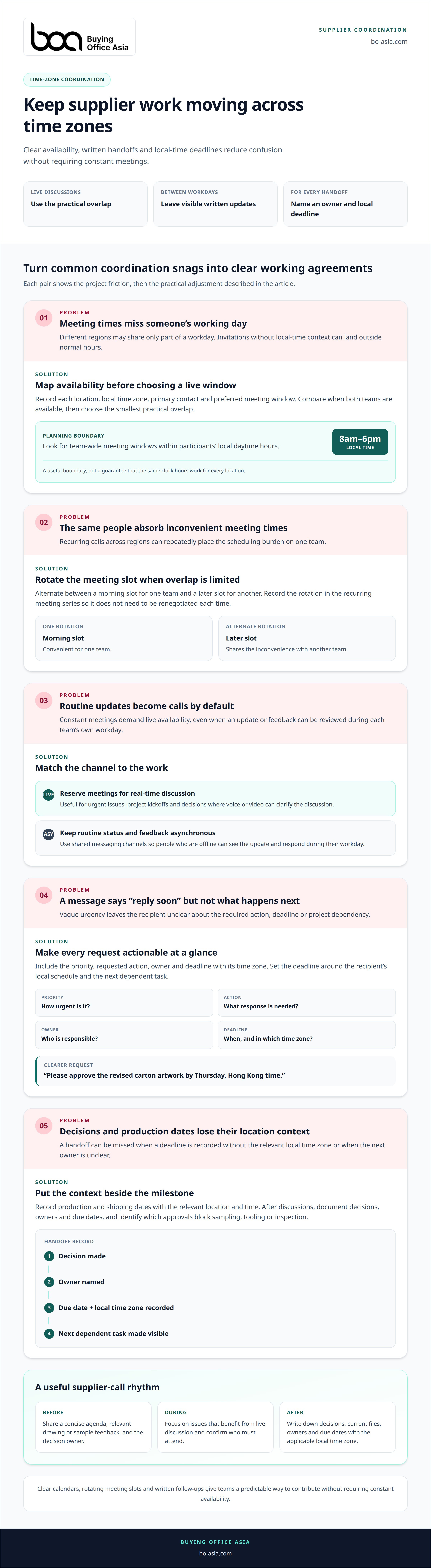
A procurement partner starts by mapping each supplier’s working hours against the buyer team’s availability. Record each location, local time zone, primary contact, and preferred meeting window. A factory contact in Hong Kong and a product team in Helsinki may share only part of their workday. Including both local times in the project calendar helps prevent invitations from falling outside someone’s normal schedule.
To find a workable meeting window, the coordinator compares the hours when both teams are available, then selects the smallest practical overlap. As an internal scheduling rule, keep proposed windows within 08:00 to 18:00 in each participant’s local time unless the participants agree otherwise. This is a practical boundary, not a reason to assume the same clock hours suit every location. If a production decision needs several stakeholders, the coordinator confirms who must attend before offering times.
When there is little overlap between regions, rotating meeting times can share the inconvenience fairly. For example, alternate a recurring supplier review between a morning slot for one team and a later slot for another. Record the rotation in the meeting series so participants do not have to renegotiate each invitation. Live meetings are most useful for urgent issues, project kickoffs, and discussions where voice or video can clarify a decision.
For free or low-cost scheduling, use Google Calendar’s time-zone settings, a shared availability poll, or timeanddate’s Meeting Planner to compare local times. These tools help identify possible windows, but a coordinator still needs to confirm availability and send the final invitation.
Preparation makes overlapping work hours more productive. Before a supplier call, circulate a concise agenda, attach the relevant drawing or sample feedback, and identify the decision owner. A tooling discussion, for instance, could list the open dimension, the factory’s response needed, and the next production milestone. Participants can review the details during their own workday instead of using meeting time to reconstruct the issue.
After the call, the coordinator records decisions, owners, and due dates with the applicable local time zone. A supplier receiving a change request should know which file is current and what response is expected. The production schedule can also flag which decisions block sampling, tooling, or inspection. Linking the schedule to supplier information across production regions keeps location context close to the work plan.
Set realistic expectations for live attendance, too. Frequent meetings across time zones can contribute to burnout, so routine status updates should not automatically become calls. A clear calendar, rotating meeting times, and written follow-ups give everyone a predictable way to contribute without requiring constant availability.
A clear availability record prevents routine production questions from becoming after-hours demands. For each supplier contact, record the local time zone, normal working days and hours, and preferred communication channel. Document the client team’s availability alongside it, so participants can see who is working before assigning a response or deadline.
Agree on response-time expectations with the supplier and client team, then match them to the request’s urgency and the recipient’s working hours. Distinguish routine updates from production holds, identify who acknowledges each category, and explain what happens when the assigned contact is offline.
Each message should state its priority, requested action, owner, and deadline, including the time zone. “Please approve the revised carton artwork by Thursday, Hong Kong time” is clearer than “Please reply soon.” For requests that need investigation, ask for an acknowledgement and a realistic response estimate. This keeps the project visible without suggesting that every message needs an immediate resolution.
Set deadlines around the recipient’s local schedule and the next dependent task. If a factory needs to clarify a component specification, a deadline that falls during its local night leaves no useful working time. Give the supplier time to review drawings, consult production staff, and provide a considered answer. If the reply is needed before sampling or production can proceed, state that dependency plainly.
For urgent issues, name the escalation contact and the channel to use during agreed working hours. An urgent message should explain the operational consequence, such as an approval holding up a production step. The label alone is not enough: a supplier may receive the message while asleep or away from work. When normal hours resume, the coordinator can send a written summary that records the issue and next action.
Off-hours boundaries apply to the buyer team, too. Avoid scheduling routine messages to arrive during a supplier’s night when timed sending is available. If an unexpected production concern arises outside normal hours, distinguish an immediate escalation from information that can wait until the next workday. This prevents ordinary follow-up from being treated as urgent by default.
For teams coordinating several factories, discuss supplier communication support to align availability records, escalation paths, and deadline conventions with active production work.
A shared supplier channel lets everyone catch up without being online at the same time. Keep production questions, answers, and decisions visible to the project team instead of leaving critical context in private chats. For a packaging approval, for example, the thread can include the latest artwork file, the factory’s comment, the decision owner, and the next action. This record gives the next person the context to act.
Relying on real-time communication creates risks when supplier and buyer working hours do not overlap. Calls can interrupt focused work, force inconvenient scheduling, and leave decisions waiting while one side is offline. When teams discuss changes only in live conversations, people who could not attend may miss context or misunderstand what was agreed.
Asynchronous messaging works well for non-urgent tasks, quick edits, mid-project check-ins, routine announcements, and daily status updates. Make each request answerable without a live discussion. A useful message names the product or workstream, describes the requested action, attaches the relevant file, and states the reply deadline with its time zone. This helps the supplier respond during its next working period.
For example, a factory update about a revised sample can include:
• The sample version and date of the attached image or document.
• The specific change requested, such as confirming a component dimension.
• The person responsible for answering or approving the change.
• The next project milestone affected by the response.
When a full answer is not immediately available, acknowledge the request and give a response timeline. A brief message such as “Received, I’ll review the revised component drawing and reply during my next working period” sets expectations without requiring an instant resolution. The coordinator can track the pending response and follow up if it affects sampling or production.
Public project channels make decisions easier to find than one-to-one messages. Pin the current specification, approval status, or open issue, then use reminders to revisit messages received outside someone’s working hours. A clear thread title and file version also reduce the risk of a supplier acting on outdated instructions.
Asynchronous work has trade-offs: feedback may take longer, and brief text can be misunderstood. For a complex dependency or sensitive production issue, add a screen recording or annotated image. If real-time clarification is still needed, use a focused call, then write down the decision, owner, and next step.
A supplier project often involves product development, sampling, tooling, production, inspection, and shipping coordination. For managing different time zones with suppliers, connect each workstream to its dependencies, decision owner, and required handoff in the project plan. If artwork approval holds up packaging production, show that dependency beside the relevant milestone. This helps the team identify which unanswered decision could affect the next activity.
To document decisions across time zones, record the decision, date, owner, affected specification, and next action in a shared project log. Each handoff should also identify the current file version and the person responsible for continuing the work. After a supplier call, circulate a written summary so people who were offline can follow the same decision trail.
A useful workstream plan separates supplier tasks from client approvals. For a custom product, the supplier may prepare a sample while the client reviews its finish and dimensions. Show who provides feedback, which revision it concerns, and what work can proceed in the meantime. Clear ownership prevents either team from assuming the other has approved a change.
Send meeting invitations early, with the purpose, agenda, required participants, and deadline stated clearly. Choose a time that fits participants’ local hours and allows enough working time for preparation. If a decision does not need live discussion, use email or a project management tool to share the update without interrupting production work.
Reserve video meetings for decisions that need real-time discussion, such as resolving conflicting sample feedback or agreeing on corrective action. Keep routine status reports in writing. Before a call, circulate the latest open issues; afterward, record the decision and assign the next task. This supports managing different time zones with suppliers by making the outcome accessible to participants who could not attend.
Make each handoff specific enough for the next person to act without reconstructing earlier conversations. For example, a project record can state that the supplier’s revised sample images are ready, identify the requested review, and assign the response owner. Link that task to the next approval or production milestone instead of leaving it as an isolated message.
Across parallel workstreams, make these details easy to scan:
• Current milestone and the task that depends on it.
• Decision owner, supplier contact, and next responsible person.
• Relevant document version and location of the decision record.
• Deadline, including the time zone used for the handoff.
When a deadline changes, update the affected tasks and notify the relevant participants. A shift in the sample approval date, for instance, may affect production planning and inspection scheduling. Recording these dependencies keeps the project plan useful across working days, not just during a shared meeting.
A production milestone is useful only when everyone understands its date, time, and location. Record the time zone beside each approval deadline, factory handoff, inspection, and shipping milestone. A date without a time zone can fall on different calendar days for the supplier and buyer, especially when work crosses midnight locally.
For a clear record, the schedule can retain a shared reference time, such as UTC, alongside the local time needed by each participant. Use a calendar that applies the named location and date, then record the converted local date and time beside the reference entry. Record the corresponding scheduled ship date in the local time used at its location. Keeping the reference and local entries together makes the conversion traceable.
Do not reuse a fixed offset between two cities without checking the date. Daylight-saving rules can make the difference change during the year. The coordinator should label the origin and destination clearly, then verify that the converted calendar date still matches the intended production or delivery sequence. This catches errors where a date appears correct in one location but refers to the previous or following day elsewhere.
Daylight saving time can change the offset between locations during a project, and regions may change clocks on different dates. Review upcoming milestones after each local clock change instead of relying on an offset copied from an earlier calendar entry. Calendar invitations should name the location or time zone, not just the clock time.
To coordinate production deadlines and shipping, link factory completion, inspection readiness, handoff, and planned dispatch in the project schedule. Record each milestone in the location where it occurs and identify which event starts the next task. A factory’s “ready to ship” notice, for example, is not the same as carrier pickup or arrival. Logistics coordination keeps these dates distinct without suggesting that transit time is fixed.
Each schedule entry should include:
• Milestone name and responsible supplier or team.
• Local date, local time, and named time zone.
• Shared reference time when teams need a common comparison.
• Dependency, such as inspection approval before dispatch coordination.
When a supplier changes a production-ready date, the coordinator updates dependent milestones and notifies the affected teams using their local times. A revised inspection date may also shift dispatch planning, so the change needs to flow through the schedule rather than remain in a message thread. For support coordinating supplier schedules and shipment milestones, contact the procurement team.
Buying Office Asia coordinates supplier communication as part of sourcing and procurement across Asia. When production involves multiple factories, approvals, and local work schedules, a dedicated Asia procurement team can connect responsibilities and handoffs to the wider project plan. End-to-end sourcing and procurement is useful when you need supplier coordination alongside purchasing and production decisions, rather than managing each relationship in isolation. For larger programs, high-volume sourcing and procurement can support coordination across multiple suppliers and workstreams. Factory-direct price negotiations can also be managed within the procurement process, keeping commercial discussions aligned with supplier planning.
If supplier schedules and project handoffs are becoming difficult to manage, contact Buying Office Asia to discuss your sourcing requirements.
Build supplier availability into project planning from the outset, rather than addressing it after a deadline slips. A shared operating plan should reflect the product schedule, decision-makers, and sequence of work across locations. This gives your team a practical basis for managing different time zones with suppliers as production requirements evolve.
For your next project, bring together supplier locations, key contacts, known milestones, and decisions that need your approval. This gives a procurement partner the context to coordinate communication around your actual production priorities, rather than a generic meeting routine. If supplier coordination is taking time away from your team’s other priorities, discuss those requirements as part of project planning.
Contact Buying Office Asia to discuss how your sourcing project can be coordinated across time zones. A clear starting brief can help turn schedule complexity into a more manageable part of production planning.
Choose tools that create an accountable record, not just a stream of messages. A project platform should make access permissions clear, track changes, and let authorized participants retrieve previous decisions. For example, a procurement partner can link a decision log to the relevant product record, helping new team members understand why a specification changed. For modern retail teams managing detailed catalog data and specifications at enterprise scale, platforms like Ommni help centralize core product details. Choose a setup that fits your existing systems and document-control needs.
Schedule around the people and production activities needed to resolve the issue. If a decision depends on a factory engineer’s input, choose a meeting time that fits their availability, not only senior stakeholders’ calendars. For complex issues involving several parties, separate discussions may be more practical than trying to find one time for everyone. The coordinator can relay confirmed decisions between participants and document any unresolved points.
Make the status of every message unmistakable. A supplier update should distinguish a proposed change from an approved instruction, especially for specifications or artwork. Annotated images can pinpoint a disputed area, while a short written note clarifies whether the supplier should pause, proceed, or wait for approval. This reduces the risk of a suggestion being mistaken for authorization to change production.
For a project spanning several locations, compare the normal working hours of only the people needed for each decision. If they have no shared window, use a staged handoff: one participant provides input, the coordinator passes it to the next, and the decision owner responds after reviewing both. This can work better than requiring every supplier and client representative to attend the same live meeting.

A shipment can be ready to move and still be held at the border. The customs clearance process for imports determines whether goods can enter their destination market, which documents are reviewed, and what duties or fees may be due. The exact requirements depend on the goods and the country they’re...

Distance can turn a small production issue into a coordination problem. The benefits of having a team on the ground in Asia include closer alignment between regional operations and your wider business. Local presence can connect strategy with supplier activity, product decisions, and day-to-day coll...

A container can be ready to move and still incur port charges. The practical question is what demurrage is and how to avoid it: demurrage is a charge for cargo left at a port or terminal beyond its agreed free time. The amount depends on the applicable rate and how long the cargo remains there.That...