


Traditional sourcing agents don't protect your supply chain; they monetize your blind spots. If you manage overseas production, you already know the frustration of watching landed margins erode beneath hidden intermediary markups, communication barriers, and unexpected defect rates. The fundamental question isn't whether to delegate, but how to leverage asia procurement outsourcing effectively without surrendering visibility, intellectual property, or direct operational control.
You don't need another commission-taking broker standing between you and your suppliers. Real strategic outsourcing replaces predatory middlemen with an integrated, on-the-ground extension of your own enterprise. This model secures enforceable, factory-direct contracts, eliminates covert trading margins, and establishes strict quality control directly on the factory floor before finished goods ever leave port.
This guide breaks down the operational blueprint to eliminate compounding broker fees, safeguard your production quality, and maintain total transparency across Asian manufacturing hubs.
• Learn how modern asia procurement outsourcing replaces opaque trading intermediaries with factory-direct contracts and true open-book pricing.
• Identify the hidden margin erosion and operational vulnerabilities built into traditional sourcing broker models.
• Discover why physical factory floor presence and on-site inspections are mandatory to stop container-level defect rates before departure.
• Follow a practical four-step implementation blueprint to audit your supply base, establish technical tolerance baselines, and scale production smoothly.
• Understand how the hybrid governance model pairs boots-on-the-ground regional oversight with Western corporate accountability to protect your intellectual property.
Asia procurement outsourcing is the strategic delegation of supplier discovery, factory vetting, commercial negotiations, and production governance to dedicated, on-the-ground operational teams across key manufacturing hubs. For decades, international brands treated global purchasing as an arm's-length administrative transaction. In 2026, enterprise leaders recognize that transactional buying creates profound supply vulnerabilities. Modern businesses rely on integrated operational extensions to protect margins and secure their supply pipelines.
This operational shift replaces legacy trading intermediaries with client-aligned teams that eliminate hidden broker fees and safeguard production schedules. Rather than handing control to an independent third party, effective procurement outsourcing embeds specialists directly into your organization. As industry benchmarks show, strategic sourcing works as an ongoing process designed to continually re-evaluate and improve purchasing activities, ensuring direct contractual ownership over manufacturing relationships, intellectual property, and pricing structures.
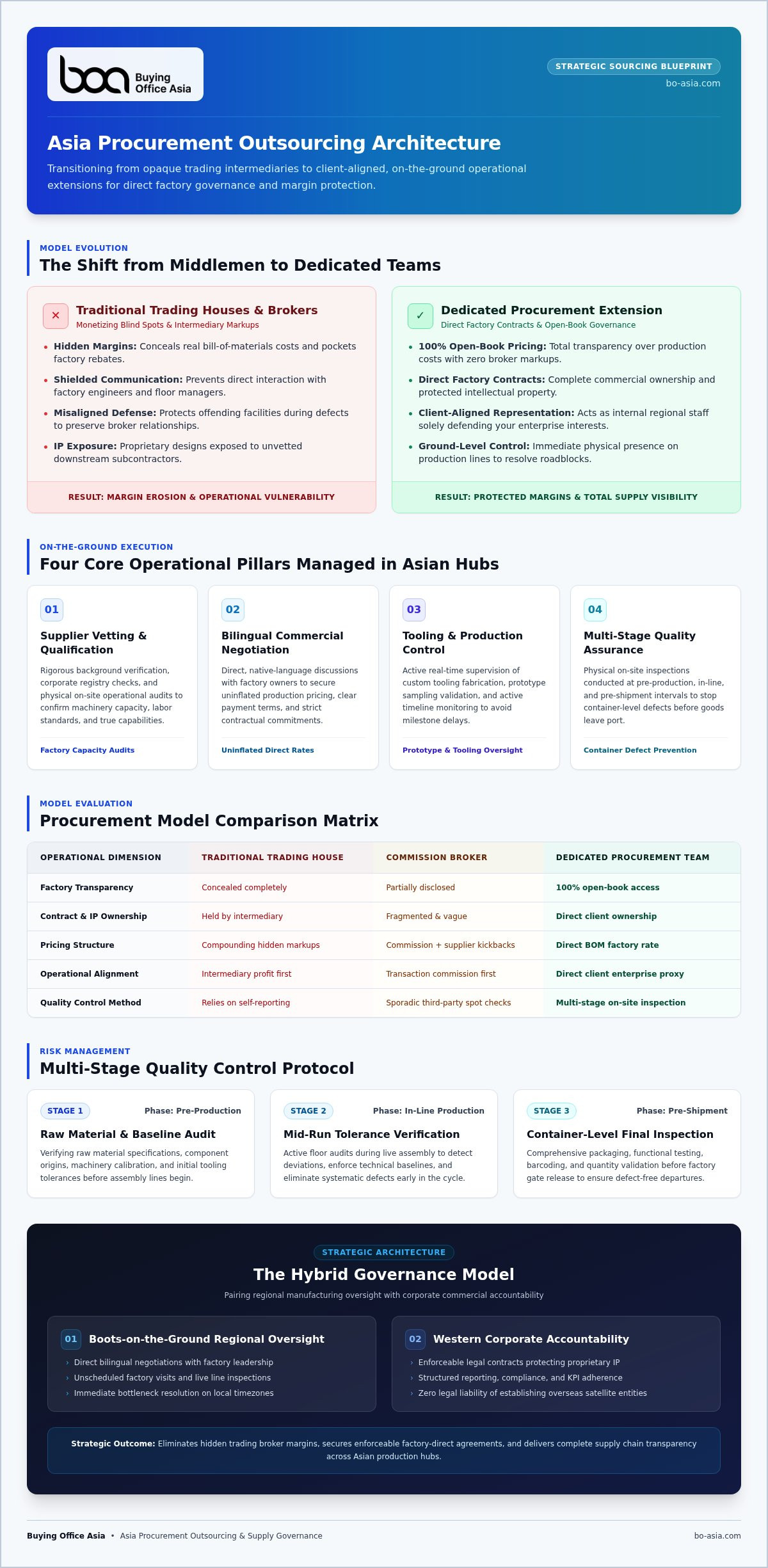
Traditional trading companies survive by intentionally obscuring actual production expenses. They mark up unit costs, pocket factory rebates, and prevent you from directly communicating with line engineers. When production stalls or defects occur, these brokers shield the offending facility to preserve their own supplier relationships.
Dedicated procurement partners reverse this dynamic entirely. Operating as your internal regional staff, they represent your commercial interests without taking hidden commissions. Direct, factory-direct contracts ensure your intellectual property remains legally protected, while giving your team complete transparency over bill-of-materials costs. To understand how modern enterprises structure these on-the-ground partnerships, examine systematic sourcing and procurement methodologies across Asian manufacturing centers.
Managing production thousands of miles from headquarters demands hands-on execution across every manufacturing phase. A dedicated procurement infrastructure manages four fundamental operational pillars directly on the factory floor:
Comprehensive background verification, corporate registry validation, and physical operational audits to verify technical capabilities, machinery capacity, and labor standards.
Direct discussions with factory owners in their local language to secure transparent, uninflated production rates without third-party markups.
Real-time oversight of custom tooling fabrication, prototype sampling validation, and production scheduling to prevent milestone delays.
Rigorous on-site quality control inspections conducted at pre-production, in-line, and pre-shipment stages to enforce strict component specifications.
By delegating these functions to trusted specialists, brands maintain complete visibility over their operations without absorbing the legal liability or overhead of running overseas satellite entities.
Selecting the wrong operational structure quietly inflates unit costs and exposes proprietary designs to unvetted subcontractors. Managing direct factory relationships across overseas hubs requires dedicated local expertise to bridge commercial and cultural divides. Understanding why Buying Office Asia champions transparent oversight clarifies how operational alignment protects your margins.
| Operational Criteria | Traditional Trading House | Commission Broker | Dedicated Procurement Team |
|---|---|---|---|
| Factory Transparency | Concealed completely | Partially disclosed | 100% open-book access |
| Contract & IP Ownership | Held by intermediary | Vague or fragmented | Owned directly by client |
| Pricing Structure | Compounding hidden margins | Commission plus factory rebates | Uninflated factory-direct cost |
| Quality Accountability | Defends manufacturer | Passive dispute handling | Direct on-site enforcement |
Trading houses rarely let you see the actual factory floor. By acting as the vendor of record, they conceal supplier identities to prevent direct negotiations and protect their markup. Commission-based agents present an equally hazardous conflict of interest. Many accept undisclosed factory rebates, incentivizing them to defend the manufacturer during production disputes rather than protect your quality standards.
A dedicated team functions exclusively as an integrated extension of your business under rigorous service-level benchmarks. You retain open-book visibility over raw material, labor, and packaging expenses down to the cent. Crucially, your company retains full legal ownership of all tooling, production molds, and manufacturing agreements. Learn how a dedicated sourcing team manages these operations on the ground.
Evaluating the true financial return of asia procurement outsourcing requires looking beyond initial quotes. Variable intermediary markups compound exponentially as purchase orders scale into high-volume runs. Under broker models, production efficiencies benefit the middleman, not your balance sheet. Transitioning to factory-direct agreements secures authentic baseline costs, ensuring economies of scale flow directly into your gross margins. If you want to review your current overseas purchasing exposure, you can connect with our team for an operational assessment.
Physical factory proximity is mandatory if you want to maintain strict component standards. Managing production remotely through email threads and sporadic video calls invites disaster. Defect batches discovered after an ocean container docks at your domestic warehouse are practically unrecoverable. Resolving these operational risks requires systematic oversight directly where items are built. Professional asia procurement outsourcing closes this vulnerability by embedding quality auditors on the factory floor before shipments ever leave the facility.
Desktop audits cannot reveal how a plant actually functions. Thorough factory vetting separates legitimate, export-licensed manufacturers from unregulated subcontracting workshops that pose severe regulatory hazards. A rigorous on-site audit validates municipal business licenses, machinery calibration logs, labor conditions, and updated quality management standards, such as the ISO 9001:2026 framework. Crucially, in-person auditors inspect raw material storage areas and batch traceability records, ensuring unauthorized material substitutions don't compromise your bill of materials.
Catching dimensional variance or cosmetic blemishes requires physical intervention at defined milestones. Waiting for finished goods to sit packed in shipping cartons guarantees blind spots. A robust quality assurance framework enforces three mandatory on-site checkpoints:
Validate that initial production samples match approved golden prototypes and CAD engineering tolerances before mass production commences.
Audit active assembly lines once 20% to 50% of the run is completed to identify process flaws or tooling wear early.
Conduct statistically rigorous sampling on completed batches to test packaging durability, barcoding compliance, and functional performance.
Rigorous pre-shipment inspections eliminate defective goods before ocean freight departure, ensuring you never pay to ship substandard inventory across the world. Learn more about managing proprietary tooling and production governance in our OEM manufacturing guide.
Executing a transition from unmanaged buying or broker dependence requires methodical staging. A haphazard handover disrupts production runs, alienates factory managers, and risks tooling security. Successful asia procurement outsourcing follows five structured phases that establish baseline metrics, clarify engineering limits, and migrate contracts without operational downtime.
Analyze current purchase order line items, landed margins, historical defect rates, and supplier lead times across every active SKU.
Document exact CAD drawings, raw material chemical specifications, approved color swatches, and quantitative acceptable quality limit (AQL) standards.
Partner with a dedicated procurement team that delivers 100% open-book pricing and refuses covert supplier kickbacks.
Transition manufacturing agreements into direct client-held contracts, legally confirming ownership of all proprietary molds and dies.
Implement structured weekly milestone reporting, production line scrap tracking, and on-site inspection protocols.
Start by dissecting your commercial invoices. Intermediary trading margins are rarely listed explicitly; they sit concealed inside inflated unit costs, packaging fees, or domestic handling surcharges. Next, clarify legal custody of your physical production assets. Many buyers assume they own their tooling, only to discover their broker registered the injection molds or extrusion dies under local corporate entities. Finally, map your component bills of materials to pinpoint single-source dependencies across mainland facilities.
Vague quality expectations guarantee manufacturing drift. Establish clear contractual agreements that bind production facilities to defined AQL thresholds for minor, major, and critical defects. Define strict delivery windows to eliminate schedule slippage before ocean cargo cutoff deadlines. These protocols should also mandate rapid response requirements, ensuring line supervisors address engineering revisions within 24 to 48 hours.
Cross-border procurement fails when instructions get distorted in translation. An on-the-ground partner connects your Western engineering team directly with local Asian floor managers, cutting through linguistic ambiguity and cultural hesitancy. Weekly operational reviews track tooling wear, production velocity, and material batch certifications in real time. For actionable steps on auditing prospective manufacturing partners, read our comprehensive analysis on supplier vetting in Asia.
Ready to eliminate intermediary costs and establish full operational control over your Asian manufacturing? Schedule a strategic consultation with our procurement team to audit your current supply setup.
Choosing an operational partner dictates whether your overseas manufacturing flourishes or stumbles into perpetual friction. Purely local agents often lack Western corporate accountability, while remote management consultants cannot physically inspect a tooling line. Sustainable execution relies on a hybrid governance model that pairs boots-on-the-ground factory presence with Western executive oversight. This structure eliminates timezone delays, bridges cultural divides, and protects your commercial margins.
Western corporate leadership establishes clear ethical compliance, IP protection protocols, and recognizable legal accountability. At the same time, maintaining operational headquarters in Hong Kong enables rapid deployment of technical engineers directly onto factory floors across key manufacturing corridors. Bilingual procurement specialists bridge the communication gap between your domestic design engineers and local plant managers, converting technical drawings into production realities without nuance getting lost in translation. Review these structural advantages in our guide to China sourcing companies.
Transitioning your supply operations to structured asia procurement outsourcing should follow an orderly roadmap. The first quarter focuses on stabilizing existing production while dismantling hidden intermediary costs:
Map component supply chains, conduct on-site factory verification audits, verify tooling custody, and establish accurate cost baselines across every SKU.
Execute direct manufacturer contracts under your entity, institute open-book material breakdowns, and implement multi-stage quality control protocols.
Monitor production line efficiency, enforce milestone delivery schedules, and optimize logistics coordination for continuous mass production.
A hybrid governance framework ensures you never have to choose between regional factory proximity and corporate legal protection. Ready to eliminate middlemen and optimize production? Contact our dedicated procurement team to begin your supply chain evaluation.
Scaling production overseas doesn't require surrendering control to opaque intermediaries. As global trade demands greater agility, strategic asia procurement outsourcing bridges the distance between corporate expectations and manufacturing reality. By pairing European executive leadership in Helsinki with an operational headquarters in Hong Kong, you gain an accountable, boots-on-the-ground extension that enforces your standards daily.
This hybrid governance model secures 100% open-book transparency, eliminating predatory broker markups and covert factory commissions. Direct contractual relationships ensure your enterprise retains full legal ownership of proprietary tooling, molds, and product designs. You protect your intellectual property while driving authentic factory-direct efficiencies straight to your balance sheet.
Stop leaving your landed margins and component quality to chance. Schedule a strategic consultation with our Asia procurement specialists today, and build a resilient manufacturing pipeline positioned for enduring commercial success.
A traditional sourcing agent operates as a transactional broker, often taking undisclosed supplier markups and restricting direct factory contact. In contrast, asia procurement outsourcing embeds a dedicated, on-the-ground operational extension into your business. You hold direct manufacturing contracts, maintain complete pricing visibility, and retain full legal ownership over production assets without paying concealed intermediary markups.
Legitimate procurement outsourcing eliminates hidden kickbacks through an open-book pricing structure where you audit every raw material, labor, and packaging expense. You contract directly with the manufacturing facility and pay authentic factory-direct rates rather than an intermediary's bundled invoice. Because your dedicated procurement team operates as your corporate representative rather than a vendor of record, all commercial incentives align with protecting your margins.
Yes, retaining direct contractual and asset ownership is a foundational principle of professional procurement outsourcing. Unlike trading companies that register injection molds, casting dies, and manufacturing agreements under their own corporate entities, a dedicated partner structures all contracts under your legal name. This ensures your tooling remains your uncompromised property, allowing you to relocate production lines whenever necessary without legal friction or ransom fees.
Dedicated on-the-ground teams deploy technical inspectors directly to factory floors across critical manufacturing milestones. They perform first-article inspections to confirm prototype fidelity, during-production checks to catch assembly line deviations early, and pre-shipment audits against strict acceptable quality limits. Every step is documented in comprehensive inspection reports with objective photographic verification, ensuring non-compliant batches get corrected before container loading.
Established procurement partners oversee operations across primary industrial clusters, including mainland China, Vietnam, Thailand, Malaysia, Indonesia, and India. Operating from an operational hub like Hong Kong allows technical teams to rapidly mobilize across southern manufacturing hubs as well as Southeast Asian production corridors. This regional footprint helps enterprises execute resilient multi-country sourcing strategies such as China Plus One.
Modern asia procurement outsourcing protects intellectual property by establishing enforceable non-disclosure, non-use, and non-circumvention contracts governed by appropriate regional legal frameworks. Dedicated on-site personnel continuously audit production floors to ensure factories don't secretly outsource sensitive sub-assemblies to unvetted workshops. This physical oversight keeps your CAD drawings, custom tooling, and proprietary production methods securely contained within approved facilities.
Professional procurement firms typically utilize transparent service models rather than perpetual margin markups. These arrangements generally include project-based sourcing and supplier vetting fees, dedicated quality inspection service fees, or monthly supply chain management retainers. By decoupling compensation from purchase volume margins, your business secures predictable operational costs while retaining 100% of the volume discounts negotiated directly with factories.

The lowest freight quote can carry the highest operational risk if supplier readiness, documentation, and exception handling are left outside the plan. If you’re asking how to choose a freight forwarder for Asia, look beyond the headline rate. A smooth shipment depends on who coordinates each handof...
What if your signed OEM agreement protects the product on paper but leaves the factory unclear about what to make, when to deliver it, or how quality will be judged? That gap is where an oem manufacturing agreement china project can lose control: responsibilities blur between buyer, sourcing interme...

What if the safest payment deal isn’t the one that delays the most cash, but the one that releases it only when progress is verifiable? Payment terms negotiation with Asian suppliers is about balancing your working capital with the supplier’s need for confidence, not simply pushing for a smaller dep...