


Most businesses think they're getting factory-direct pricing when they're actually paying a hidden 10% markup to a middleman who never steps foot on the production floor. You likely understand that selecting the right asia sourcing company is the difference between a healthy margin and a supply chain nightmare. You want the cost benefits of manufacturing in hubs like Vietnam or Indonesia, but you're tired of the constant anxiety over quality shifts, IP theft, or unethical factory practices. It's difficult to manage a multi-country supply chain when you don't have eyes on the ground to ensure your standards are met.
This guide will show you how to navigate the 2026 manufacturing landscape with total confidence. You'll learn how to secure 100% transparent pricing and Western-standard quality control by treating your procurement partner as a professional extension of your own team. We'll examine the critical shifts happening right now, including the 20% tariffs on Vietnamese goods and the rising labor costs in Thailand. By the end of this briefing, you'll have a strategic roadmap to build a scalable, ethical, and financially viable supply chain that protects your brand's future.
• Understand why a modern asia sourcing company must act as an integrated extension of your team to protect 2026 profit margins.
• Identify the "hidden commission" trap and learn how the Buying Office model secures 100% transparent, factory-direct pricing.
• Master the "China Plus One" strategy to balance complex OEM manufacturing in China with emerging hubs in Vietnam and Southeast Asia.
• Discover the two-step verification process for vetting partners, focusing on physical regional presence and specific product category expertise.
• Learn how European-managed leadership provides the security and accountability required for high-volume procurement and mass production oversight.
A professional asia sourcing company has evolved far beyond the traditional "product finder" model. In 2026, professional procurement requires a deep, on-the-ground presence to manage complex regulatory environments and protect thin margins. Global sourcing is no longer about finding the lowest unit price; it's about securing a transparent supply chain that functions as an extension of your own business. You don't just need a contact; you need a partner that ensures your interests are protected at the factory gate.
The 2026 market is defined by unprecedented volatility. With the U.S. implementing 20% tariffs on Vietnamese goods and launching Section 301 investigations into structural excess capacity across 16 economies in March 2026, unmanaged sourcing has become a significant liability. You need a partner that provides end-to-end sourcing and procurement oversight to navigate these shifting trade agreements and stringent ESG requirements. This transition from simple product finding to holistic supply chain management is what separates high-growth brands from those struggling with unforeseen expenses.
Asia's dominance persists because of its unrivaled infrastructure and specialized industrial clusters. While labor costs in Vietnam saw a 7.2% regional minimum wage increase in January 2026, the region's value now lies in its high-tech ecosystems and operational efficiency. For example, Shenzhen's electronics cluster provides a competitive advantage in OEM manufacturing and complex tooling that newer markets can't yet replicate. These specialized zones create a synergy of speed and technical capability that keeps your production cycle lean and responsive to market demands.
Digital platforms often offer a false sense of security through unverified five-star ratings and polished factory photos. These platforms can't prevent "quality fade," where a factory uses cheaper materials during mass production to offset their own rising costs. Without a dedicated asia sourcing company physically inspecting the production line, you're operating with zero visibility. The "Black Box" of unmanaged sourcing represents a critical risk to your brand's reputation and financial health. Professional oversight eliminates the uncertainty of digital-only interactions by placing experienced eyes directly on the factory floor, ensuring every unit meets your specific quality standards before it leaves the port.
Choosing an asia sourcing company often feels like a choice between two evils: the opaque trading company or the independent broker. Most traditional agents operate on a commission-only basis, which creates a fundamental conflict of interest. They're incentivized to keep you away from the factory floor to protect their "kickback" from the manufacturer. This "Hidden Commission" trap can quietly inflate your unit costs by 10% to 15% without you ever seeing a line item for it. When your agent's income depends on the factory's payout, they'll always prioritize the supplier's relationship over your brand's bottom line.
To protect your margins in 2026, you must move toward a 100% transparency model. Unlike a trading company that buys and resells to you at a profit, a professional buying office acts as your internal procurement department. This alignment ensures you receive factory-direct pricing, where every dollar you pay is accounted for. It's the only way to secure a clear audit trail from raw material procurement to final shipping, which is vital for both financial rigor and ethical compliance. Direct factory access also serves as your primary defense for intellectual property; if you don't know exactly who is making your product, you cannot effectively enforce non-disclosure agreements.
A broker's priority is the transaction, not your long-term ROI. When your interests aren't aligned, you're vulnerable to quality shifts and production delays that the agent might hide to ensure their commission is paid. As sourcing shifts to Southeast Asia, the complexity of managing multiple vendors in different jurisdictions grows. A dedicated team provides a defense against these operational setbacks by negotiating directly with factory ownership. They act as a stabilizing force, ensuring that the factory respects your production timelines and quality standards because they represent your total buying power, not just a single order.
The allure of "zero-fee" sourcing is a dangerous myth in international trade. If an agent isn't charging you a transparent service fee, they're getting paid by the factory, which inevitably leads to higher unit prices and compromised oversight. Investing in professional Sourcing and Procurement Fees actually reduces your total landed cost by eliminating these invisible margins. It allows for rigorous factory audits and on-site quality control that "free" agents simply won't perform. If you're ready to gain full control over your manufacturing costs and eliminate middleman markups, you should speak with a procurement expert about establishing a transparent partnership.
In 2026, your choice of geography is as critical as your choice of factory. An effective asia sourcing company must navigate a fragmented landscape where the "cheapest" option often carries the highest hidden risks. The strategy for this year isn't about a wholesale exit from established markets; it's about intelligent diversification. While China remains the anchor for complex production, emerging hubs in Southeast Asia offer vital alternatives for brands looking to mitigate geopolitical exposure and manage rising costs.
The "China Plus One" strategy has evolved from a trend into a corporate necessity. However, moving production isn't as simple as switching zip codes. You must account for the 20% tariffs currently facing Vietnamese goods and the March 2026 Section 301 investigations into structural excess capacity across the region. Hong Kong continues to serve as the strategic gateway for these operations, providing the legal security and logistical headquarters required to manage a multi-country supply chain with European-standard accountability.
China remains the gold standard for OEM manufacturing and complex tooling. Its unrivaled infrastructure depth and integrated component supply chains mean that even as labor costs rise, the total efficiency often outweighs the savings of less mature markets. When you're producing high-volume electronics or products requiring intricate molds, the maturity of the Chinese ecosystem provides a level of stability that is difficult to replicate. For a deeper analysis of this specific market, see The Definitive Guide to Choosing a China Sourcing Company in 2026.
Vietnam and Thailand have solidified their positions as strengths in textiles, furniture, and light assembly. Vietnam's GDP grew 8.18% year-on-year in the first half of 2026, reflecting its aggressive industrial expansion. Despite this growth, newer markets face significant infrastructure challenges and heavy raw material dependencies. Most Vietnam-based factories still rely on Chinese sub-suppliers for components, which can create bottlenecks if your asia sourcing company doesn't have a presence in both regions. When vetting foreign sourcing partners, it's essential to verify they have the regional network to manage these cross-border logistics. Relying on a partner without a physical office in these emerging zones leaves you vulnerable to production delays and quality inconsistencies that can't be resolved from a distance.
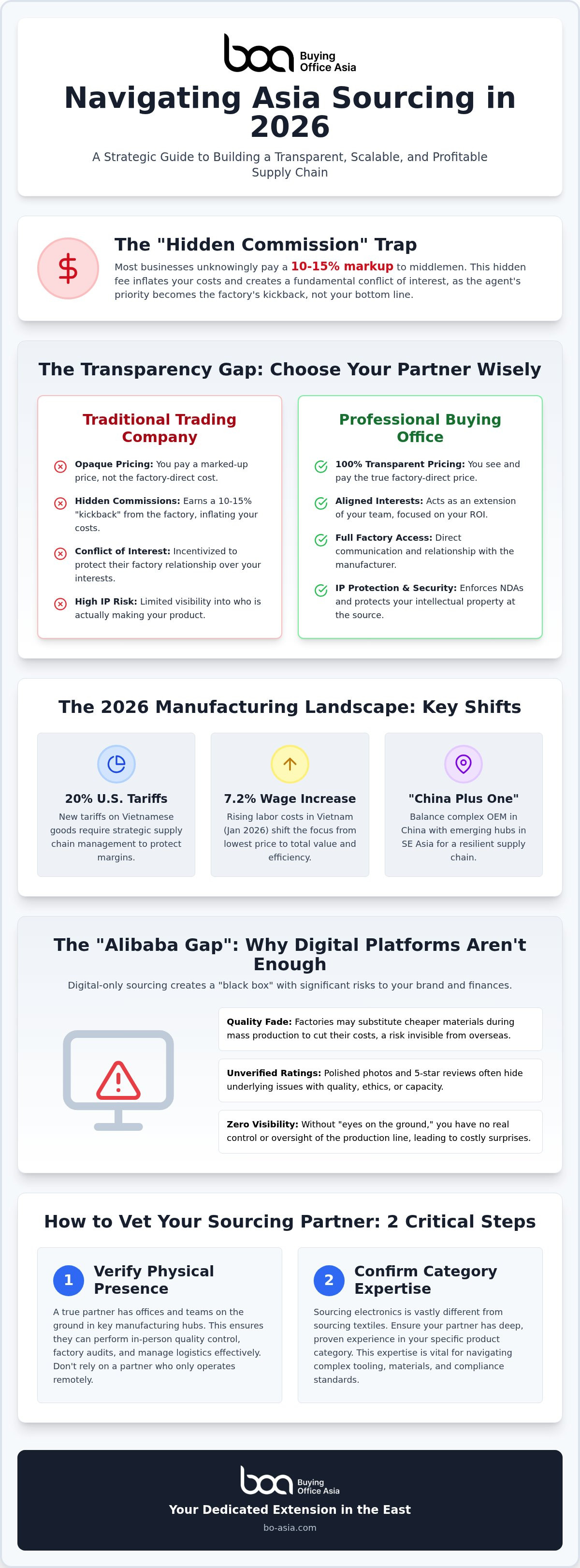
Vetting an asia sourcing company is the most critical step in protecting your capital. You aren't just looking for a vendor; you're hiring a protective extension of your own team. A professional partner should act as a stabilizing force in a market where risks are often hidden behind polished websites and unverified claims. This process requires a methodical approach to ensure your chosen partner possesses both the regional expertise and the ethical standards your brand demands.
A professional vetting process should follow five distinct steps to ensure total alignment with your business goals:
A legitimate partner must have an on-the-ground presence in manufacturing hubs. Virtual offices or "remote agents" cannot provide the accountability required for mass production.
Ensure the team has specific experience in your product category. Generalists often miss the technical nuances of tooling and material specifications that lead to quality fade.
Review their Quality Control and Inspection protocols. You need to see a structured, documented process for on-site checks during production.
A professional partner will never hide the factory's identity. If an agent refuses direct contact with the manufacturer, they're likely masking hidden markups.
In 2026, ethical supply chains are a regulatory necessity. Your partner must be able to verify factory labor practices and environmental standards through on-site audits.
You should be wary of any agent who provides vague, "all-inclusive" quotes. These often mask hidden margins and prevent you from seeing the true factory-direct price. A lack of a structured, on-site Supplier Vetting process is another major warning sign. If they can't explain their criteria for factory selection, they're likely choosing suppliers based on their own commission rather than your quality requirements.
During your first meeting, ask how they handle factory disputes or quality failures in real-time. You need to know that your asia sourcing company can act decisively when problems arise on the factory floor. Inquire about their specific process for on-site mass production oversight and whether they can provide documented savings examples for similar high-volume clients. If you're ready to secure a partner that prioritizes your financial health, contact our procurement team for a professional briefing.
Establishing a resilient presence in Asian markets requires more than just a list of suppliers. It demands a partner that functions as an integrated extension of your own organization. Buying Office Asia (BOA) provides this stability through a unique structure: European leadership based in Helsinki combined with a operational headquarters in Hong Kong. This model ensures that while your asia sourcing company is physically present on the factory floor, your account management remains aligned with Western standards of quality, communication, and legal accountability. We don't just find products; we build and defend your supply chain.
A Dedicated Sourcing Team offers a level of focus that third-party brokers simply cannot match. While traditional agents often juggle hundreds of transactional orders, our team prioritizes the long-term financial health of your brand. This dedication allows us to manage the entire product lifecycle, from initial OEM development and custom tooling to final logistics management. By eliminating the middleman, we maintain 100% transparency, ensuring that every negotiation results in factory-direct pricing without the hidden markups that typically erode margins in unmanaged supply chains.
The primary hurdle in international procurement is the "expectations gap" regarding quality and reporting. Our professional account management team understands Western quality requirements and translates them into actionable production protocols for regional manufacturers. We provide real-time reporting and seamless communication across time zones, giving you the same level of oversight you'd expect from a local facility. Our history of scaling production for international brands demonstrates our ability to move beyond simple transactions toward high-volume, scalable manufacturing partnerships that grow alongside your business.
As we move through 2026, the definition of a successful supply chain must include ethical rigor and long-term Supplier Development. We don't just vet factories; we develop them to meet the evolving regulatory landscape, including stringent audit requirements. Our ESG commitment ensures that your production remains future-proof and protected against the brand risks associated with unethical labor or environmental practices. This proactive stance on compliance is what makes us a stabilizing force in a complex global market. If you're ready to secure your margins and eliminate the anxieties of unmanaged manufacturing, you should contact Buying Office Asia to build your dedicated procurement strategy today.
Navigating the complexities of international manufacturing in 2026 requires more than a digital connection; it demands a strategic, on-the-ground ally. You've seen how the distinction between a middleman broker and a professional asia sourcing company directly impacts your bottom line. By prioritizing 100% transparency and eliminating hidden factory markups, you regain control over your landed costs. Whether you're diversifying into Vietnam or optimizing established OEM production in China, your success depends on having eyes on the factory floor and a firm grip on ethical compliance.
Buying Office Asia acts as your protective partner in this landscape. As a European-managed firm with Helsinki leadership and a physical headquarters in Hong Kong, we bridge the gap between Western quality expectations and regional manufacturing realities. We offer a defense against quality fade and operational risks with a model built on zero hidden commissions. It's time to move away from unmanaged sourcing and toward the steady confidence of an established expert. Build Your Dedicated Asia Procurement Team today and ensure your supply chain remains a resilient competitive advantage.
A buying office operates as an integrated extension of your own procurement department, while a sourcing agent typically acts as an external third-party broker. Buying offices prioritize long-term partnership and financial transparency through structured service fees; agents often focus on transactional commissions which can lead to misaligned incentives and hidden factory markups.
Industry standards for a reliable asia sourcing company in 2026 generally range from 3% to 10% of the total order value. For high-volume projects or ongoing support, many professional firms offer monthly retainers between $2,000 and $8,000 to provide dedicated procurement teams and on-site oversight.
China remains the gold standard for complex OEM manufacturing and mature component supply chains, whereas Vietnam is a primary hub for textiles, furniture, and light assembly. You must balance China's technical maturity against Vietnam's 8.18% GDP growth and the 20% tariffs currently impacting Vietnamese exports to certain Western markets.
Preventing quality fade requires consistent, on-site quality control and mass production oversight. A professional partner places experienced inspectors directly on the factory floor to verify that material specifications and production standards don't shift after the initial sampling stage.
Yes, professional firms provide end-to-end logistics and shipping management as a core part of their service. This includes coordinating with freight forwarders and ensuring all customs documentation is accurate to prevent costly delays or regulatory penalties at the port of entry.
You can identify "kickback" models by an agent's refusal to provide direct factory contact details or their use of vague, "all-inclusive" quotes. A transparent asia sourcing company always provides a clear audit trail and ensures you have direct access to the manufacturer and the true factory-direct price.
Professional sourcing firms specialize in custom product development and tooling, managing the process from initial technical drawings to final mass production. They act as a protective layer for your intellectual property by ensuring all molds and proprietary designs are handled by vetted, ethical suppliers.
Digital platforms like Alibaba provide unmanaged access to suppliers but offer no defense against "quality fade" or unethical factory practices. A professional company provides the physical proximity and regional expertise required to vet suppliers in person, negotiate better pricing, and ensure your brand's financial health isn't left to chance.

Scaling production to millions of units isn't a purchasing task; it's a high-stakes risk management discipline where a single percent of quality fade can liquidate your annual margin. You likely understand that the leap from mid-scale orders to massive procurement runs often exposes cracks in even t...

In 2026, the traditional sourcing agent isn't just an expense; they're a strategic liability that obscures your true cost of goods. Most procurement leaders recognize that supplier selection in asia has become a defensive maneuver where the goal is to eliminate the "Middleman Tax" before it erodes y...

Successful oem sourcing asia isn't just a search for a factory, but the implementation of a transparent, on-the-ground management ecosystem. You likely already know that the traditional intermediary model is flawed, often hiding true costs behind layers of markups and opaque communication. It's frus...