


What if the lowest unit quote isn’t the lowest-cost way to make your board game? Board game manufacturing costs depend on more than the number of boxes ordered. Component materials, custom tooling, assembly, packaging and delivery scope can all change what a quote covers, making headline prices difficult to compare.
If you’re unsure which specifications are driving the price, look beyond the unit figure. A simpler component may reduce cost but change the game’s finish or feel. A custom miniature may need tooling that affects both upfront investment and the per-unit price. Clear specifications help you weigh those trade-offs without obscuring quality or delivery risks.
This article explains the main cost categories, how quantities and tooling affect quotes, and what to include in a comparable manufacturing brief. You’ll also see how to specify components, finishes, assembly, packaging and shipping scope so suppliers quote against the same requirements. The aim is to give you a clearer basis for decisions, not a generic estimate that may not match your game.
• Board game manufacturing costs reflect the full specification and delivery scope, not just a per-unit factory quote.
• Separate component costs from development, samples, tooling, oversight and logistics to make quote assumptions easier to compare.
• Assess how materials, custom pieces, assembly and order quantity affect both unit economics and production trade-offs.
• Build a quote-ready brief with a defined component list, finishes, packaging, quantities and clear inclusions and exclusions.
• Coordinated oversight links supplier selection, sampling, production checks and logistics. A standalone inspection provides a snapshot at a specific point in production.
Board game manufacturing costs depend on the product, its production requirements and the delivery scope included in the quote. A game title or genre can suggest its general format, but it doesn’t define the materials, component count, finishes, assembly steps or packaging. Those details determine what factories need to produce and what an estimate covers.
Separate factory production cost from the broader landed-cost view. A factory quote may cover manufacturing and packing, while your full budget may also include development, sampling, production coordination and international transport. Compare offers on the same scope, and make assumptions and exclusions visible instead of relying on a single unit figure.
Component specifications and order assumptions shape any meaningful comparison. Without them, two quotes may appear comparable while describing different products or delivery responsibilities.
Break the estimate into clear categories so you can identify what is driving the cost:
Paper and card, boards, tokens, dice, plastic pieces, miniatures and other custom parts.
Printing, cutting, moulding, surface finishes and decoration.
Collation, inserts, box construction, wrapping and master cartons.
Design adaptation, prototypes, sampling and custom moulds or other production tools.
Supplier coordination, production oversight, quality checks and logistics coordination, alongside international transport where included in the estimate.
Development and tooling are often project-specific or one-time items. Materials, production and packing recur with each run. Keep those categories separate so you can see how a design change or different order quantity affects the estimate. State service and oversight scope plainly rather than burying it in an unexplained mark-up. BOA’s custom manufacturing support connects product requirements with supplier and production coordination.
Picture a simple card game with a deck, rules sheet and standard-size box. Compare it with a tabletop game built around cards, a folding board, custom-shaped tokens, a moulded miniature, player aids and a fitted insert. Their themes may be similar, but the second design requires more part types, production processes and assembly steps.
Artwork affects printing requirements, while component dimensions and material choices can change how parts are produced and packed. Special finishes or decoration add requirements that need to be sampled and checked for consistency. Packaging matters too: a compact box with a simple insert has different requirements from a larger box designed to hold many organised components.
This is the difference between adapting a standard product and coordinating custom production. A useful overview of the board game development process shows how decisions made before production can affect manufacturing requirements. Document the components, artwork, dimensions, finishes and packaging as one connected specification. That gives suppliers a clearer basis for quoting and gives you a sounder comparison.
A useful estimate should show how the product is made, not just give you a unit figure. For board game manufacturing costs, separate the physical parts and factory processes from development, sampling, tooling, assembly, packaging, oversight and logistics coordination. This makes it easier to identify what changes when you revise a component or adjust the production plan.
A project estimate should show components and materials, production processes, development and sampling, tooling, assembly and packaging, production oversight, and logistics coordination as separate categories. International transport can be listed separately or included in a broader delivery estimate, but its scope should be clear. This breakdown helps you compare offers without mistaking differences in included services for differences in manufacturing efficiency.
List the parts your game needs, then specify the material, dimensions, finish and quantity for each. Cards and boards may involve paperboard selection, printing and die-cutting. Tokens, inserts and miniatures can call for different materials or production methods. Plastic injection moulding is one option for custom plastic pieces. Decoration, such as printed graphics or paint, adds requirements for colour and finish consistency.
Process selection depends on the part’s material, shape, finish, production quantity and required consistency. A unique component can create a separate sampling requirement, and a moulded part may need tooling. Each extra part can also affect assembly: a token that must be sorted or placed in a particular position adds a step to collation and packing. Confirm which parts are custom and which use standard formats before comparing process assumptions.
Prototype work helps test design and function. Production samples help assess the intended materials, finishes and appearance. These activities are distinct from mass-production setup and recurring unit production. If a custom mould or other tooling is required, show it separately from the cost of producing each unit. This makes the upfront investment visible and prevents it being treated as if it recurs in the same way as materials.
Assembly planning matters too. A box with cards, boards, tokens and a fitted insert requires a defined packing sequence. Box dimensions affect how components fit, how the finished game is packed and what packaging materials are needed. Specify whether parts are individually wrapped, bagged, sorted or placed into an insert rather than leaving these details implicit.
Once approved, keep a golden sample as the shared reference for materials, finishes, component fit and appearance. It supports clear communication during production, but it doesn’t replace checks against the approved specification. Record any agreed deviations so suppliers and your team work from the same reference.
If you’re preparing a component breakdown or aligning sample and production requirements, contact Buying Office Asia about coordinated manufacturing support.
There’s no universally optimal order quantity or component set. A larger run may spread setup and tooling investment across more units, but it also commits you to producing and managing more inventory. A simpler design may reduce production steps, yet removing a distinctive component could weaken the intended gameplay or product identity. Compare options against the same specification and delivery scope.
The table outlines common choices and trade-offs to assess. These effects are directional, not price promises. The impact depends on the design and production plan.
| Design choice | Likely cost effect | Trade-off to assess |
|---|---|---|
| Custom-shaped piece or standard token | A custom shape can add development, sampling or tooling work. | Does the shape contribute enough to gameplay or identity to justify the added process? |
| More unique pieces or fewer shared parts | More part types can increase sourcing, handling and assembly requirements. | Can a shared component serve multiple purposes without making play less clear? |
| Detailed decoration or simpler finish | Additional colour or paint requirements can add consistency checks. | Which visual details are essential, and how will the approved result be assessed? |
| Smaller run or larger run | Setup allocation per unit may change as quantity changes. | Does the planned volume fit demand, storage and cash-flow needs? |
Assess board game manufacturing costs alongside these trade-offs, not as a target unit figure detached from design and quantity. A lower quote may reflect a different component, finish, packing method or delivery assumption. Reducing one specification can shift cost or risk elsewhere. For example, fewer unique parts might simplify collation, while changing a material or finish could affect the intended look or feel. Make proposed changes explicit and assess their effect on gameplay, consistency and delivery.
Tooling is an upfront investment in equipment or moulds for a custom part. Recurring production costs relate to making and finishing each unit. A custom shape may support the game’s identity but require development and sample reviews. Document the tooling scope and ownership terms, including which parts it supports and how it relates to future production runs.
Hypothetical example: One design uses several distinct, painted pieces; another uses fewer standardised tokens that still support the same decisions in play. The first may need more sampling, colour control and handling. The second may simplify production, but only works if players can distinguish the pieces clearly.
For decorated parts, define colour references, acceptable finish variation, key dimensions and fit requirements. These specifications give sampling and inspection a shared basis. Multiple versions, language editions or packaging variations can also require separate artwork control, packing instructions or production scheduling. Identify each version’s differences and keep approvals aligned so requirements aren’t applied to the wrong edition.
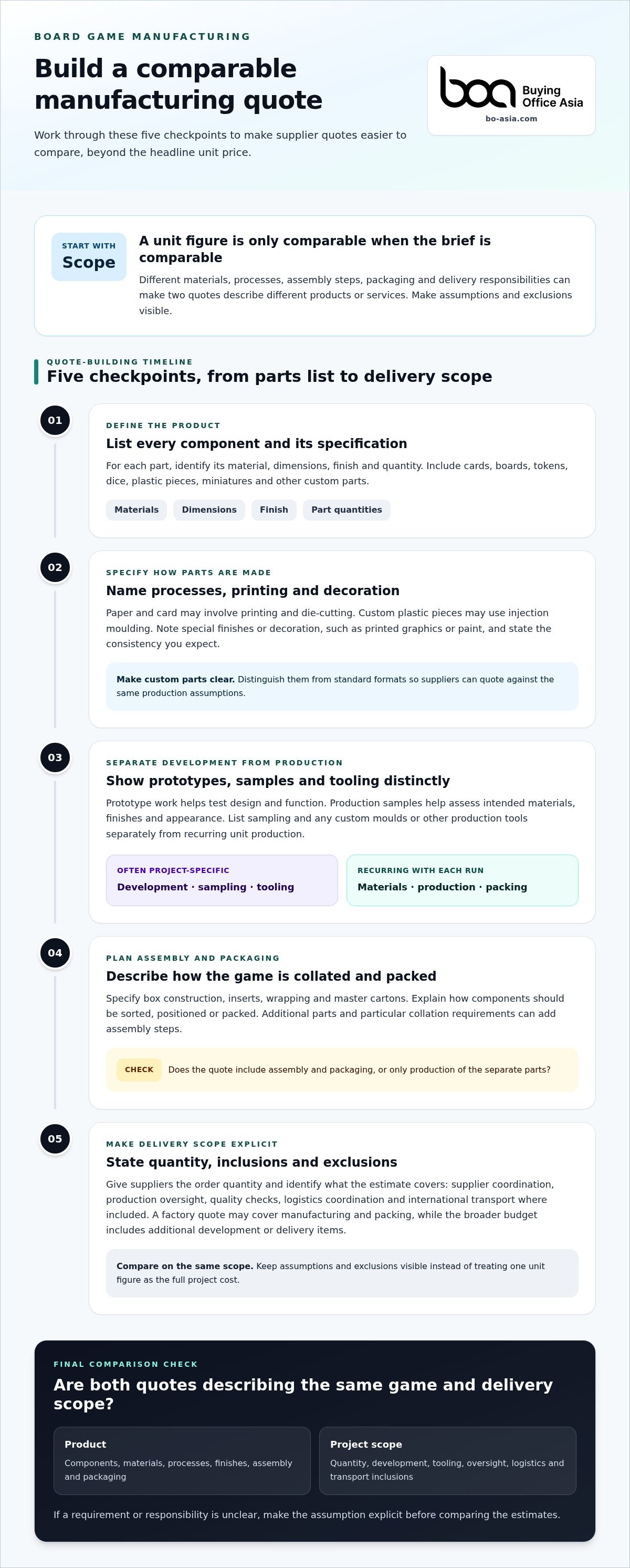
A clear brief turns a broad idea into requirements that can be priced, sampled and checked. It also helps you identify why offers differ instead of comparing unit figures built on different assumptions. Board game manufacturing costs are easier to assess when the specification, order quantity and delivery scope are consistent across every quote.
Work through the brief in sequence. If key design decisions are still changing, mark them as provisional so suppliers can distinguish confirmed requirements from open questions.
Provide the current rules, component layout and artwork files. Note what is approved, in progress or subject to revision, and state who approves samples and artwork.
For each part, list its name, quantity per game, dimensions, material, finish, decoration and any fit or tolerance requirements. Include the box, insert, instructions and outer packing.
State the quantities you want quoted and identify language editions, artwork variations or other versions. Explain which parts differ between versions.
Describe the intended users and destination markets. These details inform which product requirements may apply. Don’t assume a game has the same requirements in every market or for every age group.
Identify prototype or sample stages, the reference sample for production, and the checkpoints where you expect to review progress or approve changes.
Match each quote against the same specification, quantities, packaging, delivery scope, inclusions and exclusions. Request a revised breakdown where assumptions differ.
Use a simple checklist alongside each estimate. It exposes missing scope before a low headline figure becomes an unplanned cost or production disagreement.
• Are all components, quantities per game, materials, finishes and artwork versions included?
• Are development, sampling and tooling separated from recurring production and assembly?
• Does the quote state the packaging configuration and what delivery or logistics coordination covers?
• Are exclusions, unresolved assumptions and optional specifications listed clearly?
• Is there a defined sample approval process, including how changes are recorded before production?
• Are quality checkpoints, tolerances, inspection scope and corrective-action steps described?
Two manufacturing quotes are genuinely comparable only when they use the same product specification, order assumptions, packaging and delivery scope, with inclusions and exclusions made explicit. An approved sample gives the production team a visual and material reference, while agreed checkpoints help identify issues during the run. Inspection sampling is a snapshot of selected units at a particular stage, not a guarantee of every unit’s quality.
For a quote-ready brief that connects specifications with sampling and production follow-up, contact Buying Office Asia about your manufacturing project.
Cost clarity depends on connecting commercial decisions to production records. A change to a component, finish or packing method can affect supplier instructions, approvals and the final estimate. Coordinated management keeps those decisions traceable, so you can see what changed, who approved it and which quote assumptions need updating.
Buying Office Asia shares factory prices, documents and communications transparently. It works as an on-the-ground partner coordinating suppliers and production, not as a factory or shipping line. Its experience includes supporting a US board-game brand producing at least 2.7 million games annually. That experience informs its support for projects with different scales and component requirements, without implying a particular result for your project.
Once a sample is approved, record the decision alongside the relevant component specification and artwork version. This creates a clear reference for the production team and reduces ambiguity if a supplier proposes a substitution or a design revision arises.
Set out who receives production updates, who can approve changes and how unresolved issues are escalated. These responsibilities matter when several suppliers contribute different game components. Keeping decisions and communications together helps your team understand the operational and quote implications before accepting a change.
End-to-end support is useful when a project needs connected coordination across suppliers, product requirements, production decisions and delivery planning. BOA’s contract manufacturing and OEM support can align custom product requirements with production work. Its sourcing and procurement services support supplier engagement and purchasing decisions.
A standalone inspection can suit a publisher with an established production arrangement who needs a check against defined criteria. BOA provides standalone inspections starting from one inspector-day, with same-day reporting. The inspection scope and reporting focus on the agreed product and criteria.
Choose the level of support that fits your project stage and internal resources. Discuss your board game manufacturing project with Buying Office Asia.
Your next step is to turn the quote brief into a working document for decisions, approvals and production follow-up. Keep revisions visible, record who approves each change, and connect cost assumptions to the specification. This gives your team a practical way to assess board game manufacturing costs as the design develops, without losing sight of quality or delivery requirements.
Buying Office Asia’s founders bring over 20 years of experience managing Asian production. That perspective supports a coordinated approach to sourcing and manufacturing, with clear communication as your project moves from development toward production.
You don’t need every production question settled before starting a conversation. Bring the design stage, component brief and key decisions you’re working through. Discuss your board game manufacturing project with BOA and take the next step with a clearer plan.
To get a useful project figure, request a written estimate tied to a specific production plan rather than relying on a broad industry average. Ask for the proposed per-unit amount and any non-recurring charges to be shown separately, with quantity breaks and quote validity stated. If you’re still deciding between design options, request comparable alternatives so you can see how each affects the budget before approving the specification.
Not always, but substitutions limit what you can learn from a prototype. A stand-in card stock may be fine for testing sequence and legibility, but it won’t tell you how the final cards feel in play. Likewise, a rough substitute for a fitted part may not reveal whether the production version assembles correctly. Treat results from substitute materials as provisional, and evaluate production-representative materials before final approval.
Yes. The main control challenge is matching each language’s approved text and artwork to the correct edition. Give every version a distinct file name or identifier, and have a responsible reviewer approve the final text before print files are released. If editions are packed or shipped at different times, make the version designation clear on production and carton records to help prevent mix-ups.
No. A publisher should first establish how the product will be presented and used, then determine which requirements apply in each sales market. Don’t treat labels such as “promotional item” or “collectible” as automatic exemptions. Before committing to production, verify the product’s classification and applicable testing with the relevant official regulator or standards source. This avoids building a compliance plan around an informal assumption.
Control artwork access and file versions as part of the production workflow. Share only the approved assets needed for each production task, identify who may access them, and keep a record of which version was supplied and when. Remove obsolete files from active working folders where practical. These measures support confidentiality and reduce accidental use of outdated artwork, but they can’t guarantee that materials won’t be misused.
Use shipment-ready data, not just the dimensions of the game’s retail box. Ask for the planned master-carton quantity, packed carton dimensions and gross weight once the pack-out is defined. Those details help make a freight request more specific and expose changes caused by a revised insert or carton configuration. Check that the delivery address and requested arrival window are stated consistently in the estimate and the production plan.

What if the first clear sign of a production problem arrives after the goods are packed? Manufacturing risk management in Asia works best when controls are connected from the start, not left to a final inspection or occasional supplier update. You need visibility into factory activity, early warning...

What if the factory’s lowest quote isn’t the lowest-cost option? A lower unit price can hide differences in materials, tooling, packaging, quality checks or production terms. Understanding how sourcing agents negotiate factory prices starts with making those differences visible, not simply asking a...
A factory audit can look reassuring while leaving a critical question unanswered: will the same materials, processes and controls be used for your production run? Responsible toy manufacturing in China requires more than reviewing a certificate. You need to understand factory conditions, subcontract...