

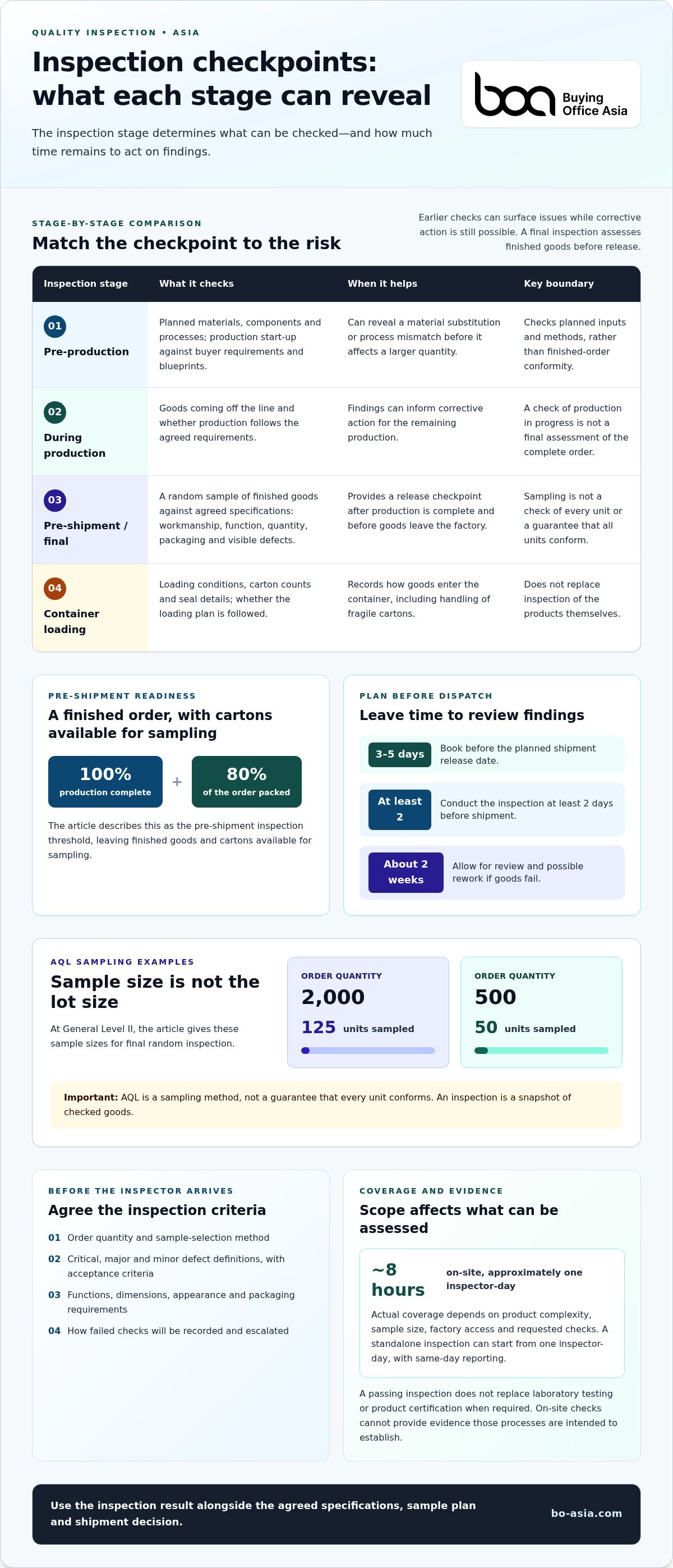
A final inspection is a release checkpoint, not a guarantee that every unit is flawless. A standalone quality inspection in Asia can assess a random sample against your agreed specifications; a pre-shipment inspection typically takes place after production is 100% complete and at least 80% of the order is packed. The scope can start from one inspector-day, with same-day reporting.
You need a clear view of what an inspection covers before goods leave the factory. It can assess workmanship, function, quantity, packaging and visible defects, while the sampling plan determines how much of the shipment is checked. A passing result doesn’t replace laboratory testing or product certification when required.
This article explains how pre-shipment and final inspections work, what to include in the inspection scope, and how inspector-days affect coverage. You’ll also learn when an earlier production check can surface issues sooner, what a useful report should contain, and where inspection ends and testing or certification begins.
• Match the inspection stage to the risk: checks before and during production can surface issues while corrective action is still possible.
• Define the inspection scope around approved samples, specifications, materials, function, workmanship, components and packaging.
• Set sampling criteria and defect classifications in advance so the report supports a clear shipment decision.
• Use laboratory testing or product certification where the product or destination-market requirements call for evidence an on-site visual inspection cannot provide.
• Treat inspection findings as a snapshot of the checked goods, not proof that every unit is defect-free or legally compliant.
A standalone quality inspection in Asia is an on-site assessment of products against agreed specifications, conducted independently of broader production management. A pre-shipment or final inspection assesses finished goods before release, while earlier checks can identify problems sooner.
Inspection stages follow production from material preparation through loading, with each stage focused on different risks. A pre-production inspection reviews intended materials, components and processes; an in-process inspection checks goods coming off the line. A pre-shipment inspection assesses finished products, while container-loading supervision records loading conditions, carton counts and seal details.
The timing changes what can still be corrected. A during-production inspection can identify issues early enough to inform corrective actions for the remaining production. A container check can confirm that the loading plan is followed, including keeping fragile cartons from the bottom. It doesn't replace checking the products themselves.
Pre-production checks compare planned inputs and production methods with the buyer’s requirements. The inspector can review the raw materials and components the supplier intends to use, then examine how production begins and whether the factory follows the buyer’s blueprints. This can reveal a material substitution or process mismatch before it affects a larger quantity.
Product checks depend on what is being made. For a consumer product, an inspection can assess visible finish, assembly, function and packaging against approved samples. For an industrial product, the scope may need to include process steps and specifications established during development. A multi-component item, such as a board game, also calls for checks on component counts and pack-out. Clear criteria make reports useful for action.
A common final-inspection booking condition is that production is 100% complete and at least 80% of the order is packed; confirm the threshold with the inspection provider. That threshold gives the inspector finished goods to assess while cartons remain available for sampling. Booking the check before the planned shipment leaves time to review findings and address rework, instead of discovering problems after dispatch.
Leave enough time before shipment for your team to review findings and for any agreed rework and reinspection. The supplier and buyer should agree on the inspection date and time in advance, since container loading may be scheduled only a few hours before an inspector arrives. If loading is imminent, a product inspection and a loading check answer different questions: one assesses product conformity; the other records how goods enter the container.
Match the inspection scope to the product and shipment decision. Provide the inspector with current specifications, approved samples, packaging requirements and a list of critical checks. For changing designs or complex industrial processes, a final snapshot may reveal issues too late for efficient correction. Factory observations are most useful when they inform purchasing decisions; the on-the-ground sourcing approach explains how regional presence connects those decisions with factory conditions.
A pre-shipment inspection checks finished goods before release, using an agreed scope and sampling plan. Under your contract, you retain the shipment decision.
Final random inspection uses a sample from the completed order to assess conformity without checking every unit. AQL sampling applies an agreed acceptance quality limit to that sample, helping buyers set consistent criteria for shipment decisions.
For a 2,000-unit order inspected at General Level II, the sample size is 125 units. For a 500-unit order, the stated sample size is 50 units. The inspection checks selected products against specifications, approved samples and defect classifications. AQL is a sampling method, not a guarantee that every unit conforms.
Agree on these items before a production or final inspection:
• The order quantity and method for selecting the sample.
• Critical, major and minor defect definitions, with acceptance criteria.
• Product functions, dimensions, appearance and packaging requirements.
• How failed checks are recorded and escalated for action.
Clear criteria prevent disputes over whether a scratch, assembly issue or missing component counts as a defect. A report should identify observed failures and supporting evidence, so you can compare findings with the agreed standard.
Pre-shipment readiness thresholds vary by provider and the agreed assignment. Confirm the required production and packing status in the inspection booking. A final random inspection is conducted after 100% of the shipment quantity is finished, allowing the sample to represent the complete lot.
Book the inspection early enough for the factory to confirm access and readiness, and schedule it with enough time before shipment to review findings and decide on any rework or reinspection. These timings leave room to review findings before goods are dispatched. If issues emerge only after the shipment is ready, replacing or reworking defective products may delay delivery.
Actual coverage depends on product complexity, sample size, factory access and the checks requested. Buying Office Asia offers standalone inspections starting from one inspector-day, with same-day reporting. A larger scope or additional testing can change the time needed.
Inspection pricing depends on the case and is provided after a quote request; product scope, location, access, sampling, tests and timing shape the work. To arrange a standalone inspection discussion, share the shipment stage and inspection requirements.
An inspection evaluates products against defined specifications through documented checks, but it doesn’t replace laboratory testing or certification. Inspectors can compare markings, warnings, age grading, instructions and packaging with destination-market requirements. What applies depends on intended use, components and destination.
An inspection scope defines which products, components, specifications and checks the inspector evaluates. Clear boundaries help buyers interpret findings and distinguish observed defects from issues requiring other evidence.
Give the inspector the current specification, approved sample, relevant artwork and packaging requirements. Identify functional checks, measurements, appearance criteria and records to review. Independent assessment means findings are judged against agreed criteria, rather than relying only on the supplier’s internal report. For example, a report can document a missing component in a carton and photograph the affected item.
For products with several parts, name each component and its acceptance criteria. A generic instruction to “check quality” leaves room for inconsistent judgments between the factory and buyer.
Random sampling selects units from a lot for assessment, giving buyers a structured view of observed quality. It cannot establish that every unsampled product is free from defects.
Assess sampled units against defined defect categories and requirements. A visual finish issue, a failed function and a missing component have different consequences, so record each finding separately. The report should identify the checked items, evidence, affected sample and result against the agreed criteria. This helps buyers decide whether corrective action or further review is appropriate.
Sampling has limits: defects outside the sample may remain undetected, and an inspector cannot infer material composition from appearance alone. If a product’s safety or performance depends on a material property, laboratory evidence may be necessary. On-site findings are a snapshot of manufacturing output, not proof of universal conformity.
AQL sampling uses statistical plans to set sample sizes and acceptance criteria for lot-by-lot inspection. ISO 2859-1:2026 describes sampling schemes indexed by acceptance quality limit, giving buyers a consistent framework for evaluating sampled lots.
Before inspection, agree on the applicable plan, defect classifications and acceptance limits. The sample and thresholds affect how findings translate into an accept or reject result. AQL doesn’t mean that the permitted proportion of defects is guaranteed in every shipment, nor does a passing result certify every unit.
Keep the sampling decision separate from compliance evidence. Inspectors can record visible labels, warnings and product condition against supplied requirements, while laboratory tests address properties that visual checks cannot establish. Use inspection reports to document observed results, and applicable test reports or certification records to support requirements that call for them.
The infographic's booking and rework windows are planning examples, not guaranteed lead times or minimum service requirements. Agree on the actual booking, inspection, reporting and corrective-action schedule for your assignment. The scope can start from one inspector-day, with same-day reporting.
A useful inspection report connects each finding to a specification, product sample or shipment decision. Clear evidence helps importers prioritize corrective action across the supply chain.
Digital quality platforms organize inspection results by product, batch, defect type and evidence. For example, a platform can group the same stitching error across batches, helping buyers see whether an issue is isolated or recurring.
Photos and measured results make findings easier to interpret than a pass-or-fail summary. A report should identify the inspected items, applicable criteria, observed condition and supporting evidence. For a packaging check, that could include a photograph of damaged cartons and the recorded carton count.
• Match each defect to the relevant specification or approved sample.
• Record the product or component affected, with clear photo evidence.
• Separate functional, visual and packaging findings.
• State the inspection result against the agreed acceptance criteria.
These details let procurement teams compare reports from different production runs. They also help suppliers understand what needs correction, rather than relying on a vague instruction to improve quality control.
Inspection companies can assess inspector qualifications through documented training, relevant product experience and reviews of completed inspection work. Reports are more reliable when inspectors use a defined checklist, record evidence against each criterion and submit findings for separate review.
Importers can assess the process by reviewing a sample report for traceable observations, consistent defect classifications and clear photographs. For example, a measured dimension should show the requirement and recorded result, not simply “checked.” Confirm that the report distinguishes direct observations from conclusions and identifies checks that could not be completed.
A report supports action only when each finding has an owner and a practical next step. Depending on the evidence and issue, the supplier can sort affected goods, investigate a process cause or correct packaging before shipment.
For recurring defects, compare records by batch, component or production stage. If the same paint inconsistency appears across separate lots, the pattern may point to a process issue rather than isolated handling damage. Re-inspection can then focus on corrected items and the original failure criteria.
Digital records also preserve inspection history for future quality control. Keep the report, approved specifications and corrective-action evidence together, so later reviews can use the same criteria and identify unresolved supply-chain risks.
An on-site inspection evaluates finished goods against agreed criteria, but it can’t establish every material property or prove legal compliance. Use each method for the evidence it can provide.
An on-site inspection records observable conditions and selected functional checks at the factory. It matters because some hazards and performance issues aren’t visible during a visual review.
An inspector can compare a finished item with a specification, inspect assembly and packaging, and document visible defects. But a product that looks correct may still contain an unsuitable material or fail a test requiring laboratory equipment. For example, checking a coating’s appearance doesn’t establish its chemical composition.
Certification and laboratory testing serve different purposes from inspection. Testing evaluates defined properties under a specified method; certification provides evidence tied to applicable requirements. For toys, electrical goods, food-contact products or items with safety claims, intended use and destination determine which evidence is relevant. An inspection checklist can record labels and warnings, but that review alone doesn’t prove they satisfy every applicable rule.
A factory audit also has limits: it can assess observed capability, production organization and quality processes, but it doesn’t prove a future batch will conform. Use audit findings to understand supplier controls, then assess actual production separately.
Acceptable Quality Limits set sampling criteria for evaluating defects in a lot; they don’t promise defect-free products. Buyers need defined defect classes and acceptance limits to interpret a sample consistently.
Major defects are typically assigned an AQL of 2.5, and minor defects an AQL of 4.0. Critical defects, including safety hazards or regulatory violations, have zero tolerance. These values are acceptance criteria, not a prediction of the defect rate in every shipment. A sampled pass also can't reveal every defect in unsampled units.
Use ANSI/ASQ Z1.4-2003 (R2018) as a reference for acceptance sampling by attributes. Set criteria before the inspection, then make sure the supplier and inspector use the same defect definitions. A scratch might be cosmetic on one product, but unacceptable on a visible licensed collectible where artwork consistency matters.
Supplier risk can persist beyond the inspection date. Materials may change, production processes may drift, or corrective action may not reach every unit. If an inspection finds repeat defects, document the affected products, require a clear corrective-action response, and decide whether follow-up checks are needed before release. Use a factory audit to assess process controls, inspection to review goods, and testing or certification for evidence those methods cannot provide.
Buying Office Asia connects inspection findings with the broader sourcing and procurement decisions that shape production risk. A standalone inspection gives you a snapshot; coordinated oversight can address supplier selection, factory-direct price negotiations and production decisions before issues reach finished goods.
Turn to end-to-end support when you need an ongoing procurement partner across suppliers, production and quality checkpoints, rather than a single shipment assessment. A dedicated Asia procurement team can align factory communication with your specifications and commercial priorities. For high-volume sourcing, that continuity can make supplier and production decisions easier to manage as requirements change.
Explore sourcing and procurement support from Buying Office Asia, or visit bo-asia.com to discuss your manufacturing needs.
Make the next inspection part of your procurement calendar, not an isolated response to a problem. Record the decision it supports, the internal owner and how the outcome will inform future orders from the same supplier.
For a standalone quality inspection in Asia, prepare a concise booking brief that identifies the product, factory and decision deadline. This gives the inspection a clear operational purpose and helps your team act on its findings within the order process.
For support with an upcoming inspection, contact Buying Office Asia to discuss your requirements. A defined next step can help keep your production plan moving.
Third-party inspection in China is an external product assessment arranged by the buyer and performed separately from the factory’s own production team. The inspector records observations against the buyer’s agreed requirements; they aren’t a regulator or import authority. For useful traceability, tie the assignment to the purchase order and identify the exact approved drawing or sample revision being assessed.
Yes. Put the inspection arrangement in writing and notify the supplier’s responsible contact. Clarify who will coordinate entry, who may accompany the inspector, and whether factory rules restrict photography or access to production areas. Keep the supplier’s acknowledgement with the order records. These details help avoid disagreements about access or evidence collection on inspection day.
A third-party inspector can provide independent observations, but your company should retain control of confidential information and the final release decision. Limit access to proprietary artwork or technical files to what the agreed checks require. Set expectations for handling photos and documents, and send the completed report to an authorized buyer contact. This keeps inspection evidence useful without giving an external party authority over your commercial decision.
Standalone product inspections are used in manufacturing markets across Asia, including China, India, Vietnam and Thailand. The relevant country is where the goods are physically available for assessment. For orders involving suppliers in several countries, identify each factory and the products held there in the booking information. This helps keep separate orders and production locations clear in the resulting records.
Product-focused inspections can be arranged independently of a factory audit. The appropriate visit depends on the decision you need to make: review an input before production, investigate output during a process change, assess goods before release, or document loading activity. A factory audit instead examines the supplier’s observed facilities and quality processes. You can choose a product check without commissioning that broader supplier assessment.
There isn’t one price that applies across China, India, Vietnam and other Asian markets. Request a quotation for the specific assignment, then compare proposals against the same deliverable rather than country labels alone. For budget planning, distinguish a visual product assessment from an assignment that includes additional testing or a follow-up visit. This makes proposals with different scopes easier to compare fairly.
Use the report as part of a traceable order record, not as a standalone file. Keep it with the purchase order, the specification revision used for assessment, any supplier response and evidence of corrective action. This helps your team establish which requirements applied and how findings were addressed. It’s especially useful if a later delivery question concerns a specific order or production run.
ISO 2859-1 and ANSI/ASQ Z1.4 are sampling references used for product inspections. Specify the chosen plan in the inspection instruction, including the lot, inspection level, defect categories and acceptance criteria. Don’t assume the supplier’s internal sampling plan matches your contractual requirements. Set stricter controls for safety-critical issues separately from routine appearance defects, and make sure all parties use the same written criteria.

A collector’s edition succeeds when its packaging supports the product experience and the practical demands of production. Collector’s edition box manufacturing brings design, materials, components, and assembly planning together in one coordinated brief. The aim is a presentation that feels conside...

Learn how to find a manufacturer in China without an in-house Asia team: define your brief, shortlist factories, compare quotations, validate samples and control quality.

Fine detail only matters when it can be reproduced reliably. Injection moulded figurine manufacturing shapes plastic by injecting molten material into a closed mould, cooling it, then ejecting the formed part. The method supports repeatable, intricate components, while the mould’s design and precisi...