


If you are relying on a supplier's website and a few emails to secure a high-volume order, you aren't just taking a risk; you are gambling with your brand's survival. Building trust with a new Asian supplier has become significantly more complex in 2026, especially with the compliance demands of China's revised Foreign Trade Law and the security mandates of Decrees 834 and 835. You likely feel the weight of communication barriers and the constant fear that the reality on the factory floor won't match the sample on your desk.
We understand that the lack of visibility into international manufacturing is the primary source of operational anxiety for your business. This guide shows you how to transform these high-risk transactions into secure, high-yield partnerships by utilizing cultural intelligence and professional on-site verification. You'll learn how to establish a transparent supply chain that delivers factory-direct pricing without the hidden markups of traditional intermediaries. We will outline the specific strategies needed to navigate current trade investigations and fragmented digital regulations, giving you the peace of mind that only comes from verified data and a dedicated regional presence.
• Identify why digital 'Gold Supplier' badges are insufficient and how to conduct rigorous legal and financial audits to protect your capital.
• Master the multi-stage verification framework required for building trust with a new Asian supplier while scaling to high-volume production.
• Learn to navigate the nuances of high-context communication and 'Mianzi' to resolve disputes without compromising your manufacturing timeline.
• Implement a robust on-site inspection system that monitors the four critical stages of production to ensure factory-floor reality matches your specifications.
• Understand the strategic ROI of integrating a dedicated Asia procurement team as a protective, on-the-ground extension of your own business.
Digital marketplaces often present a polished veneer that obscures operational reality. While a "Gold Supplier" badge or a high rating on a sourcing platform suggests reliability, these are frequently paid marketing assets rather than verified performance indicators. Relying solely on a digital profile is a dangerous starting point when building trust with a new Asian supplier. In 2026, the complexity of global trade, underscored by China's Revised Foreign Trade Law and supply chain security regulations like Decrees 834 and 835, requires a shift from transactional interactions to strategic partnerships. You aren't just buying a product; you're securing a link in your supply chain that must withstand regulatory scrutiny and market volatility.
The "Middleman Trap" remains a significant hurdle for independent business owners. Trading companies often masquerade as manufacturers by using professional photography and sophisticated English communication. While they provide a service, they also introduce obscured costs and a lack of direct control over the factory floor. To avoid this, you must transition from a "customer" mindset, where you simply place orders, to a "partner" mindset, where you demand transparency into the production process itself. True trust isn't found in a PDF brochure; it's built through the steady confidence of verified data and physical oversight.
Guanxi, or the system of social networks and influential relationships, remains the engine of Asian business. It's not merely about social banquets; it's about establishing a level of mutual obligation that ensures your orders receive priority during peak seasons. However, unvetted intermediaries often claim "false Guanxi" to justify higher margins without providing actual protection. Professional procurement teams leverage authentic local networks to negotiate better terms and faster lead times. A deep understanding intercultural communication allows you to distinguish between genuine influence and empty promises, ensuring your interests are defended on the ground.
Blindly trusting a supplier's self-reported data carries a heavy financial burden. Batch defects and production delays don't just cost money; they erode your brand's market position. Without physical proximity and on-site oversight, you're vulnerable to "hidden markups" where unit prices are inflated to cover the intermediary's overhead. True financial optimization requires a transparent view of the factory's cost structure. Beyond the balance sheet, your brand reputation depends on sustainable sourcing practices. Ethical lapses at the factory level can lead to catastrophic brand risks that are far more expensive to repair than the cost of initial, rigorous vetting.
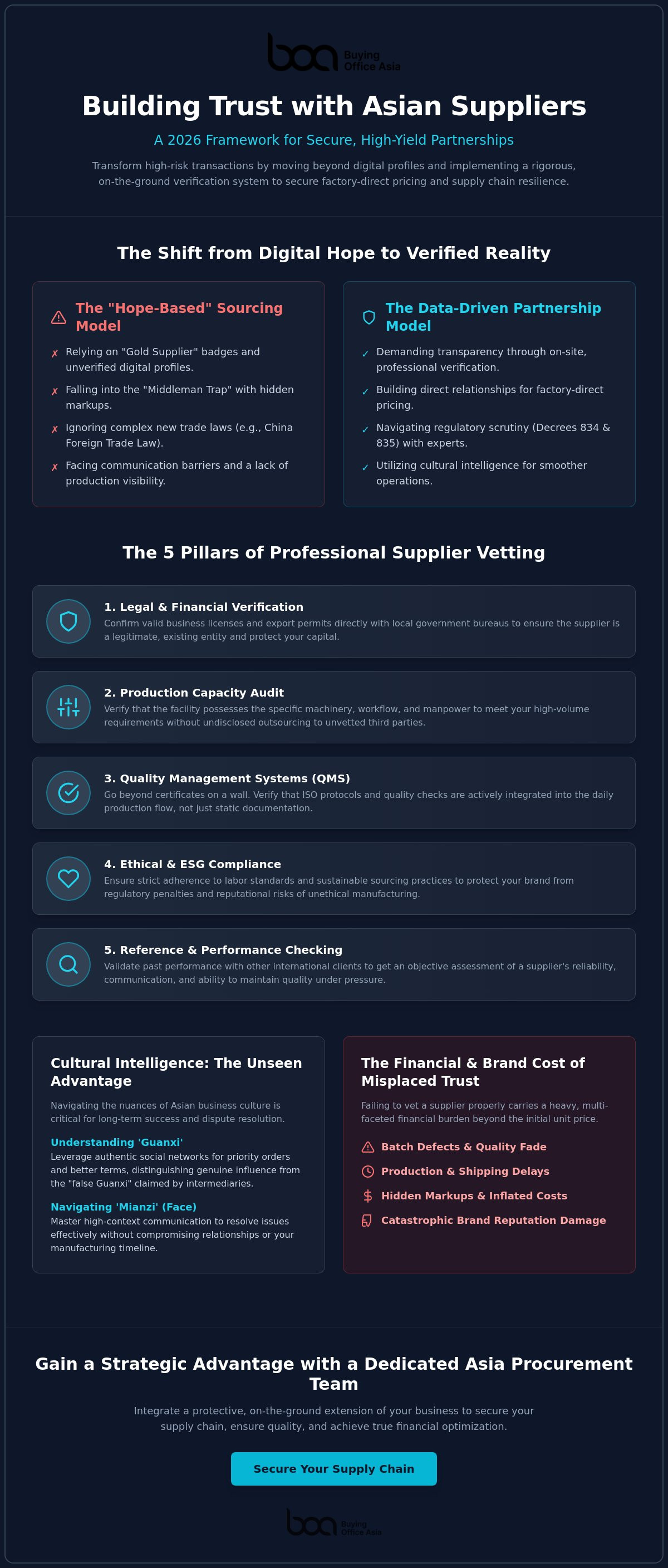
Trust in international trade isn't a nebulous feeling; it's the result of a rigorous, data-driven verification process. When building trust with a new Asian supplier, you must dismantle the "hope-based" sourcing model and replace it with a system of objective pillars. This methodology ensures your capital is protected and your supply chain remains resilient against the volatility of the 2026 trade environment. By quantifying risk through these five lenses, you move from a position of vulnerability to one of strategic control.
This involves confirming valid business licenses and export permits directly with local government bureaus to ensure the entity exists legally.
You must verify if the facility possesses the specific machinery and manpower to meet your high-volume requirements without outsourcing to unvetted third parties.
Look beyond certificates on a wall; verify that ISO protocols are actively integrated into the daily production flow rather than just existing as static documentation.
Modern trade requires strict adherence to ESG and labor standards to protect your brand from regulatory penalties and the reputational risks of unethical manufacturing.
Validating past performance with international clients provides an honest look at the supplier's reliability and their ability to maintain quality under pressure.
The most common source of obscured costs is the hidden middleman. To ensure you're conducting factory direct price negotiations, you must verify the identity of your contact. Red flags include a lack of technical knowledge regarding the manufacturing process or an inability to provide a factory-issued business license in the manufacturer's name. By removing these layers, you secure the financial viability of your product line. Implementing strategies for long-term supplier relationships starts with knowing exactly who is receiving your payments and ensuring they own the production floor.
Desktop audits are fundamentally flawed because they rely on data provided by the supplier. A comprehensive supplier vetting report requires physical proximity to the shop floor to capture the reality of daily operations. A factory audit is a physical verification of a supplier's claims. On-site inspections reveal the truth about equipment maintenance, worker conditions, and raw material storage that a PDF can easily hide. If you want to eliminate the anxiety of the unknown, you can request a professional factory audit to secure your next production run with absolute certainty.
Operational success in Asian manufacturing is as much about psychological alignment as it is about technical specifications. When building trust with a new Asian supplier, you must move beyond the literal interpretation of your emails. Many Asian cultures are high-context, meaning the relationship and the setting of the conversation carry more weight than the words themselves. If you approach these interactions with a purely transactional Western mindset, you risk creating friction that leads to production delays and quality inconsistencies.
The concept of 'Mianzi', or Face, is a critical operational lever that influences supply chain priority. In a business context, giving face involves publicly acknowledging the supplier's expertise and value; saving face involves handling disputes privately and respectfully. If a supplier loses face due to aggressive or accusatory communication, their commitment to your project will likely diminish. According to Purdue University research on building trust, Western managers often fail because they prioritize immediate efficiency over the long-term relationship building required in these regions. To secure your supply chain, you must view every interaction as an investment in mutual respect.
One of the most common pitfalls is the interpretation of the word "Yes." In many Asian manufacturing hubs, "Yes" often signals that the listener has heard you, not necessarily that they agree with your proposal or can meet your deadline. This is not a form of deception; it is a cultural preference for harmony over direct confrontation. Professional procurement requires a "Verify then Trust" approach where verbal affirmations are immediately followed by detailed, bilingual documentation to ensure absolute alignment on technical requirements.
Information silos are the enemy of production speed. You should establish a single point of contact within the factory to ensure accountability. Relying on bilingual project management is essential for translating complex technical specifications into actionable shop-floor instructions. By using real-time communication tools and frequent video calls, you can maintain a presence on the factory floor without being physically present, reducing the risk of "information drift" during long production cycles.
Aggressive negotiation tactics that drive a supplier's margin to zero are counterproductive. When a factory cannot sustain a healthy profit, they are forced to cut corners, leading to the phenomenon of "quality fade." To ensure building trust with a new Asian supplier remains a high-yield strategy, aim for a "Win-Win" price point. This financial viability ensures the factory remains committed to your quality standards and grants you priority during peak production seasons. Reciprocity is the currency of a strategic partnership; by being a reliable and respectful client, you secure a defense against the operational setbacks that plague unmanaged supply chains.
Trust in international manufacturing is not a static achievement; it's a variable that must be managed through every production cycle. While initial vetting establishes a baseline, building trust with a new Asian supplier during mass production requires a transition to a "Trust but Verify" framework. This systematic approach ensures that the standards agreed upon during the sampling phase are strictly maintained as volumes scale. Without a permanent verification system, you remain vulnerable to "quality fade," a common industry phenomenon where material grades or finishing standards slowly decline over time to increase the factory's margin.
A robust oversight strategy utilizes four critical stages of on-site inspection. Pre-production inspections verify raw materials before they reach the line. During-production checks identify defects while there's still time to correct them. Final random inspections ensure the batch meets your specifications before payment; container loading supervision prevents damage or "short shipping" during the final logistical step. These technical anchors are defined by your Acceptable Quality Level (AQL) standards, which must be explicitly detailed in your manufacturing contract to provide a measurable basis for batch acceptance or rejection.
Factory-internal QC teams are often incentivized to prioritize production speed over rigorous defect detection. To protect your brand, you must implement independent on-site quality control. If an inspection fails, it should be treated as a professional correction rather than a relationship-ending event. A structured rework process, followed by a re-inspection at the supplier's expense, reinforces your commitment to quality without damaging the partnership. This transparency reduces return rates and stabilizes your financial projections in a volatile market.
The "Golden Sample" serves as your primary legal and technical benchmark. Every unit that rolls off the line is measured against this master specimen, leaving no room for subjective interpretation. When navigating the complexities of oem manufacturing, protecting your intellectual property and custom tooling is paramount. Trust is reinforced when you have a dedicated team ensuring that your designs aren't shared with competitors and that your tooling remains your exclusive property. If you're ready to secure your production line with professional oversight, you can connect with our procurement experts today to discuss your 2026 manufacturing goals.
Many businesses mistakenly believe that an annual factory visit or a quarterly flight to a manufacturing hub is enough to maintain oversight. In the complex trade environment of 2026, where intra-Asian consumption drives 65% of supply chain investment decisions, occasional presence is no longer a viable strategy for high-volume operations. Building trust with a new Asian supplier requires more than a handshake; it demands consistent, daily accountability that only a permanent regional presence can provide. When you have a team on the ground in hubs like Hong Kong, you move from being a distant customer to a prioritized partner with immediate visibility into the factory floor.
A dedicated procurement team functions as an integrated extension of your own business rather than a third-party intermediary. This model eliminates the obscured costs and misaligned incentives typical of traditional sourcing agents. By maintaining physical proximity to your suppliers, we provide a stabilizing force that protects your financial health against sudden regulatory shifts or production bottlenecks. This level of oversight ensures 100% transparency, allowing you to capture the full financial benefits of factory-direct pricing while mitigating the risks of unmanaged international manufacturing.
The primary friction points in global trade are often rooted in time zone disparities and language barriers. By combining European leadership with local Asian expertise, we provide a communication bridge that ensures your technical specifications are never lost in translation. This dual approach allows you to sleep while your production is managed in real-time. Our documented performance history shows that this level of professional oversight has consistently saved clients between 15% and 25% in procurement costs by identifying inefficiencies that a distant buyer would never see.
As your volume increases, the risks associated with quality fade and logistical delays grow exponentially. Transitioning to a dedicated Asia procurement team allows you to scale your operations without losing control. We manage the entire lifecycle of the order, from factory-direct negotiations to complex logistics and shipping coordination. This end-to-end management ensures that your goods arrive on time and within budget, regardless of the shifting geopolitical landscape. If you are ready to transform your supply chain into a secure, high-yield asset, you can consult with our experts to begin building a more resilient manufacturing strategy today.
Success in international manufacturing requires a fundamental shift from passive observation to active, on-site management. You've seen that building trust with a new Asian supplier is not a single event but a continuous process of verification and cultural alignment. By moving beyond digital profiles and implementing the five pillars of professional vetting, you eliminate the "middleman trap" and secure the financial viability of your production. This strategic approach replaces anxiety with the steady confidence of an established expert.
As a European-managed firm with our headquarters in Hong Kong, we provide the physical proximity and regional expertise your business needs to thrive. We offer 100% transparency with no hidden markups, ensuring you receive factory-direct pricing and elite oversight. Our proven track record in high-volume OEM and ODM management serves as your defense against operational setbacks and brand risks. It's time to move toward a more resilient manufacturing model.
Book a consultation with our Asia-based procurement experts to transform your supply chain into a stable, high-yield partnership. Your global growth starts with a foundation of verified data and professional accountability.
You verify a license by requesting the original document and cross-referencing the Unified Social Credit Code through official government databases like the NECIPS. Building trust with a new Asian supplier requires ensuring the company name on the license matches their bank account and export permits. This step prevents you from sending funds to an unauthorized entity or a shell company during the initial procurement phase.
Guanxi is the system of reciprocal social networks that drives business priority in many Asian cultures. It matters because it transforms a transactional order into a strategic obligation. Factories with strong Guanxi ties to your team are more likely to honor lead times during high-demand periods. This social capital acts as an informal insurance policy for your manufacturing schedule and overall supply chain resilience.
No, platform badges like "Gold Supplier" are marketing tools and don't replace professional vetting. Relying on digital profiles without an on-site audit leaves you vulnerable to trading companies masquerading as factories. Physical verification is the only method to confirm a supplier's true production capacity and regulatory compliance before you commit significant capital to a high-volume order.
Preventing quality fade requires implementing a "Trust but Verify" framework through every production run. You must conduct on-site inspections at the pre-production and during-production stages to catch material substitutions early. By enforcing strict Acceptable Quality Level (AQL) standards in your contract, you signal that any deviation from the original "Golden Sample" will result in a rejected batch and required rework.
Key red flags include vague answers to technical questions and a refusal to share factory-direct documentation. If a contact cannot explain the specific machinery used for your production, they're likely a middleman. Another warning sign is a sudden change in bank details or a company name that doesn't match the provided business license, indicating potential financial instability or hidden intermediaries.
A dedicated procurement team is superior for high-volume operations because it offers 100% transparency and functions as an extension of your own staff. Traditional sourcing agents often survive on hidden commissions and markups from the factory. A dedicated team provides the permanent, on-the-ground presence necessary for building trust with a new Asian supplier while protecting your profit margins from obscured costs.
Intellectual property protection starts with registering your trademarks and patents in the specific country of manufacture. You should use NNN agreements tailored to local laws rather than standard Western NDAs. Additionally, ensure your custom tooling is marked as your property and verified during on-site audits to prevent unauthorized use for other clients or competitors in the market.
The best approach is to request a detailed cost breakdown that justifies the increase based on raw material or labor market data. Professional procurement involves analyzing these figures against industry benchmarks to determine if the hike is legitimate. A strategic partnership allows for open negotiations where you can find a "Win-Win" price point that maintains factory commitment without eroding your financial viability.

A supplier listing can open a door, but it can’t show whether a factory is right for your order. Choosing a ningbo sourcing agent means looking beyond access to local suppliers: you need clear oversight of supplier vetting, production follow-up, and quality checks. Without defined responsibilities,...

What if the supplier with the strongest online profile isn’t the factory best suited to your shoes? In footwear manufacturing in China, a directory listing can start your search, but it can’t confirm who will make your product, whether the factory can handle its construction and materials, or how cl...
What if the mold you paid to develop couldn’t be released when you needed to change suppliers? Managing tooling and molds with a foreign factory means more than tracking where production equipment is stored. Payment alone may not establish clear ownership, access, or transfer rights. Without visibil...