


The lowest quoted price is often the most expensive mistake a supply chain leader can make. While a traditional middleman might promise simplicity, the reality usually involves opaque pricing structures and hidden quality defects that silently erode your margins. With new Section 301 tariffs of up to 12.5% currently reshaping trade, calculating ROI of a procurement partner is no longer a luxury; it's a requirement for survival. You've likely felt the frustration of trying to justify the cost of a dedicated regional team when stakeholders only focus on the immediate invoice.
• Identify the three core pillars of a comprehensive ROI framework: direct financial savings, quantified cost avoidance, and enhanced operational efficiency.
• Quantify the immediate margin gains achieved by moving to a factory-direct negotiation model that eliminates hidden middleman markups.
• Master the specific formulas for calculating ROI of a procurement partner by factoring in the "Cost of Poor Quality" and risk mitigation through on-site audits.
• Analyze the "Time-is-Money" factor, measuring how a dedicated local presence in Asia reduces sourcing cycle times and accelerates your time-to-market.
• Understand how to benchmark service fees against total COGS reduction to demonstrate the long-term financial viability of a professional procurement partnership.
Measuring the success of your supply chain requires a move away from superficial metrics. While procurement software provides visibility, a professional partner provides results through on-the-ground execution. When calculating ROI of a procurement partner, you aren't just looking at a dashboard; you're evaluating the tangible impact on your bottom line. It's a shift from tracking data to measuring performance in the real world.
The 2026 global market is defined by volatility. Proposed Section 301 tariffs of up to 12.5% and shifting trade agreements with nations like India and Taiwan make a 'Total Cost of Ownership' (TCO) perspective mandatory. You can't rely on the factory gate price alone. You must account for logistics, compliance, and the inherent risks of unmanaged production. A TCO approach ensures that every dollar spent is tracked from the raw material stage to the final delivery at your warehouse.
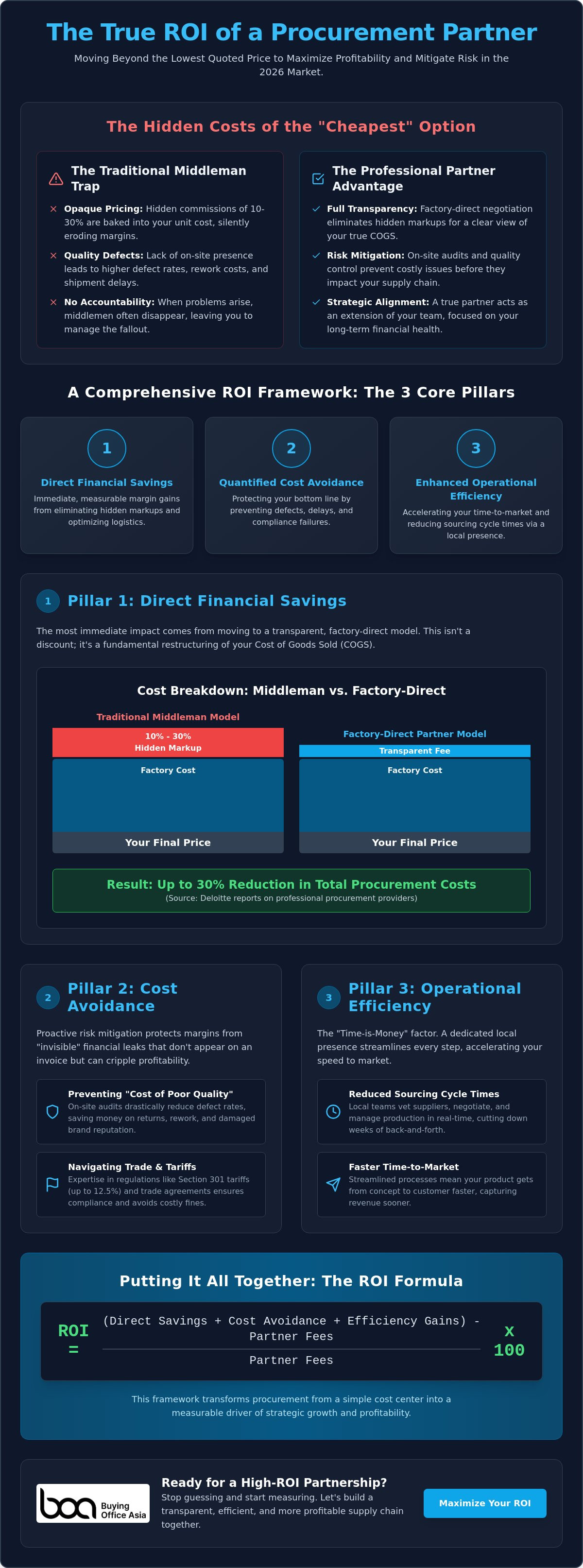
At its most fundamental level, procurement ROI is the net financial gain divided by the cost of the partnership. This follows the standard logic of Return on Investment (ROI), yet it requires deeper data points to be accurate. We categorize these gains into three critical pillars: direct savings, cost avoidance, and operational efficiency. Each pillar represents a different facet of your financial health and long-term viability.
Hard savings are the most visible. These include negotiated price reductions on raw materials and the optimization of logistics routes. If your partner secures a 15% reduction in unit costs through direct factory negotiation, that's a direct win. However, in 2026, CFOs are shifting their focus toward cost avoidance. This includes the 'soft' savings that prevent financial leaks. Avoiding a 5% defect rate or a three-week shipment delay doesn't always show up on a standard invoice, but it protects your margins from collapse. Effective risk mitigation is often the difference between a profitable quarter and a logistical disaster.
The traditional middleman model is designed to obscure. Hidden commissions and markups, often ranging from 10% to 30%, are frequently baked into the unit price. These 'invisible' costs make it impossible to determine your true cost of goods. Achieving a high ROI depends on a foundation of absolute clarity. When you eliminate these markups, your ROI formula becomes a tool for genuine growth rather than a mask for inefficiency. You can learn more about Buying Office Asia's approach to transparency and how we prioritize your financial health through direct factory access. By removing the veil of the intermediary, you regain control over your capital.
The most immediate impact on your balance sheet comes from dismantling the traditional intermediary model. Conventional middlemen often layer hidden commissions between 10% and 30% into your unit prices, effectively taxing your growth. By shifting to a factory-direct model, you reclaim this margin entirely. Factory-direct negotiations immediately improve gross margins. This isn't just a one-time discount; it's a structural realignment of your Cost of Goods Sold (COGS). When you are Calculating And Maximizing Procurement ROI, this elimination of the "hidden tax" serves as your primary baseline for success.
The multiplier effect of high-volume sourcing further enhances this value. As your production scale increases, the cost of a dedicated procurement team becomes a smaller percentage of your total spend, while the savings per unit remain constant or improve. Deloitte reports that professional procurement providers can deliver a 20% to 30% reduction in total procurement costs. For a high-volume enterprise, these percentages translate into millions of dollars in reclaimed capital that can be reinvested into product development or market expansion.
To accurately calculate your return, you must weigh the partner's service fees against the total reduction in COGS. Whether you utilize a fixed-fee or performance-based model, the objective is to ensure the fee is an investment, not an expense. You're paying for the security of rigorous factory audits and the stability of a vetted supplier network. While an unmanaged supplier might seem cheaper initially, the cost of a single factory failure can eclipse years of service fees. You can explore different Sourcing and Procurement pricing models to see how they align with your specific volume and risk profile.
Financial impact extends beyond the factory gate. Consolidation strategies, where multiple smaller orders are combined into full containers, frequently reduce shipping costs by 15% to 20%. In the 2026 trade environment, professional documentation has become a high-ROI activity. With the "Strengthening Customs Enforcement" executive order issued on June 5, 2026, the cost of errors has skyrocketed. A procurement partner ensures regulatory adherence, helping you avoid the heavy penalties and demurrage charges associated with stricter CBP enforcement. Quantifying these avoided fines is a critical step in calculating ROI of a procurement partner. If you are ready to audit your current supplier margins and logistics spend, reach out to our team for a strategic financial review.
Risk is often treated as an abstract concept until it manifests as a line item on a loss statement. In international trade, unmanaged risk is a direct liability that erodes the gains made through price negotiation. When calculating ROI of a procurement partner, you must account for the "Cost of Poor Quality" (COPQ). This metric includes the immediate financial impact of returns and rework, but it also encompasses the long-term damage to your brand equity. A single batch of defective goods can undo years of customer trust. The risk-adjusted ROI of a procurement partner is the sum of direct financial gains and the value of avoided losses, divided by the total partnership cost.
True protection requires a physical presence at the point of origin. By catching errors before goods leave the factory floor, you eliminate the compounding costs of international shipping and duties on defective inventory. This proactive stance is central to calculating procurement ROI with accuracy. You're no longer just buying a service; you're purchasing an insurance policy against supply chain collapse.
The financial logic of on-site oversight is undeniable. A $500 investment in a professional inspection can prevent a $50,000 product recall or a total loss of a shipment. Mass production oversight ensures that the gold sample approved during development is the same product that arrives at your warehouse. Without this layer of defense, you are essentially gambling with your capital. Our Quality Control and Inspection services function as a terminal gate, ensuring only compliant, high-standard goods are cleared for transport. This methodology transforms a potential disaster into a predictable operational expense.
Regulatory adherence has become a critical financial metric in 2026. With the "Strengthening Customs Enforcement" executive order issued on June 5, 2026, the US government has increased the frequency of port rejections and the severity of penalties for non-compliance. These aren't just administrative hurdles; they're significant financial threats. Furthermore, around 80% of IT companies now require suppliers to meet strict ESG mandates. Failing to vet your suppliers for ethical standards can lead to lost contracts and permanent exclusion from key markets. Utilizing BOA’s ESG standards provides a robust financial defense, ensuring your supply chain remains resilient in a conscious and highly regulated market. Calculating ROI of a procurement partner must include the value of this continued market access and the avoidance of government-imposed fines.
Speed isn't just a metric; it's a form of liquidity. In the competitive landscape of 2026, the ability to move from a concept to a finished product sitting in your warehouse defines your market position. When calculating ROI of a procurement partner, you must look beyond unit costs and analyze operational velocity. By utilizing a partner with physical proximity to your manufacturers, you eliminate the 12-hour communication lag that often results in stalled production lines and missed shipping windows. Real-time problem solving prevents minor factory misunderstandings from snowballing into month-long delays. This increased velocity shortens your cash-to-cash cycle, freeing up capital that would otherwise be trapped in an inefficient production queue.
Opportunity cost is the silent killer of profitability. If a product launch is delayed by six weeks due to unmanaged supplier friction, the lost revenue is often unrecoverable. You can calculate this loss by multiplying your projected daily revenue by the number of days delayed. For seasonal goods or fast-moving consumer electronics, being late to market can render an entire production run obsolete. AI-driven procurement tools have shown up to 10% improvements in productivity, but technology alone cannot replace the speed of an on-site expert who can walk onto a factory floor to resolve a bottleneck in person.
Building an internal sourcing department is a heavy capital commitment. Hiring an in-house procurement manager in the U.S. costs approximately $121,000 per year, which does not include the massive overhead of establishing a physical regional office in Asia. A dedicated partner team provides the same level of oversight without these fixed-cost burdens. Local expertise also eliminates the "cultural tax," which refers to the invisible costs of miscommunication and indirect negotiation styles that frequently lead to expensive delays. You can explore a detailed comparison in our case study on The ROI of a Dedicated Asia Procurement Team to see how this model outperforms traditional hiring.
Product development often stalls during the sampling phase because instructions are lost in translation. Without technical guidance on the ground, you might endure five or six sampling rounds before achieving the correct specification. Each round adds weeks to your timeline and thousands in shipping and tooling costs. Professional oversight during OEM and ODM contract manufacturing ensures that custom tooling is built for long-term durability, protecting your investment from premature wear. If your current lead times are hindering your growth, consult with our Asia-based team to optimize your production schedule.
True financial leadership in the supply chain requires looking past the immediate unit price to the long-term health of the organization. When calculating ROI of a procurement partner, you're building a business case based on cumulative gains. This includes the 10% to 30% margin reclaimed from middlemen, the $50,000 recall costs avoided through on-site inspections, and the revenue protected by faster time-to-market. In 2026, the complexity of global trade doesn't allow for transactional sourcing. It demands a strategic alliance that functions as a seamless extension of your own operations.
Buying Office Asia (BOA) offers a unique trust-to-value ratio by combining European management standards with a deep local presence across key Asian manufacturing hubs. This hybrid model ensures that your ethical standards and quality requirements are never lost in translation. It provides a stabilizing force in a market currently navigating new Section 301 tariffs and evolving trade frameworks with partners like India and Taiwan. This makes calculating ROI of a procurement partner a transparent exercise in profit maximization rather than a speculative guess. By choosing a partner with physical accountability, you replace the anxiety of unmanaged production with the steady confidence of an expert insider.
When presenting these findings to your board or CFO, focus on the shift from variable risk to predictable performance. Highlight how transparent BPO providers have helped companies achieve 25% to 35% better budget accuracy. Use the data points regarding TCO and risk-adjusted returns to demonstrate that a professional procurement partner isn't a cost center; it's a profit-protection engine. This transition from a transactional mindset to a strategic partnership is the most effective way to ensure your brand's financial viability in a volatile global economy.
Understanding the difference between 'cheap' sourcing and 'profitable' procurement is vital for long-term growth. A low-cost agent might save you pennies on a unit, but a strategic partner secures your entire margin through rigorous vetting and logistical optimization. You can review our real-world savings examples to see how this framework translates into documented financial success. These cases illustrate the tangible impact of professional oversight on the bottom line. If you're ready to secure your supply chain and maximize your margins, contact Buying Office Asia for a custom ROI assessment tailored to your specific production volume.
Success in the 2026 manufacturing landscape depends on your ability to transform the supply chain into a competitive advantage. We've explored how moving beyond surface-level unit prices to a Total Cost of Ownership model reveals the true impact of your procurement strategy. Calculating ROI of a procurement partner involves quantifying the value of eliminated middleman markups, reduced shipping delays, and the avoidance of catastrophic quality failures. These metrics provide the data-driven foundation your board requires to support a shift toward resilient, factory-direct models.
Buying Office Asia stands as a stabilizing force, offering European-managed expertise paired with a dedicated local presence across Asia. Our commitment to 100% transparency means you never face hidden commissions that eat into your bottom line. With our proven track record in high-volume sourcing and complex OEM projects, we provide the elite oversight usually reserved for major enterprises. It's time to replace transactional uncertainty with a partner who prioritizes your financial health and operational velocity.
Calculate your potential savings with Buying Office Asia and take the first step toward a more transparent, high-velocity supply chain. We look forward to helping you master your Asian production.
Identify your net financial gains and divide them by the total cost of the partnership. Your net gains should include direct unit price reductions, logistics savings, and the quantified value of avoided risks, such as defective batches or shipment delays. By calculating ROI of a procurement partner using this comprehensive formula, you establish a baseline that accounts for both immediate hard savings and long-term operational protection.
While specific returns vary by production volume, Deloitte reports that procurement outsourcing providers can deliver a 20% to 30% reduction in total procurement costs. Additionally, well-structured offshore outsourcing models can cost 55% to 70% less than maintaining an equivalent in-house function. These percentages represent a structural improvement to your gross margins that is difficult to achieve through unmanaged sourcing or traditional middleman models.
A procurement partner is often the more financially viable choice for businesses seeking regional agility without fixed overhead. Hiring an in-house procurement manager in the U.S. costs approximately $121,000 per year, which does not include the massive expense of establishing a physical office in Asia. A partner provides immediate regional expertise and physical proximity, allowing you to scale your operations without the long-term liability of international payroll and facilities.
Service fees are an investment in margin protection that should be benchmarked against the total reduction in your Cost of Goods Sold (COGS). While these fees are a visible line item, they're offset by the elimination of the 10% to 30% markups typically hidden by conventional intermediaries. When you're calculating ROI of a procurement partner, the focus should remain on the net profitability gained through transparency and the prevention of expensive quality failures.
The ROI of ESG audits is measured through risk avoidance and continued market access. Around 80% of IT companies now require suppliers to meet strict ESG mandates, and non-compliance can lead to permanent contract loss or port rejections under 2026 customs enforcement protocols. The financial value lies in protecting your brand equity and ensuring your supply chain remains resilient against increasingly rigorous global regulatory standards.
Agents lacking a physical presence often rely on sub-agents, which adds layers of hidden commissions and obscures the true cost of your goods. You also face the "time-is-money" penalty of communication lags and the high cost of poor quality when defects are caught only after they reach your warehouse. Without on-site accountability, you're essentially paying for unmanaged errors that a regional partner would've resolved at the factory gate.
A partner acts as an integrated extension of your team to negotiate directly with factory owners, bypassing the price-inflating layers of middlemen. This transparency allows you to see the real cost of raw materials and labor. By leveraging regional networks and high-volume spend, a partner secures more favorable terms than an independent business could achieve alone, which directly improves your gross margins from the first production run.
Professional logistics management can reduce shipping costs by 15% to 20% through strategic consolidation. By combining smaller orders into full containers and optimizing international transport routes, you achieve significant economies of scale. Accurate documentation also prevents expensive customs fines and demurrage charges, which have become more prevalent under the stricter enforcement protocols issued in June 2026.

A technical drawing isn't just an engineering reference; it's your primary legal baseline against cost-driven supplier compromises. When sourcing abroad, vague manufacturing product specification sheets inevitably invite unauthorized material substitutions, delayed timelines, and sudden quotation in...

The traditional commission-based sourcing agent in India is no longer an asset; they're often your greatest financial risk in a market rapidly scaling toward a $2 trillion export target. You likely recognize the inherent conflict when an agent's income rises alongside your factory costs, or the anxi...

If your current sourcing agent claims their services are free, you're likely paying a hidden tax of 10% to 30% through inflated unit prices and factory kickbacks. This lack of transparency doesn't just erode your margins; it creates a dangerous barrier between you and the factory floor. Finding a re...