


With the blended effective U.S. tariff on Chinese imports reaching approximately 33% as of May 2026, the margin for error in your supply chain has effectively vanished. You've likely experienced how opaque pricing from middlemen and quality fade during mass production can turn a profitable product line into a financial liability. It's a common frustration to watch engineering errors mount because of communication barriers, yet the pressure to scale remains constant. This is why a sophisticated approach to electronics manufacturing services China is no longer optional; it's a requirement for professional survival.
We'll provide you with a professional framework for tiered supplier selection and risk mitigation that functions as a direct extension of your own team. You'll learn how to secure factory-direct pricing while bypassing the hidden markups of traditional sourcing agents. This guide details how to navigate the 2026 regulatory landscape, including the new VAT laws and IC layout protections, to ensure your intellectual property remains secure. By the end of this briefing, you'll have a clear roadmap for on-the-ground management that reduces lead times and restores control over your manufacturing outcomes.
• Understand the 2026 tiered ecosystem to determine whether a Tier 1 giant or a Tier 2 specialist offers the best financial fit for your specific production volume.
• Learn to bypass the "Alibaba Trap" by identifying trading companies masquerading as factories, ensuring you secure factory-direct pricing for electronics manufacturing services China.
• Implement a rigorous technical capability audit that goes beyond surface-level certifications to verify if a partner can manage your PCBA complexity.
• Discover why on-site oversight is a non-negotiable requirement for preventing quality fade and maintaining real-time control over mass production.
• Adopt a hybrid management model that combines European leadership with local execution to eliminate communication barriers and protect your intellectual property.
In 2026, Electronics Manufacturing Services (EMS) represents a full-spectrum turnkey solution where design, component sourcing, PCBA assembly, and rigorous testing are integrated into a single managed workflow. The industry has moved beyond simple labor arbitrage. By early 2026, China's manufacturing sector demonstrated its resilience with an 18.9% overall growth rate, fueled by a fundamental move toward high-end New Product Introduction (NPI) services. For your business, this means the choice of a partner for electronics manufacturing services China is no longer just about finding a factory; it's about securing a sophisticated engineering ally.
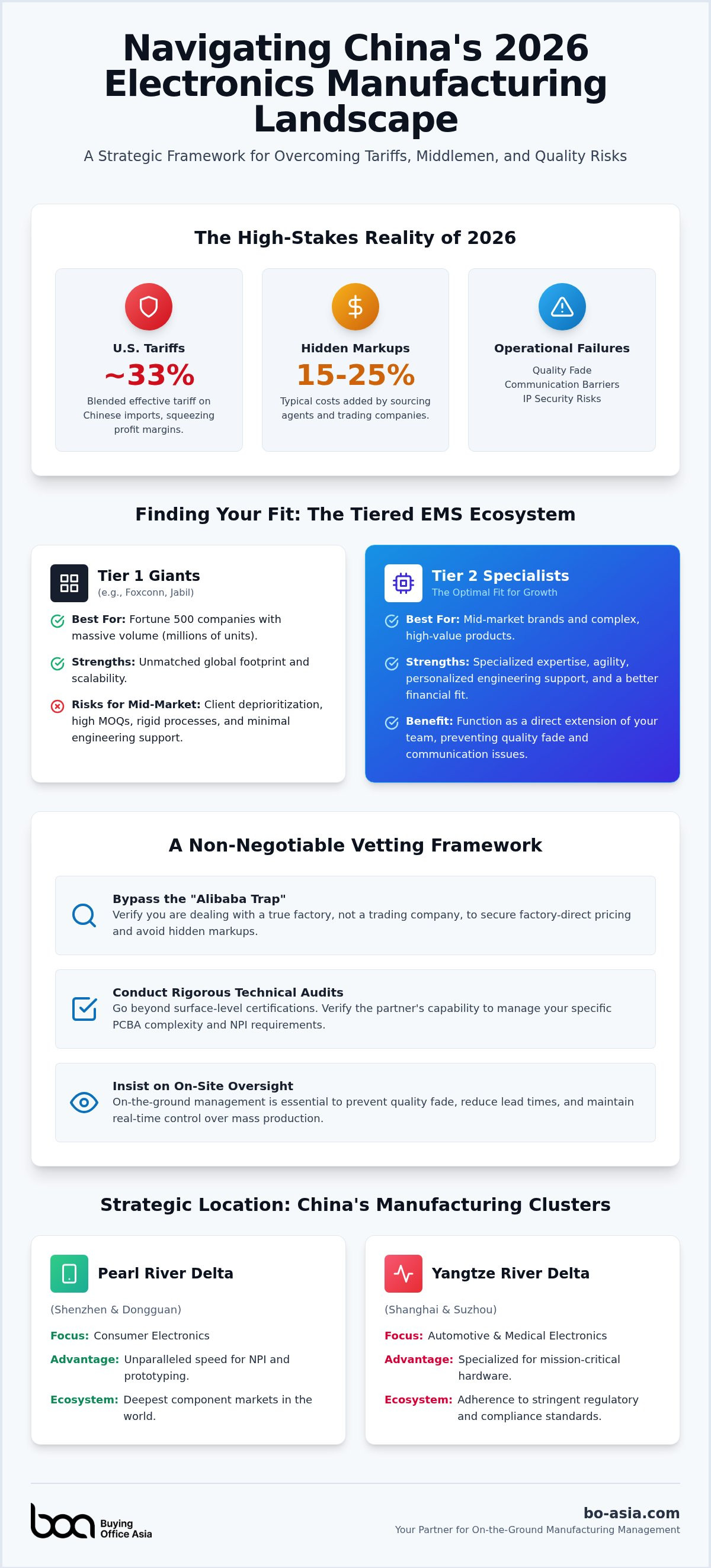
The economic context of 2026 demands a lean approach. With the blended effective U.S. tariff on Chinese imports holding at approximately 33% as of May 2026, your margins are under constant siege. You cannot afford the 15% to 25% markups typically hidden within middleman contracts. Industrial profits in China rose by 15.2% year-on-year in early 2026, yet these gains are often captured by intermediaries rather than passed to the client. Securing factory-direct pricing through a transparent management framework is your primary defense against these escalating costs.
Regional specialization has reached a peak in 2026, making your factory's location a critical factor in your logistics strategy. The Pearl River Delta, specifically the Shenzhen and Dongguan corridor, remains the heartbeat of consumer electronics. It offers unparalleled speed for NPI and proximity to the world's deepest component markets. If your product requires rapid prototyping and high-volume consumer assembly, this is where you'll find the necessary infrastructure.
Conversely, the Yangtze River Delta, centered around Shanghai and Suzhou, has solidified its position as the hub for automotive and medical electronics. These clusters provide specialized supply chains that adhere to the stringent regulatory standards required for mission-critical hardware. Choosing a factory within the correct cluster reduces component lead times and ensures your supplier is already familiar with the specific compliance needs of your industry.
The "Created in China" shift is characterized by a massive investment in Industry 4.0. As average annual manufacturing wages in China reach a projected 115,000 yuan in 2026, Tier 1 and Tier 2 factories have aggressively adopted AI-driven quality inspection and automated SMT lines to maintain cost-efficiency. This automation provides you with a higher degree of consistency than traditional manual assembly, effectively neutralizing the risks of human error during mass production.
Sustainability has also moved from a branding exercise to a regulatory requirement. With China's comprehensive VAT Law taking effect on January 1, 2026, and a renewed focus on ESG-compliant manufacturing, vetted factories are now providing transparent reporting on energy usage and ethical labor practices. This alignment with international standards protects your brand from the reputational risks associated with unmanaged, "dark" factories that operate outside these modern frameworks.
Selecting a partner for electronics manufacturing services China requires more than a technical audit; it requires an honest assessment of where your brand sits in the global hierarchy. The most frequent cause of supply chain failure isn't a lack of factory capability. It's a fundamental mismatch between the client's volume and the manufacturer's operational model. If you're a mid-market brand competing for attention in a Tier 1 facility, you'll likely face deprioritization, high overhead costs, and rigid minimum order quantities (MOQs) that stifle your agility. Conversely, pushing a high-complexity project into a Tier 3 shop often leads to quality fade as their limited engineering teams struggle to maintain consistency.
Tier 1 giants like Foxconn and Jabil offer unmatched global footprints and massive scalability. These facilities are designed for millions of units and Fortune 500 budgets. For companies outside this elite bracket, these facilities often lack the personalized engineering support required for complex product development. You're effectively paying for a level of infrastructure you don't fully utilize while receiving minimal attention from their senior engineering teams. Establishing a direct line to our procurement team can help you identify which tier matches your current growth stage before you commit to a restrictive contract.
While Tier 1 providers offer the security of a global name, Tier 2 regional specialists frequently provide better outcomes for high-growth SMEs. These manufacturers have invested heavily in the same high-end automation and Industry 4.0 systems as the giants but remain flexible enough to offer superior Design for Manufacturability (DFM) support. They treat your project as a priority, providing the dedicated engineering feedback necessary to refine your PCBA layout and reduce component costs. For a deeper analysis of how these production models differ, review our guide on OEM Manufacturing in 2026.
Tier 3 niche turnkey assemblers are the backbone of the high-mix, low-volume (HMLV) electronics sector. They offer the highest degree of flexibility and are often willing to work with lower MOQs, making them ideal for specialized industrial or medical devices. However, this flexibility comes with increased risk. These factories typically have thinner management layers and less robust internal quality systems. Success with a Tier 3 partner is entirely dependent on rigorous, on-site quality control. You must vet their financial stability with the same intensity as their technical skills, as these smaller entities are more vulnerable to the economic shifts and component shortages that can disrupt your supply chain.
The allure of a simplified digital storefront often masks a complex web of intermediaries that can quietly drain your project's financial health. Many businesses looking for electronics manufacturing services China fall into what we call the "Alibaba Trap," where a polished online profile suggests a massive factory but actually represents a small trading company. These entities don't own production lines; they simply rent capacity and add a significant markup to every stage of your project. This layer of separation creates an immediate conflict of interest. While you prioritize quality and long term reliability, the middleman's primary incentive is to protect their margin by sourcing the cheapest possible components without your knowledge.
Beyond the obvious price inflation, middlemen impose a heavy "communication tax" on your engineering team. When you aren't speaking directly to the factory's production engineers, critical technical specifications get lost in translation. This information loss is a leading cause of batch defects and quality fade. A simple design change that takes hours in a factory-direct relationship can take days or weeks when filtered through a trading agent. This delay doesn't just stall your timeline; it increases the risk of engineering errors that only surface once mass production is already underway. Our approach at Buying Office Asia is to function as an integrated extension of your team, providing 100% transparency to ensure your ROI isn't eroded by these hidden inefficiencies.
Identifying an intermediary before you sign a contract is essential for protecting your supply chain. You should look for these specific warning signs during your initial vetting process:
If a supplier claims to manufacture high-end medical PCBA alongside consumer kitchen gadgets, they're likely a trading company. True electronics manufacturers specialize in specific technical niches.
Trading companies often block direct access to the production floor or refuse to let you speak with lead engineers. They fear that direct contact will reveal their lack of physical infrastructure.
Intermediaries often hold "business licenses" but cannot provide the specific ISO or industry-specific certifications that belong to the factory actually performing the work.
Factory-direct negotiations serve as the primary driver of procurement ROI by stripping away hidden markups and ensuring every dollar spent contributes directly to component quality and production efficiency.
The financial impact of eliminating middlemen is measurable and immediate. When you move to a factory-direct model with professional oversight, you typically see a reduction in total landed costs that far outweighs any procurement fee. Based on our internal data, clients who transition from unmanaged trading company models to our managed, transparent framework often reduce their overall manufacturing expenses by 15% to 20%. These savings aren't just from lower unit prices; they come from reduced defect rates and optimized component sourcing. You can review these benchmarks in detail on our Pricing and Savings Examples page to see how a transparent model stabilizes your financial projections.
Vetting isn't a simple checklist. It's a defense mechanism for your capital. When you evaluate a provider for electronics manufacturing services China, you must look beyond their equipment list to their actual experience with your specific PCBA complexity. Many factories claim capability but lack the engineering depth to handle high-density interconnects or rigid-flex boards without excessive scrap rates. A professional selection framework requires a five-step audit that prioritizes technical reality over sales presentations.
Verify the factory's SMT precision and their ability to handle components like 01005 or fine-pitch BGAs. Ask for recent production data on similar complexities.
Don't rely on a scanned ISO 9001 certificate. Inspect their use of Automated Optical Inspection (AOI), X-ray for BGA solder joints, and In-Circuit Testing (ICT).
Review their compliance with the comprehensive VAT Law that took effect on January 1, 2026. A factory with unstable finances is a risk to your entire supply chain.
Test their responsiveness during the New Product Introduction phase. If they're slow to provide feedback on a prototype, they'll be even slower during mass production.
With the revised IC layout-design protections taking effect on October 15, 2026, ensure your partner has strict protocols for firmware loading and design file access.
If you need a professional assessment of a potential partner's technical readiness, you can request a factory audit from our on-the-ground team to verify these claims in person.
A factory's value isn't just in assembly; it's in their ability to optimize your design for lower production costs. Design for Manufacturability (DFM) is where the most significant cost savings are found. Local engineering oversight is required to translate Western technical specifications into a format that fits Chinese production floor realities. Without this translation, you risk engineering errors that only surface during the first batch of mass production. Our OEM/ODM and contract manufacturing services focus on this bridge, ensuring your design is optimized for both speed and yield before the first line starts running.
The "Golden Sample" is a dangerous myth in international manufacturing. Every factory can produce one perfect unit for approval. The real challenge is preventing quality fade once you move into high-volume production. This requires a shift from passive trust to active, on-site inspections. You must implement a management layer that monitors production in real-time, catching defects before they're packed into containers. For a deeper look at protecting your brand from these risks, read our Insider's Guide to Supplier Vetting in Asia. This level of oversight ensures that the quality of your ten-thousandth unit matches the quality of your first.
The transition from a transactional vendor relationship to a strategic supply chain partnership is the final step in securing your manufacturing ROI. Many enterprises treat the selection of electronics manufacturing services China as a "find and forget" task, assuming that a signed contract and a few video calls will guarantee success. In reality, the complexities of PCBA production and the volatility of global trade in 2026 demand a constant physical presence. Your supply chain is either actively managed or it is at risk. Passive oversight often leads to the quality fade and communication errors discussed in previous sections, which are only catchable when you have professional eyes on the factory floor.
Our hybrid management model addresses this gap by combining the steady confidence of European leadership in Helsinki with a dedicated, on-the-ground execution team in Hong Kong. This structure provides you with a seamless communication channel in your own time zone while ensuring real-time accountability at the factory. We don't function as a third-party intermediary; we act as an integrated extension of your own company. This partnership model ensures that your interests are protected during price negotiations and that your technical standards are never compromised for the sake of a factory's internal margins.
Managing high-complexity electronics via Zoom and email has significant limitations. Digital communication cannot replicate the nuanced problem-solving that occurs during a face-to-face meeting on a production line. Physical proximity to manufacturing clusters in the Pearl River Delta allows for immediate intervention when technical hurdles arise. If a component shortage or a batch defect occurs, a local team can resolve the issue in hours rather than days. This level of responsiveness is what separates a resilient supply chain from one that is vulnerable to disruption. You can learn more about how our dedicated sourcing team maintains this accountability through every stage of production.
Successful manufacturing in 2026 requires a proactive stance on global trade volatility and regulatory adherence. With the 10% reciprocal tariff extension running through August 2026 and the continued impact of the 33% blended effective U.S. tariff, your logistics management must be as precise as your engineering. Strategic oversight includes integrating ESG and ethical standards directly into your operations, ensuring your brand is protected against the reputational risks of non-compliant factories. By moving beyond transactional sourcing, you create a stable, transparent, and financially viable production ecosystem. To discuss how we can stabilize your international operations, contact Buying Office Asia to review your 2026 electronics manufacturing strategy.
Success in the Chinese market requires more than just a factory address; it requires a tiered selection strategy and a total rejection of opaque middleman models. You've seen how prioritizing technical capability audits and rigorous on-site inspections protects your capital from quality fade and costly engineering errors. Implementing these professional frameworks for electronics manufacturing services China ensures your supply chain remains resilient against the regulatory shifts and economic volatility of 2026.
Our European-managed firm, led from Helsinki with a physical presence in Hong Kong, provides the 100% transparency model your brand deserves. We function as your primary defense, conducting factory audits and mass production oversight to ensure your margins stay protected. You don't have to manage these complexities alone. By integrating our team into your workflow, you gain the regional expertise and hands-on control usually reserved for global enterprises. It's time to move from transactional sourcing to a strategic, managed partnership that fuels your long-term growth.
Secure Your Supply Chain with a Dedicated Asia Procurement Team
Typical lead times for standard PCBA production generally range from 8 to 12 weeks once all components are secured. You must account for the 2026 logistics landscape where component availability remains the primary bottleneck for complex builds. We recommend early procurement of long-lead items to prevent production stalls and ensure your timeline remains predictable.
You should utilize the revised IC layout-design protections taking effect October 15, 2026, and register your trademarks locally within China. It's essential to split your firmware loading from the main assembly process and use robust NNN (Non-use, Non-disclosure, Non-circumvention) agreements. Professional oversight ensures these legal protections are physically enforced on the factory floor every day.
OEM (Original Equipment Manufacturer) involves a factory building a product based entirely on your specific designs and engineering specifications. ODM (Original Design Manufacturer) allows you to use the factory's existing designs with minor branding changes. For professional electronics manufacturing services China, the OEM model is usually preferred to maintain full control over your intellectual property and design quality.
Yes, you can manufacture low-volume electronics economically by targeting Tier 3 niche assemblers who specialize in high-mix, low-volume (HMLV) production. While unit costs are naturally higher than mass production, these providers offer the flexibility required for specialized industrial or medical devices. Success depends on having a management layer that bridges the communication gap without the overhead of a larger facility.
Beyond the standard ISO 9001, you should verify industry-specific certifications like ISO 13485 for medical devices or IATF 16949 for automotive electronics. Ensure the factory complies with the comprehensive VAT Law that took effect on January 1, 2026. These certifications indicate a level of regulatory adherence and operational maturity necessary for high-complexity electronics manufacturing services China.
Verify a factory's authenticity by requesting a live video tour of the production floor and checking their business license for specific manufacturing scopes. Trading companies often have licenses for "business" or "consulting" rather than "manufacturing." A physical on-site audit remains the only foolproof method to confirm that the entity you're paying actually owns the SMT lines and testing equipment.
Quality fade is typically caused by unauthorized component substitution or the reduction of testing cycles to protect the factory's margin. This often occurs after the first "Golden Sample" is approved and mass production begins. You can prevent this by implementing on-site quality control and unannounced inspections to ensure every unit matches your approved specifications throughout the entire run.
A Hong Kong-based partner provides a strategic bridge between Western legal standards and mainland Chinese production reality. Hong Kong offers a stable legal environment for contract enforcement while maintaining physical proximity to the Pearl River Delta manufacturing clusters. This allows for real-time factory oversight and rapid problem-solving that is impossible to achieve through digital communication or remote management.

If your current sourcing agent claims their services are free, you're likely paying a hidden tax of 10% to 30% through inflated unit prices and factory kickbacks. This lack of transparency doesn't just erode your margins; it creates a dangerous barrier between you and the factory floor. Finding a re...

A perfect golden sample is often the most dangerous document in your supply chain. If a prototype is handcrafted by a master technician rather than built using scalable factory processes, your sample development phase isn't a success; it's a liability. This gap between a one-off masterpiece and a hi...

Scaling production to millions of units isn't a purchasing task; it's a high-stakes risk management discipline where a single percent of quality fade can liquidate your annual margin. You likely understand that the leap from mid-scale orders to massive procurement runs often exposes cracks in even t...