


The true cost of your product isn't the figure on your proforma invoice; it's the financial impact of batch defects and the lack of professional mass production oversight on the factory floor. You've likely felt that familiar knot of anxiety the moment a production deposit is wired, wondering if the output in Guangdong or Vietnam will actually mirror your approved sample. It's a common frustration for brands that feel disconnected from their own supply chains, often trapped between opaque middlemen and a total lack of real-time visibility into the manufacturing process.
Securing your margins in 2026 requires more than just a signed contract. It demands a strategic presence to bridge the physical and cultural gap between your headquarters and the factory floor. This guide will show you how professional, on-the-ground management transforms manufacturing volatility into predictable financial returns and absolute brand security. You'll learn the strategic mechanics of achieving zero-defect shipments, maintaining factory-direct pricing without hidden margins, and leveraging regional expertise to build a resilient, high-performance supply chain that functions as a true extension of your team.
• Understand why periodic inspections are no longer sufficient and how continuous mass production oversight prevents defects before they reach the shipping container.
• Identify the true "Cost of Quality" to eliminate unexpected expenses from batch failures and obscured middleman margins.
• Master the three pillars of manufacturing supervision by integrating rigorous technical documentation with a consistent on-site physical presence.
• Apply a five-step framework for factory-direct procurement to ensure your production timelines remain predictable and your brand reputation secure.
• Leverage a 100% transparent procurement model to gain real-time visibility and verified data directly from the factory floor.
The landscape of Asian manufacturing in 2026 has shifted from a pure focus on scale to a mandate for resilience. With manufacturing growth in Asia projected at 3.2% this year, the competition for factory capacity is intense. You can no longer afford to treat production as a "black box" where components enter and finished goods emerge weeks later without your direct involvement. Mass production oversight is the continuous management of manufacturing standards and timelines, providing a bridge between your technical specifications and the factory's daily output. It isn't a luxury; it's a financial defense mechanism.
Traditional models relied on reactive inspection, but today's margins are too thin for such risks. When you consider the "Cost of Quality," the math is clear. A single batch defect discovered at your warehouse can erase an entire quarter's profit. By integrating Quality Control Principles directly into the production cycle, you transition from a diagnostic approach to a preventative one. This proactive supervision ensures that your brand equity remains untarnished by the catastrophic failure of a sub-par shipment reaching your customers. It's about securing your reputation before the first unit is even boxed.
High-volume runs are uniquely prone to "quality drift," a subtle degradation of standards that occurs as machinery wears or labor shifts change. Without eyes on the floor, a product that passed the initial sampling stage can slowly deviate from the gold standard over a run of 10,000 units. The financial fallout is severe. Beyond the obvious loss of physical inventory, you face return shipment costs, administrative overhead, and late-to-market penalties that disrupt your entire retail cycle. To truly protect your interests, you must look at Mastering Sourcing and Procurement in Asia through a lens of constant accountability rather than occasional check-ins. If you aren't visible, you're vulnerable.
Effective oversight secures the ROI of your initial capital expenditures, specifically your custom tooling and product development investments. It functions as a stabilizing force that prevents the "risk premium" often baked into factory quotes when requirements are vague or unmanaged. When a factory knows a dedicated team is monitoring every stage, they prioritize your standards and timelines. Mass production oversight is a capital protection strategy designed to insulate your manufacturing investment from operational variance. By establishing yourself as a hands-on partner through a regional team, you command better performance and ensure that every dollar spent on the factory floor translates into a sellable, high-quality asset.
To move beyond the financial risks of unmanaged production, you need a framework that leaves nothing to chance. Professional mass production oversight rests on three foundational pillars that ensure every unit matches your brand's integrity. By establishing these pillars early, you transform a potentially volatile manufacturing environment into a disciplined extension of your own operations.
A "Golden Sample" is a vital benchmark, but it's only the starting point. It must be supported by a comprehensive technical file and Standard Operating Procedures (SOPs). These documents define non-negotiable tolerances and material specifications that the factory must follow without deviation. Control Plans are essential here to prevent batch-to-batch variation. They serve as the definitive rulebook, ensuring that the last unit produced is as high-quality as the first. When specifications are documented with this level of precision, the factory has a clear path to success and no room for excuses.
Digital reports and software dashboards are convenient, but they are easily manipulated without physical verification. The Challenges in Global Manufacturing often stem from a lack of genuine ground-level visibility. Our model is built on accountability through physical proximity. When factory management knows that a dedicated team is physically present on the production floor, the psychological impact is immediate. Performance improves because oversight is constant, verified, and impossible to ignore from a distance. This physical presence is what turns a contract into a commitment.
In 2026, compliance isn't just about product safety; it's about supply chain transparency. With the rise of mandatory human rights due diligence (HRDD) legislation in countries like South Korea, Thailand, and Indonesia, you must monitor labor conditions and environmental standards in real-time. Adhering to strict ESG standards protects your brand from public relations catastrophes and legal liabilities that can arise from unmanaged tiers of your supply chain. Integrating these ethical protections into your OEM/ODM manufacturing strategy ensures your business remains resilient against shifting global regulations.
Implementing these pillars requires a partner who understands the regional nuances of Asian manufacturing hubs. If you're looking to secure your production with a team that acts as a protective, hands-on extension of your own company, you can consult with our procurement experts to review your current oversight strategy.
Many brands fall into what we call the "Snapshot Trap." They rely on a final pre-shipment inspection to verify quality, only to discover that a significant portion of the batch is defective when it's already too late to restart the production line. By the time a diagnostic inspection identifies a failure, your capital is already tied up in unsellable inventory. Mass production oversight shifts the focus from catching errors at the finish line to preventing them on the factory floor. It's the difference between performing an autopsy and providing preventative care.
Continuous supervision allows for real-time adjustments. If a machine calibration drifts or a material batch shows inconsistency, a team on the ground can halt production immediately. This early intervention is far more cost-effective than a total batch rejection, which often leads to catastrophic supply chain delays and lost retail opportunities. By adopting Supply Chain Performance Frameworks that prioritize active management, you ensure that production remains within your specified tolerances from the first unit to the last. This is why a dedicated Asia procurement team is a strategic necessity rather than an optional service.
Traditional sourcing agents often operate on a transactional basis, prioritizing their long-term relationships with factories over your specific quality requirements. This conflict of interest frequently leads to hidden margins, obscured costs, and "kickbacks" that compromise the integrity of your quality checks. We reject this intermediary model entirely. Our 100% transparency policy ensures that you see the same data we do, directly from the source. You pay factory-direct prices without the invisible markups that traditional agents use to pad their own bottom lines. This level of honesty is the only way to build a truly secure manufacturing partnership.
Managing production from thousands of miles away creates an information vacuum. Cultural and linguistic barriers often result in "misunderstandings" that factories use to justify sub-par output or missed deadlines. Our Helsinki-Hong Kong bridge solves this by combining European strategic leadership with regional execution. You don't need to be physically present at the factory because we act as your protective, hands-on extension. We speak the local language, understand the regional manufacturing culture, and enforce your standards with the authority of an insider. This proximity ensures that your directives aren't just heard; they're followed with precision.
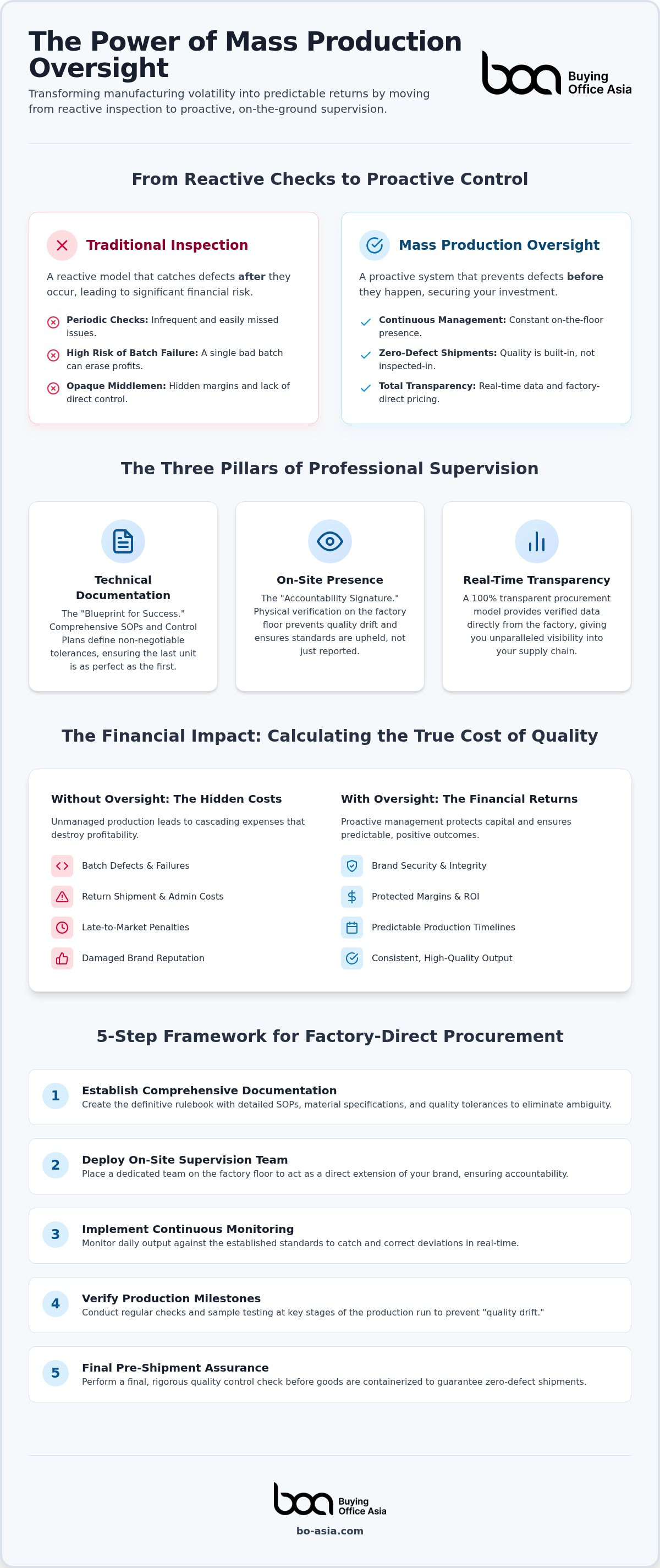
Effective mass production oversight is not a single event but a disciplined sequence of interventions. By following a structured framework, you eliminate the ambiguity that factories often exploit to cut corners or accelerate timelines at the expense of quality. This five-step approach ensures that your standards are embedded into every phase of the manufacturing cycle, from the initial factory selection to the moment the container is sealed. It's a comprehensive defense designed to keep your production predictable and your capital secure.
The first step is Rigorous Supplier Vetting and Factory Audits. You must identify "red flags" such as inconsistent documentation, aging machinery, or poor housekeeping before any capital is committed. Our supplier vetting process goes beyond surface-level certificates to verify the actual operational capacity and financial stability of the facility. Once a supplier is cleared, Step 2 involves the Pre-Production Meeting (PPM). This is the moment of technical alignment. You must clarify every detail of the technical file with the factory's production manager to ensure they understand your non-negotiable tolerances. Establishing clear communication channels at this stage prevents the "misunderstandings" that often derail unmanaged production runs.
Step 3 is During Production (DUPRO) Monitoring. This is your primary mechanism for course correction. By catching systematic errors when production is only at 20 percent to 30 percent completion, you can rectify issues without scrapping the entire batch. Step 4 follows with the Pre-Shipment Inspection (PSI), where we implement statistical sampling methods based on AQL standards to verify the final output against your gold sample. This final verification provides the data-backed assurance you need to authorize the final payment. Finally, Step 5 is Container Loading Supervision (CLS). This step is critical because CLS prevents a "bait and switch" where a factory might attempt to substitute inspected goods with unverified or sub-par inventory during the final logistics handover.
This framework provides the steady confidence you need to manage complex global supply chains with precision. If you're ready to implement a professional defense for your manufacturing ROI, you can connect with our Hong Kong and Helsinki teams to begin auditing your current production protocols.
Profitability in international manufacturing isn't just about the lowest unit price; it's about the total cost of ownership and the elimination of invisible margin erosion. Our model is built on the principle that mass production oversight should be a profit generator rather than a cost center. By removing the opaque layers of traditional sourcing agents, we enable factory-direct pricing negotiations that reflect the actual cost of materials and labor. This "Zero Middleman" policy ensures that every cent of your budget is working toward product quality rather than padding the pockets of an unverified intermediary.
The ROI of transparency is measurable and immediate. We provide 100% open-book procurement, giving you full visibility into the factory's cost structures and performance data. This verified information allows you to make informed decisions that protect your margins from unexpected quality failures or timeline shifts. You can review our savings examples to see how this level of transparency translates into significant financial advantages for brands operating at scale. When you control the data, you control the profit.
We've moved beyond transactional sourcing to offer a model of strategic supply chain management. We don't just find suppliers; we act as your eyes and ears on the factory floor, functioning as an integrated extension of your own team. This physical proximity allows for a level of accountability that digital-only models cannot match. To understand the full financial impact of this approach, you can explore The ROI of a Dedicated Asia Procurement Team. This partnership ensures that your directives are executed with the same rigor you'd expect from your own headquarters staff.
Building a resilient supply chain requires planning for scalability and high-volume growth. As you look toward your 2026 production targets, the stability provided by professional mass production oversight becomes your most valuable asset. Transitioning from an unmanaged or intermediary-led model to a managed one is a strategic shift that safeguards your brand's future. It's about moving from a state of constant manufacturing anxiety to one of calm, data-driven assurance. If you're ready to secure your shipments and realize the true ROI of your Asian manufacturing operations, you can contact Buying Office Asia for a production audit today.
The complexity of Asian manufacturing hubs requires a shift from reactive problem-solving to proactive management. By implementing professional mass production oversight, you transition from a position of vulnerability to one of strategic control. You've seen how continuous monitoring prevents the quality drift that erodes margins and how a five-step framework ensures your technical specifications are met with precision. This isn't just about avoiding defects; it's about building a resilient, transparent supply chain that functions as a high-performance extension of your own organization.
Buying Office Asia provides the European-managed reliability and on-the-ground presence in Hong Kong necessary to navigate these challenges. Our 100% Transparency Guarantee ensures you never pay hidden middleman margins, while our physical proximity to manufacturing hubs provides the accountability that digital reports cannot replicate. You can transform your production risks into predictable financial returns with a partner dedicated to your long-term growth. Take the first step toward a more secure and profitable manufacturing model today.
Secure your supply chain with Buying Office Asia’s professional oversight and gain the peace of mind that comes from verified data and expert on-site management. Your brand's security is within reach.
Oversight is a continuous, preventative process, whereas inspection is a one-time diagnostic snapshot. While a standard inspection identifies defects after they've occurred, mass production oversight involves active management of the production line to prevent errors from happening in the first place. It ensures that manufacturing standards are upheld daily rather than just verified at the end of the run.
It eliminates the substantial financial losses associated with batch rejections, return shipping, and late-to-market penalties. By catching errors during the production cycle, you avoid paying for defective inventory and the administrative overhead of managing replacements. This proactive approach also removes the "risk premium" factories often bake into quotes when they anticipate unmanaged or vague requirements.
Technology is a vital supporting tool, but it cannot replace a physical on-site presence for genuine accountability. Digital dashboards provide data, but that data can be manipulated if there's no one on the floor to verify the reality of the inputs. Physical proximity remains the only definitive way to ensure that the factory floor actually matches your technical specifications.
DUPRO monitoring frequently identifies systematic issues such as machine calibration drift, material color inconsistency, and incorrect component assembly. For instance, if a sealing machine operates at the wrong temperature, we catch it when only 20 percent of the batch is completed. This allows for immediate recalibration, saving the remaining 80 percent of the run from becoming unsellable waste.
We utilize a 100% transparency model that explicitly rejects the commission-based intermediary structure used by traditional agents. You receive original factory invoices and negotiate directly with the manufacturer's management team. This approach eliminates hidden kickbacks and markups, ensuring your entire budget is spent on product quality and manufacturing efficiency rather than obscured middleman margins.
Hong Kong serves as our strategic operational base, providing immediate access to manufacturing hubs across Southern China and Southeast Asia. Its robust legal framework and logistics infrastructure make it the ideal bridge between European leadership and Asian production floors. This location allows our team to be on-site at your factory within hours, providing the rapid response time essential for effective mass production oversight.
Oversight is necessary whenever the cost of a failed batch exceeds your profit margin, regardless of the order size. While high-volume runs have higher cumulative risk, a single defective small-batch shipment can still disrupt your retail schedule and damage customer trust. Professional supervision ensures that even smaller orders receive the same level of technical rigor and quality adherence as major enterprise productions.
We issue an immediate stop-work order and initiate a formal corrective action plan to address the root cause of the failure. If the factory cannot demonstrate immediate compliance with the agreed SOPs, we leverage our pre-vetted supplier network to transition production to a more reliable facility. Our priority is always your financial health and brand security, which means we never compromise on non-negotiable quality standards.

The traditional commission-based sourcing agent in India is no longer an asset; they're often your greatest financial risk in a market rapidly scaling toward a $2 trillion export target. You likely recognize the inherent conflict when an agent's income rises alongside your factory costs, or the anxi...

If your current sourcing agent claims their services are free, you're likely paying a hidden tax of 10% to 30% through inflated unit prices and factory kickbacks. This lack of transparency doesn't just erode your margins; it creates a dangerous barrier between you and the factory floor. Finding a re...

A perfect golden sample is often the most dangerous document in your supply chain. If a prototype is handcrafted by a master technician rather than built using scalable factory processes, your sample development phase isn't a success; it's a liability. This gap between a one-off masterpiece and a hi...