


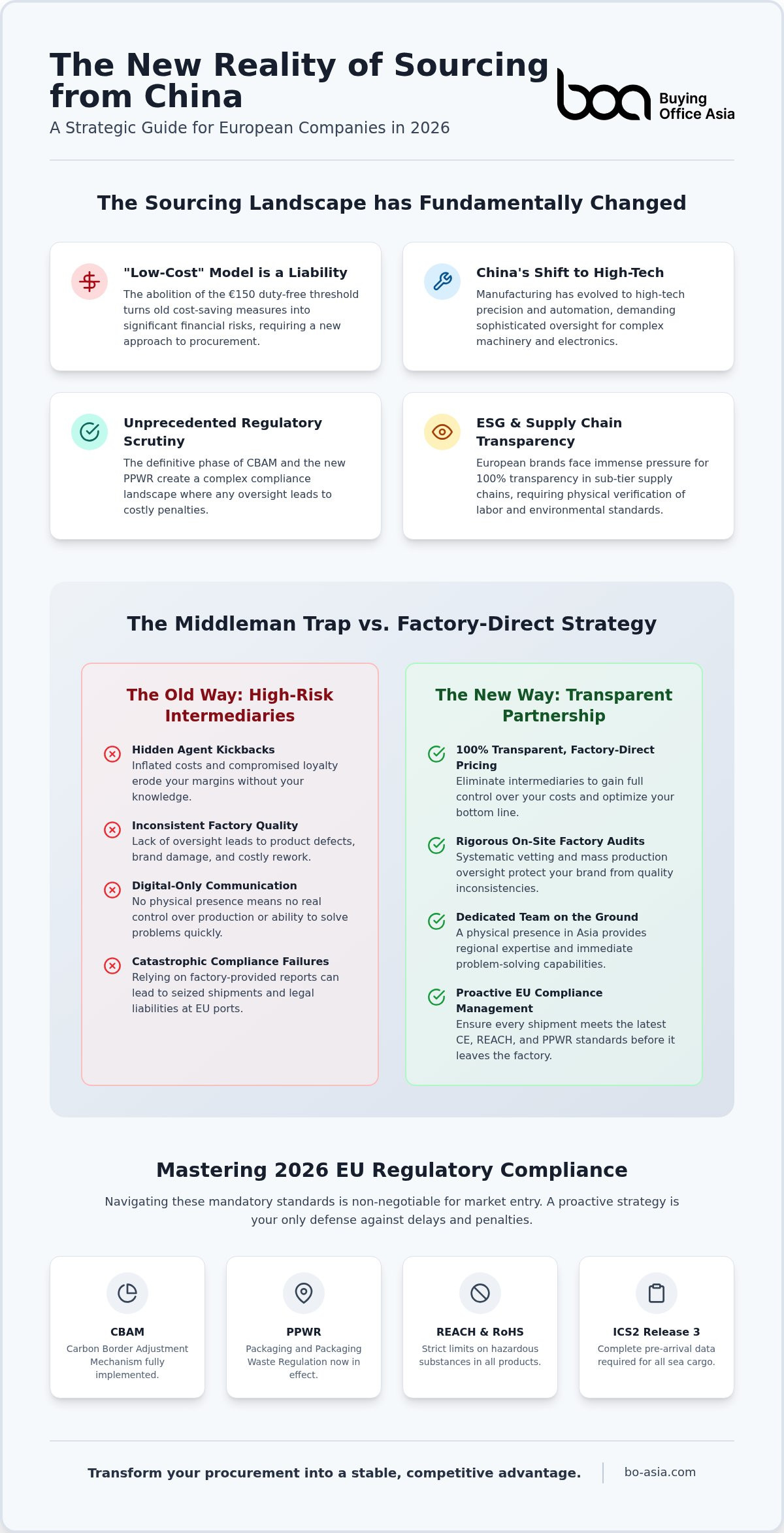
By August 2026, the "low-cost" sourcing model that many European firms once relied on has become a significant financial liability. With the abolition of the €150 duty-free threshold and the definitive phase of the Carbon Border Adjustment Mechanism (CBAM) now in effect, navigating China procurement services for European companies requires more than just a digital connection; it requires physical proximity and regional expertise. You likely recognize that hidden agent kickbacks and inconsistent factory quality are risks your brand can't afford in this high-stakes regulatory environment. It's frustrating to feel like you're losing control of your margins to intermediaries who don't share your professional standards.
This guide provides the strategic framework to master your 2026 supply chain by shifting to a transparent, factory-direct strategy. We'll outline how to achieve 100% visibility and navigate the strict new Packaging and Packaging Waste Regulation (PPWR) requirements that became effective this month. You'll learn the mechanics of placing a dedicated team on the ground to manage mass production, ensuring your operations are defined by financial optimization rather than unforeseen expenses. We'll preview the essential steps to transform your procurement from a source of anxiety into a stable, competitive advantage that protects your bottom line.
• Understand why China's shift toward high-tech precision and automated manufacturing in 2026 requires a more sophisticated procurement strategy.
• Identify the mandatory EU certifications and chemical restrictions required to ensure your imports meet the most recent safety and environmental standards.
• Discover how specialized China procurement services for European companies eliminate hidden agent kickbacks to secure 100% transparent, factory-direct pricing.
• Master the vetting process through rigorous on-site factory audits and mass production oversight that protects your brand from quality inconsistencies.
• See how a European-managed bridge between Helsinki and Hong Kong provides the regional expertise and accountability needed to mitigate supply chain risks.
The trade corridor between Europe and China has transformed significantly by mid-2026. While some competitors still frame China primarily as a low-cost destination, modern procurement reality centers on high-tech precision and advanced automation. European firms are no longer just buying simple components. They're sourcing complex industrial machinery and high-value electronics that require elite technical oversight. This shift makes professional China procurement services for European companies essential for maintaining a competitive edge in a market that rewards quality over mere price.
Geopolitical shifts have introduced new complexities to lead times and logistics. The abolition of the €150 duty-free threshold in July 2026 and the definitive phase of the Carbon Border Adjustment Mechanism (CBAM) mean that every shipment now faces rigorous customs scrutiny. Understanding the nuances of EU-China trade relations is no longer optional for your logistics strategy. Within this environment, Hong Kong serves as the vital gateway. It bridges European capital with Asian production, offering a stable legal framework and a physical proximity to mainland factories that digital-only models simply cannot replicate.
Digital supply chains are now the standard for shortening the gap between design and delivery. However, technology doesn't replace the need for physical oversight. Freight rates remain volatile; as of late July 2026, spot rates from Shanghai to Rotterdam hovered around $4,677 per 40ft container. You must balance sea, rail, and air options to avoid bottlenecks during peak seasons. You can read more about these complexities in our guide on Mastering Sourcing and Procurement in Asia.
European brands now face unprecedented pressure to provide 100% transparency in their sub-tier supply chains. The Packaging and Packaging Waste Regulation (PPWR), which became effective on August 12, 2026, demands strict adherence to material standards and waste reduction. You can't rely on self-reported data from distant factories. On-site audits are the only way to verify labor standards and environmental compliance. Our approach to ESG and sustainable sourcing focuses on physical verification at the factory floor. This level of oversight ensures your brand remains protected against regulatory penalties and ethical risks that can arise from unmanaged supply chains.
Compliance in 2026 is no longer a secondary concern; it's a fundamental requirement for market entry. As the European Union tightens its oversight on imported goods, the standard CE mark is often insufficient on its own. Your procurement strategy must account for the latest iterations of REACH and RoHS, which strictly limit hazardous substances in everything from consumer electronics to industrial tools. Failure to provide granular technical files can result in immediate shipment seizures at EU ports, leading to catastrophic delays and legal liabilities that far outweigh any initial savings. Engaging professional China procurement services for European companies ensures that your supply chain isn't just productive, but legally resilient.
The regulatory environment has become increasingly complex with the implementation of the ICS2 Release 3 system in February 2026. This requires complete pre-arrival data for all sea cargo entering the EU. Additionally, the Packaging and Packaging Waste Regulation (PPWR) now mandates specific material standards that many independent factories are not yet equipped to meet. Staying informed via the official EU trade policy on China is a start, but real-world protection requires on-the-ground verification of these standards before the goods ever leave the factory floor.
Factory-provided test reports are frequently outdated or narrow in scope. To protect your investment, you must implement a "Golden Sample" protocol. This physical benchmark is verified by independent, accredited labs in Asia to ensure every unit in a mass production run matches your approved specifications. We facilitate this by coordinating directly with third-party testing facilities, ensuring that your technical documentation is robust enough to withstand any customs audit or market surveillance check.
Correct HS Code classification is the difference between a profitable venture and an expensive mistake. The 2026 EU Customs Union harmonized tariff schedules have introduced new categories for high-tech components, and misclassification can lead to significant overpayments or fines. Our team ensures your "Proof of Origin" documentation is flawless, facilitating smooth clearance through the Helsinki-Hong Kong bridge. For a broader look at selecting a partner capable of managing these technicalities, see The Definitive Guide to Choosing a China Sourcing Company in 2026. If you're unsure if your current documentation meets 2026 standards, you can speak with our compliance specialists for a preliminary assessment.
Many European firms enter the Asian market under the illusion that sourcing agents provide a "free" or low-cost service. This is rarely the case. In a market where China procurement services for European companies are often opaque, the traditional agent model frequently hides costs that erode your competitive advantage. These intermediaries often claim to work for you while actually collecting undisclosed commissions from the factory side. This creates a fundamental conflict of interest where the agent's loyalty is divided between your quality requirements and the factory's payout.
The "Commission Trap" is a systemic issue that inflates your unit costs without adding any measurable value to your product. When an agent relies on hidden kickbacks, they are less likely to report production delays or quality defects that might jeopardize their commission. This lack of transparency is particularly dangerous as the European Union implements new EU trade-defense and industrial-policy measures aimed at addressing industrial overcapacity. You need a partner whose interests are perfectly aligned with your own, ensuring that every cent of your budget is optimized for production quality and regulatory compliance.
Our model rejects these hidden fee structures in favor of 100% transparency. By securing factory-direct pricing, we eliminate the unnecessary markups that characterize the traditional middleman approach. This transparency extends to every aspect of the negotiation, from raw material costs to tooling expenses. You can view our savings examples and pricing model to see how this direct approach translates into tangible financial gains for your business.
Independent agents who claim to be "factory-neutral" are often deeply embedded in factory-affiliated networks. This proximity makes it nearly impossible for them to provide objective quality oversight during mass production. The kickback model relies on hidden factory commissions that artificially inflate unit prices, directly siphoning profit away from European SME margins. When defects occur, these agents often prioritize their relationship with the supplier over your brand's reputation, leading to inconsistent product quality and unmanaged risks.
True risk mitigation requires a management structure that you can hold accountable under European legal standards. Our Helsinki-Hong Kong bridge provides this security, combining Finnish leadership with a physical presence in the heart of Asian manufacturing. We operate on a retainer-based model, which ensures our team functions as a seamless extension of your own company. This alignment means our primary goal is your profit, not a factory commission. This structure provides the steady confidence you need to scale your operations without the fear of unforeseen expenses or compromised standards.
Operational success in the 2026 trade corridor requires a shift from passive monitoring to active, on-the-ground management. You cannot manage a complex manufacturing project through an email thread or a digital portal alone. Effective China procurement services for European companies must provide a physical presence at every critical milestone. This begins with a four-step strategic framework designed to eliminate the common pain points of international production: quality inconsistencies, hidden costs, and logistical delays.
Your journey starts with rigorous supplier vetting. We conduct on-site factory audits that go beyond surface-level certifications, verifying a factory's actual capacity, machinery condition, and labor standards. Once a supplier is cleared, the focus shifts to product development and sampling support for OEM or ODM projects. This ensures that your technical specifications are accurately translated into a physical prototype before mass production begins. Following approval, our team provides continuous mass production oversight, functioning as your eyes and ears on the factory floor. The final phase involves sophisticated logistics coordination and European customs management, ensuring your goods clear ports without the risk of seizure or unexpected fines.
Protecting your brand reputation requires a multi-stage inspection strategy. We implement Pre-production, During-production (DUPRO), and Final Random Inspections (FRI) to catch defects before they leave the province. We quantify these results using industry-standard Acceptable Quality Levels (AQL), providing you with comprehensive, data-driven inspection reports that offer a transparent view of your shipment's health. This level of rigor is vital for complex OEM and Contract Manufacturing services where precision is non-negotiable. By identifying issues at the source, you avoid the prohibitive costs of shipping defective units to Europe.
Logistics in 2026 is defined by volatility and strict data requirements. As of late July 2026, spot rates for a 40ft container from Shanghai to Rotterdam were $4,677, but these figures can spike during peak seasons. We optimize your spend by consolidating shipments from multiple suppliers into a single container, significantly reducing your freight costs. Our Hong Kong-based team manages the mandatory ICS2 Release 3 submissions and ensures your Bill of Lading and Packing List are error-free. This meticulous documentation is the only way to facilitate fast clearance through the Helsinki-Hong Kong bridge. For a deeper dive into the initial vetting phase, read our guide on Supplier Vetting in Asia. If you're ready to secure your 2026 production schedule, contact our logistics team for a strategic review of your current supply chain.
In the 2026 trade landscape, the difference between a profitable venture and a costly failure is the level of accountability in your supply chain. China procurement services for European companies shouldn't just be a transaction; they should be a defense mechanism. By partnering with Buying Office Asia, you gain European-managed oversight that understands both the regulatory demands of Brussels and the manufacturing realities of Guangdong. We function as an integrated extension of your own procurement department, removing the anxieties of unmanaged production and ensuring your financial health remains the priority.
Our Helsinki-Hong Kong bridge is designed specifically to solve the communication gaps that plague traditional sourcing. With leadership in Finland and operations in Hong Kong, we provide a seamless link across time zones. This ensures that while you're making strategic decisions in Europe, our team is already on-site in Asia implementing them. You're never left waiting for an answer in a digital void. Instead, you receive a professional briefing from a partner who shares your business philosophy and legal standards. This structure provides the steady confidence you need to scale without the risk of unforeseen expenses.
Getting started is a methodical process. It begins with your initial inquiry, where we define your technical and commercial requirements. From there, we move through rigorous supplier vetting and factory-direct negotiations to lock in your margins. Once sampling is approved, we manage the mass production cycle and multi-stage quality control protocols discussed earlier. The process concludes only when your shipment clears European customs and arrives at your warehouse, fully compliant and ready for market. This roadmap ensures every step is documented, transparent, and focused on your bottom line.
You aren't just hiring an agency; you're accessing a pre-vetted network of high-performance manufacturers. Our local experts conduct factory-direct negotiations on your behalf, ensuring you bypass the markups of trading companies. This physical proximity allows for real-time adjustments and tooling development that unmanaged teams can't offer. Discover how we build your dedicated sourcing team to meet your specific volume and technical needs.
The measurable impact of our model is best seen through our results. European brands have scaled their operations by eliminating middlemen and reclaiming significant portions of their gross margins. These success stories aren't just about cost savings; they're about the security of knowing every shipment meets EU safety standards. Explore our client success stories to see how we've helped businesses achieve 100% supply chain transparency and reliable growth.
Navigating the 2026 China-Europe corridor requires a shift from passive sourcing to active, on-the-ground management. You've seen how the abolition of duty-free thresholds and the rise of ESG mandates have made regulatory compliance a non-negotiable pillar of profitability. By rejecting the opaque commission-based models of independent agents, you reclaim your gross margins and secure 100% pricing transparency. True risk mitigation isn't found in a digital portal; it's built through physical proximity and rigorous on-site factory inspections that protect your brand from mass production defects.
As the complexity of international trade increases, utilizing professional China procurement services for European companies becomes your most significant competitive advantage. Our European leadership office in Helsinki and Hong Kong operations provide the stability you need to navigate this high-stakes market with calm assurance. You don't have to manage these risks alone. Take the next step to stabilize your operations and achieve measurable financial growth in the coming year.
Secure your supply chain with our European-managed sourcing team in Asia and gain the oversight your business deserves.
Mandatory regulations include the Carbon Border Adjustment Mechanism (CBAM), which entered its financial phase on January 1, 2026, and the Packaging and Packaging Waste Regulation (PPWR) effective as of August 12, 2026. You must also ensure compliance with ICS2 Release 3 for all sea cargo data. These mandates require precise technical documentation and on-site verification to avoid shipment seizures at European ports.
Focus on firms that offer physical proximity to manufacturing hubs and European legal accountability. Avoid agents who claim their services are free, as they likely rely on hidden factory kickbacks. The most reliable China procurement services for European companies provide 100% pricing transparency and act as an extension of your own team. This proximity ensures that quality control happens at the factory floor, not at your warehouse.
Sourcing agents typically operate as transactional middlemen and often collect undisclosed commissions from suppliers. In contrast, a procurement company functions as a strategic partner with a transparent fee structure. By choosing a procurement firm, you secure direct factory access and negotiations that prioritize your margins. This model eliminates the conflicts of interest inherent in commission-based agency work, ensuring your quality standards remain the primary focus.
Physical on-site audits are the only definitive way to verify a factory's credentials. Digital certificates are frequently edited or shared between unrelated entities. You should check the Unified Social Credit Code on the official National Enterprise Credit Information Publicity System. Professional teams also verify that the factory's registered business scope actually covers the specific products they're manufacturing for your brand.
Sea freight from major ports like Shanghai to Rotterdam currently averages 30 to 45 days. If you require faster delivery, rail freight via the Middle Corridor takes approximately 18 to 22 days. Air freight is the quickest option at 5 to 10 days, though it carries significantly higher costs. These timelines are subject to seasonal volatility and current port congestion levels across the 2026 trade route.
You must register your intellectual property with the China National Intellectual Property Administration (CNIPA) before engaging any suppliers. Relying on European patents isn't sufficient for protection within China. Implementing a China-specific NNN agreement is essential to prevent factories from circumventing your business. Professional oversight also involves splitting production of critical components across multiple vetted suppliers to ensure no single entity holds your entire design.
Hong Kong serves as a strategic bridge that combines a stable legal framework with immediate access to the Pearl River Delta. It offers a sophisticated banking environment for European capital and simplified logistics for international trade. This regional presence allows for same-day factory visits and real-time problem solving. It's a vital location for managing China procurement services for European companies while maintaining high standards of accountability.
Professional sourcing firms typically move away from opaque commission models toward transparent retainer or project-based fee structures. These costs depend on the scope of supplier vetting, quality control frequency, and the complexity of your OEM projects. This investment pays for itself by eliminating hidden agent markups and preventing the catastrophic costs of defective shipments. It ensures your procurement spend is optimized for long-term financial viability.

Scaling production to millions of units isn't a purchasing task; it's a high-stakes risk management discipline where a single percent of quality fade can liquidate your annual margin. You likely understand that the leap from mid-scale orders to massive procurement runs often exposes cracks in even t...

In 2026, the traditional sourcing agent isn't just an expense; they're a strategic liability that obscures your true cost of goods. Most procurement leaders recognize that supplier selection in asia has become a defensive maneuver where the goal is to eliminate the "Middleman Tax" before it erodes y...

Successful oem sourcing asia isn't just a search for a factory, but the implementation of a transparent, on-the-ground management ecosystem. You likely already know that the traditional intermediary model is flawed, often hiding true costs behind layers of markups and opaque communication. It's frus...