


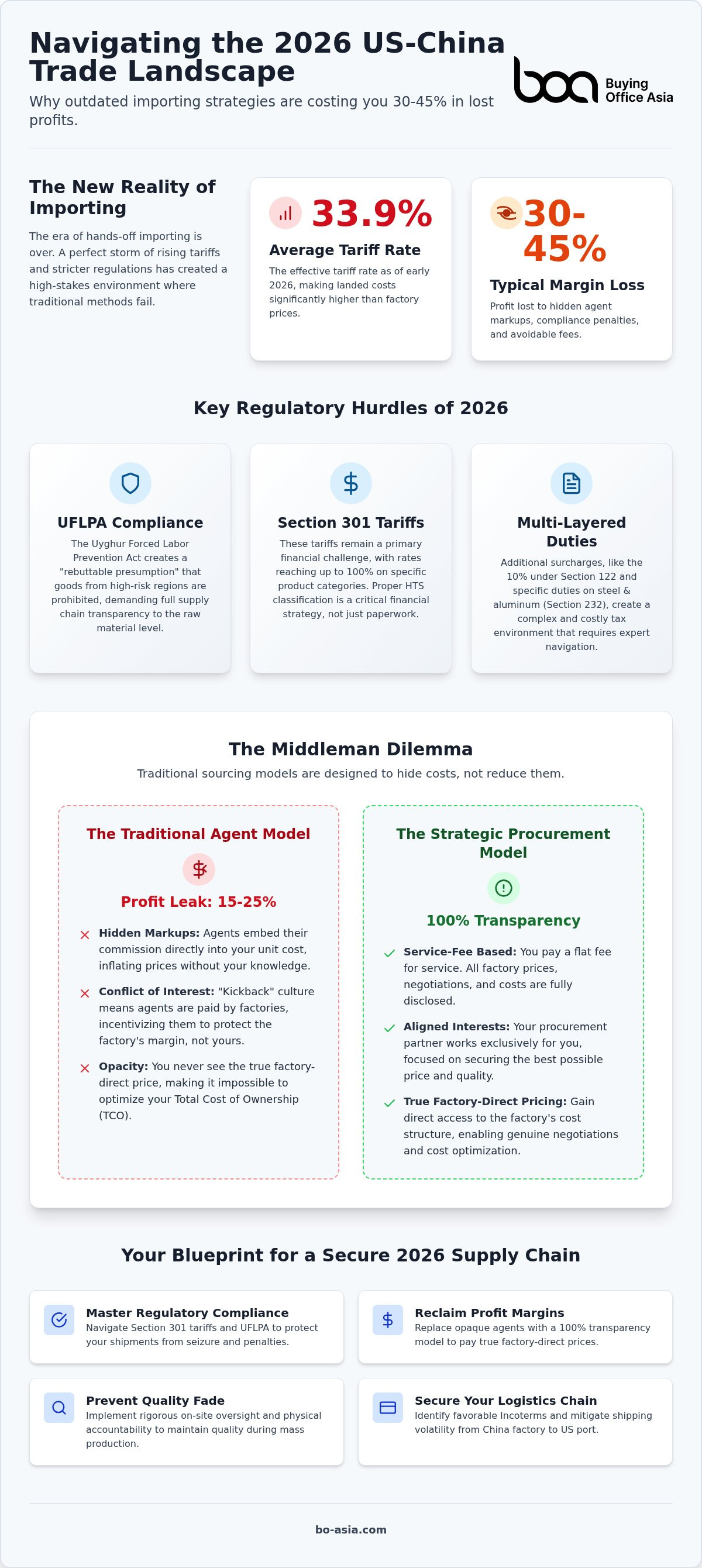
With an average effective tariff rate now reaching 33.9 percent as of early 2026, the era of hands-off importing is officially over. If your business still relies on digital platforms or unmanaged agents to move goods from a China factory to USA warehouses, you are likely losing 30 to 45 percent of your margin to hidden markups and avoidable compliance penalties. The elimination of the de minimis exemption in 2025 means every shipment now faces the full weight of US Customs scrutiny, leaving no room for error in your documentation or supplier vetting.
You probably recognize that the complexity of trans-Pacific trade has reached a tipping point where traditional intermediary models simply fail to protect your financial interests. This guide will show you how to master the 2026 regulatory landscape, achieve genuine factory-direct pricing, and secure your supply chain against UFLPA risks. We will explore the physical oversight required to maintain quality during mass production and the specific logistics strategies needed to navigate current customs requirements without costly delays or unexpected surcharges.
• Navigate the 2026 regulatory landscape by mastering Section 301 tariffs and UFLPA compliance to protect your shipments from seizure.
• Reclaim your profit margins by replacing opaque sourcing agents with a 100% transparency model that ensures you pay true factory-direct prices.
• Prevent quality fade during high-volume production cycles through rigorous on-site oversight and physical accountability at the source.
• Secure your logistics chain from a China factory to USA ports by identifying the most favorable Incoterms and mitigating 2026's increased shipping volatility.
• Transition to a strategic procurement model that utilizes regional expertise in Hong Kong to act as a protective extension of your own corporate team.
The 2026 trade environment is no longer a simple exercise in logistics. It's a high-stakes geopolitical puzzle where volatility and opportunity exist in equal measure. For high-volume importers, moving goods from a China factory to USA ports now demands a shift from tactical buying to strategic procurement. The old "hands-off" model, where an importer simply waits for a container to arrive, has become financially unsustainable due to the sheer complexity of the current trade landscape.
Success today is measured by Total Cost of Ownership (TCO) rather than the deceptive simplicity of a unit price. When you factor in the 2026 effective tariff rates, which have climbed to an average of 33.9 percent, the "cheap" factory quote often turns into a liability. You must account for a landed cost that is typically 30 to 45 percent higher than the Free on Board (FOB) price. This reality is forcing professional procurement teams to prioritize transparency and risk mitigation over the lowest possible bid.
The Uyghur Forced Labor Prevention Act (UFLPA) remains the most significant regulatory hurdle for US-bound shipments. Custom and Border Protection (CBP) operates under a "rebuttable presumption" that goods with any connection to high-risk regions are prohibited. This makes comprehensive supply chain mapping to the raw material level a mandatory operational requirement. You can't rely on a supplier's word; you must integrate rigorous ESG standards into your vetting process to ensure every link in your chain is defensible under federal audit.
Section 301 tariffs continue to define the financial viability of importing from a China factory to USA markets, with rates on specific categories reaching up to 100 percent. Additionally, a 10 percent surcharge under Section 122 and specific Section 232 duties on steel and aluminum create a multi-layered tax environment. Mitigation now relies on precise HTS classification and proactive planning. It's also vital to remember that labeling goods as "Made in PRC" provides no relief from these duties; CBP applies the same scrutiny regardless of the nomenclature used. Proper classification isn't just about paperwork; it's a critical financial strategy.
The traditional sourcing model is built on opacity. Most importers unknowingly lose 15 to 25 percent of their margin to hidden markups added by trading companies and unmanaged sourcing agents. These intermediaries often claim to offer "factory prices" while embedding their own commissions into the unit cost. When you are moving high-volume shipments from a China factory to USA warehouses, these invisible costs compound into hundreds of thousands of dollars in lost profit. True financial optimization requires a shift to a 100% transparency model where every cent is accounted for.
Professional factory direct price negotiations are the only way to secure the actual cost of production. By removing the middleman, you gain direct access to the factory's cost structure, allowing for honest discussions about material costs and manufacturing efficiencies. Our European management team, based in Helsinki, provides the cultural alignment and professional rigor your HQ expects, while our Hong Kong operations ensure real-time oversight. This dual presence creates a secure bridge between American business standards and Asian manufacturing realities.
Traditional sourcing often suffers from a "kickback" culture where agents receive undisclosed payments from factories in exchange for your business. This creates a fundamental conflict of interest; the agent is incentivized to protect the factory's margin rather than yours. A service-fee model eliminates this risk by aligning your partner's interests entirely with your own. Transparent pricing turns your supply chain from a cost center into a measurable competitive advantage. If you want to see how this model impacts your specific product categories, you can connect with our team for a strategy briefing.
High-volume orders demand more than a "one-off" agent; they require your own dedicated team on the ground. This team functions as an integrated extension of your own company, providing the same level of loyalty and oversight you would expect from your internal staff. While CBP's tips for new importers emphasize the importance of documentation, a dedicated team ensures that the data in those documents is accurate at the source. This physical presence is what separates successful 2026 importers from those struggling with "quality fade" and unexpected delays in the China factory to USA supply route.
Quality fade is a silent margin killer. It occurs when a manufacturer gradually substitutes inferior components or reduces processing time to increase their own profits at the expense of your brand's integrity. Protecting your reputation as goods move from a China factory to USA distribution centers requires more than just trust. In 2026, digital inspections and "Golden Samples" are insufficient because they only capture a moment in time, not the reality of a high-volume production run. Physical accountability at the factory floor is the only way to ensure that the millionth unit matches the first.
The ROI of on-site quality control and inspections is realized the moment you prevent a defective shipment from leaving the port. When managing complex OEM and ODM manufacturing projects from the US, the distance creates a control vacuum that factories may exploit. Having a dedicated team on-site allows for real-time adjustments and immediate correction of technical deviations before they become systemic failures. This proactive oversight transforms your supply chain from a source of anxiety into a reliable engine for growth.
Success begins with a comprehensive 4-step audit process that evaluates potential partners across four critical pillars: Financial, Technical, Social, and Environmental. You can't rely on scanned documents that are easily forged; our team verifies Chinese business licenses and actual production capacity in person. This granular level of detail is essential for meeting modern ESG requirements and ensuring long-term supplier stability. For a complete set of checklists on how to evaluate your partners, refer to our Supplier Vetting Guide.
Effective oversight requires a tiered inspection strategy. During-Production (DUPRO) checks allow us to catch errors while the line is still running, whereas a Final Random Inspection (FRI) provides the statistical certainty needed for shipment approval. We work with you to set clear Acceptable Quality Level (AQL) standards that the factory must meet to trigger payment. Consistent on-site monitoring ensures that a minor technical deviation doesn't snowball into a total batch failure that arrives at your US warehouse as unsellable scrap. Managing the transition from a China factory to USA retail shelves involves constant vigilance to maintain these standards across every SKU.
Moving high-volume cargo from a China factory to USA ports in 2026 requires a precise balance between cost-efficiency and regulatory safety. The choice of Incoterms is your first major strategic decision. While DDP (Delivered Duty Paid) may seem convenient, high-volume importers generally favor FOB (Free on Board). FOB grants you control over the freight carrier and insurance, preventing the factory from embedding inflated shipping margins into your unit price. This control is essential when ocean freight costs for a 40-foot container from Shanghai to Los Angeles currently range between $3,200 and $5,500.
Route volatility has become a constant factor in 2026 lead-time calculations. Selecting between West Coast entry for faster transit and East Coast entry for proximity to major population centers depends on your specific distribution strategy and current congestion levels. Consolidating shipments from multiple suppliers into a single Full Container Load (FCL) remains the most effective way to lower your per-unit landed cost and minimize the risk of damage during transit.
Optimizing container loading is a measurable way to maximize shipping ROI. Every cubic meter of wasted space is lost capital. As your procurement partner, we manage freight forwarder relationships to ensure your cargo receives priority space during peak seasons. We focus on physical oversight at the loading dock to verify that the container is packed securely and matches the manifest exactly. This level of detail prevents damage during the trans-Pacific crossing and simplifies the clearance process upon arrival.
Customs delays are often the result of documentation discrepancies. Every Bill of Lading and commercial invoice must align perfectly with your sourcing and procurement records to avoid flagging. The Importer Security Filing (ISF) is particularly critical. It must be submitted at least 24 hours before the vessel is loaded in China. Failure to comply results in a mandatory $5,000 penalty and increased scrutiny on all your future shipments. Managing the "last mile" from the US port to your warehouse is the final link in this chain, requiring a reliable drayage partner to avoid mounting demurrage fees. If you need a comprehensive audit of your current logistics strategy, reach out to our team for a professional consultation.
The complexities of 2026 trade, from 33.9 percent effective tariffs to the rigorous demands of UFLPA compliance, have fundamentally changed the requirements for success. Moving high-volume goods from a China factory to USA distribution centers is no longer a task that can be managed through a web browser or an unvetted agent. It requires a fundamental shift from tactical, transactional buying to a strategic procurement model built on physical presence and radical transparency. By treating your supply chain as a proprietary asset rather than a series of expenses, you secure the financial viability of your business in an increasingly volatile global market.
Our unique operational structure provides the stability you need. With European leadership based in Helsinki, we ensure that your corporate values, communication standards, and legal expectations are fully understood and met. Simultaneously, our on-the-ground presence in Hong Kong allows for real-time oversight and immediate intervention at the factory level. This combination eliminates the "control gap" that typically plagues international manufacturing, replacing uncertainty with the steady confidence of an established insider. We don't just describe a connection; we provide a defense against the operational setbacks that affect unmanaged supply chains.
Strategic procurement isn't just a defensive measure; it's a significant driver of profitability. When you review our documented savings examples, the financial impact of removing middleman markups and optimizing negotiations becomes clear. Buying Office Asia often pays for itself by identifying hidden inefficiencies and preventing the catastrophic costs of batch failures or customs seizures. By securing a transparent, middleman-free pipeline from your China factory to USA warehouses, you reclaim the margins that traditional sourcing models have been quietly eroding for years. This lean approach to procurement mirrors the operational efficiency we promise in every service delivery.
The most successful importers in 2026 are those who've moved beyond the "hands-off" approach. We invite you to consult with our teams in Helsinki or Hong Kong to discuss your specific high-volume procurement needs. Whether you require end-to-end management or a dedicated team to act as an extension of your HQ, we provide the regional expertise and protective oversight necessary for long-term growth. Don't leave your 2026 margins to chance. Contact Buying Office Asia to optimize your China-to-USA supply chain and secure your dedicated procurement team today. We are ready to act as the stabilizing force your global operations require.
Managing the flow from a China factory to USA distribution centers has become a strategic operation that demands physical accountability and technical rigor. Success in 2026 hinges on your ability to bypass opaque intermediaries and establish direct, transparent relationships with your manufacturing partners. By prioritizing on-site quality control and strict regulatory compliance, you protect your brand from the financial risks of quality fade and costly customs seizures.
Buying Office Asia serves as your protective partner in this complex landscape. Our European leadership team in Helsinki provides the cultural alignment your HQ requires, while our Hong Kong operations have delivered real-time oversight since 2010. We operate with a 100 percent transparency model, ensuring that every negotiation and inspection serves your bottom line without hidden markups. This integrated approach transforms your supply chain from a source of anxiety into a stable, profitable asset for your business.
Take control of your procurement and secure your margins against the volatility of the coming year. Contact our expert team to secure your China-to-USA supply chain and begin building a more resilient manufacturing future today.
Finding a reliable partner requires moving beyond digital directories to conduct physical, on-site audits. You must verify the factory's business license, technical capacity, and social compliance records in person. In the 2026 trade environment, relying on unverified claims is a significant risk to your brand. Professional procurement teams conduct a four-step audit process to ensure your chosen manufacturer can handle high-volume production without compromising on quality or ethical standards.
As of early 2026, the estimated average effective tariff rate on Chinese imports is 33.9 percent. This total includes Section 301 duties ranging from 7.5 to 100 percent, a 10 percent Section 122 surcharge, and Section 232 tariffs on steel and aluminum. You should anticipate a total landed cost that is 30 to 45 percent higher than your FOB price. Proper HTS classification is essential to mitigate these expenses and avoid unexpected penalties.
The UFLPA creates a rebuttable presumption that any goods linked to high-risk regions are produced with forced labor and are prohibited from entry. This regulation affects every shipment from a China factory to USA ports, requiring you to map your supply chain down to the raw material level. You must maintain a comprehensive audit trail that proves your components are compliant. Failure to provide this documentation can lead to immediate shipment seizures by US Customs.
A sourcing agent typically operates on undisclosed commissions or kickbacks from the factory, which creates a fundamental conflict of interest. In contrast, a procurement office functions as an integrated extension of your own company using a 100 percent transparency model. This model ensures you pay the true factory-direct price while your partner's interests are entirely aligned with your financial health. Professional procurement offices offer the elite oversight usually reserved for major enterprises.
Securing quality during high-volume production requires a combination of During-Production (DUPRO) and Final Random Inspections (FRI). You must set clear Acceptable Quality Level (AQL) standards and have a physical presence on the factory floor to enforce them. This on-site oversight prevents quality fade, where a manufacturer substitutes inferior materials over time. Constant vigilance is the only way to ensure that the millionth unit meets the same specifications as your golden sample.
The choice depends on your final distribution points and required transit speed. Shipping to the West Coast is generally faster, with ocean freight from Shanghai to Los Angeles taking significantly less time than East Coast routes. If your primary customers are in the Atlantic states, shipping directly to the East Coast can reduce domestic trucking and rail costs. You must analyze the total landed cost and lead times for both options to optimize your ROI.
Achieving factory-direct pricing requires eliminating intermediaries who obscure the true cost of production. You should adopt a service-fee model that allows for open-book negotiations based on raw material costs and manufacturing efficiencies. This transparency ensures that the price you pay reflects the actual manufacturing value rather than hidden markups. Our Hong Kong operations facilitate these direct negotiations, providing you with the regional expertise and networks that traditional agents lack.
US Customs requires a commercial invoice, a detailed packing list, and the Bill of Lading for all formal entries. You must also submit an Importer Security Filing (ISF) at least 24 hours before the cargo is loaded onto a vessel in China. Since the de minimis exemption was repealed in May 2025, all shipments regardless of value must undergo formal entry. Ensuring your documentation is accurate prevents costly delays when moving high-volume cargo from a China factory to USA ports.

As of July 2026, the average effective tariff rate on Chinese imports has climbed to 22.8%, but is the cost on the invoice really your biggest financial risk? You likely feel the mounting pressure of managing a supply chain where the rules of engagement change every quarter. The challenges of sourci...

Is your current China manufacturing management strategy robust enough to survive the regulatory shifts of 2026? With the recent implementation of Decree 834 and the new "Made in China" procurement standards, the distance between a successful product launch and a costly supply chain failure has never...

What if your final quality check isn't just a formality, but the only thing standing between a successful product launch and a container full of unsellable defects? For many businesses, the fear of receiving substandard goods from overseas is a constant anxiety, often compounded by communication bar...