

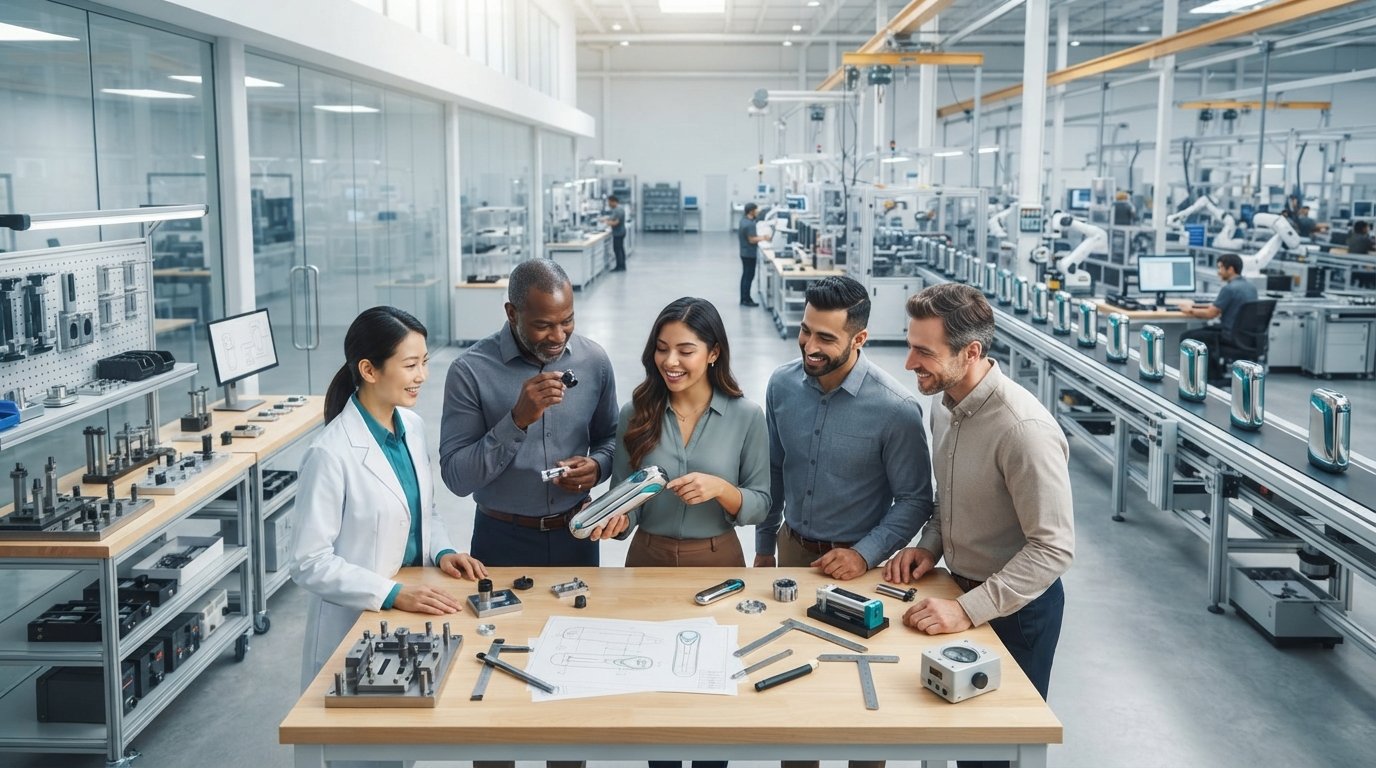
A perfect golden sample is often the most dangerous document in your supply chain. If a prototype is handcrafted by a master technician rather than built using scalable factory processes, your sample development phase isn't a success; it's a liability. This gap between a one-off masterpiece and a high-volume run is where most brands lose their margins and their reputations.
You've likely experienced the frustration of receiving a flawless iteration, only to find the factory cannot replicate that quality at scale. Miscommunications over technical specifications and the constant risk of intellectual property theft make this process feel like a gamble rather than a strategic investment. It's a common pain point that stems from a lack of on-the-ground control and technical oversight. You deserve a process that prioritizes your financial health and brand integrity.
This guide will show you how to navigate the complexities of manufacturing in Asia to ensure your mass production matches your vision without costly defects or delays. You need a roadmap that works. You'll learn how to treat sampling as a technical stress test rather than a creative exercise. We'll explore how to secure your proprietary designs, eliminate hidden intermediary costs, and establish a clear path from your first production-ready sample to successful high-volume delivery in 2026.
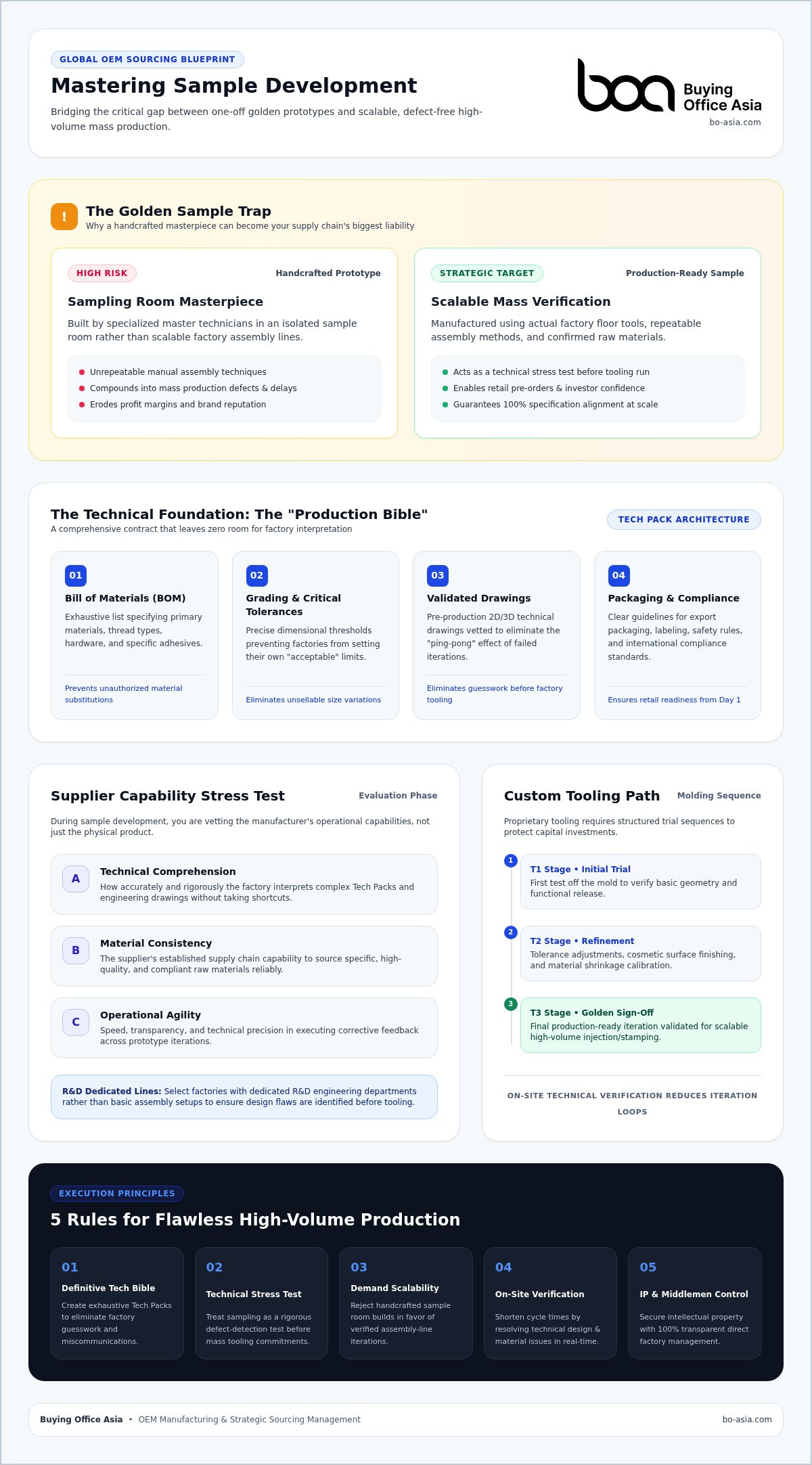
• Create a definitive "production bible" using detailed Tech Packs to eliminate miscommunication and ensure your technical specifications are followed exactly.
• Use the sample development process as a technical stress test to identify manufacturing flaws before they escalate into expensive mass production defects.
• Understand why handcrafted prototypes from specialized sampling rooms often fail on the factory floor and how to demand scalable iterations instead.
• Shorten your development timeline by utilizing on-site technical verification to resolve material and design issues in real-time.
• Protect your intellectual property and ensure 100% transparency by managing the transition from final sign-off to high-volume production without middlemen.
Sample development is the technical bridge where a 2D design transforms into a 3D reality. It's not just a preliminary step in the procurement process; it's the most critical risk-mitigation tool available to your business. If you skip or rush this phase, you're essentially gambling with your entire production budget. In the complex landscape of international manufacturing, this stage serves as a vital stress test for both your product design and your supplier's capabilities.
You must distinguish between a proof of concept and a production-ready sample. While a proof of concept validates an idea, a production-ready sample proves the factory can manufacture the item using scalable, repeatable methods. During the prototyping process, you're not just testing the physical product. You're testing the supplier. Their ability to follow complex tech packs and meet technical requirements during sampling is a direct predictor of their performance during a high-volume run. We use this phase to vet several key indicators:
How accurately the factory interprets your specifications.
The supplier's ability to source specific, high-quality raw materials.
Their willingness and speed in implementing corrective feedback.
Errors found in early iterations are inexpensive to fix. However, if those same errors reach the mass production floor, they compound into massive financial losses and brand-damaging delays. Hidden costs often emerge when technical specifications aren't locked down during the early stages of development. Beyond risk management, a physical, high-quality sample is a powerful commercial asset. It allows you to secure retail pre-orders and build investor confidence by demonstrating a tangible, market-ready product that meets all safety and quality standards.
Strategic sourcing is fundamentally incomplete until you've validated a physical sample. This phase is deeply integrated into the OEM manufacturing lifecycle. It's vital to select factories that possess dedicated R&D departments rather than just basic assembly lines. A factory with strong development capabilities can troubleshoot design flaws that might lead to structural failures later. We act as your on-the-ground extension in Asia to ensure these technical nuances aren't lost in translation, providing the oversight necessary to transition from a single prototype to a successful mass production run.
A successful sample development phase begins long before a single machine is turned on. It starts with your Tech Pack. Think of this document as the technical "Bible" for your product. It's a comprehensive contract that leaves no room for interpretation. If you allow a factory to "fill in the blanks" of your design, you're surrendering control over your quality and your margins. Factories will inevitably choose the path of least resistance, which rarely aligns with your brand's standards.
We act as your technical gatekeeper. Buying Office Asia validates your technical drawings before they ever reach the factory floor. This proactive oversight prevents the "ping-pong" effect of failed iterations caused by simple misalignments in specifications. By ensuring the factory receives a flawless blueprint, you eliminate the guesswork that leads to production delays.
A robust Tech Pack must be exhaustive. It's the difference between a production-ready result and a costly mistake. Your documentation should include a detailed Bill of Materials (BOM) that specifies every component, from the primary material to the thread type and specific adhesives. You also need precise grading sheets and tolerances. Without defined critical dimensions, a factory's definition of "acceptable" might result in an unsellable product. Finally, your pack must document packaging, labeling, and compliance requirements to ensure your goods meet international standards from day one.
For proprietary designs, custom tooling is often the most significant upfront investment. This process typically follows a "T1 to T3" trial sequence. T1 is the first test off the mold, while T3 represents the refined, production-ready version. Managing this transition requires technical expertise to identify whether a defect is caused by the mold itself or the injection process.
Intellectual property protection is paramount here. You must establish clear legal ownership of all molds and tooling, ensuring they remain your assets even if stored at the factory. This protection allows you to move production if necessary without losing your initial investment. Balancing these tooling costs with long-term production efficiency during sample development is where strategic procurement expertise becomes a competitive advantage. If you're concerned about securing your proprietary components during this phase, it's wise to consult with an on-the-ground partner who understands the regional legal landscape.
A "Golden Sample" represents the pinnacle of your product's potential, but it's often a deceptive benchmark. In many Asian factories, these are produced in specialized sampling rooms by master technicians using manual techniques. This controlled environment doesn't reflect the reality of a high-volume assembly line where speed and cost-efficiency dominate. If your sample development process concludes with a hand-crafted masterpiece that cannot be replicated by automated machinery, you've created a significant liability for your mass production run.
You must ensure the transition from development to the Pre-Production Sample (PPS) is strictly managed. The PPS is your final gatekeeper; it must be pulled from the actual production line using the same tools, materials, and labor that will execute your full order. This is why thorough supplier vetting is mandatory. You need to verify that the factory's technical infrastructure actually matches the quality of the sample they sent to your office. Without on-the-ground verification, you're simply hoping the factory floor can match the sampling room's output.
Discrepancies often emerge the moment the first container is loaded. Material substitution is a frequent issue; a factory might use premium raw materials for the sample but switch to a generic equivalent when they "run out" during a high-volume run. Color variance is another major risk. Without strict Pantone or Lab standards, "forest green" can shift significantly across different batches. You should also watch for finishing quality. A hand-polished sample feels premium, but a machine-finished mass run might show tool marks or rough edges that were absent in the prototype.
To protect your investment, you must establish a Red-Limit Sample alongside your approved Golden Sample. While the Golden Sample shows the ideal state, the Red-Limit Sample defines the absolute floor of quality. A Red-Limit Sample is the boundary of acceptable manufacturing defects. This physical benchmark serves as your legal and technical safeguard during on-site quality inspections. It allows your procurement team to objectively reject items that fall below this line, using predefined Acceptable Quality Levels (AQL) to manage variance. By locking in these benchmarks during the final stages of sample development, you ensure the factory remains accountable to your standards throughout the entire production lifecycle.
Managing sample development from a distance is one of the most common causes of supply chain failure. When you rely solely on couriers to review iterations, you enter the "ping-pong" effect. A single technical adjustment requires five days of international shipping, followed by days of factory re-tooling and another five days of return shipping. This cycle can easily bloat a three-week task into a six-month delay. You don't have time for that level of inefficiency in a competitive 2026 market.
Physical presence is the only way to verify material quality in real-time. Our teams visit the factory floor to touch the fabrics, test the tolerances, and verify the assembly before the sample is even boxed for shipment. This on-site verification ensures that when a sample finally reaches your desk, it's already been vetted for compliance with your tech pack. It moves the decision-making process from your office to the source, where problems can be solved in hours rather than weeks.
Financial transparency is equally vital during this phase. Factories often charge significant "sample fees" to cover their R&D and tooling costs. We negotiate these fees directly at the factory level to ensure they're fair and, crucially, credited back to your balance upon the placement of a mass production purchase order. This protects your capital and ensures the factory remains motivated to reach the sign-off stage quickly. Eliminating middlemen in these negotiations ensures you aren't paying obscured markups on development costs.
A dedicated Asia procurement team functions as your immediate eyes and ears. By eliminating time-zone lag, we facilitate instant technical feedback loops. Instead of waiting 24 hours for an email response, we make on-site "go/no-go" decisions that save weeks of unnecessary courier time. This operational efficiency is what separates a professional procurement strategy from a reactive one. It allows you to maintain the same level of oversight usually reserved for major enterprises.
Protecting your intellectual property during the prototype handover is a strategic necessity. We often recommend a "fragmented development" approach, where different components are developed at separate factories to prevent any single supplier from seeing the complete design. Additionally, we utilize enforceable NDAs rooted in Hong Kong jurisdiction, providing a layer of legal security that domestic-only contracts lack. Securing your design before it hits the open market isn't just about paperwork; it's about physical oversight and regional expertise. If you're struggling with iteration delays or IP concerns, you can connect with our technical team to streamline your development cycle.
The final sign-off marks the formal conclusion of the sample development phase and the beginning of your commercial lifecycle. This is the moment your design becomes a binding technical obligation. Moving from a single approved iteration to a high-volume Purchase Order (PO) requires a seamless transfer of data. You aren't just buying a product; you're buying the factory's ability to replicate a specific standard thousands of times without deviation. We manage this transition by ensuring all technical adjustments made during sampling are permanently integrated into the factory's standard operating procedures.
Your quality control framework must be built directly from the final approved iteration. This "Master Sample" serves as the physical evidence for our on-site inspectors. It's the benchmark that prevents "quality fade," a common issue where standards slowly slip over subsequent production runs. By locking in these specifications now, you establish a clear legal and technical baseline that protects your financial interests. Strategic logistics planning also begins here. You must account for mass production lead times and volume requirements to ensure your market launch remains on schedule for 2026.
Before the first full production run commences, your final sample must undergo rigorous lab testing to ensure global compliance. Depending on your target market, you'll likely require certifications such as CE, RoHS, or REACH. We facilitate this process by coordinating with accredited third-party laboratories to verify that the materials used in your sample development match the safety standards required by law. Don't leave compliance to chance. Obtaining these certifications based on the final sample provides the legal security you need before shipping large volumes across international borders.
Transitioning from a prototype to a scalable production line is a high-stakes operation. Buying Office Asia functions as an integrated extension of your team, providing the European-standard oversight necessary to eliminate the risks of unmanaged sourcing. We offer 100% transparency and factory-direct pricing, ensuring your margins are protected from hidden intermediary costs. Our on-the-ground presence in Hong Kong and China guarantees that your vision is executed with technical precision. If you're ready to secure your supply chain and move toward a defect-free mass production run, we invite you to book a strategy session via the BOA Contact Page. Let's build a roadmap that ensures your product's success in the global market.
Success in global manufacturing depends on treating the sample development phase as a rigorous technical stress test rather than a creative formality. You've learned that a "Golden Sample" is only valuable if it's reproducible on a high-volume factory floor. By locking in detailed Tech Packs and establishing clear Red-Limit benchmarks, you protect your brand from the risks of quality fade and material substitution. These strategic safeguards ensure that your final product matches your vision without the standard delays of unmanaged sourcing.
Navigating these complexities requires more than just digital communication; it demands physical proximity and technical expertise. Buying Office Asia provides the European-managed oversight and 100% transparency you need to eliminate middlemen and secure your proprietary designs. With offices in Hong Kong and Helsinki, we act as a stabilizing force in the global market, offering the same level of oversight usually reserved for major enterprises. It's time to move away from the anxieties of international manufacturing and toward the confidence of a managed supply chain. Secure your product development with on-the-ground experts; contact Buying Office Asia today. We look forward to helping your business grow with precision and reliability.
Sample development costs depend on materials, complexity, and whether custom tooling is required. While factories often charge a premium for one-off items, we negotiate these fees to be credited against your mass production order. By eliminating middlemen, you ensure transparency in these development fees. Every project is unique; therefore, costs are determined by the specific technical requirements of your tech pack and the labor involved in specialized sampling rooms.
The timeline generally ranges from three weeks to several months depending on design complexity. In 2026, courier lead times for shipping samples from Hong Kong or China to Europe typically average three to five business days. However, the total duration is often extended by the need for multiple iterations. Having a dedicated on-site team reduces this by providing real-time technical verification and immediate "go or no-go" decisions on the factory floor.
A prototype is an early-stage iteration used to validate your design's physical form and functionality. In contrast, a pre-production sample is the final version pulled directly from the actual mass production line. While a prototype might be handcrafted, the PPS must use the exact machinery and materials intended for your high-volume run. This distinction is vital for ensuring that your vision is actually scalable and repeatable during manufacturing.
You can protect your proprietary designs through a combination of legal and operational strategies. We utilize enforceable NDAs rooted in Hong Kong jurisdiction and often employ a "fragmented development" approach. This involves splitting component production across different factories so no single supplier possesses the complete blueprint. Combined with our on-the-ground presence, these methods create a robust defense against intellectual property theft during the sensitive sample development phase.
Factories charge higher rates for single samples because they disrupt standard high-volume production lines. Creating one item requires master technicians to perform manual labor and dedicated R&D time that isn't covered by the unit price of a mass run. These fees also account for the specialized materials and machine setup time required for a one-off iteration. We work to ensure these costs are transparent and credited back to your mass production purchase order.
If mass production fails to match your approved sample, the Master Sample and Red-Limit Sample serve as your legal benchmarks for rejection. These physical references allow our quality inspectors to objectively identify defects during on-site assessments. Because your contract is tied to these specific standards, you have the right to demand rework or refuse payment for goods that fall below the agreed AQL levels. This safeguard protects your financial health and brand reputation.
You don't need to visit the factory personally if you have a professional on-the-ground team acting as an extension of your company. We provide the technical verification and physical oversight necessary to manage iterations in real-time. Our European-managed leadership ensures clear communication and high-level consulting, giving you the same control as a personal visit without the travel expenses or time-zone lag. This allows you to focus on growing your business while we handle the technical details.
For a product with a well-defined tech pack, two to three iterations are typically normal. The first iteration identifies structural or material issues, while subsequent versions refine the finishing and tolerances. If you find yourself reaching six or more iterations, it usually indicates a failure in technical communication or a supplier that lacks the necessary R&D capabilities. Professional oversight helps you reach a production-ready sign-off faster by ensuring sample development specifications are understood from the first day.

If your current sourcing agent claims their services are free, you're likely paying a hidden tax of 10% to 30% through inflated unit prices and factory kickbacks. This lack of transparency doesn't just erode your margins; it creates a dangerous barrier between you and the factory floor. Finding a re...

Scaling production to millions of units isn't a purchasing task; it's a high-stakes risk management discipline where a single percent of quality fade can liquidate your annual margin. You likely understand that the leap from mid-scale orders to massive procurement runs often exposes cracks in even t...

In 2026, the traditional sourcing agent isn't just an expense; they're a strategic liability that obscures your true cost of goods. Most procurement leaders recognize that supplier selection in asia has become a defensive maneuver where the goal is to eliminate the "Middleman Tax" before it erodes y...