


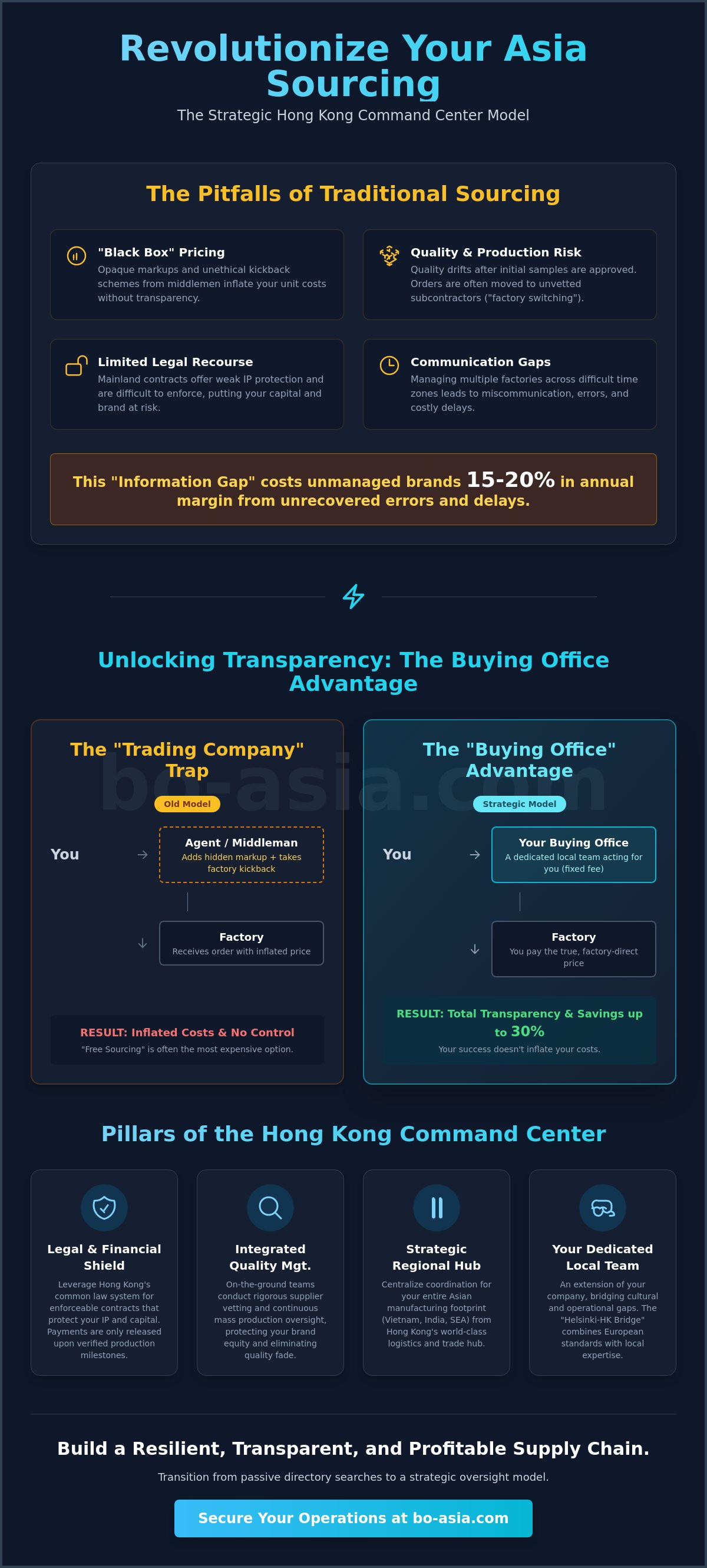
The traditional model of hong kong sourcing, often built on opaque markups and "black box" factory relationships, is no longer a viable strategy for scaling a secure supply chain. You've likely experienced the frustration of seeing a competitive quote slowly inflate through hidden commissions; or worse, watching product quality drift as soon as mass production begins. Relying on mainland contracts that offer limited legal recourse or attempting to manage communication across impossible time zones creates a level of risk that your bottom line should not have to carry.
This guide reveals how to leverage Hong Kong as a high-level strategic command center for your entire Asian procurement operation. We'll show you how to eliminate intermediaries to secure 100% transparent, factory-direct pricing while maintaining European-standard quality control. You'll learn how to integrate a local team that acts as a protective extension of your own company, ensuring your operations are optimized for financial health. We also detail the critical 2026 shifts, including the new Protection of Critical Infrastructures Bill and the transition to audit-ready sustainability data, so your business remains resilient in a complex global market.
• Transition from passive directory searches to a strategic oversight model that utilizes Hong Kong as your regional command center for Asian manufacturing.
• Eliminate hidden markups and unethical kickback schemes by adopting a transparent "Buying Office" framework that ensures factory-direct pricing.
• Protect your brand equity through integrated quality management and rigorous supplier vetting conducted before any financial commitment is made.
• Streamline complex multi-factory operations and logistics through a dedicated hong kong sourcing team that provides the oversight and scalability required for high-volume production.
In 2026, hong kong sourcing has evolved far beyond the traditional act of searching a supplier directory. It's now a strategic oversight model designed to give western brands a command center in the heart of Asia. Many procurement teams make the mistake of treating the region like a digital marketplace, but the most successful operations utilize the "Helsinki-HK Bridge." This model combines European management standards and leadership with a physical, boots-on-the-ground presence. It's the gold standard for 2026 because it bridges the cultural and operational gaps that frequently lead to production failure.
While manufacturing footprints are expanding rapidly into Vietnam, India, and Southeast Asia, Hong Kong remains the most efficient node for regional coordination. The Economy of Hong Kong is built on a foundation of logistics and trade expertise that decentralized factory locations simply cannot match. By centralizing your sourcing and procurement here, you gain a vantage point that overlooks the entire regional supply chain. It's not just a city; it's a shield against the volatility of unmanaged manufacturing.
Signing contracts directly with mainland factories or emerging market suppliers often leaves you with zero legal recourse when things go wrong. Hong Kong’s common law system provides a familiar, enforceable framework for your manufacturing agreements that protects your intellectual property and capital. This legal safety net is coupled with a transparent banking sector that facilitates seamless international payments. At Buying Office Asia, we leverage this infrastructure to protect your capital. We ensure that funds are only released when specific production milestones are verified on-site. This moves your business from a position of vulnerability to one of controlled financial transparency.
The allure of "going direct" via digital marketplaces often hides a mountain of unforeseen expenses. You aren't just paying the unit price; you're paying for the risk of "factory switching," where your order is quietly moved to an unvetted subcontractor to save the factory a few cents. A local office prevents this through constant factory audits and mass production oversight. The Information Gap between a remote buyer and a distant factory often costs unmanaged brands 15-20% in annual margin due to unrecovered quality errors and logistical delays. By choosing a partner that follows the Buying Office Asia model, you eliminate these hidden costs before they impact your balance sheet.
Achieving 100% financial transparency in your supply chain isn't just about ethics; it's a fundamental requirement for long-term profitability. Most businesses engaging in hong kong sourcing unknowingly fall into the "Trading Company" trap. These entities often present themselves as factories or low-cost agents while burying substantial markups in the unit price. A true "Buying Office" operates differently. It functions as an extension of your own team, charging a fixed service fee in exchange for total visibility into the factory-direct cost.
This distinction is critical when you consider the prevalent "kickback" culture in traditional sourcing. Many agents take a commission from the buyer and a hidden rebate from the factory. This conflict of interest ensures the agent will never prioritize your price negotiations over their own profit. By shifting to a transparent fee-for-service model, you can often secure savings of up to 30% compared to unmanaged intermediary quotes. You can see exactly how Buying Office Asia delivers this level of transparency through our documented case studies.
The markup model is inherently flawed for high-volume buyers. When an agent adds a 10% or 15% margin to every unit, your costs scale with your success, which is counter-intuitive. "Free Sourcing" is often the most expensive option you'll find. If you aren't paying a service fee, the agent is simply hiding their profit in an inflated factory quote. To protect your margins, you must insist on seeing the original factory invoice and the breakdown of raw material costs. This is the only way to ensure your capital is being used efficiently rather than funding a middleman's lifestyle.
Real price negotiation requires more than just an email exchange. It demands a physical, on-site presence and the ability to speak the local language fluently. You need a team that understands the technical components of your product. This expertise allows your representatives to dismantle inflated quotes by challenging the factory on specific material costs or labor hours. As noted by the U.S. Commercial Service Hong Kong, the city's sophisticated business environment supports high-level trade oversight that is difficult to replicate elsewhere.
To verify transparency during your procurement process, use this checklist:
• Demand the original factory name and location before placing an order.
• Request a bill of materials (BOM) breakdown for every major product.
• Compare factory-direct quotes against regional benchmarks.
• Ensure your agent's fee is a separate line item on your financial reports.
If you're ready to audit your current supply chain costs for hidden markups, it's time to speak with a procurement expert who prioritizes your financial health.
Reliable hong kong sourcing isn't a hands-off process; it's an active defense of your brand equity. Many procurement teams mistake a simple "checklist inspection" for comprehensive quality management. A checklist only tells you if a box was ticked on a specific day. Integrated quality management, however, involves a deep understanding of your product's technical specifications from the initial sampling stage through to final loading. This level of oversight ensures that the factory doesn't deviate from the agreed standards once mass production begins.
Your first line of defense is rigorous supplier vetting, which must occur before you pay a single dollar in deposits. Once capital is committed, your leverage decreases significantly. We focus on establishing a "Golden Sample," a physical prototype that serves as the immutable standard for every unit that follows. By maintaining this physical reference point, we eliminate the ambiguity that often leads to quality drift. Resources available through Hong Kong Business & Trade emphasize the importance of these regulatory and operational standards in maintaining a competitive edge in global markets.
We deploy a structured framework to catch errors before they become expensive liabilities. It begins with Pre-Production audits, where we verify raw materials and tooling to ensure the factory is equipped for your specific requirements. During Production (DUPRO) inspections take place when approximately 20% of the batch is complete. This allows us to identify and correct systematic defects before the entire order is finished. Finally, a Final Random Inspection (FRI) serves as the last line of defense. We only authorize shipment once the goods meet every specified criterion, ensuring you don't receive a container full of non-conforming products.
A factory's website rarely tells the full story of its operational reality. Our on-site audits verify actual production capacity and equipment maintenance schedules to ensure the factory can meet your deadlines without subcontracting to unvetted workshops. We also prioritize ESG and ethical standards, assessing worker conditions and environmental compliance to protect your brand from reputational risk. A "clean" audit report is only valid if verified by an unannounced visit. This boots-on-the-ground approach is a core part of the dedicated Asia procurement team model. It transforms your supply chain from a source of anxiety into a stable, high-performing asset.
Hong Kong's role as a global logistics nexus remains unrivaled, especially as manufacturing footprints diversify across Southeast Asia. While production may occur in Vietnam, India, or mainland China, centralizing your oversight through a hong kong sourcing hub provides a level of coordination that decentralized shipping simply cannot match. The city's freight and logistics market is valued at USD 23.21 billion in 2026, which underscores its status as a high-velocity transit point. By integrating our logistics and shipping management services, you navigate the 2026 landscape with real-time tracking and route optimization designed to bypass common regional bottlenecks. This is particularly vital given the 5.9% year-over-year increase in air cargo volumes at Hong Kong International Airport, which demands a sophisticated team to manage priority cargo space.
Managing high-volume procurement across multiple factories often leads to inflated costs if shipments are handled individually. We solve this by using Hong Kong as a strategic consolidation point. This approach allows us to combine Less than Container Load (LCL) shipments from various Asian suppliers into a single Full Container Load (FCL). This doesn't just lower your freight expenses. It also streamlines your "Last Mile" delivery by centralizing regional distribution through HK-based warehousing. You gain the steady confidence of a streamlined supply chain instead of the anxiety of tracking dozens of disparate shipments across different time zones. This operational efficiency is the hallmark of a results-oriented procurement strategy.
The 2026 geopolitical trade environment requires a rigorous approach to documentation and regulatory adherence. A minor error in an HS code can result in significant overpayment of duties or cause your goods to be impounded at the port of entry. We meticulously manage the "Source to Contract" paperwork trail, ensuring every certificate of origin is verified and VAT compliance is maintained. This protective oversight is even more critical following the 2026 Protection of Critical Infrastructures Bill, which has heightened the focus on supply chain resilience and mandatory incident reporting. We act as your expert ally, dismantling the complexities of international trade to protect your capital and ensure your goods move across borders without friction.
If you want to optimize your regional shipping routes and reduce transit overhead, contact our logistics team for a strategic briefing.
In 2026, relying on a "Freelance Agent" to manage millions in procurement is a liability your business can't afford. These individuals often lack the physical infrastructure to handle complex mass production oversight or the legal accountability to protect your interests when quality drifts. Instead, the most resilient brands are building a Dedicated Asia Procurement Team that functions as a direct extension of their own headquarters. This model provides the scalability required for high-volume growth without the risk of "black box" intermediary relationships. By integrating a Hong Kong-based office into your European or US workflow, you bridge the communication gap and gain real-time control over your manufacturing assets.
Moving from off-the-shelf catalog items to custom product development is the primary way to differentiate your brand in a crowded market. However, this transition introduces significant complexity, particularly regarding custom tooling and intellectual property protection. Hong Kong's independent legal regime allows you to enforce NDAs and manufacturing agreements that are far more robust than those signed directly with factories in mainland China or other regional markets. Your dedicated team manages the entire lifecycle of custom tooling development, ensuring your proprietary designs remain secure and your production runs are consistent. This level of oversight is a cornerstone of professional hong kong sourcing in a competitive global landscape.
The financial justification for professional hong kong sourcing is clear when you measure the reduction in unit costs alongside lower defect rates. You eliminate the hidden markups that typically erode 15-20% of your margin while benefiting from significantly more efficient logistics. Beyond the balance sheet, there's the "Peace of Mind" factor. This model allows your executive team to focus entirely on sales and brand strategy while Buying Office Asia handles the operational friction of production and procurement. It's about moving from a reactive state of crisis management to a proactive state of strategic growth. By stabilizing your supply chain today, you're securing the financial health of your company for the years to come.
Buying Office Asia represents the logical conclusion for brands seeking 100% transparency and a risk-free path to scale. If you're ready to secure your supply chain and eliminate the middlemen, discover how our team can stabilize your Asian operations. In 2026, the most successful brands don't just source from Asia; they manage Asia through a professional Hong Kong office.
The shift toward a more transparent and resilient supply chain isn't a future trend; it's a current necessity for brands that prioritize financial health. By utilizing hong kong sourcing as a strategic oversight model, you move beyond the risks of unmanaged factory relationships and hidden markups. You've seen how a dedicated local team provides the technical expertise and legal security required to protect your brand equity while ensuring every production run meets European quality standards. This transition from transactional sourcing to integrated management is what separates market leaders from those struggling with quality drift and escalating costs.
At Buying Office Asia, we act as a stabilizing force in a complex global market. Our European-managed team brings over 15 years of on-the-ground experience to your procurement strategy. We operate with a 100% transparent fee structure, which means you never have to worry about hidden commissions or kickbacks. Whether you're managing high-volume production or navigating complex OEM/ODM projects, we provide the steady confidence you need to scale. Take the first step toward a more profitable and secure Asian operation. Book a consultation with our Helsinki-Hong Kong leadership team to discover how we can transform your procurement into a competitive advantage. Your business deserves a partner that prioritizes your growth as much as you do.
Yes, Hong Kong remains the premier hub because it offers a level of legal and financial security that isn't available when dealing directly with mainland factories. While production has diversified into regions like Vietnam and India, hong kong sourcing provides a centralized command center under a common law system. This ensures your contracts are enforceable and your intellectual property is protected by a sophisticated regulatory framework that operates independently of mainland jurisdictions.
A sourcing agent typically operates on a commission or markup model, often hiding their true profit within the factory's unit price. In contrast, a buying office acts as an integrated extension of your own company. We use a transparent fee-for-service structure that aligns our interests with yours. This focuses on reducing your total cost of ownership rather than maximizing a hidden margin on every unit produced.
We provide 100% price transparency by giving you direct access to the original factory invoices and material cost breakdowns. Our revenue comes from a clearly defined service fee, not from markups on your goods. This open-book approach allows you to see exactly where every dollar is spent. It ensures that all negotiated savings from our factory-direct price negotiations go directly to your bottom line.
Yes, we specialize in high-volume OEM and ODM projects, including custom product and tooling development. Our team manages the entire lifecycle from initial sampling and prototyping to mass production oversight. We ensure that your proprietary designs are protected through HK-governed agreements and that the final product matches your approved prototype perfectly before any shipment is authorized.
Professional hong kong sourcing firms generally move away from hidden commissions toward a fixed service fee or a transparent management percentage. This fee covers end-to-end procurement, supplier vetting, and on-site quality control. Because we don't take kickbacks from factories, our focus remains entirely on securing the most competitive factory-direct pricing for your high-volume orders without inflating your unit costs.
We mitigate disputes by establishing clear technical specifications and "Golden Samples" before production begins. If a quality drift occurs, our on-site team identifies the issue during mass production oversight, allowing for immediate correction. Because our contracts are governed by Hong Kong law, we have the legal leverage to enforce compliance and ensure the factory remains accountable for any non-conforming goods.
Yes, we conduct rigorous on-site factory audits that focus on verifiable ESG data and ethical standards. Our process includes unannounced visits to assess worker conditions, environmental compliance, and actual production capacity. This ensures your supply chain meets the 2026 shift toward audit-ready sustainability disclosures, protecting your brand from reputational risks associated with unvetted or unethical suppliers.
The Helsinki-Hong Kong bridge combines European management standards and leadership with deep regional expertise. This model eliminates the communication gaps and risks caused by time zones and cultural differences. You receive the same level of oversight and accountability you'd expect from your own local team, but with the physical proximity required to manage complex Asian manufacturing operations effectively.

The lowest freight quote can carry the highest operational risk if supplier readiness, documentation, and exception handling are left outside the plan. If you’re asking how to choose a freight forwarder for Asia, look beyond the headline rate. A smooth shipment depends on who coordinates each handof...
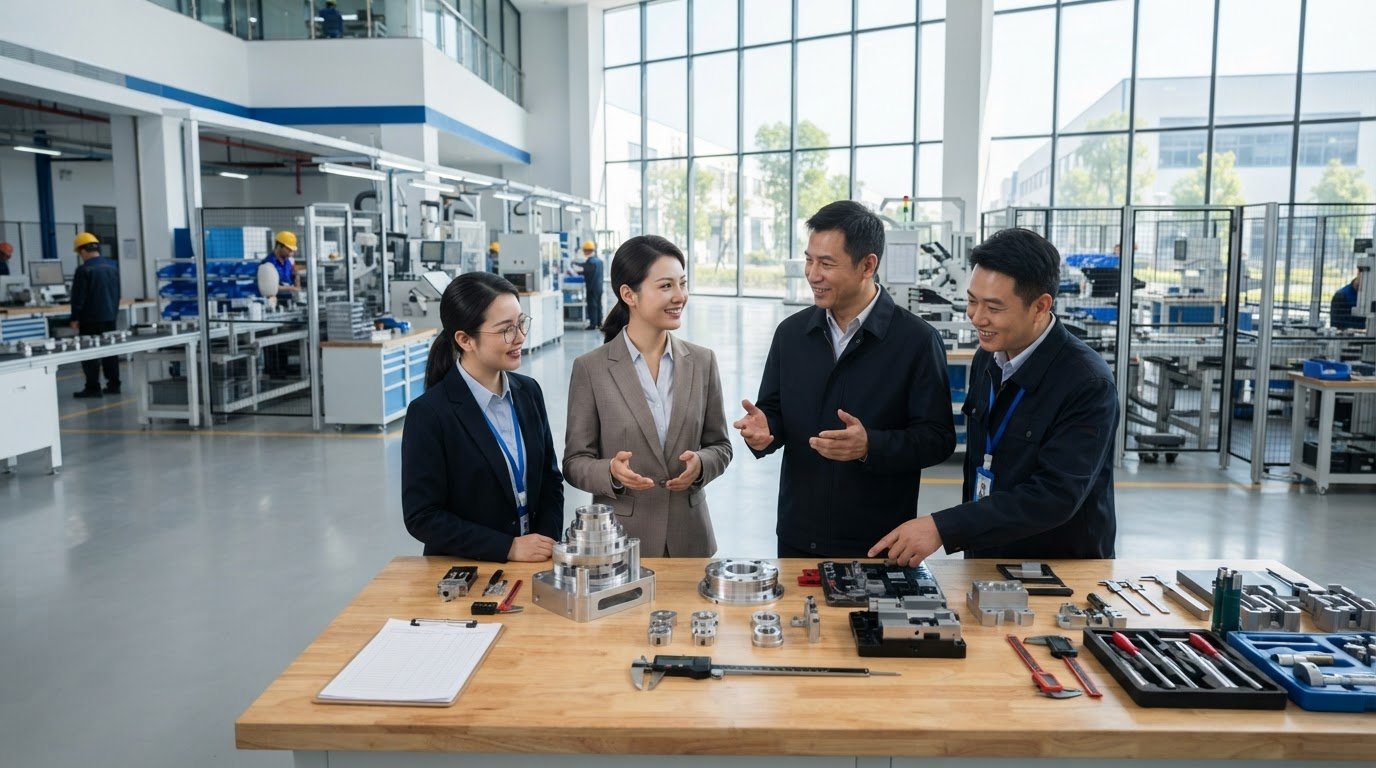
What if your signed OEM agreement protects the product on paper but leaves the factory unclear about what to make, when to deliver it, or how quality will be judged? That gap is where an oem manufacturing agreement china project can lose control: responsibilities blur between buyer, sourcing interme...

What if the safest payment deal isn’t the one that delays the most cash, but the one that releases it only when progress is verifiable? Payment terms negotiation with Asian suppliers is about balancing your working capital with the supplier’s need for confidence, not simply pushing for a smaller dep...