


Relying on digital directories to find chinese manufacturers is no longer a viable strategy for brands that value their bottom line. In March 2026, exports of China's "new three" technologies reached $21.6 billion, yet many wholesalers still lose significant margins to opaque middlemen and hidden commissions. You've likely felt the anxiety of sending a deposit to a factory you've never visited, fearing that the final batch won't match your sample. It's a valid concern; the 2026 regulatory environment, including the new VAT Law and the April 1 removal of certain export tax rebates, has made the landscape more complex for those without a local presence.
We understand that you need more than just a supplier; you need a shield against production delays and reputational damage. This guide provides a professional roadmap to help you navigate these shifts, move past the traditional agent model, and secure direct factory relationships that protect your interests. We'll outline the exact steps to achieve direct pricing and consistent quality, from on-site vetting to the negotiation tactics that keep your production timelines simple, safe, and profitable.
• Identify the structural differences between OEM, ODM, and trading companies to ensure your supply chain matches your specific business model.
• Move beyond high-risk digital directories by leveraging specialized trade shows that provide direct access to verified chinese manufacturers.
• Implement a two-tier vetting process that combines rigorous document verification with technical capability assessments to eliminate sub-standard partners.
• Unlock factory-direct pricing by identifying hidden costs and negotiating contracts that prioritize quality over the lowest possible bid.
• Protect your investment through on-site quality inspections that bridge the gap between initial sampling and consistent mass production.
The landscape of production in China has shifted from low-cost assembly to a high-tech powerhouse. By March 2026, China's "new three" clean-energy exports reached $21.6 billion, marking a 70% year-on-year increase. This evolution means chinese manufacturers are now global leaders in precision and advanced materials, largely achieving the 70% domestic content goals set years ago. For you, this shift demands a more sophisticated approach to sourcing. You aren't just looking for a workshop; you're looking for a partner capable of meeting the strict 2026 VAT Law requirements and surviving the April 1, 2026, removal of specific export tax rebates. Understanding the structural differences between suppliers is the first step toward a simple, safe, and profitable supply chain.
Choosing between these models dictates your speed to market and your intellectual property control. OEM manufacturing is the standard for brands with proprietary designs. You provide the specifications, and the factory provides the capacity. This model offers the highest level of customization but requires a larger upfront investment in tooling and quality oversight. Conversely, understanding the ODM meaning is essential if you want to launch quickly using existing factory designs. While ODM reduces R&D costs, it often limits your ability to differentiate your product from competitors using the same base mold. For high-volume orders, the OEM model typically yields better long-term margins as you own the assets and can negotiate from a position of strength.
Digital platforms are saturated with trading companies masquerading as chinese manufacturers. These entities often use professional photography and stolen certifications to appear as the source. They exist to collect a margin, often adding 10% to 15% to your unit cost without providing on-site oversight or technical support. This lack of transparency is where most production delays and quality issues begin. When a problem occurs on the factory floor, a middleman will prioritize their relationship with the supplier over your delivery schedule. We believe 100% transparency is the only way to conduct business. By bypassing these opaque middlemen and establishing a direct line to the factory floor, you stop leaving money on the table and regain control over your production timelines. Our local presence acts as your shield, ensuring that the "China Price" you pay is the actual factory-direct cost, not a padded invoice designed to fund a third party's commission.
Digital platforms like Alibaba and Global Sources offer a convenient entry point, but they rarely tell the whole story. By 2026, most Chinese provinces have popularized online portals for company registration and remote identity verification. While this shortens application times, it also creates a digital veneer that can hide a supplier's true limitations. Relying solely on a "Verified" badge is a risk you shouldn't take; these are often paper-based audits that don't reflect real-time production capacity or labor compliance. To find the best chinese manufacturers, you must look where search engines can't reach.
High-volume buyers still prioritize specialized trade shows in Canton and Hong Kong. These events provide physical proof of a factory's existence and allow for immediate technical assessments. However, the most reliable partners are often "hidden gems" that don't advertise on global platforms because their capacity is already filled by long-term clients. Accessing these suppliers requires a local network and a physical presence. A dedicated sourcing team acts as a filter, identifying factories that prioritize quality over volume and safety over shortcuts. If you're ready to move beyond generic listings, you can reach out to our local team for a more targeted approach.
Bypass generic resellers by using technical, industry-specific keywords during your initial research. Instead of searching for "electronics," use terms related to specific components or certifications like "ISO 9001 injection molding." Analyze a supplier's export history to see if they've shipped to your region within the last 24 months; this indicates they understand your local compliance standards. Watch for red flags during the first contact. If a supplier provides vague answers about their technical process or refuses to share their business license, they're likely a middleman. Authentic chinese manufacturers will be transparent about their capabilities and their 2026 tax compliance status.
Hong Kong remains the strategic gateway for professional procurement. Many top-tier manufacturers maintain corporate offices here to provide clients with greater legal and financial stability. This structure offers a layer of protection that mainland-only entities often lack. Our sourcing and procurement expertise in Hong Kong bridges the gap between international expectations and mainland production realities. We provide the "boots-on-the-ground" presence necessary for real-time communication and physical oversight. This local presence ensures that your production timelines are respected and that any issues on the factory floor are resolved before the goods leave the province. It's a simple, safe, and profitable way to manage a complex global supply chain.
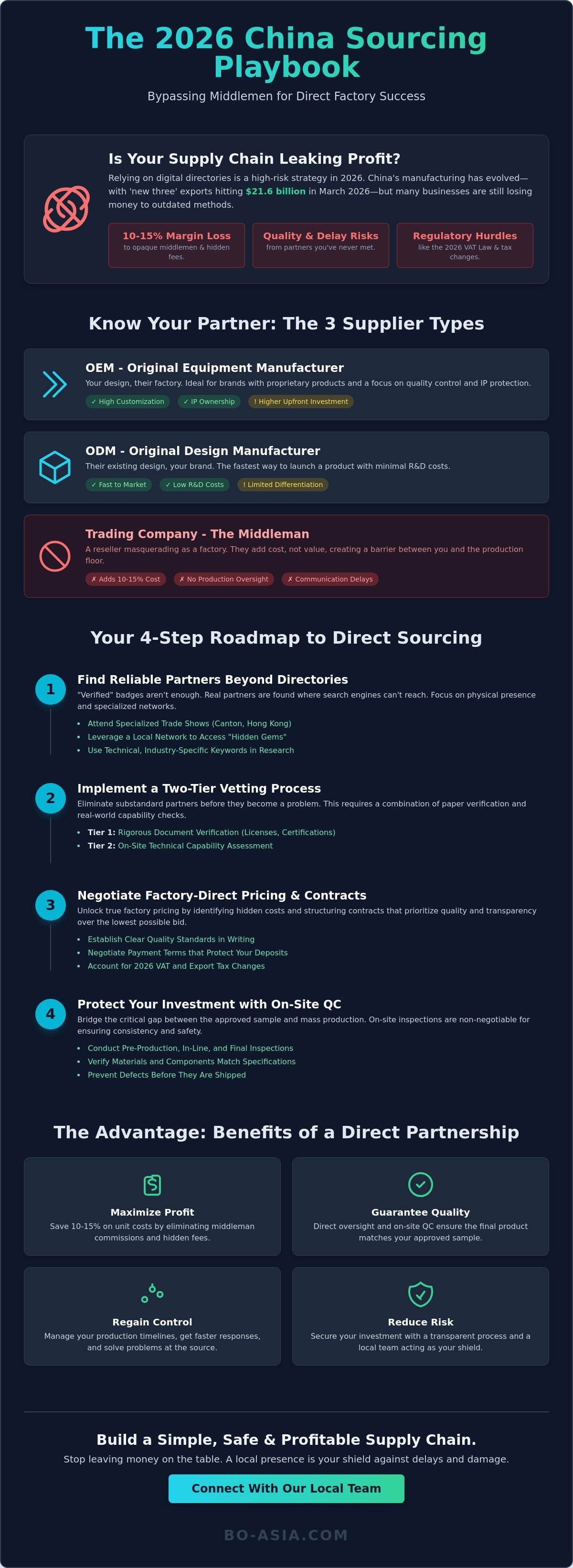
Vetting chinese manufacturers requires more than a cursory glance at a PDF. It's a rigorous, multi-stage process designed to protect your capital and your brand's reputation. Many buyers fall into the trap of the "golden sample," a hand-crafted prototype that bears little resemblance to the actual mass-produced goods. To avoid this, you must look beyond the surface. Professional vetting ensures that the factory you select has the technical capacity and the legal standing to deliver your order on time. Since the new Company Law took effect on July 1, 2024, and the formal VAT Law was implemented on January 1, 2026, verifying a supplier's compliance is now a critical step in risk management.
Follow this five-step roadmap to secure a reliable production partner:
Request the latest business license, ISO 9001 certifications, and export permits. Cross-reference these with the national credit information system to ensure they aren't on a blacklist.
Don't take their word for it. Review their equipment list and ask for a detailed production flow chart for your specific product type.
You need eyes on the ground. A physical visit confirms the factory actually exists and isn't just a small office sub-contracting your work to unverified workshops.
Utilize professional Sampling Support to bridge the gap between your design and the factory's output. This step identifies potential defects before you commit to a full production run.
Ask for contacts of existing clients in Western markets. A factory that refuses to provide references is a major red flag.
A professional audit goes deeper than a simple walkthrough. You should demand to see machinery maintenance logs dated within the last 30 days to ensure equipment isn't prone to failure. Inspect the raw material storage areas; damp or disorganized warehouses often lead to component degradation. Finally, assess the internal Quality Control (QC) department. A reliable factory should have a QC-to-worker ratio of at least 1:10, with documented "pass/fail" logs at every stage of the assembly line.
For modern wholesalers, ESG (Environmental, Social, and Governance) compliance is a commercial necessity. Western consumers and regulators now demand full supply chain transparency. During your vetting process, confirm the manufacturer holds valid environmental permits and adheres to the Labor Contract Law, which mandates standard 40-hour work weeks and specific overtime pay rates. Protecting your brand from the fallout of a supply chain scandal is far more cost-effective than trying to repair a damaged reputation later. By prioritizing ethical chinese manufacturers, you build a stable and sustainable business model.
Negotiating with chinese manufacturers is a high-stakes exercise in balance. You want the most competitive unit price, but pushing a factory too hard on cost often leads to "quality fade"—the gradual substitution of cheaper materials to maintain their margins. The "China Price" is a transparent calculation of raw materials, labor, and overhead. If a quote seems too good to be true, the factory is likely cutting corners in areas you can't see, such as waste management or labor compliance. In 2026, with the 13% standard VAT rate firmly established, professional buyers demand a full breakdown of costs to ensure they aren't paying for a middleman's hidden commission.
Your contract is your primary defense. A standard platform agreement isn't enough; you need a Manufacturing Agreement that's enforceable in a Chinese court. This document should mandate a 30% deposit to start production, with the remaining 70% balance paid only after a successful pre-shipment inspection. These "quality gates" ensure you never pay for sub-standard batches. Setting clear milestones protects your cash flow and keeps the manufacturer accountable to your timeline. If you want to secure these terms without the usual friction, contact our team to lead your next negotiation.
Negotiation is an art, but it's also a science. High-volume orders give you leverage, but only if you use it correctly. Don't accept the first quote you receive on a digital platform; it's almost always a "testing" price designed to see how much you're willing to pay. Negotiating in the local language is your greatest advantage. It allows you to build "Guanxi"—a level of mutual trust and respect that email translations can't replicate. When you speak the language of the factory owner, you're seen as a serious partner, not just another remote transaction. This relationship often yields better tooling costs and priority during peak production seasons.
IP security is non-negotiable for brands growing in 2026. Use a China-specific NNN (Non-Disclosure, Non-Use, Non-Circumvention) agreement instead of a generic Western NDA. These are designed to be enforceable within the local jurisdiction where chinese manufacturers operate. Register your trademarks in China before the first prototype is even built to prevent "squatting." Most importantly, ensure your contract explicitly states that you own all custom tooling. If you don't own the molds, the factory can hold your production hostage or sell your design to competitors. We act as your shield, ensuring your designs remain your assets and your brand stays protected.
Moving from a successful prototype to full-scale mass production is the most vulnerable phase of your supply chain. It's the moment where "quality fade" often takes hold. Many chinese manufacturers excel at creating a single "golden sample" but struggle to maintain that same standard across a run of 10,000 units. Without a dedicated sourcing team act as your eyes and ears on the factory floor, you're essentially flying blind. You need a physical presence to verify that the raw materials used in the final batch match the specifications of your initial sample.
Logistics coordination is equally critical to your bottom line in 2026. The updated tariff schedule, implemented on January 1, 2026, covers 8,972 product categories with specific provisional import rates. Any documentation error can lead to expensive port delays or customs holds that erode your margins. We manage the transition from the assembly line to the shipping container, ensuring that your goods are classified correctly and that all 2026 VAT compliance paperwork is airtight. This proactive oversight prevents the "reputational damage" caused by stockouts and late deliveries.
A robust quality control strategy relies on three distinct pillars to eliminate batch defects. First, a Pre-Production Inspection ensures raw materials meet your standards before the machines start. Second, a During Production (DUPRO) inspection happens when roughly 20% of the order is complete; this allows us to catch systemic errors early enough to fix them. Finally, a Final Random Inspection (FRI) is conducted before the balance payment is released. We utilize the AQL (Acceptable Quality Level) standard, a rigorous statistical tool that defines exactly how many minor or major defects are permissible before a batch is rejected. If a batch fails, we oversee the rework process on-site, ensuring the factory corrects the issues without you losing your deposit or your timeline.
Buying Office Asia is designed to act as your shield in a complex global market. We reject the traditional agent model because it thrives on opaque middlemen and hidden margins. Instead, we provide a European-managed team with local operations in Hong Kong and mainland China, offering you the same level of oversight that large corporations enjoy. Our philosophy is built on transparency and results. We identify the most reliable chinese manufacturers, negotiate the best factory-direct pricing, and manage the entire production cycle on your behalf. This approach makes your procurement process simple, safe, and profitable. You can see our recent cases and savings examples to understand how we've helped other brand owners stop leaving money on the table and secure their supply chains for the future.
Success in global trade now requires a shift from passive sourcing to active, on-site management. You've seen how the 2026 VAT Law and the removal of export rebates on April 1, 2026, have redefined the cost of doing business. Profitability depends on your ability to bypass opaque middlemen and establish direct, transparent relationships with chinese manufacturers. By implementing a rigorous vetting process and enforcing a "quality gate" payment structure, you protect your brand from the hidden margins and production delays that plague unmanaged supply chains.
Buying Office Asia stands as your protective partner in this landscape. Our European leadership and local Hong Kong presence ensure that your interests are represented with 100% transparency and rigorous on-site quality control. We don't just act as a bridge; we act as your dedicated sourcing team, dismantling the risks of remote procurement. It's time to stop leaving money on the table and start building a resilient, profitable production line. Take the first step toward a simple, safe, and profitable supply chain today.
Get Factory-Direct Pricing with Your Dedicated Sourcing Team and secure your manufacturing future.
You verify legitimacy by requesting a current business license and cross-referencing it with the National Credit Information Public System. Legitimate chinese manufacturers will also provide a 2026-compliant VAT invoice and possess a valid export license. Paper-based audits are insufficient; physical on-site verification is the only way to confirm a factory's technical capacity and legal standing in the current regulatory environment.
Buying on Alibaba is a common starting point, but it isn't inherently safe for high-volume orders. The "Verified Supplier" status often relies on third-party paper audits that don't reflect actual production quality or labor compliance. You face the risk of "quality fade" or dealing with middlemen who vanish after receiving a deposit. True safety requires an on-site presence to manage the production cycle directly.
A factory owns the production lines and machinery, while a trading company acts as a reseller that adds a 10% to 15% markup to your unit cost. Trading companies often masquerade as factories on digital platforms to secure orders. You can identify a real factory by checking their business license for "Manufacturing" scope rather than just "Sales" or "Trading" activities.
Professional sourcing teams typically charge a service fee based on the complexity of the project or a percentage of the total order value. You should avoid "free" agents, as they often collect hidden margins from the factory, which inflates your final price. A transparent fee structure ensures your interests are prioritized over the factory's commission, keeping your procurement simple, safe, and profitable.
You can negotiate directly, but your success depends on technical knowledge and local language skills. Factories prioritize clients who understand the "China Price" and the 2026 tax landscape. Negotiating in the local language builds "Guanxi," which can lead to better tooling costs and priority production slots. Without a local team, you're often given "testing" prices that leave money on the table.
A robust contract must include an NNN agreement, clear AQL quality standards, and defined payment milestones like a 30/70 split. It should also specify that you own all custom tooling and molds. To be effective, the agreement must be written in Chinese and enforceable in the local jurisdiction where the chinese manufacturers operate. Standard platform contracts rarely offer this level of protection.
You protect your designs by registering your trademarks in China before production begins and using a China-specific NNN agreement. These legal shields prevent manufacturers from "squatting" on your brand or selling your designs to competitors. Owning the physical molds and tooling is your final layer of defense. This prevents the factory from holding your production hostage or unauthorized reproduction of your assets.
The average lead time for mass production in 2026 is 30 to 45 days, depending on the industry and component availability. However, the surge in clean-energy exports in March 2026 has increased pressure on logistics hubs. You must factor in an additional 10 to 14 days for shipping and customs clearance to avoid stockouts. Proactive management of the production schedule is essential to meet these timelines.
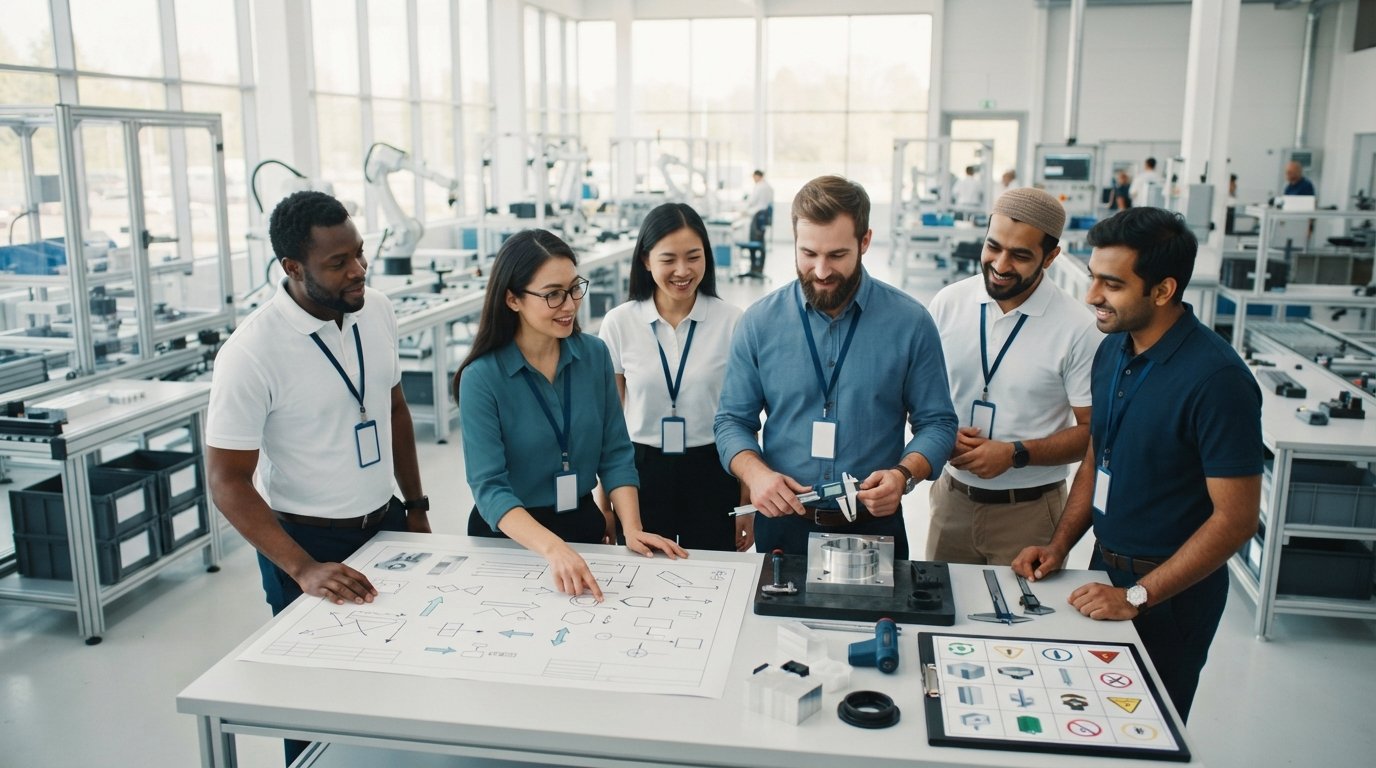
A technical drawing isn't just an engineering reference; it's your primary legal baseline against cost-driven supplier compromises. When sourcing abroad, vague manufacturing product specification sheets inevitably invite unauthorized material substitutions, delayed timelines, and sudden quotation in...

The traditional commission-based sourcing agent in India is no longer an asset; they're often your greatest financial risk in a market rapidly scaling toward a $2 trillion export target. You likely recognize the inherent conflict when an agent's income rises alongside your factory costs, or the anxi...

If your current sourcing agent claims their services are free, you're likely paying a hidden tax of 10% to 30% through inflated unit prices and factory kickbacks. This lack of transparency doesn't just erode your margins; it creates a dangerous barrier between you and the factory floor. Finding a re...