

The most reliable manufacturers in China don't list themselves on public directories like Alibaba or Global Sources. Finding the best China factories requires moving beyond digital storefronts and into the heart of regional industrial clusters where transparency is earned through physical presence. You've likely faced the anxiety of quality inconsistency during mass production or discovered that your primary contact is actually a middleman inflating your costs. These risks aren't just inconveniences; they're direct threats to your financial stability and brand reputation.
We understand that the current environment is complex, especially with the new Supply Chain Security regulations enacted in April 2026. You need a sourcing strategy that balances Western compliance with China's evolving legal framework. This article teaches you how to identify, vet, and secure partnerships with top-tier manufacturers that remain hidden from the public eye. You'll learn the exact protocols for factory-direct price negotiations and on-site oversight. We'll show you how to build a transparent supply chain that delivers consistent quality, even as export VAT rebates for specific categories like solar and batteries face significant reductions through 2027.
• Identify manufacturers based on technical engineering capabilities rather than paid "Gold Supplier" marketing badges found on B2B platforms.
• Access the best China factories that stay hidden from public directories by leveraging a dedicated procurement team with a regional presence.
• Eliminate the 15% to 25% hidden cost increases typical of unmanaged supply chains through direct factory negotiations and transparent pricing.
• Implement a rigorous two-part audit protocol that verifies business legitimacy and technical machinery standards before you sign a contract.
• Shift from simple transactional sourcing to a managed partnership model that ensures consistent quality across high-volume mass production.
The search for the best China factories often begins on B2B directories, yet these platforms rarely showcase the elite tier of manufacturers. For a professional procurement strategy, "best" isn't a static ranking. It's a precise alignment between a factory's technical capabilities and your specific requirements for quality, volume, and regulatory compliance. Many businesses mistake a "Gold Supplier" badge for a verified endorsement. In reality, these are paid marketing features. They don't guarantee that the facility exists as described or that it possesses the engineering depth required for complex production.
One of the most significant risks in unmanaged sourcing is "Quality Fade." This is a documented phenomenon where initial samples meet every specification, but quality steadily degrades during mass production as the factory swaps materials to protect their margins. Elite manufacturers, often referred to as the "Hidden Layer," don't participate in this race to the bottom. These factories don't need to advertise on Alibaba because their capacity is fully booked by long-term OEM partners who value stability over the lowest possible unit price.
Digital verification has strict limitations. Trading companies frequently pose as factories by using professional photography and sophisticated storefronts to capture Western leads. They act as intermediaries, adding a layer of cost while obscuring your visibility into the actual production floor. This lack of transparency makes it impossible to verify working conditions or technical workflows. The most sophisticated factories prioritize custom product development and long-term partnerships. They aren't interested in the transactional, low-margin inquiries that dominate public directories.
China's industrial landscape has evolved. For a comprehensive overview of China's industrial sector, one can see a clear transition toward "Manufacturing 2.0." This era is defined by automation, high-precision robotics, and significant R&D investment. In 2026, "cheap" is no longer the primary metric for identifying the best China factories. You're looking for a partner that offers financial viability through operational efficiency rather than one that cuts corners on raw materials. Finding a partner means securing a manufacturer that functions as an extension of your own team, providing the transparency and technical rigor necessary for high-volume success.
Distinguishing the best China factories from mid-market competitors requires a structured evaluation of five core pillars. It isn't enough to look at machinery; you must assess the management philosophy and technical depth that drive the production floor. Tier-1 manufacturers operate as strategic partners rather than mere vendors, providing the stability needed for long-term growth. They possess the infrastructure to manage risk and the engineering talent to solve complex production hurdles before they impact your bottom line.
To secure a reliable supply chain, focus on these five critical attributes:
The manufacturer must have the in-house capability to support custom product development and technical troubleshooting.
Professional factories use data-driven quality systems that go far beyond a basic ISO 9001 certificate.
Your partner must demonstrate the capital and floor space required for high-volume sourcing without operational collapse.
Modern brands require strict adherence to environmental and social governance to protect their market standing.
You need direct access to production data and honest communication to eliminate the "black box" of international manufacturing.
Evaluate whether a factory maintains an internal tooling shop or relies on outsourced components. Internal tooling allows for tighter tolerances and faster iterations during the sampling phase. Automation also plays a decisive role in maintaining consistency across mass production batches, reducing the human error associated with manual assembly. A Tier-1 factory is defined as one that invests at least 5% of its annual revenue back into R&D. This commitment ensures they remain competitive as global standards for precision and efficiency evolve. If you're unsure where to start your technical evaluation, you can consult the U.S. government guide to doing business in China for baseline regulatory expectations.
Adhering to ESG standards is now a prerequisite for Western market entry, especially with the increased regulatory scrutiny seen in early 2026. You must look past "greenwashing" in factory brochures. During a visit, check for actual waste management protocols and energy-efficient machinery rather than just marketing slogans. Ethical manufacturing doesn't just protect your brand from legal liability; it increases your company's long-term valuation by building a resilient, defensible supply chain. If you need assistance verifying these complex standards on the ground, our team can provide the necessary oversight.
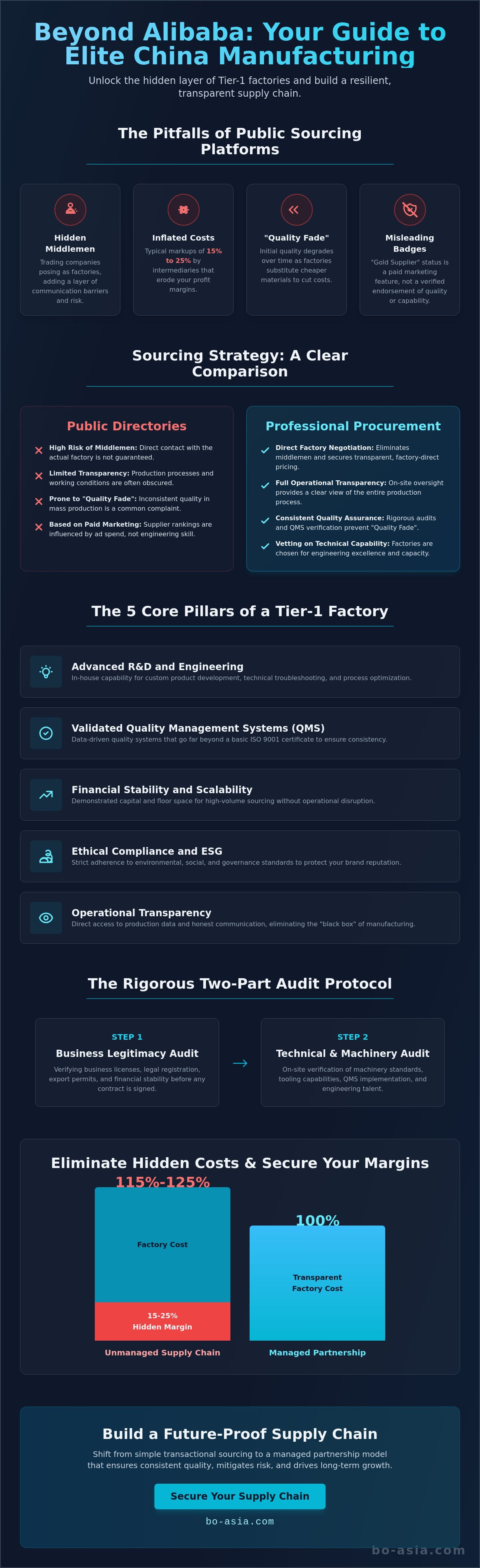
The decision between a "Do-It-Yourself" approach and professional procurement determines the long-term financial health of your supply chain. While public directories offer the illusion of easy access, they often lead to unmanaged supply chains that suffer from a 15% to 25% increase in hidden costs. These expenses manifest through quality defects, shipping delays, and the administrative burden of managing overseas disputes. To access the best China factories, you must penetrate the "Hidden Layer" of manufacturing. These elite facilities don't advertise on B2B platforms because they operate at capacity for major global brands that require strict technical and ethical adherence.
Relying on a dedicated Asia procurement team transforms your operation from a series of risky transactions into a managed strategic asset. A common objection is whether a procurement office is simply another middleman. The distinction lies in transparency. Traditional intermediaries often obscure their margins within the unit price. A professional procurement partner operates as an integrated extension of your own team, providing 100% visibility into the factory's true costs and operational capabilities. This defensive layer protects your brand from the volatility of unmanaged sourcing.
Many "free" sourcing agents or low-cost intermediaries generate their revenue through undisclosed kickbacks from the factory. This conflict of interest means they'll prioritize the factory's profit over your product quality. Our model rejects this inefficiency. We focus on factory-direct price negotiations where every dollar is accounted for. Professional procurement fees aren't an additional cost; they're a strategic investment in risk mitigation. By eliminating hidden commissions and securing true market pricing, you often see a net reduction in landed costs while simultaneously improving product consistency.
In the Chinese manufacturing sector, "Face" culture and physical proximity dictate your order's priority level. When a factory knows a representative can be on-site within hours, their accountability increases. This on-the-ground presence allows for real-time problem solving. We identify and fix production issues on the factory floor before the goods ever reach the port. This proactive oversight is only possible through a synergy of European leadership and local Asian operational expertise. You don't just need a contact; you need a stabilizer that bridges the cultural and operational gap to ensure the best China factories deliver exactly what was promised.
Professional vetting is a sequential process designed to eliminate risk before capital is committed. While a business license confirms a factory exists legally, it doesn't guarantee they possess the operational rigor to be classified among the best China factories. You need a defensive vetting strategy that moves from digital verification to physical, technical validation. This protocol ensures that your manufacturing partner is capable of maintaining quality across high volumes while adhering to the complex regulatory landscape of 2026.
A comprehensive audit follows these five critical stages:
We verify business licenses, export rights, and litigation history to identify red flags before any on-site investment occurs.
A physical inspection of machinery and quality control protocols to confirm the factory's stated capabilities.
Verification of compliance with international labor standards and the new environmental regulations enacted in early 2026.
An evaluation of the factory's liquidity to ensure they can procure raw materials for your specific order without delays.
A final technical gate where we test the factory's ability to translate your exact specifications into a physical product.
The production floor is where true capability is revealed. We examine the Incoming Quality Control (IQC) logs to ensure raw materials are inspected before they enter the line. We also evaluate "In-Process" quality control (IPQC) at every workstation to prevent defects from compounding. A professional auditor should spend 70% of their time on the production line, not in the office. This hands-on approach allows us to verify that the best China factories actually follow the workflows they claim on paper.
Factories often inflate their production capacity to win high-volume contracts. We calculate "True Capacity" by analyzing machine uptime and labor shifts to prevent unauthorized sub-contracting, which is the primary cause of quality fade. Reviewing the factory's client portfolio is equally vital. If they don't currently work with brands of your caliber, they may lack the sophisticated management systems you require. We also scrutinize production schedules for potential bottlenecks that could lead to shipping delays during peak seasons. If you want to secure your supply chain with a verified Tier-1 manufacturer, contact our procurement team to schedule a formal audit.
Securing a contract with one of the best China factories is a significant milestone, but it's not the finish line. The most critical phase of procurement begins after the deposit is paid. Without continuous management, even elite manufacturers can succumb to operational drift or prioritize other high-volume clients over your specific needs. Transitioning from "finding" a supplier to "managing" a partnership requires a permanent, on-the-ground presence that can enforce your standards in real-time. This is where the Buying Office Asia (BOA) framework provides a definitive defensive advantage for your business.
Our dual-presence model bridges the cultural and operational gap that often leads to communication breakdowns. With leadership based in Helsinki and an operational engine in Hong Kong, we provide the strategic clarity of a European consultancy paired with the regional muscle of a local procurement team. This structure allows us to maintain mass production oversight that third-party agents simply cannot match. In several documented cases, our strategic sourcing and direct negotiation protocols have helped clients achieve savings exceeding 20% by removing the hidden margins typical of unmanaged intermediaries.
We don't function as a third-party intermediary; we act as an integrated extension of your own team. This model ensures that our interests are perfectly aligned with your financial health and brand reputation. You gain the benefits of a dedicated Asia procurement office without the overhead of managing foreign entities yourself. Our European leadership ensures that complex technical requirements and ESG standards are communicated with absolute precision. Getting started requires a commitment to a professional supplier vetting process that prioritizes long-term stability over short-term price wins.
The manufacturing landscape in 2026 is more complex than ever. With new supply chain security laws and shifting export VAT rebates, professionalizing your Asian supply chain isn't just an option, it's a necessity for survival. The best China factories are looking for partners who bring transparency and technical rigor to the table. By building a vetted, transparent factory network today, you're securing the future valuation of your brand. Contact Buying Office Asia to discuss how our on-the-ground expertise can stabilize your production and protect your margins in this evolving market.
Navigating the complexities of global trade in 2026 requires more than a digital search; it demands a defensive, on-the-ground strategy. You've seen how the "hidden layer" of the best China factories remains invisible to public directories, accessible only through regional presence and rigorous technical vetting. By implementing a multi-stage audit protocol and prioritizing engineering depth over paid marketing badges, you protect your brand from quality fade and unforeseen operational risks. The shift toward high-value, automated manufacturing means your choice of partner will define your company's financial viability for years to come.
Buying Office Asia provides the stabilization your supply chain needs. Our model combines European leadership in Helsinki with an elite procurement engine in Hong Kong. We offer 100% transparency with zero hidden commissions, backed by decades of experience in high-volume sourcing and complex product development. This integrated approach ensures that your production remains efficient, compliant, and consistently high-quality. It's time to move away from transactional sourcing and toward a secure, managed partnership that grows with your business.
Secure your manufacturing future with a professional Asia procurement team.
You can identify a trading company by examining their business license for the "Scope of Business" section. Genuine manufacturers list "production" or "processing" as their primary activity, while traders focus on "wholesale" or "distribution." Additionally, trading companies often showcase a broad range of unrelated products. The best China factories are typically specialized and can demonstrate deep technical knowledge of a specific production process during a live video audit.
In 2026, certifications must go beyond ISO 9001 to include social and environmental validation. You should prioritize factories with SA8000 or SEDEX certifications to ensure compliance with modern ESG standards. It's also vital to verify their adherence to the April 2026 Supply Chain Security regulations. These laws require manufacturers to prove their operations don't conflict with national interests, which is a prerequisite for a defensible supply chain.
Public directories like Alibaba primarily attract trading companies and smaller manufacturers looking for one-off transactions. While you can find vendors there, the Tier-1 elite manufacturers usually avoid these platforms to protect their production capacity for long-term OEM partners. Accessing these premium facilities requires a professional procurement network that operates within China's regional industrial clusters rather than relying on paid digital rankings.
The cost of a professional audit depends on the complexity of the production line and the depth of the inspection required. A preliminary desktop audit is less intensive than a full on-site technical and social compliance audit. Since every manufacturing project has unique requirements, you should view auditing as a necessary risk mitigation investment rather than a fixed administrative expense that fits a single price point.
Quality fade is a strategic, gradual reduction in material quality used by some factories to protect their profit margins over time. It often begins after the first few successful batches when Western oversight decreases. Preventing this requires continuous, on-site quality control inspections and mass production oversight to ensure that the best China factories maintain the standards established during the sampling phase without unauthorized material substitutions.
Protecting your IP is possible through a combination of legal and operational defenses. You should use NNN agreements that are enforceable in Chinese courts rather than relying on Western contracts that have no local jurisdiction. The revised Foreign Trade Law, effective March 1, 2026, provides updated frameworks for intellectual property protection. Pairing these legal tools with a trusted procurement partner on the ground minimizes the risk of unauthorized design replication.
We ensure factory-direct pricing by removing the hidden commissions that standard sourcing agents often build into the unit cost. Our team conducts negotiations directly with factory management using real-time data on labor costs and raw material prices. This transparent approach ensures you receive the true market rate. By operating as an extension of your team, we provide 100% visibility into the financial structure of your supply chain.
OEM manufacturing involves producing a product based on your specific design and technical requirements. In contrast, ODM manufacturing allows you to select a factory's pre-existing design and apply your branding. OEM is the preferred route for unique, custom product development where you own the tooling and intellectual property. ODM is generally faster for standard market goods but offers less control over the product's unique specifications.

What if the first clear sign of a production problem arrives after the goods are packed? Manufacturing risk management in Asia works best when controls are connected from the start, not left to a final inspection or occasional supplier update. You need visibility into factory activity, early warning...

What if the lowest unit quote isn’t the lowest-cost way to make your board game? Board game manufacturing costs depend on more than the number of boxes ordered. Component materials, custom tooling, assembly, packaging and delivery scope can all change what a quote covers, making headline prices diff...

What if the factory’s lowest quote isn’t the lowest-cost option? A lower unit price can hide differences in materials, tooling, packaging, quality checks or production terms. Understanding how sourcing agents negotiate factory prices starts with making those differences visible, not simply asking a...