


Your current production delay isn't a seasonal accident; it's a systemic failure of visibility in a year where the Strait of Hormuz blockade has rewritten the rules of global trade. If you're struggling with how to handle production delays from Asian factories, you're likely facing the fallout of an early June peak season that has pushed freight rates and port congestion to critical levels. The margin for error has vanished, leaving many businesses vulnerable to missed retail windows and evaporating revenue.
It's frustrating to manage the silence of a supplier who won't admit their sub-suppliers have run out of raw materials or that regional power shifts are stalling the line. You need a strategy that replaces guesswork with calm assurance. This guide provides the frameworks and on-the-ground tactics required to reclaim control over your manufacturing timeline and protect your financial health.
We'll examine how to implement direct factory oversight and navigate the complexities of the 2026 trade landscape. By the end of this briefing, you'll have the tools to build a resilient supply chain that offers real-time visibility and predictable delivery schedules, even in a volatile market.
• Identify the true duration of a delay by measuring the delta between your Proforma Invoice and the actual Bill of Lading.
• Learn how to handle production delays from Asian factories by auditing tier-2 and tier-3 sub-suppliers to uncover the hidden dependencies that stall production lines.
• Drastically reduce your "Time to Information" by replacing unmanaged sourcing platforms with a dedicated regional office that provides real-time visibility.
• Utilize tactical floor audits and split-shipment strategies to protect your revenue and secure inventory even when global logistics are under pressure.
• Discover why an integrated procurement team acts as a stabilizing force, protecting your brand from the volatility of raw material prices and regional power shifts.
To effectively manage your operations, you must first define what a delay actually is. In the context of supply chain management, a production delay is the delta between the date on your Proforma Invoice (PI) and the actual date on the Bill of Lading (BOL). This gap represents lost time that directly impacts your bottom line. Understanding how to handle production delays from Asian factories requires acknowledging the "ripple effect." A single week of lost production often translates into a three-week shipping delay because you miss your vessel window, leading to port congestion or expensive airfreight requirements.
This dynamic creates what we call the Asian Manufacturing Paradox. The region offers world-class efficiency and scale, yet it often operates with remarkably low transparency for the end buyer. When you aren't physically present, you're essentially flying blind, relying on data that may be outdated or intentionally obscured to protect the factory's reputation.
Many importers focus solely on the Lunar New Year (CNY) cycle. While CNY is predictable, it's often misunderstood. The disruption isn't seven days; it's a 40-day cycle of labor migration that drains factories of skilled workers weeks before and after the holiday. You must also monitor regional holidays like Thailand's Songkran or India's Diwali, which can halt production just as effectively. However, 2026 has introduced unpredictable variables that require a different level of oversight. The conflict in Iran and the blockade of the Strait of Hormuz have created a volatile environment where energy prices and raw material shortages occur without warning. Local power rationing and environmental compliance shutdowns in China further complicate schedules, often with only 24 hours of notice.
The lack of transparency in unmanaged supply chains is often rooted in a "saving face" culture. Factory managers may hesitate to report a problem until it's too late to fix. They often provide a "yes-man" response to your inquiries to maintain the appearance of progress. Relying on digital-only communication through email or WeChat is a significant risk. These tools fail to reveal physical bottlenecks on the factory floor, such as broken tooling or sub-supplier failures. Real visibility requires an integrated approach to sourcing and procurement that places eyes on the ground to verify every claim made by the factory floor.
When a factory manager reports a delay, they rarely provide the full technical picture. Most production stalls don't originate on the main assembly line but rather deep within the sub-supplier network. Professional managers who know how to handle production delays from Asian factories look deeper than the primary assembly line. They recognize that their factory is often just a final assembly point for components sourced from dozens of tier-2 and tier-3 suppliers. If a specialized packaging provider or a tooling shop fails to deliver a minor component, your entire project grinds to a halt.
This dependency is compounded by "Capacity Crowding." In a high-demand market, factories often sideline smaller independent orders to accommodate sudden rush requests from tier-1 global retailers. Without physical oversight, you won't realize your order has been bumped until the shipping deadline has already passed. Protecting your production slot requires more than a contract; it requires a consistent regional presence that signals your order is a priority.
Your factory's reliability is only as strong as its weakest sub-supplier. Common bottlenecks include specialized plastic resins, custom electronics, or even specific dyes for textiles. In June 2026, the blockade of the Strait of Hormuz has significantly disrupted the flow of these critical raw materials, causing a "pause" in production as factories wait for component prices to stabilize. Effective supplier vetting must extend beyond the main facility to include these sub-tier partners. If you don't know who is providing your factory's raw materials, you don't truly control your lead times.
The regulatory environment in 2026 has introduced new layers of complexity. China's State Council released Decree 837 on June 1, 2026, which allows for rapid adjustments in trade and investment policies. These shifts, combined with environmental "Blue Sky" initiatives, can lead to sudden, temporary factory closures in high-energy sectors. Additionally, regional manufacturing performance is diverging; while Vietnam's PMI rose to 52.8 in May 2026, Malaysia's fell to 49.9, indicating a contraction that often precedes labor shortages and missed deadlines. Building resilient supply chains in Asia requires monitoring these macro-economic indicators in real-time. If these variables are impacting your current timelines, you might find it beneficial to discuss a managed procurement strategy with our regional experts.
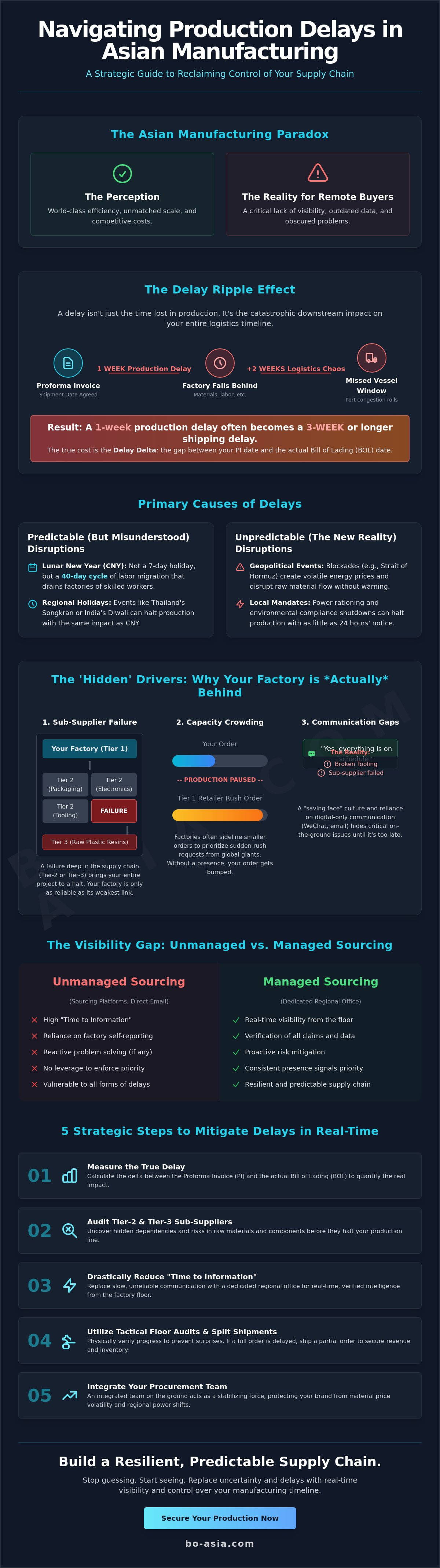
Most independent importers rely on what we call the "Alibaba Approach." This unmanaged model involves sourcing directly through digital platforms and managing the relationship via email or messaging apps. While this method seems cost-effective initially, it lacks the structural defenses needed when production schedules slip. A professional approach to how to handle production delays from Asian factories requires moving beyond transactional interactions and toward a managed office model. This shift effectively turns your procurement function from a series of external requests into an integrated extension of your own team.
The primary advantage of a managed model is the "Leverage Gap." A factory is more likely to prioritize a professional procurement firm that manages high-volume accounts over a single buyer with a one-off order. When we conduct factory direct price negotiations, we don't just talk about unit costs. We build lead-time penalties into the contract structure. This financial accountability ensures the factory has a tangible incentive to keep your goods moving through the line. Without these contractual safeguards, your order is always at risk of being sidelined for a larger client.
In an unmanaged setup, you typically find out about a delay on the day the goods were supposed to ship. This "information lag" leaves you with no options other than accepting the delay or paying for expensive air freight to save your retail window. Conversely, a managed office uses on-site inspectors to verify production status weeks before the deadline. These inspectors can identify raw material shortages or sub-supplier failures 21 days before production even begins. This early detection is critical; identifying a bottleneck three weeks in advance allows you to re-route logistics or adjust marketing schedules, which can reduce emergency air-freight costs by as much as 80%.
A dedicated Asia procurement team provides a psychological and operational advantage that digital tools cannot replicate. When a local office calls a factory manager in their own language, it signals a level of oversight and accountability that an overseas email simply doesn't carry. This regional presence is a cornerstone of effective risk management. According to the Asia-Pacific supply chain risk report, continuous monitoring and real-time risk profiling are essential for maintaining business continuity in volatile markets. Factories naturally prioritize clients who have "eyes on the ground," as they know their performance is being documented and measured in real-time. If you're currently facing silence from your supplier, it's time to consider the security of a managed regional presence.
Planning for disruptions is a baseline requirement, but knowing how to handle production delays from Asian factories when they are already in progress requires a shift from passive observation to aggressive triage. When your goods are stuck on the factory floor, you don't have the luxury of waiting for the next quarterly review. You need a stabilizing force that can enter the facility, identify the bottleneck, and implement a recovery plan within 48 hours. The goal is to minimize the financial delta between your projected revenue and the reality of a late delivery.
The first step is a physical audit of the production floor. If you lack on-site staff, you must request a "Video Production Audit." This isn't a recorded clip; it's a live, unscripted walkthrough of your specific production line to verify the actual stage of assembly. Once you have verified the status, implement a "Split Shipment" strategy. If 30% of your order is finished, move it immediately. While this increases per-unit shipping costs, the ROI of keeping your inventory alive on retail shelves far outweighs the cost of a total stock-out. Production Triage is the prioritization of high-velocity SKUs to maintain market presence while the remainder of the order is finalized.
In June 2026, with Shanghai to New York rates exceeding $5,500 per container and the Strait of Hormuz blockade causing persistent volatility, your logistics must be agile. Use professional logistics management to re-route delayed goods from congested sea lanes to sea-air or rail options where possible. For future cycles, you should implement a "Penalty-Bonus" framework. Reward your factory for early delivery and enforce financial penalties for unexcused delays. This aligns the factory's financial health with your own.
Finally, your OEM manufacturing contracts must evolve. Ensure your "Force Majeure" clauses are specific to 2026 risks, such as regional power rationing or sudden regulatory shifts. Diversification via a "China + 1" strategy is no longer optional. By adding a secondary base in ASEAN countries, where the Manufacturing PMI rose to 51.5 in May 2026, you create a safety valve for your supply chain. If your current supplier is failing to meet deadlines, reach out to our regional experts to secure your 2026 production schedule.
The ultimate strategy for how to handle production delays from Asian factories is to move beyond transactional relationships and toward a model of operational excellence. While digital platforms and third-party agents provide a surface-level connection, they often lack the accountability required to protect your financial interests during a crisis. Buying Office Asia (BOA) functions as a stabilizing force, acting as an integrated extension of your own team. By combining European strategic leadership with Hong Kong's operational expertise, we provide the regional presence you need to secure your supply chain in a volatile 2026 market.
This partnership shifts your focus from reactive crisis management to proactive oversight. When you have a dedicated team managing your high-volume sourcing and procurement, you aren't just another order number in a factory's database. You are a managed priority with a physical representative capable of identifying risks before they manifest as missed retail windows.
Traditional sourcing agents frequently operate on a hidden commission model, which creates a conflict of interest. If an agent's income is tied to the transaction volume, they have a financial incentive to downplay production risks or hide delays to ensure the deal proceeds. BOA rejects this intermediary model in favor of 100% transparency. Our fee structure is clear and decoupled from factory markups, ensuring that our loyalty remains entirely with you. This direct access allows you to see the true state of your production and the actual costs involved. You can review our pricing and savings examples to understand how this transparent approach optimizes your procurement budget while eliminating the obscured costs typical of unmanaged sourcing.
Physical proximity is the only true defense against the operational setbacks that affect unmanaged supply chains. Our team provides consistent mass production oversight and on-site quality control, ensuring that your specifications are met at every stage of the cycle. We handle the difficult conversations with factory owners on your behalf, using our regional networks to resolve bottlenecks that would otherwise stall your order. In a year where Malaysia's manufacturing PMI fell to 49.9 in May 2026 while Vietnam's rose to 52.8, having a team that understands these regional nuances is critical for resource allocation. We don't just report a delay; we dismantle the cause and implement a recovery plan. Request a consultation to audit your current Asian production schedule and secure your delivery timeline for the remainder of 2026.
Mastering how to handle production delays from Asian factories requires a fundamental shift from reactive crisis management to proactive, on-site oversight. The 2026 trade landscape, defined by raw material volatility and logistics bottlenecks, makes physical proximity a non-negotiable requirement for operational stability. By replacing unmanaged digital platforms with a dedicated regional office, you eliminate the information lag that currently threatens your retail windows and revenue.
Buying Office Asia provides the steady confidence of a seasoned insider. With our European-managed team on the ground in Hong Kong, we offer a robust defense against the risks of unmanaged sourcing. We operate with 100% transparency and zero hidden middlemen commissions, focusing entirely on your financial viability and high-volume OEM/ODM oversight. It is time to move toward a more resilient and predictable supply chain that supports your long-term growth.
Secure your 2026 production schedule with Buying Office Asia today and transform your manufacturing into a source of competitive advantage. Your business deserves the security of an expert ally.
The most common cause of production delays in China is the failure of tier-2 and tier-3 sub-suppliers to deliver components on time. While your primary factory manages the assembly, they rely on a network of providers for specialized tooling, packaging, and raw materials. If you are researching how to handle production delays from Asian factories, you must look beyond the assembly line. Disruptions in these lower tiers often go unreported until the shipping deadline passes.
Factories typically close for a formal 7 to 10 day period, but the actual disruption lasts roughly 40 days. In 2026, workers begin migrating back to their home provinces weeks before the holiday, leading to reduced capacity. After the holiday, factories face low worker retention rates and must train new staff. This cycle creates a significant bottleneck that requires you to finalize your production schedules at least three months in advance.
Suing a factory is technically possible but rarely provides a timely or cost-effective resolution for independent businesses. Litigation in local courts is expensive and time-consuming. A more effective strategy is to build lead-time penalties directly into your contract. By establishing financial consequences for unexcused delays during the negotiation phase, you create a tangible incentive for the factory to prioritize your order over unmanaged accounts.
Maintaining three to four months of safety stock is the recommended baseline for 2026. This buffer accounts for the ripple effect where a minor production stall missing a vessel window results in a multi-week delay. Given the current volatility in shipping lanes and regional power shifts, relying on just-in-time inventory models is hazardous. A robust safety stock ensures your retail presence remains uninterrupted while you resolve manufacturing bottlenecks on the ground.
A Hong Kong-based sourcing company provides a critical defensive layer through physical proximity and regional expertise. Being in the same time zone and culture allows for immediate intervention when production issues arise. This presence eliminates the information lag typical of overseas management. Additionally, Hong Kong offers a familiar legal and financial framework that bridges the gap between Western business standards and mainland manufacturing operations, providing a stabilizing force for your procurement.
You can verify a factory's claims by requesting a live, unscripted video audit of your specific production line. If the factory hesitates or provides generic footage, it's a strong indicator of a hidden delay. The most reliable method is an unannounced on-site inspection. Having a dedicated team on the ground allows you to see the physical status of your goods, ensuring that saving face culture doesn't obscure the truth.
The decision depends on your inventory velocity and the cost of a stock-out. When production is late, the most efficient approach is often a split shipment. You can air freight a small percentage of high-velocity SKUs to maintain your retail window while the bulk of the order follows via sea freight. This strategy balances the high cost of air transport with the need to protect your brand's market presence and revenue.
A sourcing agent typically operates as a transactional intermediary on a commission basis, which can lead to obscured costs. A procurement office acts as an integrated extension of your own team with a transparent fee structure. This model aligns their interests entirely with yours. If you are learning how to handle production delays from Asian factories, you'll find that a procurement office provides the mass production oversight and accountability that a standard agent lacks.

What if the first clear sign of a production problem arrives after the goods are packed? Manufacturing risk management in Asia works best when controls are connected from the start, not left to a final inspection or occasional supplier update. You need visibility into factory activity, early warning...

What if the lowest unit quote isn’t the lowest-cost way to make your board game? Board game manufacturing costs depend on more than the number of boxes ordered. Component materials, custom tooling, assembly, packaging and delivery scope can all change what a quote covers, making headline prices diff...

What if the factory’s lowest quote isn’t the lowest-cost option? A lower unit price can hide differences in materials, tooling, packaging, quality checks or production terms. Understanding how sourcing agents negotiate factory prices starts with making those differences visible, not simply asking a...