


The lowest quote you receive from a Chinese factory is often the most expensive mistake your business will ever make. You likely already know the frustration of seeing your margins vanish due to sudden lead-time increases or the middleman markup that obscures true production costs. It's exhausting to manage the quality fade that frequently follows a successful first batch. You need more than just a contact list; you need a strategic defense against the operational risks that plague unmanaged supply chains.
In this guide, you'll master how to negotiate with Chinese suppliers using a professional framework built for the 2026 regulatory environment. We'll show you how to protect your profitability while ensuring product integrity from the factory floor to your warehouse. We'll examine the impact of State Council Order No. 834 on your procurement strategy and provide a step-by-step methodology for securing ironclad quality agreements and transparent, factory-direct pricing that eliminates hidden fees once and for all.
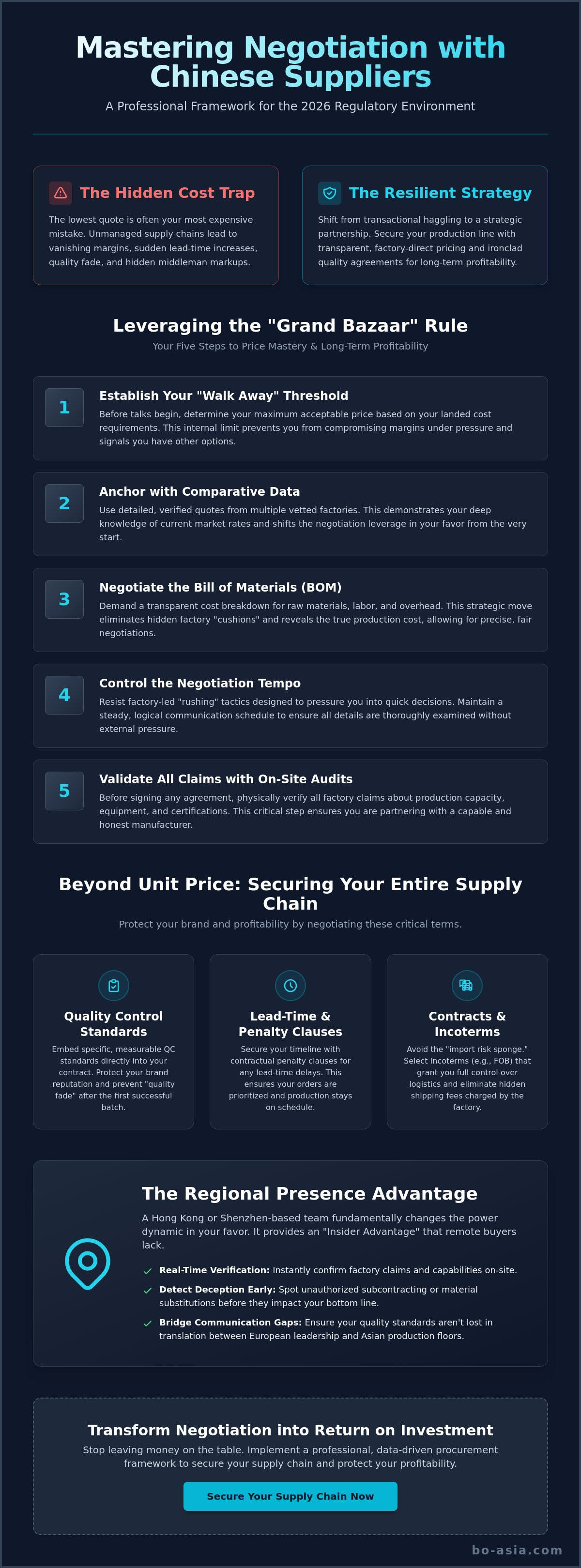
• Transition from transactional haggling to a resilient manufacturing strategy that aligns with 2026 industrial security regulations.
• Establish firm walk-away thresholds and use comparative data from vetted factories to secure predictable pricing.
• Secure your brand reputation by embedding quality control standards and penalty clauses for lead-time delays into your contracts.
• Master how to negotiate with Chinese suppliers by selecting Incoterms that grant you full control over logistics and eliminate hidden shipping fees.
• Maximize your return on investment by shifting from opaque middleman markups to a transparent, factory-direct procurement framework.
The manufacturing environment of 2026 demands a departure from traditional price-haggling. Successful procurement now requires a framework of strategic alignment rather than a one-off transaction. To understand how to negotiate with Chinese suppliers effectively, you must view the process as an end-to-end integration of your supply chain. The priority has shifted from "lowest cost at all costs" to "resilient manufacturing." This change is driven by the need for security in a market where regulatory shifts, such as State Council Order No. 834, can disrupt production without warning. You aren't just buying a product; you're securing a production line.
Leading international brands now rely on European-led oversight based in Hong Kong to manage these complexities. This model provides a stabilizing force, ensuring that 100% transparency is maintained from the first meeting. By eliminating hidden middleman fees during initial talks, you protect your margins and establish a foundation of trust that traditional intermediaries often obscure. This level of professional rigor is the only way to ensure financial viability in a complex global market.
In 2026, relying on basic Alibaba-style RFQs is a significant risk. These platforms often lead to transactional relationships that lack the depth required for complex product development. A critical pre-negotiation requirement is comprehensive supplier vetting. You can't negotiate effectively if you don't know who is actually behind the factory gate. When you engage in international negotiation, signaling your intent as a long-term, high-volume partner is essential. Factories prioritize clients who offer stability and predictable growth over those chasing the lowest seasonal quote. Your goal is to become a "preferred partner" whose orders are protected during peak seasons.
Physical proximity remains your greatest asset in any discussion. Having an on-the-ground presence in Hong Kong or Shenzhen fundamentally changes the power dynamic in your favor. It allows your dedicated team to verify claims in real-time, providing an "Insider Advantage" that remote buyers simply don't possess. Local teams can spot factory-side deceptions, such as unauthorized subcontracting or material substitutions, before they impact your bottom line. This regional presence also manages the critical communication gap between European leadership and Asian production floors. It ensures your specific quality standards aren't lost in translation, turning the question of how to negotiate with Chinese suppliers into a repeatable, data-driven process for your business.
Mastering the financial aspect of international procurement requires a systematic approach that shifts the advantage back to the buyer. When learning how to negotiate with Chinese suppliers, you must treat the initial quote as a starting point rather than a final offer. The "Grand Bazaar" rule dictates that the person most willing to leave the table holds the most power. To execute this effectively, you must establish a firm "Walk Away" threshold before the first meeting begins. This internal limit ensures you don't compromise your margins under the pressure of a boardroom discussion. You can't reach a favorable outcome if the factory senses that you have no other options.
Your strategy should follow these five pillars of price mastery to ensure long-term profitability:
Determine your maximum price point based on your landed cost requirements before talks start.
Use detailed quotes from multiple vetted factories to demonstrate your knowledge of current market rates.
Demand a breakdown of raw material costs, labor, and overhead to eliminate hidden factory cushions.
Prevent factory-led "rushing" tactics by maintaining a steady, logical communication schedule.
Confirm every claim regarding production capacity and equipment through on-site inspections before signing any agreement.
You ensure you're never held hostage by a single manufacturer by developing a robust "Plan B" supplier during the vetting phase. If a supplier tests your resolve with the common "that's not how we do it" line, it's often a signal they're probing for weaknesses in your procurement strategy. In a 2026 manufacturing context, walk-away leverage is the absolute financial and operational ability to terminate a negotiation without jeopardizing your brand's supply chain continuity. If the terms don't align with your financial health, you must be prepared to exit. If you need assistance establishing these thresholds, our procurement specialists can help you define a strategic baseline.
A flat unit price is often a mask for inefficiency. To achieve true profitability, you must negotiate raw material costs, labor, and overhead as separate line items. This transparency allows you to identify "hidden cushions" that factories build into their quotes to account for their own internal risks. By engaging in factory direct price negotiations, you ensure a zero-markup structure where you pay for the value of the product rather than the factory's administrative bloat. This granular approach transforms how to negotiate with Chinese suppliers from a contest of wills into a collaborative cost-optimization exercise, securing your margins against unforeseen market fluctuations.
Negotiation doesn't end once the unit price is settled. The most critical phase of how to negotiate with Chinese suppliers begins when you define the performance and quality metrics that protect your brand's reputation. A low cost per unit is a liability if the final shipment arrives with a high defect rate or misses a crucial retail window. You must integrate specific quality benchmarks and delivery timelines into the core of your agreement to ensure your margins aren't eroded by post-production failures. Professional procurement teams view these details as the "teeth" of the contract.
Every agreement must center on a "Golden Sample." This isn't just a prototype; it's the legally binding benchmark for every item that rolls off the production line. By establishing this physical standard, you eliminate the ambiguity that often leads to quality fade in subsequent batches. You should never sign a contract that doesn't include on-site quality control as a non-negotiable requirement. This physical presence ensures that standards are met during the manufacturing process, rather than discovering errors after the goods have been packed and paid for.
Defining your Acceptable Quality Levels (AQL) before production starts is a fundamental defensive measure. You must negotiate exactly how many minor or major defects are permissible in a batch. If these thresholds are exceeded, the responsibility for rework costs must fall entirely on the factory. By securing these terms upfront, you prevent the common "rework haggle" that occurs when errors are discovered too late. Utilizing mass production oversight allows your team to catch these deviations early, ensuring that the negotiated standards are maintained across high-volume runs without compromising your timeline.
Reliability is as valuable as pricing. You should negotiate specific production windows to avoid the peak season delays that frequently occur around major holidays. Securing priority status for your orders is a matter of leverage; the factory must understand that your high-volume commitment is contingent on their ability to meet strict deadlines. Building flexibility into the contract for future scaling ensures that as your business grows, your supplier has the tooling and capacity ready to expand with you. Don't forget to include penalty clauses for unexcused lead-time delays. This ensures the factory shares the financial risk of a late delivery and treats your production schedule with the urgency it deserves.
Protecting your margins requires you to look past the factory gate and into the legal structure of your shipment. Understanding how to negotiate with Chinese suppliers involves more than just unit costs; it requires a surgical approach to Incoterms and legal safeguards. Many buyers inadvertently absorb unnecessary liabilities by accepting "all-in" quotes that provide a false sense of security. In reality, these opaque structures often hide significant shipping markups and compliance gaps that can derail your financial health. You don't want to be the entity responsible for every failure in the chain.
To maintain control, you must insist on a bilingual, China-enforceable manufacturing contract. Standard Western NDAs are often toothless in local courts. Instead, utilize NNN (Non-use, Non-disclosure, Non-circumvention) agreements designed specifically for the Chinese legal system. These documents prevent your supplier from using your designs for other clients or bypassing you to sell directly to your market. With the Revised Chinese Maritime Code in effect since May 2026, Chinese courts now have a stronger role in contracts linked to local ports. This makes having a locally recognized legal framework a foundational defense against the operational setbacks that affect unmanaged supply chains.
Delivered Duty Paid (DDP) is frequently presented as a convenience, yet it serves as a primary source of obscured costs. When a factory handles the entire logistics chain, they often include a "buffer" in the price to cover their own risks, which erodes your profitability. Unbundling these logistics costs allows you to see the true factory-direct price and identify where you're overpaying. DDP makes the buyer a "risk sponge" by offloading critical compliance and logistics oversight to a factory that lacks the incentive to optimize for your bottom line.
Negotiating between FOB (Free on Board) and EXW (Ex Works) gives you maximum logistics control. FOB is generally the gold standard for high-volume procurement, as it requires the factory to handle local transport and export clearance while allowing you to choose your own carrier for the international leg. This shift in liability at the port ensures that you aren't paying for the factory's shipping inefficiencies. Your dedicated Asia procurement team manages this transition on the ground, ensuring that every shipment adheres to the negotiated terms. By integrating shipping coordination into the final price agreement, you eliminate hidden fees and secure a transparent supply chain. Contact our experts to audit your current Incoterms and regain control over your logistics costs.
The final pillar of a profitable procurement strategy isn't a specific tactic; it's a structural choice. Many businesses view sourcing as a series of transactional costs rather than a strategic investment. Real profitability comes from recognizing that your choice of representative is just as critical as your choice of factory. Understanding how to negotiate with Chinese suppliers effectively requires a model that prioritizes your financial health over short-term commissions. By adopting the Buying Office Asia framework, you move away from the anxieties of unmanaged risk and toward the steady confidence of an established expert.
This model functions as an elite extension of your own team. It provides the regional expertise and networks that most independent business owners lack. Instead of navigating a complex global market alone, you gain the same level of oversight usually reserved for major enterprises. This structural shift is what transforms factory direct price negotiations into a measurable return on investment. It's about securing a defense against the operational setbacks that frequently erode margins in unmanaged supply chains.
Traditional sourcing agents often operate under a significant conflict of interest. These intermediaries frequently take hidden commissions from the factory, which are then baked into your unit price. This middleman markup inflates your costs and obscures the true price of production. You can't achieve true transparency when your agent's incentives aren't aligned with your own. A partner who works solely on your behalf for a transparent fee eliminates this risk. The Buying Office Asia approach allows you to see every cost component, from raw materials to labor, ensuring you only pay for the value you receive. Real-world examples show that removing these hidden layers is the fastest way to achieve immediate margin improvement.
Bridging the gap between European brand expectations and Asian manufacturing realities requires a dual presence. Buying Office Asia's Helsinki-managed oversight provides the professional rigor and regulatory adherence your business requires for 2026. Simultaneously, our Hong Kong hub ensures we are physically present to manage the unforeseen during the negotiation and production phases. This proximity is your signature promise of accountability. We don't just facilitate a transaction; we provide a stabilizing force in a volatile market. Whether it's managing a sudden lead-time increase or enforcing a quality agreement, our team acts as your on-the-ground advocate. It's time to stop being a risk sponge and start operating with the precision of a seasoned insider.
Contact Buying Office Asia to secure your 2026 factory-direct pricing and experience the ROI of a dedicated procurement team.
Mastery of how to negotiate with Chinese suppliers is the fundamental difference between a volatile supply chain and a predictable profit engine. By shifting your focus from surface-level haggling to strategic alignment, you protect your business against quality fade and opaque pricing structures. You've seen how a Bill of Materials approach and the rejection of the "DDP trap" restore control to your procurement process. These frameworks ensure your margins remain intact while your production stays resilient in an increasingly complex regulatory environment.
You don't have to manage these complexities alone. As a European-managed firm with Helsinki leadership and a permanent on-the-ground presence in Hong Kong, we provide the real-time oversight your brand deserves. We operate with 100% transparency and zero hidden middleman markups, functioning as a direct extension of your own team. Partner with Buying Office Asia for Professional Factory Negotiations to stabilize your manufacturing and secure your financial future. Your journey toward a transparent, high-performance supply chain starts with a single strategic decision.
The most common error is focusing exclusively on the unit price while ignoring the total landed cost and quality standards. Many buyers fail to establish a firm "Walk Away" threshold, which leaves them vulnerable to factory-led pressure. This often leads to quality fade, where the first batch is perfect but subsequent runs deteriorate to offset the low initial price you negotiated during the honeymoon phase.
You validate a price by deconstructing the quote into its core components: raw materials, labor, and factory overhead. Comparing these figures against data from three to five vetted factories reveals the hidden cushions manufacturers often include. This transparency is the only way to ensure you're receiving true factory-direct pricing rather than an inflated quote designed to test your market knowledge.
Use WeChat for day-to-day coordination and relationship management, but finalize all critical terms via official email or a bilingual contract. While WeChat is the standard for speed in 2026, it doesn't replace the legal weight of a formal document. Moving the final agreement to an official channel ensures a clear, enforceable paper trail that your procurement team can use if disputes arise.
A buying office is the superior choice because it eliminates the middleman markup and hidden commissions common with traditional sourcing agents. When considering how to negotiate with Chinese suppliers, you need a partner whose incentives align entirely with your own. A buying office acts as a protective extension of your company, offering 100% transparency and professional oversight on the factory floor.
The "Grand Bazaar" rule states that the buyer with the strongest "Plan B" possesses the most leverage at the table. If you're held hostage by a single supplier, you've already lost the negotiation. Mastery of this rule requires you to have alternative, vetted factories ready to step in if the primary supplier refuses to meet your financial or quality benchmarks during the final talks.
Protect your intellectual property by executing a bilingual NNN (Non-use, Non-disclosure, Non-circumvention) agreement before sharing sensitive designs. Unlike standard Western NDAs, a properly drafted NNN is enforceable within the Chinese legal system. This prevents factories from using your custom tooling for other clients or bypassing you to sell directly to your customers, securing your long-term competitive advantage.
You can often secure lower MOQs by framing your business as a high-growth, long-term strategic partner. Factories are more likely to accommodate smaller initial batches if they see a clear roadmap for future volume. Alternatively, offering to pay a slightly higher unit price for a trial run can bridge the gap while you test the market without overcommitting your capital.
Mianzi dictates that you should never humiliate a supplier or their representatives during a disagreement. In the 2026 landscape, professional how to negotiate with Chinese suppliers involves using data-driven arguments rather than aggressive personal attacks. Preserving the factory's face ensures they remain willing to prioritize your orders and accommodate custom development needs during peak seasons, turning a transaction into a stable partnership.

A supplier listing can open a door, but it can’t show whether a factory is right for your order. Choosing a ningbo sourcing agent means looking beyond access to local suppliers: you need clear oversight of supplier vetting, production follow-up, and quality checks. Without defined responsibilities,...

What if the supplier with the strongest online profile isn’t the factory best suited to your shoes? In footwear manufacturing in China, a directory listing can start your search, but it can’t confirm who will make your product, whether the factory can handle its construction and materials, or how cl...
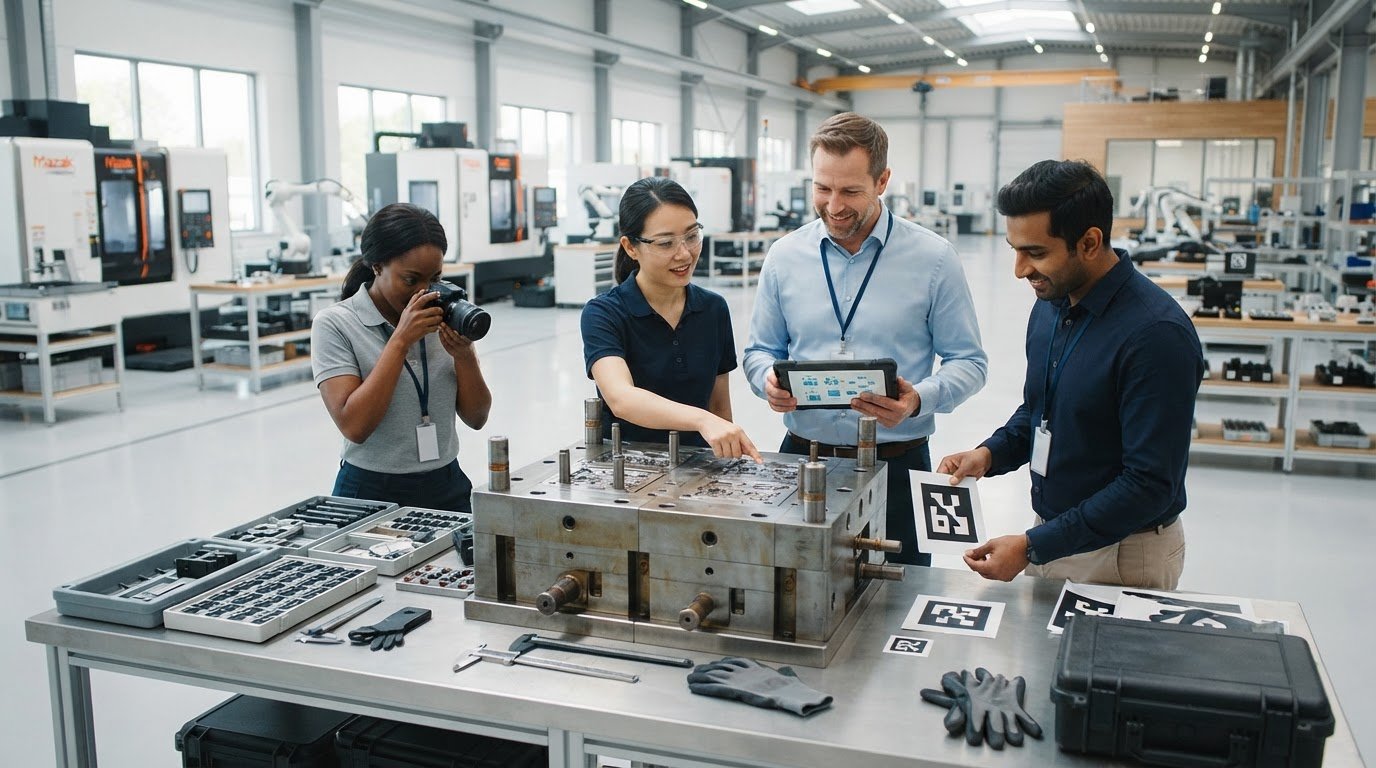
What if the mold you paid to develop couldn’t be released when you needed to change suppliers? Managing tooling and molds with a foreign factory means more than tracking where production equipment is stored. Payment alone may not establish clear ownership, access, or transfer rights. Without visibil...