


Squeezing your factory's margins is not a cost reduction strategy. It's a pressure tactic that breeds quality shortcuts, erodes supplier relationships, and ultimately costs you more in rework, rejections, and emergency reorders. If you're serious about learning how to reduce manufacturing costs in China, the real leverage isn't found on the factory floor. It's found in the layers of procurement waste sitting between you and it.
You already know China manufacturing has become more complex. Labor costs have shifted, raw material prices fluctuate, and the middlemen who once seemed convenient now represent one of the largest drains on your margins. That frustration is legitimate, and it's shared by importers at every volume level.
This guide gives you a professional framework to address that complexity head-on. You'll learn how to identify and eliminate hidden procurement inefficiencies, establish factory-direct pricing with full cost transparency, and build a supply chain structure that protects your margins without compromising the quality your customers expect. What follows is a strategic briefing, built for 2026 realities, designed to move your COGS in the right direction.
• The most effective way to learn how to reduce manufacturing costs in China is not to pressure factories on price, but to systematically eliminate the procurement waste and intermediary markups sitting between you and factory-direct pricing.
• A 3% defect rate carries a total cost of ownership far beyond the value of the rejected units—once you account for reshipping, replacement production, and brand damage, non-quality costs can dwarf the savings from a lower unit price.
• Sourcing agents and trading companies introduce hidden markups and misaligned incentives; a transparent, factory-direct model gives you full cost visibility and stronger negotiating leverage at every stage of production.
• Applying Lean procurement principles to your supply chain—eliminating over-specification, redundant approvals, and communication inefficiencies—can reduce manufacturing complexity and drive measurable COGS improvements without touching factory margins.
• A dedicated Asia procurement team, operating on the ground with European-level accountability, delivers a fundamentally different outcome than a transactional sourcing agent—one that protects your margins, your quality standards, and your supplier relationships simultaneously.
There's a fundamental error embedded in how most importers approach China sourcing: they confuse the lowest quote with the lowest total cost of ownership. These are not the same number. The gap between them is where margins quietly disappear, quality problems compound, and supplier relationships deteriorate beyond repair.
The procurement landscape has shifted considerably. Labor cost arbitrage has narrowed. Raw material pricing is volatile. And the intermediary layers that once seemed like a practical shortcut now represent one of the most predictable sources of inflated COGS. Understanding how to reduce manufacturing costs in China in 2026 requires moving past the surface-level price negotiation and addressing the structural inefficiencies underneath it.
When you push a factory hard enough on unit price, something gives. It's rarely the factory's margin. What changes instead is the specification. Factories compensate for aggressive price cuts by substituting cheaper raw materials, reducing quality control checkpoints, or deprioritizing your production run when capacity tightens. This is the mechanism behind quality fade: the gradual degradation of product specifications designed to preserve manufacturer margins without triggering an immediate rejection.
The damage is rarely visible in the first shipment. It accumulates. By the time defect rates climb or customer complaints surface, the cost of rework, replacement production, and expedited reshipping has already exceeded whatever unit-price savings you negotiated. Under-funded factory lines also introduce production delays that cascade into missed launch windows and emergency freight costs. The "cheaper" order ends up being the most expensive one you placed that year.
The second structural problem is less visible but equally damaging: the middleman tax. Trading companies frequently present themselves as direct manufacturers. The pricing they offer reflects their own markup, typically layered on top of the actual factory price, with no transparency about the spread. Industry professionals commonly report this markup sitting anywhere between 10% and 30% of the final invoice value, though the actual figure varies by product category and intermediary.
Kickback culture compounds this further. When a sourcing agent earns undisclosed commissions from the factories they recommend, their incentive is no longer aligned with your cost objectives. You're paying for representation that's working against you.
Transparency isn't a nice-to-have in this context. It's the prerequisite for any cost-reduction strategy that actually holds. Without full visibility into factory pricing, material costs, and agent compensation structures, you're optimizing against numbers you can't verify. That's not procurement strategy. It's guesswork with financial consequences.
A model built on factory-direct pricing with zero hidden commissions doesn't just reduce costs. It gives you the cost intelligence to make every sourcing decision from a position of genuine leverage.
Lean Manufacturing's "8 Wastes" framework was built for the factory floor. But the most expensive waste in international procurement happens long before a single component is assembled. It accumulates in over-engineered specifications, misaligned supplier communication, redundant approval cycles, and inventory buffers that exist purely because timelines can't be trusted. Applying Lean logic to your procurement process, not just your production line, is one of the most underutilized strategies for how to reduce manufacturing costs in China.
The distinction matters. Competitors focused on in-factory Lean improvements are solving the right problem in the wrong place. The structural inefficiencies sitting upstream of production, in your sourcing process, your specification documents, and your supplier relationships, drive costs that no amount of assembly-line optimization can recover.
Structured sourcing and procurement discipline applied at the vendor selection phase eliminates these inefficiencies before they compound. That means rigorous supplier vetting, standardized RFQ processes, and clear cost-breakdown visibility from the first conversation, not after a problematic shipment forces a renegotiation.
Over-specification is a silent cost driver. When product designs include custom tolerances, proprietary components, or assembly sequences that don't reflect actual functional requirements, you're paying for complexity that delivers no customer value. Simplifying component counts reduces tooling investment and assembly time. Substituting custom parts with standardized, off-the-shelf equivalents where performance allows can meaningfully reduce both unit cost and lead time without compromising product integrity.
This is where OEM and ODM contract manufacturing expertise becomes a direct financial asset. Experienced manufacturing partners can identify design-based savings that aren't visible from a distance, flagging redundant components, suggesting material substitutions, or restructuring assembly sequences to reduce labor hours. These recommendations don't come from a catalogue review. They come from on-the-ground factory knowledge.
Inventory waste is procurement waste in its most liquid form. When supplier timelines are unreliable, the operational response is predictable: safety stock. Excess inventory ties up working capital, increases warehousing costs, and introduces obsolescence risk if product specifications or demand patterns shift. The root cause isn't demand volatility. It's supplier unpredictability.
Aligning production schedules with verified demand signals, rather than padding orders to compensate for supplier inconsistency, requires a level of supplier relationship management that transactional sourcing simply can't deliver. High-volume sourcing consolidation also creates genuine economies of scale leverage, allowing you to negotiate better lead time commitments and pricing tiers from a position of credible, recurring volume.
If you're ready to map the procurement waste in your current supply chain, speak with the team about where the structural inefficiencies are costing you most.
Price is only half the equation. The other half is knowing whether the price you're seeing reflects actual factory economics or a number that's been processed through one or more intermediary layers before it reaches your desk. That distinction is where the real leverage in how to reduce manufacturing costs in China sits, and most importers never access it.
The intermediary markup isn't a rumor. It's a structural feature of how trading companies operate. Their business model depends on the spread between what they pay the factory and what they charge you. That spread is rarely disclosed, and it compounds across every order you place. When you don't know the true cost of materials, tooling, and labor, you're negotiating against a number you can't verify. You're not in a negotiation. You're in a performance.
Direct access to factory owners changes the negotiation entirely. You're no longer working through an information silo where communication is filtered, timelines are managed by a third party, and cost breakdowns are conveniently omitted. Factory-direct relationships give you visibility into raw material pricing, production capacity, and tooling costs that intermediaries have every incentive to obscure. That visibility is the transparency dividend: when you know what something actually costs to make, your bargaining position is grounded in fact rather than assumption.
The operational benefits extend beyond pricing. Direct factory communication compresses the sampling and product development cycle significantly. Feedback reaches the production team without translation through an intermediary layer, reducing revision cycles and accelerating time to market. For businesses managing seasonal launches or tight product development windows, that speed is a measurable financial advantage.
In the apparel sector, for example, a direct partnership with PowerSweet Fashion provides the transparency and feedback loop necessary to maintain high quality while significantly reducing the lead times that often drive up hidden procurement costs.
On-the-ground presence is what makes factory-direct relationships sustainable rather than theoretical. Physical proximity to suppliers, the ability to conduct unannounced factory visits, and the cultural and linguistic fluency to negotiate without a third-party filter are not advantages you can replicate from a remote office. For a thorough breakdown of what to look for when evaluating procurement partners, The Definitive Guide to Choosing a China Sourcing Company in 2026 provides a rigorous vetting framework.
Not all sourcing approaches carry the same cost structure or risk profile. The differences matter more than most importers realize until a problematic shipment forces the comparison:
Low entry cost, but high exposure to misrepresented factory credentials, undisclosed trading company intermediaries, and limited recourse when quality or timeline commitments aren't met. The apparent savings frequently evaporate on the first order that requires rework or replacement production.
Convenient, but structurally conflicted. Their margin depends on opacity. You receive a single price with no line-item visibility into materials, labor, or overhead. Renegotiation is difficult because you have no cost baseline to negotiate against.
Higher fixed cost, but a fundamentally different ROI profile. Full cost transparency, factory-direct pricing, and aligned incentives mean every decision is made in your financial interest. The fee structure is clear. The factory margin is not the source of your savings partner's income.
The real-world cost differential between these models is documented rather than theoretical. Visit the savings examples page to see concrete procurement outcomes across product categories, including the specific cost reductions achieved by moving from intermediary-dependent sourcing to a factory-direct model. The data makes the ROI case more clearly than any general estimate could.
Choosing the right procurement structure is one of the highest-leverage decisions in your supply chain. It determines not just what you pay per unit, but what you know about what you're paying, and that knowledge is the foundation of every cost reduction strategy that actually holds.
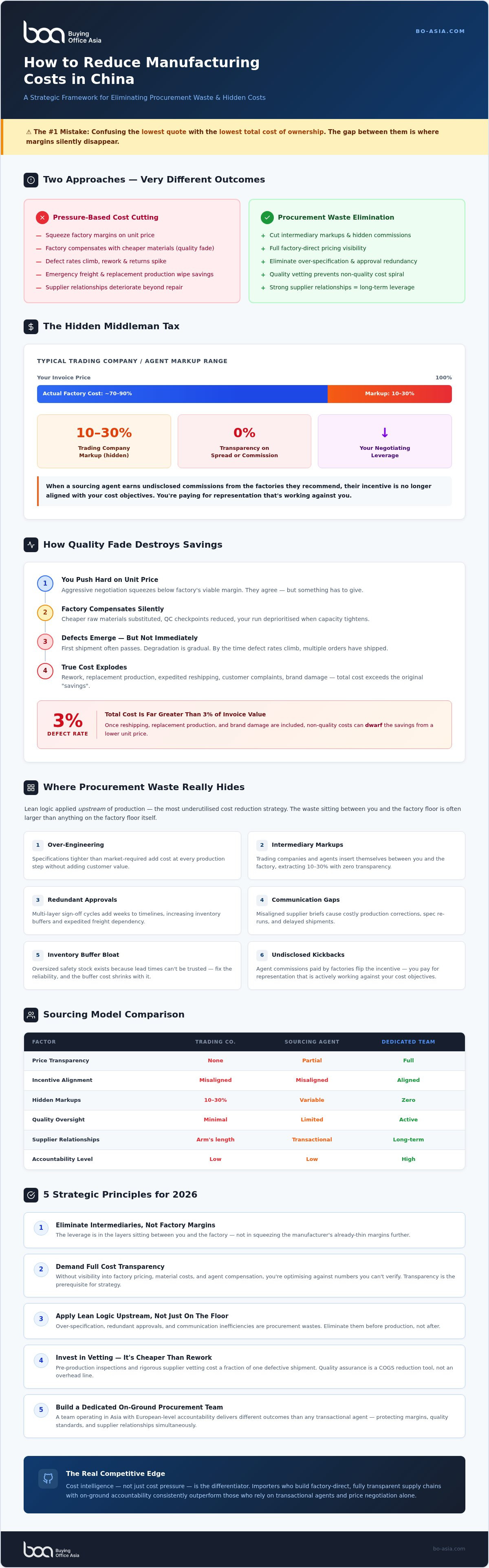
A 3% defect rate sounds manageable on paper. In practice, it's a financial event. Consider what that figure actually triggers: return freight on rejected units, replacement production at expedited timelines, reshipping costs, potential customs re-entry fees, and the downstream brand damage when defective products reach your customers. The unit value of the rejected goods is often the smallest line item in that calculation. Non-quality costs compound in ways that a simple defect percentage will never capture, and they represent one of the most underestimated drains on total cost of ownership in China manufacturing.
The most effective answer to this problem isn't a reactive inspection at the port of departure. It's rigorous supplier vetting before a single production order is placed. Vetting functions as the highest-leverage form of supply chain insurance available to importers. A factory that lacks the process controls, equipment calibration, or workforce stability to meet your specifications will not correct those deficiencies because you've placed an order with them. Identifying those gaps upfront, before your capital is committed, is categorically cheaper than discovering them mid-production or at destination.
On-site quality control delivers a fundamentally different risk profile than remote oversight. When trained inspectors are physically present on the factory floor during production, errors are caught at the source, before they propagate across an entire batch. That intervention point is critical. A defect identified during production costs a fraction of what it costs once goods are packed, shipped, and cleared through customs. The ROI of on-site inspection isn't theoretical; it's the difference between a correctable production variance and a full-batch write-off.
During-production (DUPRO) inspections are the operational mechanism that prevents small deviations from becoming batch-wide failures. By checking components, assembly quality, and specification adherence while production is still active, you retain the ability to intervene before a problem is sealed inside ten thousand finished units. Equally important is Golden Sample adherence: when the approved pre-production sample is used as the binding quality benchmark throughout mass production, it eliminates the specification drift that factories can introduce, intentionally or otherwise, when oversight is absent.
Unauthorized sub-contracting is a separate and often overlooked cost driver. When a factory quietly outsources part of your production run to a lower-tier facility, you lose control over material quality, labor standards, and process consistency simultaneously. Physical factory audits, conducted by personnel with genuine on-the-ground access, are the only reliable mechanism for detecting and preventing this practice. It's one of the clearest examples of how learning how to reduce manufacturing costs in China requires protecting quality standards, not just negotiating on price.
Quality control and logistics are more connected than most importers recognize. Defect-free production is the prerequisite for shipping optimization; you can't consolidate shipments efficiently if a portion of your goods require rework or replacement. Once quality is secured, shipment consolidation from multiple suppliers into single container loads reduces per-unit freight costs meaningfully. Packaging dimension optimization, aligning carton sizes to maximize container utilization, compounds those savings further without requiring any change to the product itself.
Customs and duty compliance in 2026 carries its own cost exposure. Misclassified goods, incomplete documentation, or non-compliant labeling can trigger delays, inspections, and fines that dwarf the cost of getting the paperwork right the first time. End-to-end logistics coordination, managed by a team with current regulatory knowledge and established customs relationships, keeps your shipments moving on schedule and your landed cost predictable.
If non-quality costs are eroding your margins and you want a clear picture of where the exposure sits in your current supply chain, speak with the team about a procurement review.
Every cost-reduction strategy covered in this guide, from eliminating intermediary markups to tightening quality control oversight, depends on one structural prerequisite: the right team executing it on the ground. A transactional sourcing agent places orders. A dedicated procurement team manages your supply chain as a living system, with aligned incentives, full cost visibility, and the local presence to intervene before problems compound. That distinction is not cosmetic. It determines whether your cost-reduction efforts hold across production cycles or erode the moment oversight lapses.
The conventional alternative, establishing your own Asia office, carries a fixed cost structure that most importers can't justify at mid-market volumes. Salaries, office infrastructure, compliance obligations, and the time required to build a functional supplier network represent a significant capital commitment before a single order is placed. A dedicated sourcing team operating as an integrated extension of your business delivers the same on-the-ground capability without that overhead, and with an accountability structure that a self-managed office rarely achieves.
The financial case for professional procurement management is built on total cost of ownership, not the fee line in isolation. When factory-direct pricing eliminates intermediary markups, when on-site inspections prevent batch-level quality failures, and when supplier relationships are managed with genuine continuity, the cumulative savings across your first two to three production cycles typically absorb the cost of the partnership entirely. The model pays for itself not through a single dramatic negotiation, but through the compounding effect of eliminating the small, recurring costs that unmanaged sourcing generates by default. The ROI of a Dedicated Asia Procurement Team case study documents this progression in concrete terms, showing how the cost structure shifts once procurement is managed with genuine transparency and local accountability.
What separates Buying Office Asia from consulting firms that offer factory-side improvement advice is permanence. Consultants complete a project and leave. The supply chain they touched continues operating without them. A Helsinki-based management structure paired with Hong Kong operational presence means your procurement partner is both culturally aligned with your business expectations and physically embedded in the supplier environment. Communication doesn't degrade through time zones or translation layers. Accountability is continuous, not project-scoped.
A practical transition begins with a 30-day supply chain audit structured around three questions: where are your current costs being generated, which of those costs are obscured by intermediary layers, and what's the verifiable gap between your current COGS and factory-direct pricing for the same specification? That baseline is the foundation for every measurable reduction target you set for 2026. Without it, you're optimizing against numbers you can't trust.
The audit process typically surfaces cost exposure in predictable places: undisclosed trading company markups, over-specified components that add cost without adding customer value, and inventory buffers that exist because supplier timelines have never been reliably managed. Identifying those gaps is how to reduce manufacturing costs in China in a way that holds, because you're addressing root causes rather than applying pressure to factory margins that will simply find another release valve.
If you're ready to establish that baseline and build a supply chain structure designed for 2026 cost performance, contact Buying Office Asia for a comprehensive supply chain audit. The first step is understanding exactly where your current procurement model is costing you more than it should.
The path to lower COGS in China manufacturing isn't found in harder price negotiations. It's built through structural change: eliminating intermediary markups, enforcing quality standards before problems compound, and managing supplier relationships with genuine continuity and transparency. Those three levers, applied consistently, deliver cost reductions that hold across production cycles rather than eroding after the first shipment.
Knowing how to reduce manufacturing costs in China is ultimately a question of who's executing the strategy on your behalf. Buying Office Asia brings 15+ years of regional expertise, a 100% transparency model with zero hidden commissions, and on-the-ground presence across Hong Kong and Mainland China, backed by European management accountability in Helsinki. That combination gives you the cost intelligence and operational control that transactional sourcing simply can't replicate.
The most expensive supply chain decision you can make is continuing with a model that obscures your true costs. Book a supply chain audit with Buying Office Asia and get a clear picture of where your margins are leaking and exactly what it takes to recover them.
The most effective way to reduce manufacturing costs in China is to eliminate the intermediary layers between you and the factory, not to pressure factories on unit price. When you access factory-direct pricing with full cost-breakdown visibility, you remove the markup that trading companies and sourcing agents build into every quote. That structural change delivers sustainable savings without triggering the quality fade that aggressive price negotiation almost always produces.
Pair that with Design for Manufacturing principles applied during product development, and you compound the gains. Simplifying specifications, reducing custom component counts, and aligning tolerances to actual functional requirements can meaningfully reduce production complexity before a single unit is assembled.
Industry professionals commonly report trading company markups sitting between 10% and 30% of the final invoice value, though the actual figure varies by product category and the number of intermediary layers involved. That spread represents the most immediate savings available when you move to a factory-direct model, and it applies to every order you place, not just the first one.
The cumulative effect across multiple production cycles is where the financial case becomes compelling. When you also factor in the reduction in non-quality costs that comes from direct supplier oversight, the total cost of ownership difference between the two models is typically larger than the markup figure alone suggests.
Labor cost arbitrage has narrowed considerably, and it's no longer the dominant lever it once was for importers sourcing from China. Raw material pricing volatility, tooling complexity, intermediary markups, and logistics costs now carry comparable or greater weight in your total landed cost calculation. Treating labor as the primary cost driver leads to negotiations that pressure the wrong variable.
The more productive focus in 2026 is on the procurement structure sitting upstream of production: which costs are obscured by intermediaries, where specifications are over-engineered relative to functional requirements, and whether your supplier relationships are managed with the continuity needed to access genuine pricing transparency.
Hidden commissions distort your cost baseline in two ways. First, they inflate the unit price you're quoted, because the agent or trading company builds their margin into the figure before it reaches you. Second, and more damaging, they misalign your representative's incentives. An agent earning undisclosed commissions from factory referrals is structurally motivated to recommend suppliers that pay the highest commission, not the ones that best serve your cost and quality objectives.
The practical consequence is that you can't negotiate effectively against a number you can't verify. A 100% transparency model, where agent compensation is fully disclosed and factory pricing is presented with line-item cost breakdowns, is the prerequisite for any cost-reduction strategy that actually holds across production cycles.
Lean principles are applied successfully in Chinese factories across a wide range of product categories, but the more important question for importers is where Lean thinking delivers the greatest leverage. The structural inefficiencies that drive the highest costs in international procurement typically sit upstream of the factory floor, in over-specified product designs, redundant approval cycles, and supplier communication gaps that add time and complexity without adding value.
Applying Lean logic to your procurement process, not just the assembly line, addresses root causes rather than symptoms. Eliminating specification waste, tightening supplier selection criteria, and aligning production schedules with verified demand signals are all Lean interventions that reduce costs before production begins.
Non-quality costs are the full financial consequences of a defect, beyond the face value of the rejected units. They include return freight, replacement production at expedited timelines, reshipping costs, potential customs re-entry fees, and the downstream brand damage when defective goods reach your customers. In most cases, the unit value of the rejected goods is the smallest line item in that calculation.
To estimate your exposure, start with your current defect rate and apply it to your average order value. Then add the cost of one replacement production run, return freight, and expedited reshipping. For businesses with customer-facing quality commitments, include a conservative estimate of lost repeat revenue. That total, compared against your current inspection and vetting spend, typically makes the ROI case for preventive quality investment self-evident.
On-site inspections save money by moving the defect intervention point from destination to source. A quality deviation identified during active production costs a fraction of what it costs once goods are packed, shipped, and cleared through customs. During-production inspections allow trained personnel to catch specification drift, material substitutions, or assembly errors while there's still an opportunity to correct them without scrapping a full batch.
Physical factory presence also deters unauthorized sub-contracting, where a factory quietly outsources part of your production run to a lower-tier facility without your knowledge. That practice simultaneously compromises material quality, labor standards, and process consistency. Regular on-site audits are the only reliable mechanism for detecting it before it affects your shipment.
Self-managed sourcing carries lower visible costs upfront, but the hidden cost structure is substantial. Without on-the-ground presence, linguistic fluency, and established supplier networks, you're exposed to misrepresented factory credentials, undisclosed intermediary layers, and limited recourse when quality or timeline commitments aren't met. Those risks translate into real financial events: rework, replacement production, and emergency freight costs that accumulate across production cycles.
Establishing your own Asia office is the alternative, but the fixed cost of salaries, infrastructure, and compliance obligations is difficult to justify at mid-market volumes. A dedicated procurement team operating as an integrated extension of your business delivers the same on-the-ground capability without that overhead, and with an accountability structure aligned entirely to your cost and quality outcomes rather than a transactional commission model.

Scaling production to millions of units isn't a purchasing task; it's a high-stakes risk management discipline where a single percent of quality fade can liquidate your annual margin. You likely understand that the leap from mid-scale orders to massive procurement runs often exposes cracks in even t...

In 2026, the traditional sourcing agent isn't just an expense; they're a strategic liability that obscures your true cost of goods. Most procurement leaders recognize that supplier selection in asia has become a defensive maneuver where the goal is to eliminate the "Middleman Tax" before it erodes y...

Successful oem sourcing asia isn't just a search for a factory, but the implementation of a transparent, on-the-ground management ecosystem. You likely already know that the traditional intermediary model is flawed, often hiding true costs behind layers of markups and opaque communication. It's frus...