

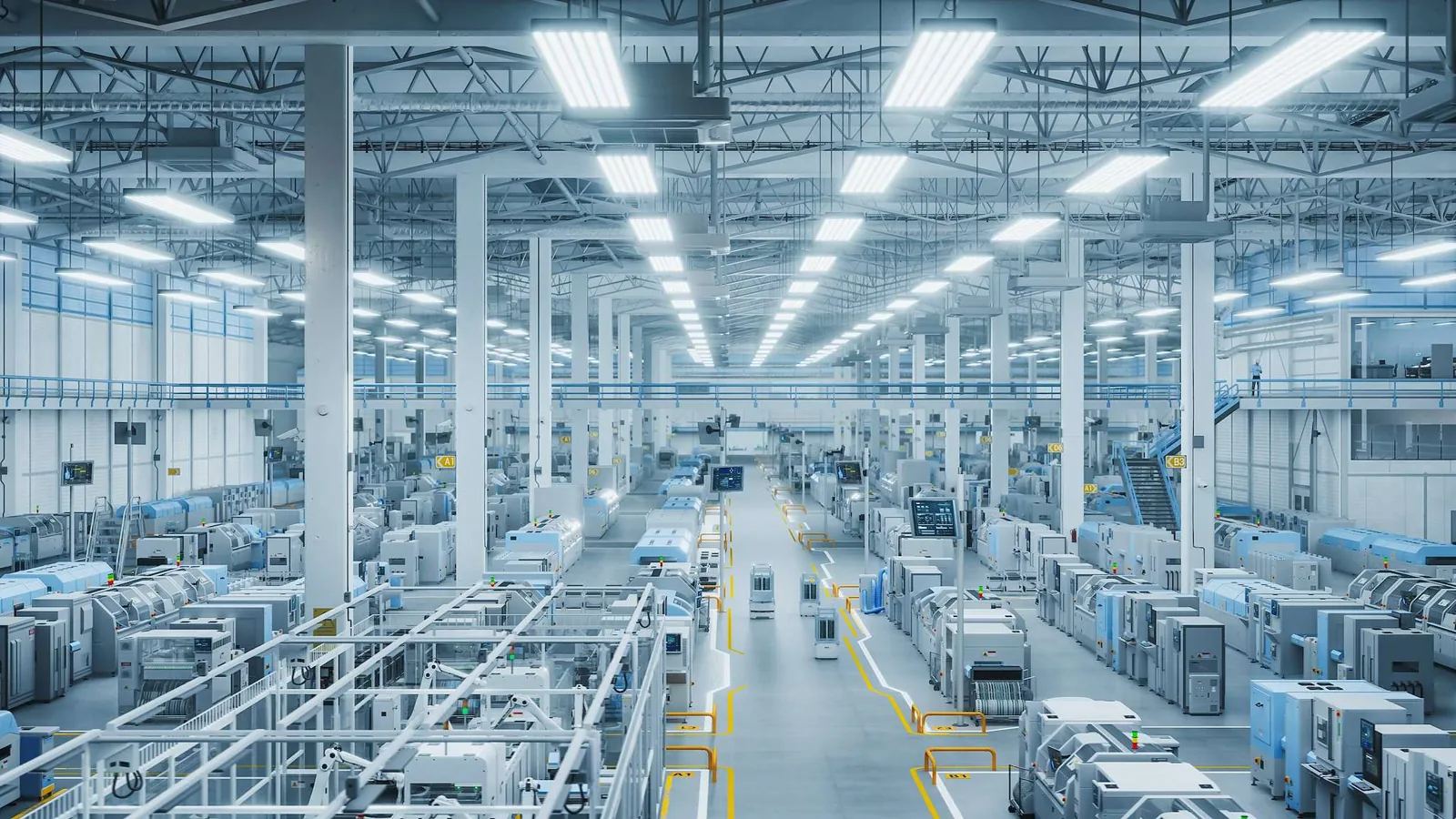
If you're relying solely on a digital business license to vet your suppliers in 2026, you're likely already paying a 20% "middleman tax" without realizing it. You know that direct access to the production floor is the only way to ensure quality and cost stability, yet trading companies have become masters of digital disguise. Learning how to verify a factory is real and not a trading company is no longer just a procurement preference; it's a financial necessity for any business looking to protect its margins in an increasingly complex global market.
We understand the anxiety of discovering a hidden intermediary after a production run has already started. This article provides the professional vetting techniques used by seasoned procurement experts to bypass these middlemen and secure genuine factory-direct pricing. We'll walk you through the critical 2026 VAT Law updates, the transition to ISO 9001:2026 standards, and the specific GSXT digital verification methods that reveal the truth behind a supplier's business scope. By the end of this guide, you'll have the tools to demand 100% transparency and build a supply chain rooted in direct manufacturer relationships.
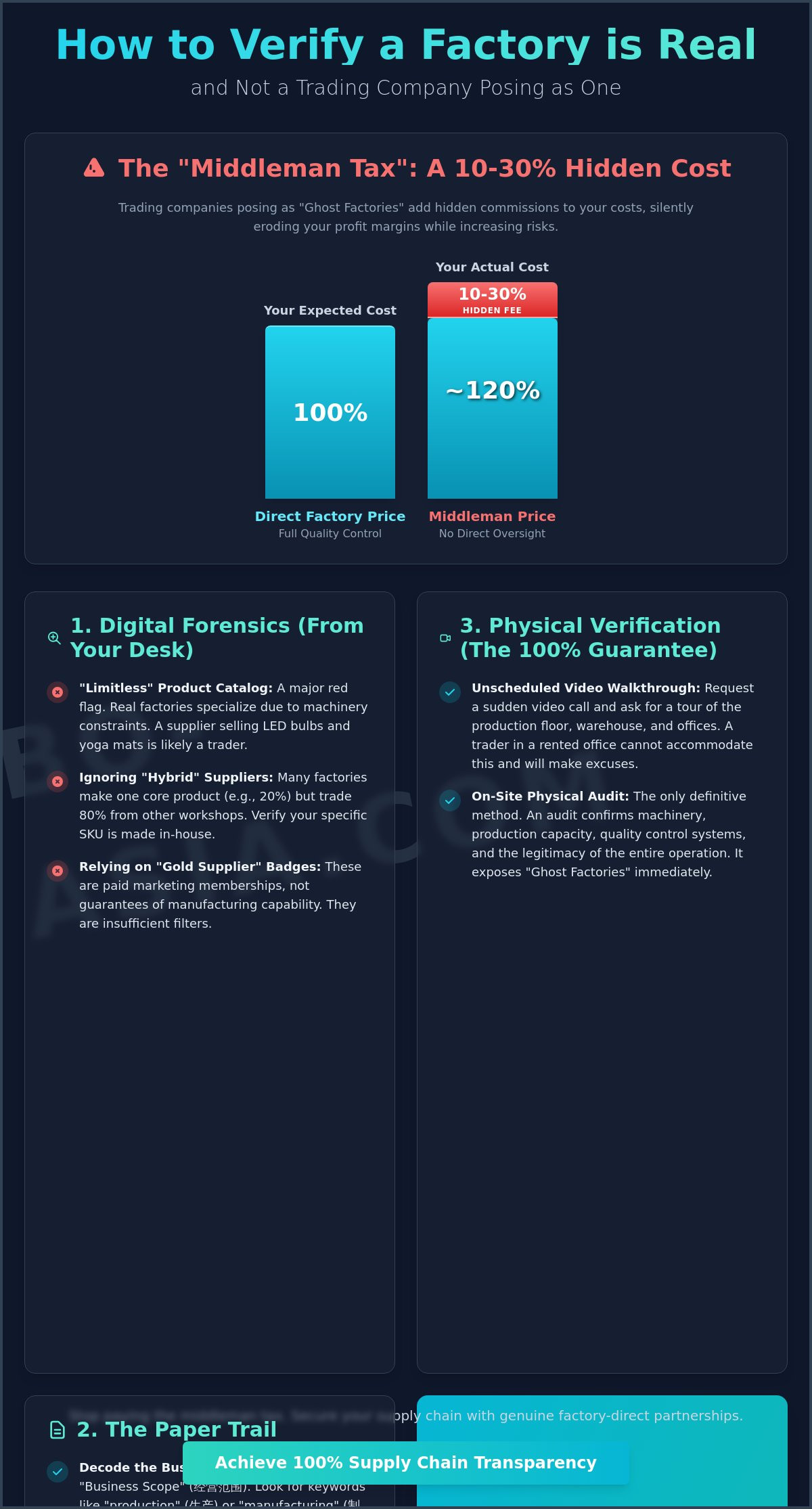
• Unmask the "Ghost Factory" phenomenon and understand how hidden commissions between 10% and 30% can silently erode your product margins.
• Learn how to verify a factory is real and not a trading company by analyzing product specialization and cross-referencing addresses with regional industrial clusters.
• Master the paper trail by decoding specific Chinese business license terms and utilizing the 13% VAT invoice test to confirm legitimate production status.
• Deploy physical verification tactics, such as the unscheduled video walkthrough, to ensure your supplier isn't simply operating out of a rented office.
• Establish 100% supply chain transparency by leveraging a dedicated procurement team that maintains a permanent, on-site presence at the factory level.
In the context of 2026 Asian export markets, a trading company is a commercial intermediary that facilitates transactions between manufacturers and foreign buyers without maintaining ownership of the physical production facilities or the specialized machinery required for fabrication. While these entities often present themselves as manufacturers to secure higher-value contracts, they are essentially arbitrageurs. This "Ghost Factory" phenomenon involves trading companies using rented office space or temporary showrooms, complete with modular signage, to deceive visitors during pre-arranged tours. They create the illusion of industrial scale while operating entirely as a sales office.
The strategic risk of this arrangement is significant. First, your financial viability is threatened by hidden commissions, which often range from 10% to 30%, silently eroding your product margins. Second, you lose the technical oversight necessary for consistent quality. Because traders don't own the factory floor, they frequently switch sub-suppliers to maximize their own profit. This leads to catastrophic shifts in material quality or production standards without your knowledge. A foundational understanding supply chain management reveals that every additional layer in the chain introduces a new point of failure. Learning how to verify a factory is real and not a trading company is the first step in securing your brand's operational health and ensuring direct accountability.
It's common for legitimate factories to operate as hybrid entities. They might manufacture 20% of a product line in-house while outsourcing the remaining 80% to smaller, unverified workshops. This allows them to offer a "one-stop-shop" convenience that appeals to buyers, but it obscures your visibility into the actual production floor. You must identify if your specific SKU is produced on-site or if it's being brokered through a third party where you have zero control over ethical standards or technical specs. Specialization is usually the hallmark of a true manufacturer; a factory that claims to make everything usually makes very little.
Many procurement teams mistakenly view "Gold Supplier" or "Verified" badges as a seal of manufacturing excellence. In reality, these are paid marketing memberships. While a "Verified Supplier" badge indicates that a third-party inspection company has checked the business, these audits are often limited in scope or conducted through remote documentation reviews. In 2026, these digital indicators are insufficient filters. Relying on a platform rating without performing your own deep due diligence leaves you vulnerable to intermediaries who have simply mastered the art of digital presentation. True verification requires a physical presence on the factory floor.
You don't need to board a plane to begin your due diligence. Digital forensics provides a high-level filter to identify intermediaries before you commit resources to a physical audit. By scrutinizing a supplier's online presence, you can uncover the operational inconsistencies that reveal a trader's true nature. Understanding how to verify a factory is real and not a trading company starts with a critical analysis of their product specialization and geographic footprint.
A true manufacturer's catalog is a direct reflection of its capital investment in machinery. If a supplier offers a "limitless" range of goods, they're likely brokering deals. Factories are constrained by their production equipment; a plastic injection plant will not naturally produce high-end textiles or complex electronics. This lack of technical synergy is your first major red flag. If the catalog feels like a general department store, you're looking at a middleman.
Watch for suppliers selling unrelated categories, such as LED bulbs alongside yoga mats. Real factories focus on a specific niche to maintain efficiency and quality. You should also examine the "Related Products" section on B2B portals. If the supplier's inventory spans multiple industries with no clear manufacturing overlap, you're dealing with a trader. Many buyers overlook the hybrid supplier: a factory that manufactures one core item but trades five others to increase their basket size. You must ensure your specific SKU isn't the one being outsourced. A dedicated Asia procurement team can quickly spot these inconsistencies based on deep regional industry knowledge.
Asian manufacturing is organized into specialized hubs. For instance, Dongguan is a global center for electronics, while Foshan specializes in furniture and ceramics. If a supplier claims to be a factory but is registered in a downtown commercial district rather than an industrial zone, proceed with caution. Use Google Earth to verify the address. A legitimate production site should show an industrial park with loading docks and warehouse space, not a high-rise office building. You must also verify the distance between the registered office and the claimed factory; a gap of hundreds of kilometers often indicates a trading entity posing as a manufacturer. This level of scrutiny mirrors the rigorous standards found in the Foreign Supplier Verification Programs (FSVP), which emphasize risk-based supplier vetting.
Digital forensics also extends to website metadata. Stock photos of clean, empty workshops are common among traders. Look for authentic images of the production line, workers in uniform, and visible company signage. Finally, perform the "Contact Us" test. Traders often use personal mobile numbers or generic email addresses. A real factory will typically have a verified landline and a professional corporate domain. If you need assistance navigating these digital red flags, you can consult with our regional experts for a more detailed assessment.
While digital forensics provide an initial filter, the legal and financial documentation of a supplier offers the most definitive evidence of their status. In 2026, the complexity of international trade requires you to look past surface-level certificates and verify the underlying data at the source. Understanding how to verify a factory is real and not a trading company requires a methodical review of their Chinese Business License and tax history. You should always verify these documents through the National Enterprise Credit Information Publicity System (GSXT) at www.gsxt.gov.cn to ensure the data is current and hasn't been tampered with.
One of the most reliable indicators of a manufacturer is their ability to handle financial scrutiny. You must verify that the beneficiary name on the bank account matches the factory name exactly. Intermediaries often request payments to offshore entities or personal accounts to avoid tax or hide their identity. This lack of transparency is a significant risk to your supply chain. High-level due diligence, similar to the standards outlined in the Foreign Supplier Verification Programs (FSVP), ensures that every entity in your procurement process is legally accountable and financially stable. Furthermore, you should cross-reference ISO 9001 certificates. Ensure the current ISO 9001:2015, or the emerging ISO 9001:2026, explicitly covers "production" or "manufacturing" of your specific product category rather than just "sales" or "distribution."
The "Business Scope" section of a license is a legal boundary that defines what a company is permitted to do. You must look for the Chinese term for "Production" (生产) or "Manufacturer" (制造). If you only see "Trading" (贸易) or "Wholesale" (批发), the entity is legally restricted from manufacturing goods. There's also a critical difference between "Processing" and "Production." Processing often implies a small assembly workshop, while production signals a full-scale manufacturing facility. A missing manufacturing license for a regulated product is a non-negotiable dealbreaker that exposes your brand to legal and operational risks. Learning how to verify a factory is real and not a trading company through these legal codes prevents you from partnering with an entity that has no legal right to produce your goods.
Under the China VAT Law enacted on January 1, 2026, the standard rate for most manufactured goods is 13%. This is where many trading companies fail the test. A real factory can issue a VAT invoice that specifically lists the goods they produce at the 13% rate. Traders often struggle to provide these because they don't hold the necessary manufacturing tax status or are trying to hide their margins. Requesting a sample VAT invoice from a previous transaction is a powerful way to verify the issuing entity. Incorporating these checks into your broader supplier vetting process is essential for ensuring you're receiving genuine factory-direct pricing without hidden intermediary markups.
Digital filters and paper trails are essential, but they aren't foolproof. In 2026, sophisticated trading companies use high-resolution rendering and modular showrooms to mimic industrial scale. To achieve 100% certainty, you must transition from remote vetting to physical verification. This is the only way to ensure your margins aren't being siphoned by intermediaries. Learning how to verify a factory is real and not a trading company requires moving beyond the screen and into the actual workshop environment.
Another physical marker is sample origin tracking. When you receive a prototype, scrutinize the courier airway bill. If the shipping address is a downtown office building or located in a different province than the registered factory, you're likely dealing with a trader. Real manufacturers ship directly from their production site to maintain logistical efficiency and cost control. If the paper trail and the physical shipment don't align, your supply chain transparency is compromised.
The unscheduled video walkthrough is your most immediate tool. Don't settle for a pre-recorded tour or a scheduled presentation. Request a live call and ask to see the raw material warehouse, the QC station, and even the employee canteen. Legitimate factories have nothing to hide. If a supplier claims they can't show a specific area due to "noise" or "proprietary secrets," it's often a sign that they don't have full access to the facility. Use the "Whiteboard Test" for instant verification. Ask a supervisor to write the current date and your company name on a production floor whiteboard. This confirms the footage is live and the location is authentic.
Professional on-site audits provide the deepest level of security. A casual walkthrough is not enough. A rigorous technical audit involves checking machinery maintenance logs, verifying raw material stock levels, and ensuring worker safety protocols are active. This is where quality control experts provide value that a remote buyer simply cannot replicate. They look for the subtle signs of sub-supplier switching that indicate a trader is brokering your order. For businesses requiring mass production oversight, European-managed on-site presence ensures that technical specifications and ethical standards are met without compromise. It's about moving from a position of hope to a position of documented fact.
Verification isn't a one-time event; it's a continuous defensive strategy. If you're ready to eliminate the risk of hidden middlemen and secure your supply chain, contact our regional audit team for a professional factory assessment.
Achieving total supply chain security requires more than just periodic checks; it demands a permanent, professional presence where your goods are actually made. Buying Office Asia (BOA) operates as your integrated partner, eliminating the obscured costs of intermediaries by providing 100% transparency. While understanding how to verify a factory is real and not a trading company is a vital skill for any procurement officer, executing that verification consistently across high-volume orders requires on-the-ground resources. By positioning ourselves as an extension of your own team, we ensure you bypass the 10% to 30% markups typically hidden by trading entities.
Negotiating from a position of local expertise changes the dynamic of the conversation. When you work with a dedicated Asia procurement team, you aren't just another remote buyer; you're a local presence with regional leverage. This allows for more aggressive factory direct price negotiations, as manufacturers prioritize partners who can provide on-site oversight. This proximity also simplifies the complex transition from initial sourcing to full-scale OEM manufacturing, ensuring that your technical specifications are never lost in translation by a middleman.
The BOA model is built on the explicit rejection of the traditional intermediary model. We provide full disclosure of factory names, physical locations, and even raw material cost breakdowns. This level of detail is rarely provided by traders who rely on information asymmetry to protect their margins. By utilizing a clear fee-based structure, we eliminate hidden markups and align our success entirely with your financial health. You gain the direct manufacturer relationship you need for stable quality and pricing, without the operational burden of managing it from thousands of miles away.
We bridge the gap between European leadership in Helsinki and our operational hubs in Hong Kong and across Asia. Our experts know exactly how to verify a factory is real and not a trading company by performing deep-dive financial and physical inspections that go far beyond standard digital checks. This regional presence is the cornerstone of global sourcing success. Physical proximity to the factory floor allows us to catch production errors before they leave the warehouse, providing a level of accountability that remote agents cannot match. If you're ready to move beyond the uncertainty of unmanaged supply chains, the first step is a professional audit. We invite you to start your first factory audit with BOA to secure the transparency your business deserves.
Protecting your product margins requires a shift from passive trust to active verification. We've explored how digital filters and the 2026 VAT invoice test provide initial layers of security. However, these tools only reach their full potential when combined with the physical oversight of a professional audit. Mastering how to verify a factory is real and not a trading company isn't just about avoiding a single bad deal; it's about building a stable, transparent foundation for your long-term growth. Intermediaries thrive on information gaps, and your best defense is a partner who operates directly on the production floor.
Buying Office Asia offers the elite oversight your brand requires. With European-managed leadership based in Finland and a dedicated, on-the-ground presence in Hong Kong, we provide the regional expertise you lack. Our model ensures 100% transparency with absolutely no hidden commissions; we function as a protective extension of your own team. It's time to eliminate the uncertainty of unmanaged sourcing and take full control of your manufacturing future. Secure your supply chain with a professional factory audit from Buying Office Asia today and start building a more resilient business.
A trading company rarely offers a lower price than a factory for the same level of quality because they must account for their own overhead and profit margins. They might appear cheaper by sourcing from unverified workshops with lower safety standards or by quoting "loss leader" prices on initial small batches. For sustainable, high-volume production, a direct manufacturer relationship always yields the most competitive pricing.
The most reliable document is the Chinese Business License verified through the GSXT government portal. You must check the "Business Scope" (Jingying Fanwei) for manufacturing keywords like "Production" (生产). Additionally, the ability to issue a 13% VAT invoice for manufactured goods is a definitive financial indicator of a legitimate factory status in 2026.
You cannot rely on platform badges alone; you must perform independent due diligence to understand how to verify a factory is real and not a trading company. Use an unscheduled video call to see the production line in real-time. If the supplier refuses to show the machinery or the warehouse, they're likely a trading entity operating out of a remote office.
Factories often refuse small orders because their production lines are optimized for high-volume efficiency. Setting up machinery for a small run is often financially unviable for a large manufacturer. Trading companies fill this gap by aggregating small orders from multiple buyers, but this convenience comes at the cost of higher unit prices and zero control over the actual production floor.
The primary risks include catastrophic quality shifts and hidden financial markups. Because traders don't own the factory, they may switch sub-suppliers without your consent to protect their own margins. This leads to inconsistent product standards and communication gaps that can result in expensive production errors and significant brand damage.
In 2026, a basic factory capability audit in China typically costs between $188 and $300 per auditor per day. If you require more comprehensive quality management or social compliance audits, prices generally range from $400 to $800. These costs are a minor investment compared to the risk of paying a 30% middleman markup on a mass production order.
Working with a trading company is only beneficial for low-value, off-the-shelf purchases where you can't meet a factory's Minimum Order Quantity (MOQ). For custom development or high-volume procurement, the lack of transparency and direct technical access makes the trading model inherently flawed. A direct relationship is the only way to ensure 100% supply chain accountability.
You can verify a factory remotely by partnering with a dedicated procurement team that maintains a physical, regional presence in Asia. These experts perform on-site audits and live "Whiteboard Tests" to confirm the production facility is legitimate. This provides the security of a physical inspection without the expense and logistical burden of international travel.

What if the first clear sign of a production problem arrives after the goods are packed? Manufacturing risk management in Asia works best when controls are connected from the start, not left to a final inspection or occasional supplier update. You need visibility into factory activity, early warning...

What if the lowest unit quote isn’t the lowest-cost way to make your board game? Board game manufacturing costs depend on more than the number of boxes ordered. Component materials, custom tooling, assembly, packaging and delivery scope can all change what a quote covers, making headline prices diff...

What if the factory’s lowest quote isn’t the lowest-cost option? A lower unit price can hide differences in materials, tooling, packaging, quality checks or production terms. Understanding how sourcing agents negotiate factory prices starts with making those differences visible, not simply asking a...