


Your search for a competitive manufacturing edge shouldn't end at a digital directory; it should start on the ground in a country where the Manufacturing PMI hit 52.03 percent in early 2026. You likely recognize that Indonesia offers an unparalleled wealth of raw materials and a robust labor force, yet the prospect of vetting suppliers across 17,000 islands often feels like an operational minefield. Between language barriers and the complexities of local SNI or Halal certifications, the risk of a costly misstep is high. This guide simplifies Indonesia factory sourcing for beginners by providing a strategic framework to manage this landscape safely and profitably.
You'll learn how to secure factory-direct pricing without the hidden markups common in unmanaged supply chains. We will detail the essential steps for supplier vetting, explain how to manage the new 2026 import prohibitions, and show you how to maintain the on-site oversight necessary to prevent production delays. This briefing transforms Indonesia's manufacturing potential into a reliable, high-margin asset for your business through a disciplined approach to procurement and quality control.
• Capitalize on the "China+1" strategy by leveraging Indonesia's raw material proximity to reduce your total landed costs.
• Learn to identify the "middleman trap" where hidden commissions erode margins, a critical lesson in Indonesia factory sourcing for beginners.
• Navigate the logistics of the Indonesian archipelago by focusing your procurement efforts on the high-density industrial hubs of Java.
• Execute a disciplined supplier vetting framework that moves beyond digital profiles to include on-site technical capability assessments.
• Replace operational anxiety with the security of an integrated procurement team that provides the physical presence necessary for mass production oversight.
Strategic diversification is no longer a luxury; it's a requirement for supply chain resilience. Indonesia has emerged as the cornerstone of the "China+1" strategy, offering a hedge against geopolitical volatility and rising costs in traditional manufacturing hubs. For those exploring Indonesia factory sourcing for beginners, the primary advantage lies in the country's unique combination of scale and resource abundance. By 2026, the nation has solidified its position as a primary destination for global procurement, driven by a stable GDP growth projection of approximately 5.2 percent.
Success in this market depends on understanding the "Raw Material Proximity" advantage. Unlike manufacturers who must import components from overseas, Indonesian factories often sit at the source of global supply for nickel, rubber, and palm oil. This proximity drastically reduces landed costs and protects your margins from international freight fluctuations. As highlighted in this Indonesian economic overview, the manufacturing sector's integration with natural resources provides a structural cost floor that few other nations can match.
The "Making Indonesia 4.0" initiative has transitioned from a policy roadmap into a tangible operational reality. By 2026, many factories in the automotive and electronics sectors have integrated IoT and robotics, increasing output consistency and precision. Simultaneously, labor remains highly competitive. While Jakarta’s minimum wage rose to IDR 5,729,876 in 2026, rates in Central and West Java remain significantly lower, often ranging between IDR 2.3 million and 3.4 million. This makes the region exceptionally attractive for labor-intensive industries like apparel and furniture where cost-efficiency is paramount.
Apparel and footwear production is concentrated in the massive industrial belts of West and Central Java, where established infrastructure supports high-volume exports. For furniture and home goods, the archipelago offers unrivaled access to sustainable teak, mahogany, and rattan. Meanwhile, the electronics sector is expanding rapidly in Batam and West Java tech hubs, benefiting from specialized economic zones and proximity to regional logistics centers. These hubs provide the technical sophistication required for modern sourcing and procurement needs.
Tariff management is simpler thanks to the Regional Comprehensive Economic Partnership (RCEP). This agreement lowers barriers for global buyers, facilitating smoother trade across the Asia-Pacific. Additionally, the Indonesia-US Reciprocal Trade Agreement signed in early 2026 has reduced tariffs on Indonesian products to 19 percent, with commodities like coffee and cocoa reaching 0 percent. For European buyers, the ongoing progress toward an EU-Indonesia CEPA deal promises even greater duty-free access for 2026 procurement activities, making Indonesia factory sourcing for beginners a timely and profitable venture.
Java isn't just an island; it's the operational engine of the nation. Approximately 70 percent of all manufacturing activity is concentrated here. For those new to the market, focusing on Java minimizes the logistical friction inherent in an archipelago of 17,000 islands. Successful Indonesia factory sourcing for beginners starts with identifying factories that utilize the Online Single Submission (OSS) system. This digital platform has become the central pillar for business licensing in 2026, ensuring that your partners are registered and compliant with national standards.
Beyond the main hubs, Special Economic Zones (SEZs) provide strategic advantages. These zones offer fiscal incentives, including tax holidays and streamlined customs procedures, which directly impact your bottom line. Understanding these regional nuances is part of the strategic case for Indonesia factory sourcing, as it allows you to position production where regulatory and financial friction is lowest.
Greater Jakarta, or Jabodetabek, remains the premier destination for high-tech automotive and consumer electronics assembly. If your focus is high-volume textiles or apparel, the regions surrounding Semarang and Solo offer a compelling combination of established infrastructure and lower labor costs. In these areas, 2026 minimum wages often hover around IDR 2.3 million to 3.4 million, providing a significant cost advantage over the capital. Conversely, Jepara stands as the global capital for wood furniture, leveraging centuries of craftsmanship and access to certified sustainable timber.
Port efficiency is the heartbeat of your export timeline. Tanjung Priok in Jakarta handles the majority of international traffic, but it often faces congestion that can delay shipments. Tanjung Perak in Surabaya serves as a critical alternative for goods produced in East Java. Inland connectivity, or the "last mile," remains a variable you must manage. Road quality and traffic in industrial corridors can add days to your lead times if not factored into the initial production schedule. Supply chain planning must also account for natural disaster risks, such as seismic activity or seasonal flooding. Choosing factories with robust disaster recovery protocols is a non-negotiable step in risk mitigation. If you need assistance mapping your supply chain to the most stable regions, you can consult with our regional specialists to ensure your production remains uninterrupted.
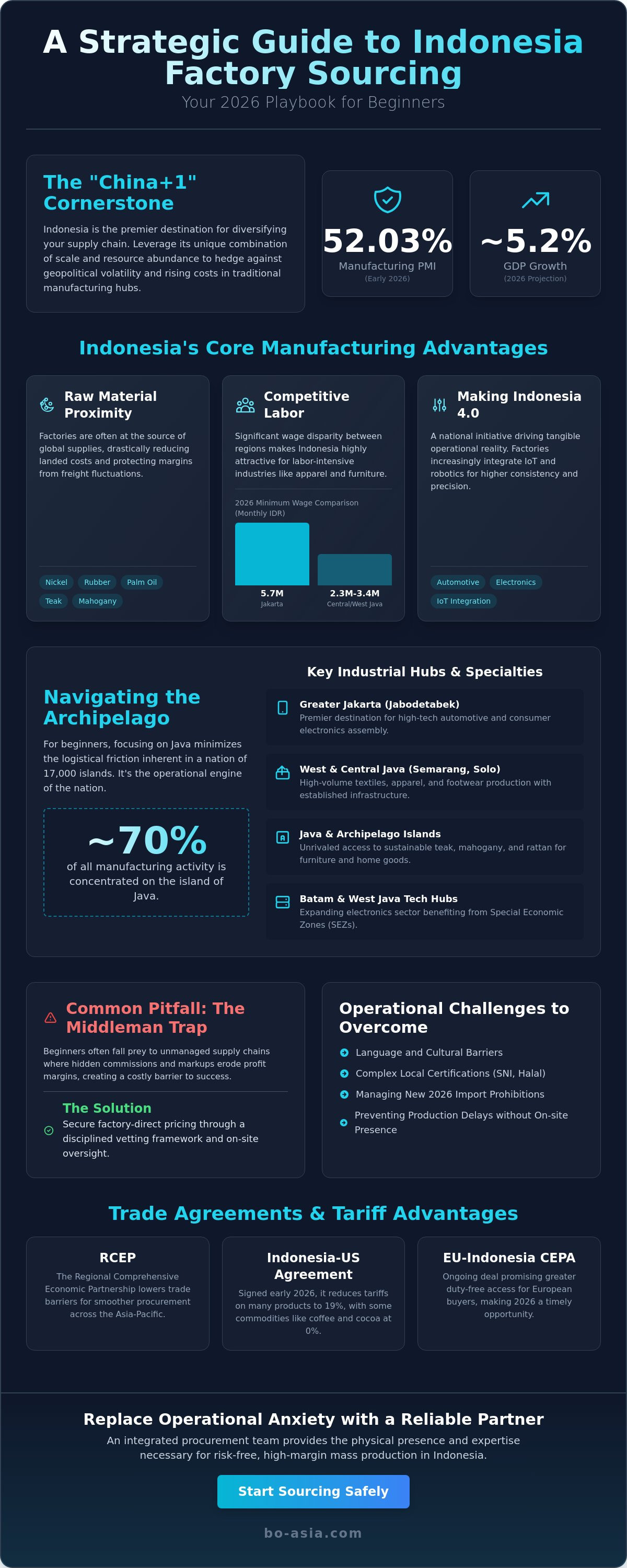
Digital directories provide a deceptive sense of security. For those entering the market, the distinction between a legitimate manufacturer and a high-margin trading company is often invisible. In Indonesia factory sourcing for beginners, the most common financial drain is the "hidden commission" model. Intermediaries frequently add substantial markups to the unit price while claiming to offer factory-direct rates. This lack of transparency doesn't just erode your margins; it creates a barrier between you and the technical reality of your production line.
The state of Indonesian manufacturing remains robust, but the industry's complexity allows middlemen to thrive by gatekeeping information. These agents often operate without any physical presence at the factory, relying on digital communication that fails when production issues arise. Without a direct line to the factory floor, you lose the ability to verify raw material origins or labor compliance. Relying on digital-only platforms leaves you vulnerable to entities that lack the authority to solve manufacturing crises.
A sustainable procurement strategy requires a 100 percent transparency model. You must verify that your supplier actually owns the machinery and employs the workforce. You can often spot a middleman on B2B directories by their overly broad product catalogs. A single factory rarely produces both high-end rattan furniture and consumer electronics. Identifying these inconsistencies early is vital. To understand how a managed approach eliminates these obscured costs and establishes direct factory relationships, see Why Buying Office Asia is the preferred choice for enterprises seeking total accountability.
Quality fade is a persistent risk in international manufacturing. It's the silent process where a supplier gradually substitutes cheaper materials or simplifies construction methods to increase their own profit after the first successful sample. This often happens alongside unauthorized sub-contracting. A factory may accept your high-volume order but secretly outsource it to a smaller, unvetted workshop to meet deadlines. Indonesia factory sourcing for beginners requires a dedicated procurement team to conduct regular, unannounced on-site inspections. This isn't an additional expense. It's a defense mechanism. It ensures that the technical specifications agreed upon during sampling are maintained throughout the entire mass production cycle. Physical proximity is the only way to prevent your brand's reputation from being compromised by unmanaged quality shifts.
Qualifying a supplier is your primary defense against operational failure. It's a technical process that transforms a list of prospects into a reliable production partner. For those navigating Indonesia factory sourcing for beginners, the first hurdle is the initial desk screening. You must verify the factory's Nomor Induk Berusaha (NIB) through the Online Single Submission (OSS) system. This Business Identification Number is the only verifiable proof of corporate legitimacy in 2026. If a supplier hesitates to provide their NIB, it's a clear signal to terminate the negotiation.
Once legitimacy is established, move to a technical capability assessment. You need to verify that the factory's machinery and workforce skill levels align with your product's complexity. Following this, conduct a certification audit. In 2026, compliance with SNI, Halal, and ISO standards is non-negotiable for most categories. Step four involves a deep dive into social and labor compliance. With Indonesia's new forced labor import restrictions effective as of April 15, 2026, ensuring ethical standards is a legal necessity to protect your brand. Finally, initiate sample development. This tests the factory’s ability to interpret your tech packs and replicate your design with precision.
The SNI (Indonesian National Standard) is often legally required for specific product categories. You should also understand the role of TKDN (Local Content Requirement), which measures the percentage of domestic components in a product. This is particularly relevant for industrial and tech-based sourcing. Halal certification has expanded beyond food. In 2026, it's a standard requirement for many cosmetics, chemicals, and pharmaceutical products manufactured within the archipelago.
You shouldn't wire a deposit based on digital photos alone. A physical audit is the only way to uncover hidden risks. During an on-site visit, look for disorganized production floors, a lack of safety gear, or poor waste management. These red flags often correlate with future quality issues and production delays. We maintain a high threshold for our partners; you can review the vetting standards for Our Suppliers to understand the level of rigor required. A dedicated procurement team provides the physical proximity needed to conduct these audits without you needing to fly across the globe. If you require an immediate on-site assessment of a potential partner, you can request a professional factory audit here.
The transition from research to execution is where most unmanaged supply chains fail. For those engaged in Indonesia factory sourcing for beginners, the primary hurdle isn't just finding a factory; it's maintaining the same level of oversight you'd expect from your own domestic operations. Buying Office Asia (BOA) functions as an integrated extension of your business, closing the gap between Western quality expectations and Indonesian manufacturing realities. Our model combines European management standards with deep local expertise, providing a stabilizing force in a market that often feels opaque to outsiders.
We reject the traditional intermediary model that thrives on obscured markups and hidden commissions. Instead, we facilitate factory-direct price negotiations that ensure every dollar of your budget is visible and optimized. By providing on-site mass production oversight, we prevent the batch defects and quality fade discussed in previous sections. Our team manages the technical dialogue with factory engineers, ensuring your specifications are met from the first prototype to the final container loading. This hands-on approach eliminates the risk of your order being secretly sub-contracted to unvetted workshops.
Our methodology covers the entire lifecycle of your order. We handle everything from initial Sourcing & Procurement to the final logistics coordination. With a dedicated presence in Helsinki and Hong Kong, we offer a communication bridge that operates in your time zone while our local Indonesian teams maintain physical proximity to the factory floor. This dual-layered approach has consistently delivered measurable results, as seen in our documented ROI and savings case studies. You gain the benefit of a global procurement department without the overhead or liability of maintaining regional offices.
In the 2026 landscape, a 5-star rating on a B2B directory is no substitute for professional vetting and on-site audits. We provide the technical rigor necessary for complex OEM projects, including custom product development and tooling support. Our goal is to eliminate the anxieties of international trade by providing a transparent, defensive shield around your supply chain. When you're ready to move beyond the risks of unmanaged sourcing and secure your production timeline, the next step is to onboard your dedicated sourcing team. Let's transform Indonesia's manufacturing potential into a secure, profitable reality for your brand.
The transition from a speculative interest to a stable production line requires more than a digital search. It demands a physical presence that can navigate the 2026 regulatory landscape and enforce quality standards on the factory floor. By replacing unmanaged intermediary models with a 100 percent transparency approach, you protect your margins from hidden markups and ensure your brand's reputation remains intact. Success in Indonesia factory sourcing for beginners depends on your ability to move beyond digital directories and establish direct, audited relationships with legitimate manufacturers.
Buying Office Asia provides the defensive shield your supply chain needs. Our European-managed oversight and on-the-ground presence in key Asian hubs ensure that your technical specifications are followed without compromise. We eliminate the middleman trap, offering you the same level of control and financial viability usually reserved for major enterprises. It's time to transform the complexities of the Indonesian archipelago into a streamlined, high-margin asset for your business. We look forward to helping you scale your operations with confidence and precision.
Secure your Indonesian supply chain with a dedicated procurement team.
Indonesia offers lower labor costs in 2026, especially in Central and West Java where minimum wages range between IDR 2.3 million and 3.4 million. This provides a clear financial advantage over China's rising industrial wages. While China remains dominant in complex electronics, Indonesia's raw material abundance in rubber and timber makes it the more cost-effective choice for high-volume furniture and apparel production.
You must verify a factory's NIB (Business Identification Number) through the Online Single Submission (OSS) system. This is the legal foundation for Indonesia factory sourcing for beginners to ensure corporate legitimacy. Beyond digital checks, you should request their taxpayer identification number (NPWP) and verify their physical address through an on-site audit to confirm they aren't a trading company posing as a manufacturer.
Indonesian factories typically offer more flexible Minimum Order Quantities than their Chinese counterparts. In the furniture sector, you can often mix multiple designs within a single 20-foot container. For apparel and textiles, MOQs generally start between 500 and 1,000 units per style. This flexibility allows your business to test market demand without committing to the massive volumes required by larger global hubs.
Export-oriented factory management and sales teams generally communicate effectively in English. However, technical instructions on the production floor are almost exclusively delivered in Indonesian. To avoid the risk of misinterpretation during mass production, it's vital to have a procurement team with local language skills. This ensures your tech packs are followed precisely by the workers actually operating the machinery.
The primary risks involve quality fade and unauthorized sub-contracting to unvetted workshops. Because manufacturing is spread across an archipelago, logistical bottlenecks at ports like Tanjung Priok can also lead to unforeseen delays. Managing these risks requires a consistent physical presence and regular on-site inspections. Without professional oversight, you're vulnerable to the operational setbacks that affect unmanaged supply chains in complex markets.
Sea freight from Indonesia to major ports in Europe or the US typically takes between 30 and 45 days. This timeline depends on whether your cargo is shipped directly from Jakarta or requires transshipment through Singapore. You should also account for an additional 7 to 10 days for customs clearance and inland transport. Planning your production schedule with these lead times is essential for maintaining inventory stability.
SNI stands for Standar Nasional Indonesia, and it's the mandatory certification for products sold on the Indonesian domestic market. While you don't always need it for exports, many global buyers use it as a baseline for quality and safety. If your product falls under regulated categories like toys or electronics, verifying a factory's SNI compliance is a strong indicator of their technical rigor and regulatory adherence.
Indonesia is a premier destination for sustainable rattan and SVLK-certified timber. The country's natural resource abundance allows for direct access to these materials, which reduces costs for eco-conscious brands. When engaging in Indonesia factory sourcing for beginners, you'll find that many manufacturers are also expanding into recycled plastics and organic textiles. This makes the region a strategic hub for brands prioritizing ethical and sustainable supply chains.

What if the safest payment deal isn’t the one that delays the most cash, but the one that releases it only when progress is verifiable? Payment terms negotiation with Asian suppliers is about balancing your working capital with the supplier’s need for confidence, not simply pushing for a smaller dep...

What if your biggest supply chain risk isn’t the supplier you chose, but what you can’t see after the order is placed? Asia procurement services can connect supplier selection with factory follow-through, giving you clearer visibility into production, product quality, and responsibilities along the...

A supplier listing can open a door, but it can’t show whether a factory is right for your order. Choosing a ningbo sourcing agent means looking beyond access to local suppliers: you need clear oversight of supplier vetting, production follow-up, and quality checks. Without defined responsibilities,...