


In 2025, Chinese police investigated 258,000 cases of telecom and online fraud, a figure that highlights the extreme sophistication of modern scammers. If you feel that a simple digital background check is no longer enough to protect your capital from ghost factories, your instincts are correct. Learning how to avoid supplier fraud in China now requires moving beyond online "verified" badges and into the realm of physical, on-site accountability. You already know that a single shipment of sub-standard goods can ruin years of brand building; you need a defense that's as rigorous as the risks you face.
This strategic guide promises to secure your supply chain by replacing digital guesswork with proven on-the-ground verification and professional safeguards. We will provide a foolproof checklist for supplier vetting, explain secure payment protocols that prevent "Hacker Scams," and analyze how the April 2026 Regulations on Industrial and Supply Chain Security impact your due diligence. By the end of this briefing, you will have the tools to ensure consistent product quality and financial security across every batch you order.
• Identify the digital red flags of AI-generated "ghost factories" to ensure your capital is never sent to a non-existent entity.
• Implement a 3-tier verification framework, including the NECIPS database, to master how to avoid supplier fraud in China.
• Establish a rigid financial protocol at the start of your relationship to neutralize the risk of hacker scams and misdirected wire transfers.
• Stop "quality fade" before it starts by using mass production oversight that keeps material standards consistent from the first sample to the final batch.
• Shift the power dynamic in your favor by maintaining a physical, on-site presence that forces suppliers to prioritize your production quality and deadlines.
The environment for international trade has shifted significantly. In 2025, Chinese authorities investigated over 250,000 cases of online and telecom fraud, proving that the digital marketplace is more hazardous than ever. Learning how to avoid supplier fraud in China is no longer about checking a few boxes on a B2B platform. It's about recognizing that modern scammers use generative AI to create hyper-realistic factory tours, professional websites, and falsified social profiles that can deceive even experienced buyers. Fraud ranges from "ghost factories" that vanish after a deposit to "quality fade," where a supplier slowly substitutes cheaper materials to pad their margins. You aren't just fighting a dishonest person; you're fighting a sophisticated digital operation.
Adopting rigorous procurement best practices is the only way to safeguard your capital. When you rely solely on digital data, you're looking at a curated facade. The financial impact of a mistake goes beyond the lost deposit. It includes the cost of replacing defective inventory, the damage to your brand's reputation, and potential legal liabilities. The April 2026 Regulations on Industrial and Supply Chain Security have also changed the stakes. These rules grant the government expanded powers to monitor supply chain security, meaning your due diligence must be both thorough and compliant with local laws.
Ghost factories remain a primary threat in 2026. These entities exist only in digital renderings; they use stolen photos of actual production lines or AI-generated video to appear legitimate. Then there's the "middleman trap." This occurs when an intermediary poses as the factory owner to inflate margins while hiding the actual production source. This lack of transparency makes it impossible to hold the real manufacturer accountable. We also see sophisticated document forgery. Scammers frequently alter the "Zhi Zhao" (Business License) or forge ISO and CE certifications to meet your requirements. They know exactly which watermarks and stamps to replicate to pass a cursory glance.
In 2026, a "Verified" badge on a sourcing platform is a baseline, not a guarantee of safety. These statuses are often gamed by actors who purchase established accounts or use sophisticated deepfakes to bypass verification protocols. Digital-only vetting fails because it cannot confirm physical reality. A professional website doesn't prove the existence of a single assembly line. Relying on software alone won't teach you how to avoid supplier fraud in China; only physical verification provides that level of security. This is why our sourcing and procurement strategy emphasizes physical proximity. Without a regional presence to conduct a surprise audit, you're essentially gambling on a digital avatar. Third-party data providers often lack the granular, on-the-ground access needed to verify a supplier's true operational capacity in the Asian market.
A Chinese Business License, or "Zhi Zhao," is often the first document a supplier provides, but it shouldn't be the last. In an era where digital forgery is commonplace, accepting a PDF at face value is a critical error. To understand how to avoid supplier fraud in China, you must move beyond static documents and utilize the National Enterprise Credit Information Publicity System (NECIPS). This database allows you to verify the company's registered capital, legal representative, and operational status directly with the government. If the registered capital hasn't been paid according to the 2024 Company Law mandates, or if the "scope of business" doesn't match the products you're buying, you've identified a major red flag.
True security comes from cross-referencing multiple data points. You should verify VAT numbers and export licenses against official records to ensure the entity is authorized for international trade. Organizations like the House Select Committee on the CCP have highlighted the prevalence of unlawful trade practices, reinforcing why deep due diligence is non-negotiable. Professional supplier vetting serves as your secondary shield, uncovering hidden risks that a basic background check might miss. If you're managing a complex project, it's often safer to consult with a regional expert before committing significant capital.
Your first layer of defense is the paper trail. Analyze bank account details with extreme scrutiny. The account name must match the name on the business license exactly; any request to pay a personal account or an offshore entity is a sign of potential fraud. You should also check for "abnormal operations" status in provincial records and review litigation history. A supplier with multiple labor disputes or contract breaches is a liability your brand doesn't need.
A physical visit is the only way to confirm that the machinery and production lines you saw in a video actually exist. During an audit, we interview key technical personnel to distinguish true manufacturers from resellers who simply rent office space. We also review raw material stocks and recent shipping logs. If a factory claims high-volume capacity but has empty warehouses and no recent outbound logs, they're likely outsourcing your order to an unvetted facility.
The "Golden Sample" strategy establishes a technical baseline for your entire production run. Don't just accept a prototype; have it tested by a third-party lab to verify material composition, such as specific steel grades or chemical safety standards. Factories often "hand-build" a perfect sample to win a contract, only to use inferior materials during mass production. Managing the sampling process ensures the quality you approve is the quality you receive in every container.
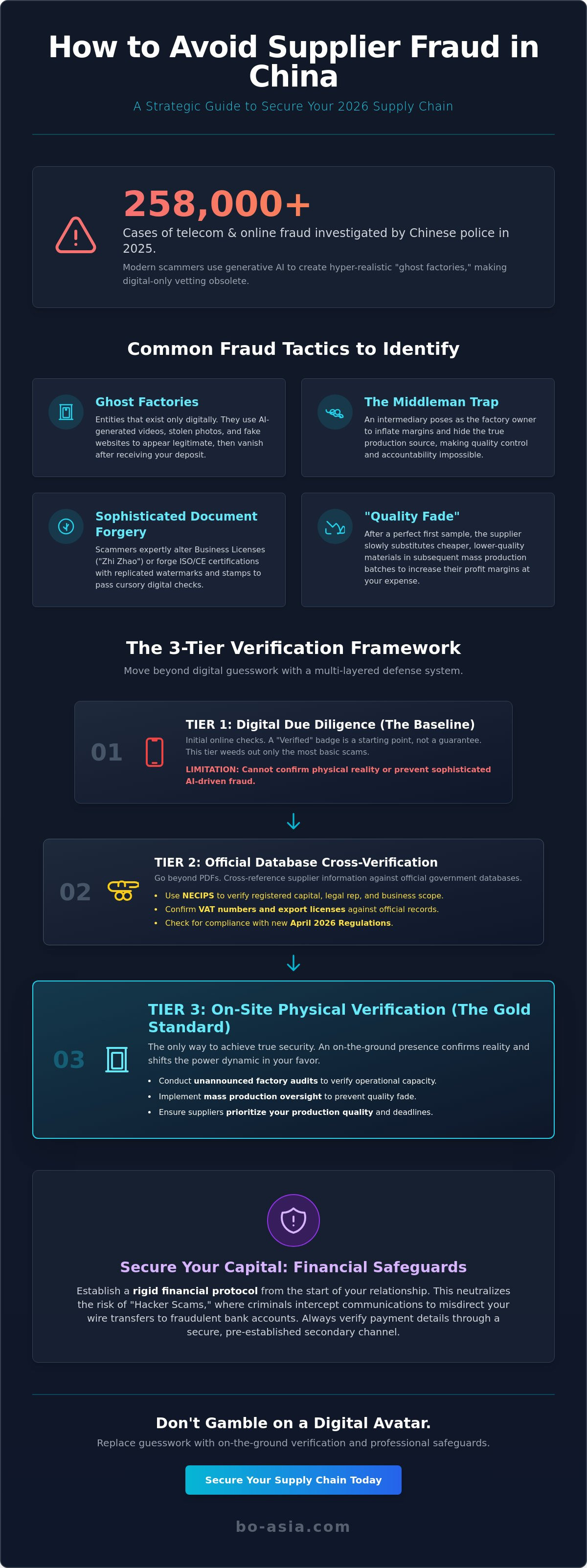
Financial integrity is the bedrock of a sustainable supply chain. Even after you've vetted a factory's physical capacity, your capital remains at risk from sophisticated digital interceptions. The "Hacker Scam," often referred to as Business Email Compromise, has become a primary method for diverting funds in 2026. Scammers compromise a supplier's email server and wait for the exact moment you're ready to send a large deposit. They then send a perfectly timed email claiming a "sudden change in bank details" due to an internal audit or a change in their corporate structure. Understanding how to avoid supplier fraud in China requires a rigid financial protocol that overrides all email-based instructions.
Never trust a notification of changed banking details sent via email, regardless of how legitimate the letterhead appears. By leveraging factory direct price negotiations, you establish a direct line of financial transparency that bypasses unverified intermediaries. This direct connection reduces the surface area for scams and ensures that your payment terms are documented and understood by the actual factory owners, not just a compromised sales account. A secure relationship is built on the steady confidence of established protocols, not the convenience of digital speed.
To secure your transactions, you must implement a multi-channel verification system. If a supplier requests a change in payment destination, verify this change via a known phone number or a video call with the legal representative you met during the audit. Never use the contact details provided in the suspicious email. Require a formal, physical "Bank Change Notification" that bears the official company seal (the "Chop"). Before initiating a full high-value deposit to a new account, send a small test payment. Only proceed with the remainder of the balance once the supplier confirms receipt of those specific funds in writing and via a secondary communication channel.
Choosing the right payment instrument is a strategic decision that balances risk and liquidity. For high-volume orders, a Letter of Credit (L/C) remains a powerful tool, as it ensures payment is only released upon the presentation of verified shipping documents. While direct T/T (Telegraphic Transfer) is common, it offers the least protection for the buyer. If you use T/T, ensure the pro-forma invoice features the factory's official "Chop." This red circular seal is a legal requirement in China; a pro-forma invoice without it lacks standing in the Chinese legal system. Mastering these financial nuances is a critical component of how to avoid supplier fraud in China and protecting your brand's financial health.
Quality fade is the silent erosion of your product's integrity. It is a deliberate, incremental reduction in material quality that often begins after the first successful shipment. While a supplier might provide a high-grade prototype to secure your contract, they may later substitute cheaper resins, thinner metals, or lower-quality components to protect their own margins. This tactic is especially common when global raw material prices rise. The supplier bets that your team won't notice minor deviations until the cumulative effect ruins your brand's reputation. Learning how to avoid supplier fraud in China means recognizing that fraud isn't always a one-time theft; it's often a slow, calculated process of corner-cutting.
Maintaining standards requires more than trust. It demands mass production oversight conducted by a team that understands the technical specifications of your product. By having eyes on the factory floor, you signal to the supplier that quality is a non-negotiable metric. If they know an inspector will measure material thickness at random intervals, the incentive to cut corners disappears. This proactive stance is what separates successful brands from those that eventually succumb to quality drift. If you're concerned about your current production consistency, speak with our regional specialists to establish a tighter control framework.
A robust defense relies on a multi-stage inspection strategy. During Production (Dupro) inspections occur when 20% to 50% of your order is finished. This allows you to catch systemic errors early enough to rectify them without missing your shipping deadline. The Final Random Inspection (FRI) serves as the last line of defense before the balance is paid. Finally, Container Loading Supervision (CLS) ensures that the specific cartons that passed inspection are the ones actually loaded into the container, preventing switch scams at the last minute.
You must define what quality means in technical terms before production begins. We utilize Acceptable Quality Levels (AQL) to set clear boundaries. Every defect is categorized as Critical (safety or legal issues), Major (functional failures), or Minor (cosmetic flaws). By including these limits and a "Right to Reject" clause in your contract, you create financial consequences for non-compliance. When a supplier knows that failing an inspection results in a rejected batch and delayed payment, they're far more likely to adhere to your approved baselines. Establishing these benchmarks is a fundamental part of how to avoid supplier fraud in China while ensuring long-term product viability.
Distance is a scammer's greatest ally. When you manage a supply chain from a different continent, you're operating with a significant information deficit. Establishing a physical presence in Hong Kong or Mainland China fundamentally shifts the power dynamic in your favor. Suppliers treat "overseas buyers" differently than they treat a team that can arrive at their factory gates within a few hours. This proximity creates an "Insider Effect" where the risk of being caught in a lie outweighs the potential profit of a scam. Understanding how to avoid supplier fraud in China ultimately comes down to closing the geographical and cultural gap that scammers exploit.
Our model combines European leadership in Helsinki with deep local expertise in Hong Kong to provide a seamless bridge for your business. This hybrid structure ensures that your strategic goals are understood while your tactical interests are protected on the factory floor. By positioning your brand as part of a dedicated Asia procurement team, you gain the leverage usually reserved for multinational corporations. You aren't just another order in a queue; you're a managed account with professional oversight that deters quality fade and financial manipulation.
Conventional intermediary models often obscure the very risks they claim to mitigate. Many commission-based agents survive on kickbacks from factories, which creates a conflict of interest that leaves you vulnerable. Buying Office Asia operates as a procurement partner, providing 100% transparency on factory-direct pricing. We've seen numerous cases where on-the-ground management identified a "factory" that was actually a small trading office posing as a manufacturer. By removing these layers, you reduce your costs and eliminate the "Middleman Trap" discussed earlier in this guide. This transparent approach is the most effective way to master how to avoid supplier fraud in China and ensure your capital is working for you, not an unvetted third party.
Sustainable growth requires moving from transactional interactions to strategic supplier management. In 2026, this includes a heavy emphasis on supply chain management that incorporates ESG and ethical audits. A supplier who is ethically compliant is statistically less likely to engage in the fraudulent practices that ruin brand reputations. We help you build a resilient network where accountability is the standard, not the exception. If you're ready to secure your manufacturing future and eliminate the anxieties of international sourcing, contact Buying Office Asia for a risk assessment. Our team is ready to function as a protective, integrated extension of your own business.
Securing your capital in the 2026 manufacturing landscape requires a shift from passive trust to active, on-the-ground defense. You've seen how digital "verified" badges and AI-generated factory tours can be gamed; true security lies in physical audits and the rigorous use of the NECIPS database. By implementing multi-channel financial protocols and setting strict AQL limits for mass production, you neutralize the risks of hacker scams and quality fade before they impact your bottom line. These strategic layers transform your procurement from a source of anxiety into a stable, financial asset.
Mastering how to avoid supplier fraud in China is ultimately about proximity and professional oversight. As a European-managed firm with headquarters in Hong Kong, we provide the regional presence and 100% transparency on factory-direct pricing that your business needs to thrive. Our proven track record in high-volume mass production oversight ensures that your brand reputation remains intact across every shipment. We dismantle the barriers of distance and communication to protect your interests at the source.
Secure your supply chain today; contact our expert team in Asia for a free consultation. We look forward to becoming the protective, results-oriented partner your business deserves.
The most immediate warning sign is a request for payment to a personal bank account or an entity whose name doesn't match the business license exactly. Legitimate manufacturers use corporate accounts that align with their registered "Zhi Zhao" details. Any deviation, especially when paired with high-pressure tactics for a quick deposit, indicates a high risk of capital loss or an unvetted intermediary posing as a factory.
Trade Assurance provides a basic level of digital security, but it's not a foolproof solution for complex manufacturing. It primarily covers non-delivery or major contract breaches but often fails to protect against "quality fade" or sophisticated hacker scams. Relying solely on platform badges won't replace the security of on-site inspections and independent verification of a supplier's physical production capacity.
You must cross-reference the license number through the National Enterprise Credit Information Publicity System (NECIPS). This official government database reveals a company's registered capital, legal representative, and authorized business scope. If the supplier's actual operations don't match their registered scope, or if their capital contribution hasn't met the 2024 Company Law requirements, the license is likely being used deceptively.
Stop all financial transactions immediately and verify the request through a secondary, non-email channel like a video call. This is a primary indicator of a "Hacker Scam" where scammers compromise email servers to intercept funds. Never accept bank changes via email alone; insist on a physical document bearing the company's official red seal (the "Chop") before proceeding with any payment.
Implementing consistent mass production oversight is the only way to deter quality fade. By conducting "Dupro" (During Production) inspections, you ensure that the factory doesn't substitute cheaper raw materials once the initial "Golden Sample" is approved. This physical presence on the factory floor reminds the supplier that quality standards are monitored throughout the entire production cycle, not just at the start.
Your first step should be reporting the incident to the local Public Security Bureau (PSB) as a criminal fraud case rather than a civil contract dispute. Criminal cases often move faster and carry more weight in the Chinese legal system. It's also vital to consult with local legal experts who understand the April 2026 supply chain security regulations to determine if your data collection and due diligence were compliant.
Audit costs depend on the complexity of your product and the geographical location of the facility. While we don't quote specific service fees here, the investment in a professional audit is significantly lower than the financial ruin of a lost container or a ruined brand reputation. Most established businesses view these audits as a necessary insurance policy for their international procurement strategy.
A dedicated procurement team provides a strategic advantage by combining factory-direct price negotiations with rigorous vetting protocols. This integrated approach is a fundamental part of how to avoid supplier fraud in China. By acting as an extension of your own team, a professional partner ensures that you receive the most competitive pricing without sacrificing the security of on-the-ground quality control and financial safeguards.

What if your biggest supply chain risk isn’t the supplier you chose, but what you can’t see after the order is placed? Asia procurement services can connect supplier selection with factory follow-through, giving you clearer visibility into production, product quality, and responsibilities along the...

A supplier listing can open a door, but it can’t show whether a factory is right for your order. Choosing a ningbo sourcing agent means looking beyond access to local suppliers: you need clear oversight of supplier vetting, production follow-up, and quality checks. Without defined responsibilities,...

What if the supplier with the strongest online profile isn’t the factory best suited to your shoes? In footwear manufacturing in China, a directory listing can start your search, but it can’t confirm who will make your product, whether the factory can handle its construction and materials, or how cl...