


The most expensive error you can make in 2026 isn't choosing the wrong factory; it's believing you can manage a complex international supply chain from a desk thousands of miles away. You likely feel the mounting pressure of rising labor costs, such as Shanghai’s RMB 2,740 monthly minimum wage, alongside the extreme volatility of raw material prices. It's exhausting to battle hidden middleman markups and quality inconsistencies while trying to protect your business margins from shifting trade policies.
We understand that these anxieties are real. This guide identifies the common mistakes when sourcing from Asia that drain your profitability and provides the strategic framework needed for secure, factory-direct procurement. You'll learn how to navigate new regulatory hurdles, such as China’s updated export licensing catalogs, and establish a transparent, hands-off supply chain. We will examine twelve critical pitfalls and the precise steps you must take to ensure reliable quality control and financial optimization in an increasingly complex global market.
• Replace digital reliance with physical factory audits so sampling errors don't snowball into catastrophic mass production losses.
• Bridge the gap between European design expectations and Asian production logic to mitigate the technical risks of the "yes" culture.
• Secure your margins by eliminating hidden middleman markups and gaining full visibility into your factory-direct supply chain.
• Identify why destination-port inspections are a reactive failure and how to preempt common mistakes when sourcing from Asia through on-site oversight.
• Transition from high-risk transactional sourcing to a strategic partnership managed by a dedicated, European-led team physically present in the region.
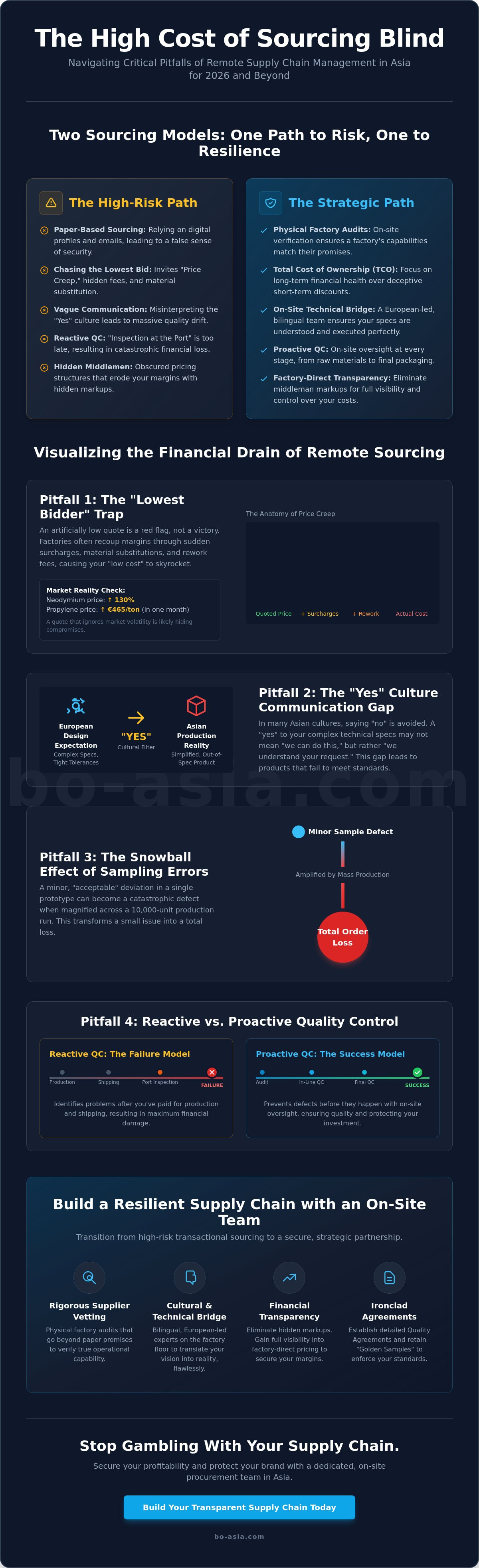
Managing a supply chain entirely from a laptop is one of the most common mistakes when sourcing from Asia. We define this as "paper-based sourcing," where procurement decisions rely on digital profiles, polished PDF presentations, and email threads rather than physical, on-site audits. While digital platforms provide a convenient entry point into global sourcing, they cannot verify the operational reality of a factory floor. Relying on paper leads to a false sense of security that often collapses during the transition from sampling to mass production.
Small errors in the sampling stage frequently snowball into massive financial losses. A minor tolerance issue or a slight deviation in material grade might seem manageable in a single prototype. However, when those defects are amplified across a high-volume production run, the cost of rework, disposal, and lost time can exceed the value of the entire order. Integrating rigorous supplier vetting early in your process is the only way to ensure the factory's technical capabilities match their digital promises.
Chasing the lowest quote is a strategy that frequently invites "Price Creep." Factories often submit an artificially low bid to win your business, only to recoup their margins through sudden surcharges or technical adjustments once production has started. This bottom-dollar pricing also correlates directly with material substitution. With raw materials like Neodymium seeing a 130% increase through early 2026, a supplier offering a price that defies market logic is likely swapping high-quality inputs for inferior alternatives. Factory-Direct pricing must still account for sustainable margins to ensure product integrity and supplier stability.
True profitability isn't found in the unit price alone. You must account for the Total Cost of Ownership, which includes logistics, import duties, and the cost of capital tied up during long lead times. In 2026, shipping and raw material volatility remain significant factors. For instance, Propylene prices increased by approximately €465 per ton in April 2026 alone. These fluctuations can quickly erase the perceived savings of a cheap factory. We've found that transparency in sourcing and procurement fees provides a much higher return on investment than "free" agent services that hide their markups within the unit cost. By identifying these common mistakes when sourcing from Asia, you can move toward a model that prioritizes measurable, long-term financial health over short-term discounts.
One of the most persistent and misunderstood common mistakes when sourcing from Asia is misinterpreting the local "Yes" culture. In many Asian manufacturing hubs, saying "no" to a client is viewed as a loss of face or a sign of incompetence. Consequently, a factory manager might agree to complex technical requirements that their facility isn't actually equipped to handle. This creates a dangerous gap between European design expectations and the reality of Asian production logic. Without an authoritative, bilingual presence on the factory floor, these subtle miscommunications remain hidden until the final product fails to meet your standards.
To avoid these pitfalls, businesses must move beyond simple email correspondence. Relying on digital communication for complex OEM manufacturing projects is a recipe for quality drift. You need a team that speaks the language of the factory floor and understands the technical nuances of your blueprints. If you're concerned about your current supplier's ability to interpret your designs, it's likely time to discuss your production requirements with a regional expert who can bridge this gap.
Assuming that "standard" terms carry the same meaning across borders is a high-risk gamble. For instance, what a factory in Vietnam classifies as "304 stainless steel" may differ significantly from European industrial standards. To prevent this, you must establish a Quality Agreement that supersedes the purchase order. This document should detail every material grade, tolerance, and finishing requirement. Additionally, your team should sign and retain "Golden Samples" on-site at the factory. Leaving the only reference sample in the hands of the manufacturer is a strategic error; you must have a physical benchmark to hold the factory accountable during mass production.
Time-zone discrepancies often exacerbate production errors. A design clarification sent from Helsinki at 4:00 PM arrives long after the Hong Kong factory has closed. By the time you receive a response the next morning, a full 24-hour production cycle may have already been completed with the wrong specifications. Email is the least effective tool for resolving these bottlenecks. Real-time reporting from the ground to your HQ is essential for maintaining a resilient supply chain. Implementing a multi-sourcing best practice can also help mitigate these risks by ensuring you aren't entirely dependent on a single communication channel or supplier region.
Entrusting your supply chain to an opaque intermediary is among the most damaging common mistakes when sourcing from Asia. Many importers rely on commission-based agents who claim to simplify the procurement process. However, there's a fundamental difference between a traditional agent and a transparent dedicated sourcing team. While an agent often obscures the factory's identity to prevent you from going direct, a dedicated team functions as an extension of your own company, providing full visibility into every transaction.
The "kickback" culture remains a significant threat to your margins. In these scenarios, an agent may accept a service fee from you while simultaneously taking a hidden commission from the factory. This dual-sided payment structure creates a conflict of interest that incentivizes the agent to protect the supplier's mistakes rather than your quality standards. Achieving true factory-direct pricing requires 100% transparency, where you pay the manufacturer directly and understand exactly what you're paying for oversight.
When you don't know who's actually making your goods, you lose control over your intellectual property and production consistency. Middlemen frequently switch factories without notice to increase their own margins, often moving your production to a facility with lower ethical standards or inferior machinery. To protect your brand, you must verify whether you're communicating with a genuine manufacturer or a trading company. You can identify trading companies by their broad product ranges and lack of specific ISO certifications tied to a physical production site. Unvetted intermediaries significantly increase the risk of IP theft, as they may shop your designs around to multiple factories to find the lowest bidder.
The "no-fee" sourcing model is a financial illusion. If an agent isn't charging you a transparent service fee, they're likely recouping their costs through significant hidden markups on the unit price. When you deconstruct the math, these opaque models are almost always more expensive than professional procurement services that charge a flat fee or a clear percentage. Professional oversight pays for itself through reduced defect rates. By choosing a partner who prioritizes transparency over convenience, you eliminate the obscured costs that drain your profitability. Identifying these common mistakes when sourcing from Asia is the first step toward reclaiming your financial health.
Inspecting your goods only after they arrive at your destination port is a high-stakes gamble that rarely ends in your favor. By the time you discover a defect in a warehouse in Rotterdam or Los Angeles, you've already settled the supplier's balance, paid import duties, and waited weeks for transit. This is among the most costly common mistakes when sourcing from Asia because it leaves you with zero leverage. If the batch is unsellable, your only options are expensive local rework or total disposal. Both choices destroy your profit margins and disrupt your inventory cycles.
Many importers skip the pre-shipment inspection (PSI) to "save time" or shave a few hundred dollars off their overhead. This is the 12th mistake on our list and often the most catastrophic. Without a PSI, you're flying blind. Quality Drift is also a real risk where a factory gradually relaxes tolerances or substitutes cheaper components over several months of production to increase their own margins. Maintaining a consistent on-site presence is the only way to uphold ESG standards and ethical compliance. It ensures your brand isn't associated with unauthorized labor practices or environmental violations that occur when oversight is absent.
We verify raw materials and components before the assembly line starts. This prevents the "wrong material" disaster before it's too late to turn back.
We catch defects when only 20% of the order is finished. This allows for immediate course correction without the need to discard an entire production run.
This serves as your last line of defense. We inspect a statistically significant sample of finished goods before the container is sealed and the final payment is triggered.
Auditing a facility is useless if that factory then subcontracts your order to a low-quality "ghost" workshop. This unauthorized subcontracting often happens when a factory is overbooked or seeks to increase its margin by using cheaper, unvetted labor. Unannounced on-site visits are the only way to verify that the facility you vetted is the one actually producing your goods. Implementing rigorous mass production oversight ensures that your specifications are followed from the first unit to the last. If you're ready to secure your supply chain with professional oversight, contact our regional team to schedule a factory audit.
Correcting the common mistakes when sourcing from Asia requires more than a change in tactics; it demands a structural shift in how you manage your supply chain. Moving from a transactional model to a strategic partnership is the only way to secure long-term financial stability. A European-managed office located physically within the region functions as your defensive barrier against quality drift and obscured costs. By positioning a dedicated Asia procurement team on the ground, you eliminate the information asymmetry that middlemen use to inflate their margins. You can review our documented savings examples to see the measurable impact that professional, factory-direct management has on the bottom line.
This approach transforms your procurement from a series of high-risk gambles into a controlled, professional briefing. You're no longer reacting to production stalls or shipping delays. Instead, you're operating with the same level of oversight usually reserved for major global enterprises. This steady confidence allows you to focus on scaling your business while we handle the technical rigors of supplier management and regulatory adherence.
The psychological impact of a local presence cannot be overstated. When a factory owner knows your team can conduct an unannounced visit tomorrow, the incentive to switch materials or prioritize other clients vanishes. This physical proximity is your primary promise of accountability. Beyond quality, our team manages the intricate web of local logistics and customs documentation that often causes port delays. Our Helsinki-Hong Kong bridge ensures that your project never sleeps; while your headquarters closes for the day, our regional experts are already on the factory floor resolving bottlenecks. This seamless coordination is what prevents the common mistakes when sourcing from Asia from ever reaching your warehouse.
If you suspect your current supply chain is vulnerable, use this three-point checklist to identify hidden risks:
Ask for the physical address of the production site and verify if the ISO certifications match that specific location.
Request a transparent breakdown of material costs, labor, and the intermediary's service fee. A refusal to provide this is a red flag.
Insist on a video call with the actual production manager, not just a sales agent.
It's time to reclaim control over your manufacturing outcomes. We invite you to contact Buying Office Asia for a professional supply chain audit. We will help you dismantle inefficient intermediary models and establish a secure, factory-direct framework that prioritizes your financial health and brand reputation.
Transitioning from unmanaged risk to strategic oversight is no longer optional in a market defined by volatile material costs and complex regulatory shifts. By addressing the common mistakes when sourcing from Asia, you've identified that sustainable profitability depends on physical proximity and absolute transparency. Relying on digital profiles or opaque middlemen creates structural vulnerabilities that modern businesses cannot afford to ignore. Instead, you can leverage a model built on European management from Helsinki and a dedicated, on-the-ground presence in Hong Kong and key manufacturing hubs.
This professional framework ensures 100% transparency with zero hidden markups, allowing you to reclaim total control over your margins and product quality. Your supply chain should be a source of competitive advantage rather than a series of unforeseen expenses. We provide the steady confidence of an established expert to help you navigate these complexities with ease. Take the first step toward a managed, factory-direct future today. Eliminate sourcing risks with your dedicated Asia procurement team and build a resilient foundation for your international growth.
The most frequent error is trusting digital profiles and email correspondence without performing a physical on-site audit. Digital presence can be easily fabricated, leading to partnerships with entities that lack the technical capacity to fulfill your order. By failing to verify the factory floor, you risk entering a relationship based on assumptions rather than operational reality. This oversight is a fundamental source of the common mistakes when sourcing from Asia that lead to mass production failure.
You can identify a trading company by their broad and unrelated product catalogs. A genuine manufacturer focuses on a specific production niche and holds ISO certifications tied to their physical facility address. Requesting a live video tour of the production line or reviewing their business license for "manufacturing" versus "trading" scope provides immediate clarity. Trading companies often operate from office buildings rather than industrial zones and lack on-site machinery.
Going direct to the factory offers the lowest unit price, but only if you have the regional resources to manage the technical rigors. Traditional commission-based agents often claim to be "free" while embedding significant markups into your unit costs. A transparent procurement team charging a professional fee is typically more cost-effective. This model eliminates hidden margins and reduces the financial impact of defective goods, ensuring you achieve true factory-direct pricing.
A robust contract must include detailed technical specifications, acceptable quality levels (AQL), and clear lead times. It's essential to define "Golden Samples" as the binding benchmark for mass production. You should also include penalty clauses for late delivery or non-compliance with material standards. This document serves as a defensive tool that establishes clear accountability and financial consequences for any deviation from your design requirements or ethical standards.
Preventing quality drift requires consistent on-site oversight throughout the entire production cycle. Relying solely on a final inspection is insufficient because it doesn't account for the gradual relaxation of tolerances or material substitution. Implementing During Production Inspections (DUPRO) allows you to catch and correct deviations when only 20% of the order is finished. This proactive approach ensures that the last unit produced matches the quality of the approved sample and your initial specifications.
An Alibaba Gold Supplier status indicates that a company has paid for a premium membership, not that they are a high-capacity manufacturer. While it provides a basic level of verification, it doesn't substitute for a comprehensive factory audit. For high-volume orders, you must verify their production machinery, labor force size, and previous export history. This ensures they can handle the scale and technical complexity of your project without unauthorized subcontracting.
"Free" sourcing services operate on a conflict of interest, as the agent often receives kickbacks from the factory to protect the supplier's interests. This model obscures the true factory-direct price and incentivizes the agent to hide production errors or material substitutions. These hidden markups often result in you paying significantly more than the market rate while receiving zero protection against the common mistakes when sourcing from Asia that compromise brand reputation.
A European-managed buying office acts as a stabilizing force by bridging the communication gap between your headquarters and the factory floor. With a physical presence in hubs like Hong Kong, our team provides real-time reporting and immediate intervention. This model eliminates the risks of unmanaged supply chains by ensuring that European quality standards and ethical compliance are enforced on-site. It provides the same level of oversight usually reserved for major enterprises while protecting your financial health.

What if your biggest supply chain risk isn’t the supplier you chose, but what you can’t see after the order is placed? Asia procurement services can connect supplier selection with factory follow-through, giving you clearer visibility into production, product quality, and responsibilities along the...

A supplier listing can open a door, but it can’t show whether a factory is right for your order. Choosing a ningbo sourcing agent means looking beyond access to local suppliers: you need clear oversight of supplier vetting, production follow-up, and quality checks. Without defined responsibilities,...

What if the supplier with the strongest online profile isn’t the factory best suited to your shoes? In footwear manufacturing in China, a directory listing can start your search, but it can’t confirm who will make your product, whether the factory can handle its construction and materials, or how cl...