


A digital directory is a liability, not a sourcing strategy. While a quick search might yield hundreds of leads, finding a manufacturer in Malaysia who can actually meet global quality standards requires more than an internet connection. You have likely felt the anxiety of potentially dealing with hidden middlemen who inflate margins or the uncertainty of whether a factory's "certified" status holds up during an unannounced floor inspection. We understand that your reputation depends on the integrity of your supply chain. You cannot afford the operational setbacks or unforeseen expenses that come with unmanaged production.
This 2026 strategic guide provides the on-the-ground insights you need to bypass intermediaries and secure factory-direct pricing. You'll learn how to navigate the regional specializations of the Penang, Selangor, and Johor industrial hubs while implementing vetting processes that ensure zero-defect oversight. We will break down the latest regulatory shifts, including mandatory e-invoicing and the 2026 chemical import amendments, so your procurement remains compliant and financially viable. This briefing serves as your roadmap for building a vetted, high-performance manufacturing partnership in one of Southeast Asia's most sophisticated industrial markets.
In this guide:
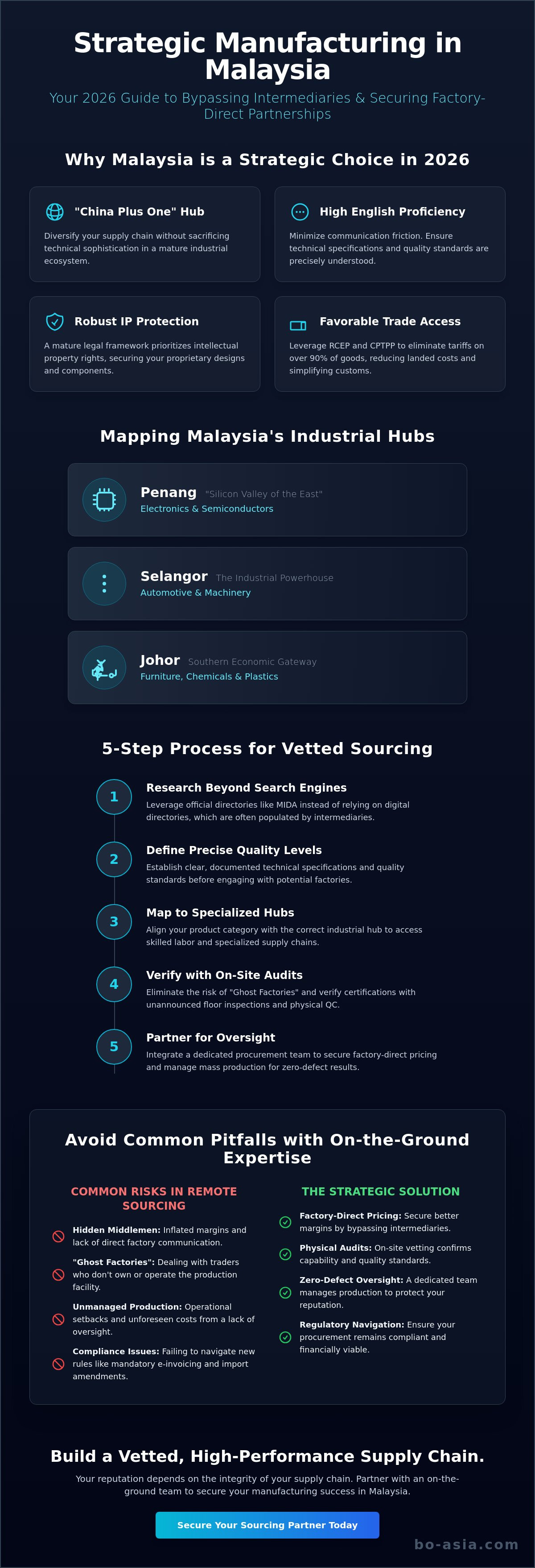
Identify the strategic advantages of Malaysia's "China Plus One" positioning and high English proficiency for technical manufacturing.
Master the 5-step process for finding a manufacturer in Malaysia by leveraging official directories and defining precise quality levels.
Map your production to the correct industrial hub, such as Penang for electronics or Selangor for automotive and machinery.
Eliminate the risk of "Ghost Factories" through on-site audits and physical quality control that remote vetting can't provide.
Secure factory-direct pricing and mass production oversight by integrating a dedicated procurement team into your supply chain.
Finding a manufacturer in Malaysia has become a cornerstone of the "China Plus One" strategy for brands seeking to diversify their supply chains without sacrificing technical sophistication. Unlike some regional neighbors, Malaysia offers a mature industrial ecosystem backed by a legal framework that prioritizes intellectual property protection. This security is essential for international brands outsourcing high-value components or proprietary designs. For a broader economic overview of Malaysia, it's clear that the manufacturing sector remains the engine of national growth, contributing significantly to the GDP through high-tech exports. The country’s commitment to international standards is reflected in its robust regulatory environment, which provides a stabilizing force in a complex global market.
Communication friction is a hidden cost that often derails international procurement. Malaysia’s high English proficiency levels ensure that technical specifications, quality standards, and contract negotiations are understood with precision. This linguistic alignment reduces the risk of production errors and accelerates the product development cycle. When you're finding a manufacturer in Malaysia, you aren't just looking for a vendor; you're looking for a partner capable of executing complex instructions without the need for constant translation or cultural mediation. This directness in communication mirrors the operational efficiency required for successful long-term partnerships.
By 2026, the Regional Comprehensive Economic Partnership (RCEP) and the Comprehensive and Progressive Agreement for Trans-Pacific Partnership (CPTPP) have fundamentally reshaped the cost structures of Southeast Asian trade. These agreements eliminate tariffs on over 90% of goods traded between member nations, providing a significant financial advantage for high-volume exporters. Malaysia serves as a strategic gateway to the ASEAN market, offering simplified customs procedures that shorten lead times. For your business, this means lower landed costs and a more agile response to market demand. These frameworks also enforce higher labor and environmental standards, ensuring your supply chain remains ethically sound and compliant with global ESG requirements.
Efficiency on the factory floor is meaningless if your goods are stalled at the border. Malaysia’s logistics infrastructure is anchored by Port Klang and the Port of Tanjung Pelepas, both of which rank among the most efficient maritime hubs globally. The national power grid provides the stability required for continuous mass production, a critical factor for energy-intensive sectors like electronics and automotive parts. Additionally, the expansion of Digital Free Trade Zones (DFTZ) has streamlined the movement of goods, allowing for faster cross-border e-commerce and bulk shipments. This sophisticated network ensures that your products move from the assembly line to the shipping container with minimal delay, protecting your margins and your delivery schedules.
Successful procurement isn't just about identifying a vendor; it's about positioning your production within the right ecosystem. When finding a manufacturer in Malaysia, you must recognize that industrial capacity is segmented by state. This regional specialization allows factories to share skilled labor pools and maintain proximity to specialized raw material suppliers. These factors directly impact your lead times and total landed costs. According to the Malaysian Investment Development Authority (MIDA), these established clusters are the primary drivers of the nation's industrial output and efficiency.
Choosing a factory outside its relevant hub often leads to hidden logistical costs and a lack of technical support. If you're looking for furniture, chemicals, or plastics, Johor is the strategic choice, especially given its proximity to Singapore. For rubber and wood-based products, the regions of Kedah and Perak offer specialized expertise rooted in local natural resources. Matching your product category to the correct geographic hub is the first step toward securing a reliable supply chain.
Penang remains the undisputed "Silicon Valley of the East." This region hosts a dense network of multinational corporations and high-tier local suppliers specializing in Electrical & Electronics (E&E) and medical devices. If your project requires high-precision custom product and tooling development, Penang is the logical starting point. The workforce here is exceptionally trained for high-tech assembly and semiconductor testing. This ensures that your mass production meets rigorous global standards without the quality fluctuations common in less specialized regions.
Selangor, specifically the Klang Valley, serves as the industrial heart for heavy engineering and automotive manufacturing. The clusters in Shah Alam and Subang are home to a sophisticated network of automotive component manufacturers and aerospace engineering firms. The primary advantage of this region is its immediate proximity to Port Klang. This logistics edge simplifies the transport of heavy machinery and large-volume shipments. For businesses finding a manufacturer in Malaysia for complex mechanical assemblies, Selangor provides the infrastructure and technical depth necessary for large-scale operations.
Selecting the wrong industrial hub can create unnecessary bottlenecks in your supply chain. If you're uncertain which region aligns with your technical requirements, it's beneficial to consult with on-the-ground experts who can provide a vetted shortlist of factories. This ensures your production is based in a region with the right talent and infrastructure to support your growth.
Strategic sourcing in Malaysia requires a disciplined approach to risk mitigation. It's not enough to send a blast email to a dozen leads and hope for a competitive quote. You need a structured methodology to filter out the noise and identify partners who can sustain high-volume production. Start by defining your product specifications and Acceptable Quality Levels (AQL) in exhaustive detail. Without these benchmarks, you leave the door open for interpretation and quality drift during the manufacturing process. The Malaysian Investment Development Authority (MIDA) provides a high-level view of industry capabilities, but the granular vetting of individual facilities remains your responsibility.
Finding a manufacturer in Malaysia who aligns with your financial and quality goals involves more than just a digital search. You must verify that a factory's stated capacity matches its actual output. Never approve mass production based on a digital render or a single "golden sample." Request physical samples and subject them to rigorous stress tests. Once a sample is approved, perform a comprehensive supplier vetting and factory audit to confirm their ethical standards and machinery maintenance schedules. This on-site presence is the only way to ensure the factory you've vetted is the one actually running your production lines.
B2B platforms like Alibaba often host trading companies masquerading as factories. While these sites are useful for preliminary research, they don't replace the depth of local networks. Trade shows in Kuala Lumpur offer a chance for face-to-face engagement, but the most reliable mid-sized factories often operate via word-of-mouth. This is where having a dedicated Asia procurement team becomes a strategic asset. We provide access to suppliers who don't rely on digital advertising and offer more competitive, factory-direct pricing as a result.
Shortlisting begins with rigorous documentation checks. Verify that the factory holds relevant international certifications, such as ISO 9001 for quality management or ISO 14001 for environmental standards. You must also verify their business license through the Companies Commission of Malaysia (SSM). If a contact cannot provide an SSM profile, they aren't a legitimate entity. Look for a proven export history to Western markets; this signals that they understand the compliance and quality expectations of your home region. Identifying whether a contact is a factory or a trading company is critical to avoiding the hidden margins that erode your profitability.
A digital listing is not a guarantee of operational reality. While finding a manufacturer in Malaysia has become easier through online platforms, the risk of "Ghost Factories" remains a significant threat to your capital. These entities often present a professional digital facade but lack the actual machinery or labor to fulfill your order. In many cases, they act as unvetted intermediaries, outsourcing your production to sub-tier workshops where quality standards are non-existent. Remote vetting via video calls or emailed certifications is insufficient for mass production oversight. You must have eyes on the factory floor to verify that the facility you've contracted is the one actually producing your goods.
Protecting your brand reputation requires a commitment to ethical compliance and ESG standards. Malaysian manufacturers are increasingly scrutinized for labor practices and environmental impact. An unmanaged supply chain leaves you vulnerable to legal and reputational damage. By conducting physical audits, you ensure that your partners adhere to the rigorous standards expected by global markets. This level of diligence transforms your supply chain from a point of vulnerability into a stable, competitive asset.
A professional on-site audit goes beyond a simple walkthrough. You must verify machinery maintenance logs to ensure that equipment is capable of maintaining tolerances over long production runs. Reviewing raw material sourcing and storage conditions is equally critical; improper storage of plastics or textiles in Malaysia’s humid climate can lead to immediate batch failure. A professional audit must include a review of the factory’s internal QC lab and testing equipment. This verification ensures that the manufacturer can perform real-time quality checks rather than relying on guesswork. For a deeper look at these protocols, consult our guide on Supplier Vetting in Asia.
Quality control is a continuous process, not a final event. We utilize ISO 2859-1 standards to implement rigorous sampling plans during the pre-production, during-production, and post-production stages. This statistical approach allows us to identify and correct batch defects before the goods ever leave the Malaysian port. If a defect is caught at the factory, the cost of rectification is the manufacturer's burden. If it's caught at your warehouse, it's a loss for your business. Implementing these oversight protocols ensures that your mass production remains consistent and profitable.
Risk is a choice. You can rely on the promises of a distant vendor, or you can secure your investment with a dedicated on-site procurement team. We provide the physical presence necessary to defend your margins and ensure every shipment meets your exact specifications.
Finding a manufacturer in Malaysia is a high-stakes endeavor that requires more than a successful search. It demands a physical presence to defend your interests on the factory floor. Buying Office Asia operates as your dedicated Asia procurement team, providing the regional oversight that remote management lacks. We don't just find suppliers; we build and protect your supply chain from the ground up. This local presence is the only way to guarantee supply chain integrity and ensure that the standards you set during the sampling phase are maintained throughout mass production.
Our role is to act as a stabilizing force in a complex global market. We manage the entire lifecycle of your project, from initial supplier vetting to final logistics and shipping management. By positioning ourselves as an integrated extension of your own team, we eliminate the anxieties typically associated with international sourcing. You gain the steady confidence of a seasoned insider who understands the local industrial landscape and possesses the networks necessary to navigate it effectively.
Traditional sourcing agents often obscure their true costs through hidden markups and factory kickbacks. This lack of transparency erodes your margins and creates a conflict of interest. Our model is built on absolute clarity. We operate on a clear fee structure, ensuring that you receive Buying Office Asia Services at actual factory-direct prices. We negotiate terms as an extension of your own procurement department, leveraging our local presence to secure the best possible financial outcomes. This directness ensures that every dollar you spend is optimized for production value rather than intermediary profit.
Complex projects require more than off-the-shelf solutions. We support your most ambitious initiatives with on-site technical expertise, bridging the gap between your design requirements and the factory's production capabilities. Our team manages the entire OEM/ODM contract manufacturing process, including custom product and tooling development. We oversee the sampling process with a focus on 100% specification adherence. This hands-on approach prevents the quality drift that often occurs when technical details are managed from a distance. We ensure your prototypes are perfected before you commit to the capital expense of mass production tooling.
Your financial health depends on a supply chain that is both transparent and resilient. By eliminating middlemen and implementing rigorous on-site oversight, we turn the challenge of finding a manufacturer in Malaysia into a sustainable competitive advantage. We invite you to learn more about our approach and how we can secure your production future in Southeast Asia.
Malaysia's manufacturing sector offers a sophisticated landscape for brands ready to move beyond traditional, unmanaged sourcing models. Success in this market isn't found in a digital directory; it's built through physical presence and rigorous technical oversight. You now understand that matching your production to the correct regional hub, such as Penang for electronics or Selangor for heavy machinery, is the first step toward operational efficiency. Finding a manufacturer in Malaysia is a strategic move that pays dividends only when you prioritize factory-direct transparency and on-site quality control.
Buying Office Asia provides the defense your supply chain needs to thrive in a complex global market. As a European-managed firm with local offices across Asia, we ensure 100% transparency with no hidden margins or obscured agent fees. Our service includes comprehensive factory audits and on-site inspections to protect your capital and your brand reputation. We act as a stabilizing force, managing every detail from custom tooling development to final logistics. Secure your Malaysian supply chain with a dedicated procurement team today. Your transition to a more resilient, factory-direct model starts with a single vetted connection. We're ready to help you build that foundation.
Malaysia is the superior choice for technically complex products like electronics, medical devices, and precision machinery where IP protection is critical. Vietnam remains a competitive hub for labor-intensive industries like textiles and simple assembly; for example, you can learn more about Dar Lon Garment to see how manufacturers in the region handle specialized clothing production. In 2026, Malaysia’s mature legal framework and sophisticated infrastructure provide a more stable environment for brands that prioritize quality and regulatory compliance over the lowest possible labor cost.
You must conduct a corporate search through the Suruhanjaya Syarikat Malaysia (SSM) e-Info portal. This official platform allows you to verify a company’s registration number, active status, and director details. Don't rely on digital copies provided by the vendor; always cross-reference their claims with the official government registry to ensure you aren't dealing with an unregistered intermediary or a "Ghost Factory."
MOQs generally range from 500 to 1,000 units for electronics and consumer goods, though these numbers vary by sector. Industrial components or heavy machinery orders may allow for lower quantities depending on the complexity of the custom tooling required. Because many Malaysian factories focus on higher-value production rather than ultra-low-cost volume, they often provide more flexibility during price negotiations than factories in larger, more rigid manufacturing hubs.
English is the primary language for business, law, and engineering in Malaysia, which significantly reduces communication friction. Most factory managers and technical staff are fluent, ensuring that your complex specifications and quality standards are understood without the need for translators. This linguistic alignment is a major advantage when finding a manufacturer in Malaysia for high-precision OEM or ODM projects that require frequent technical collaboration.
The RCEP agreement has eliminated tariffs on over 90% of goods traded between member nations, directly lowering your landed costs. It also introduces unified rules of origin and streamlined customs procedures, making the movement of goods across the Asia-Pacific region more efficient. This trade framework strengthens Malaysia’s position as a low-risk, high-efficiency gateway for international brands seeking to optimize their Southeast Asian supply chains.
Transit times from Port Klang typically range from 25 to 35 days to major European ports and 20 to 30 days to the US West Coast. These timelines are supported by Malaysia’s world-class port infrastructure, which ranks among the most efficient globally. While exact schedules depend on carrier availability and current global maritime conditions, the reliability of Malaysia’s logistics network ensures more predictable delivery windows for your mass production shipments.
Malaysia is a global leader in electronics manufacturing, with the Penang hub offering a dense ecosystem of Tier 1 suppliers. These factories specialize in high-precision assembly, semiconductor testing, and advanced custom tooling development. When finding a manufacturer in Malaysia for custom electronics, you gain access to a workforce trained in Industry 4.0 practices, ensuring your production meets the rigorous standards required for international markets.

What if the safest payment deal isn’t the one that delays the most cash, but the one that releases it only when progress is verifiable? Payment terms negotiation with Asian suppliers is about balancing your working capital with the supplier’s need for confidence, not simply pushing for a smaller dep...

What if your biggest supply chain risk isn’t the supplier you chose, but what you can’t see after the order is placed? Asia procurement services can connect supplier selection with factory follow-through, giving you clearer visibility into production, product quality, and responsibilities along the...

A supplier listing can open a door, but it can’t show whether a factory is right for your order. Choosing a ningbo sourcing agent means looking beyond access to local suppliers: you need clear oversight of supplier vetting, production follow-up, and quality checks. Without defined responsibilities,...