


What if the most expensive way to manufacture in 2026 is actually the one that looks cheapest on your balance sheet? It's natural to hesitate at the prospect of adding a service fee to your unit costs, especially when your primary goal is to protect your margins. You likely feel that direct factory contact is the purest path to profitability, yet you're still facing the anxieties of quality inconsistency and a lack of on-the-ground control in Asian factories. The risks of sourcing from China without an agent have escalated significantly this year, as new Industrial and Supply Chain Security regulations and a blended effective tariff rate of up to 33% make unmanaged procurement a high-stakes gamble.
We understand that you need more than just a connection; you need a defense against the operational setbacks that threaten your brand. Discover how to evaluate sourcing agent fees against the hidden costs of unmanaged supply chains to determine the true financial impact on your bottom line. We will preview the mechanics of regional expertise, showing you how to ensure 100% quality compliance and eliminate the headaches of the 2026 regulatory environment. This analysis moves beyond simple commissions to focus on your long-term financial health and operational security.
• Learn how to transform a sourcing partner from a line-item expense into a strategic asset that captures significant savings through logistics and duty optimization.
• Expose the critical risks of sourcing from China without an agent, specifically how on-site oversight serves as your primary defense against Quality Fade during mass production.
• Understand the financial reality behind factory direct claims on B2B platforms and why unmanaged procurement often leads to hidden costs that exceed professional service fees.
• Accelerate your speed-to-market by leveraging local sampling and tooling support while ensuring your supply chain adheres to the latest 2026 ethical and ESG standards.
• Master the selection process using a professional vetting checklist that prioritizes physical presence, transparency, and long-term partnership over transactional models.
The true price of a product is rarely the number printed on a proforma invoice. In high-volume global trade, we operate under the principle of Total Cost of Ownership (TCO). This metric accounts for every dollar spent from the initial design phase to the moment the goods reach your warehouse. While a service fee is a visible line item, it's often the invisible costs of production delays, miscommunicated specs, and quality failures that erode your bottom line. You don't just need a vendor; you need a partner who views your capital with the same rigor you do.
The risks of sourcing from China without an agent are no longer just about bad luck; they're about the math of unmanaged variables. You aren't simply hiring a middleman. You're integrating a regional extension of your own procurement department directly onto the factory floor. This on-the-ground presence in 2026 isn't a luxury. It's a strategic necessity to mitigate the volatility of a market governed by tightening supply chain security laws and shifting maritime codes. Without a physical representative, you're essentially managing a multi-million dollar asset through a computer screen, thousands of miles away.
Transactional agents often operate on a commission-only basis, which can create misaligned incentives. It's a common industry pitfall where agents prioritize factory kickbacks over your product's integrity. To combat this, many sophisticated enterprises are turning to procurement outsourcing through an integrated partner model. This shift moves the relationship from a simple transaction to a strategic alliance.
At Buying Office Asia, we function as your dedicated sourcing team, offering 100% transparency in factory-direct pricing and fee structures. This model eliminates the obscured costs typical of traditional intermediaries. By aligning our success with your financial health, we ensure that every negotiation and quality check serves your interests. We don't just find suppliers; we architect supply chains that are resilient, ethical, and optimized for profit.
DIY sourcing becomes a financial liability once you cross specific complexity and volume thresholds. If your project involves oem manufacturing or custom tooling, the margin for error disappears. On-site oversight is the only way to prevent Quality Fade, a phenomenon where material standards slowly drop during mass production after the initial samples are approved.
The 2026 regulatory landscape has added layers of complexity that a remote buyer cannot manage alone. With China's new Industrial and Supply Chain Security regulations, effective March 31, 2026, the risks of sourcing from China without an agent include legal non-compliance and potential seizure of goods. Having an expert who understands these shifts ensures your supply chain remains both viable and compliant with modern international standards.
ROI in sourcing is the delta between managed and unmanaged landed costs. It's a precise calculation that separates profitable enterprises from those struggling with shrinking margins. While service fees are a visible line item, they're often the only thing preventing a cascade of hidden expenses. The risks of sourcing from China without an agent manifest most clearly when you compare an upfront fee against the invisible savings generated by professional procurement oversight.
Standard fee structures typically fall into three categories:
A percentage of the total order value, aligning the partner's efforts with your production volume.
A fixed price per project, ideal for one-off sourcing events or specific factory audits.
A monthly fee for ongoing procurement management, effectively serving as an outsourced department.
Focusing solely on these fees misses the "Negotiation Alpha." This is the unique pricing advantage secured by on-the-ground buyers who have deep relationships and local leverage. They find value that simply doesn't exist for the remote DIY buyer. Professional buyers secure rates and payment terms that are never published on public B2B platforms, ensuring your capital works harder.
Many businesses unknowingly source through trading companies disguised as factories on public platforms. These intermediaries frequently add a 15-25% markup to every unit. By conducting factory direct price negotiations, you remove these parasitic layers. A professional partner uses competitive bidding to force transparency. They ensure you aren't just getting a "good" price, but the actual manufacturing floor price for your volume.
Logistics optimization is a primary driver of supply chain ROI. One of the significant risks of sourcing in China is the lack of shipment consolidation. If you're managing multiple vendors, shipping individual LCL (Less than Container Load) orders is a massive waste of capital. A dedicated partner consolidates these into a single FCL (Full Container Load), significantly reducing your per-unit freight cost.
Beyond shipping rates, documentation management is vital. Managing these logistics internally increases the risks of sourcing from China without an agent, as small errors in HTS codes can lead to significant overpayment of duties or weeks of customs delays. You can examine our pricing and savings examples to see how professional management protects your bottom line. If you're concerned about your current procurement efficiency, contact us for a transparency audit.
It's a common misconception that digital directories offer a shortcut to factory-direct pricing. Many procurement managers believe they've bypassed intermediaries by using B2B platforms, only to discover they're paying a hidden "convenience tax" to a trading company posing as a manufacturer. The risks of sourcing from China without an agent often start here, with a lack of transparency that inflates your unit costs before the first machine even turns on. You aren't just paying for the product; you're often unknowingly subsidizing a third party's markup.
While online directories are useful for initial research, they can't replace the physical verification of a business license or production capacity. A professional on-site presence is the only way to confirm that the entity you're paying actually owns the equipment they claim to operate. Without this, you're vulnerable to the "Middleman Trap," where your orders are quietly outsourced to unlicensed workshops with zero accountability. This lack of control is where the most significant financial leaks occur in unmanaged supply chains.
A "Gold Supplier" badge or a five-star rating on a platform doesn't equate to a rigorous factory audit. These designations are often paid memberships rather than earned certifications of quality. One of the primary risks of sourcing from China without an agent is falling victim to unauthorized subcontracting. You might vet a clean, modern facility during a video call, but your actual mass production could be moved to a "ghost factory" with lower standards to maximize the intermediary's profit.
This lack of visibility makes it impossible to maintain the standards outlined in our approach to strategic sourcing. When you lose the direct link to the production floor, you lose the ability to enforce ethical standards or technical specifications. True vetting requires a deep dive into financial records and physical site visits that digital platforms simply don't provide. We act as your eyes on the ground, ensuring the factory you hired is the one actually doing the work.
Quality Fade is the silent killer of unmanaged supply chains. It isn't a sudden failure but a gradual substitution of cheaper materials or simplified processes over time. Consider the financial impact: a 10% defect rate on a high-volume order doesn't just cost you the value of the goods. It includes the hidden tax of international returns, customer service overhead, and the permanent loss of brand trust. These costs quickly eclipse the price of professional oversight.
Implementing on-site quality control and inspections serves as your final line of defense. By catching errors at the source, you prevent faulty batches from ever leaving the port. This proactive stance ensures that your brand reputation remains intact and your customer satisfaction stays high, transforming quality control from a cost center into a profit-protection strategy. We ensure that the quality you approved in the sample is the exact quality that arrives at your warehouse.
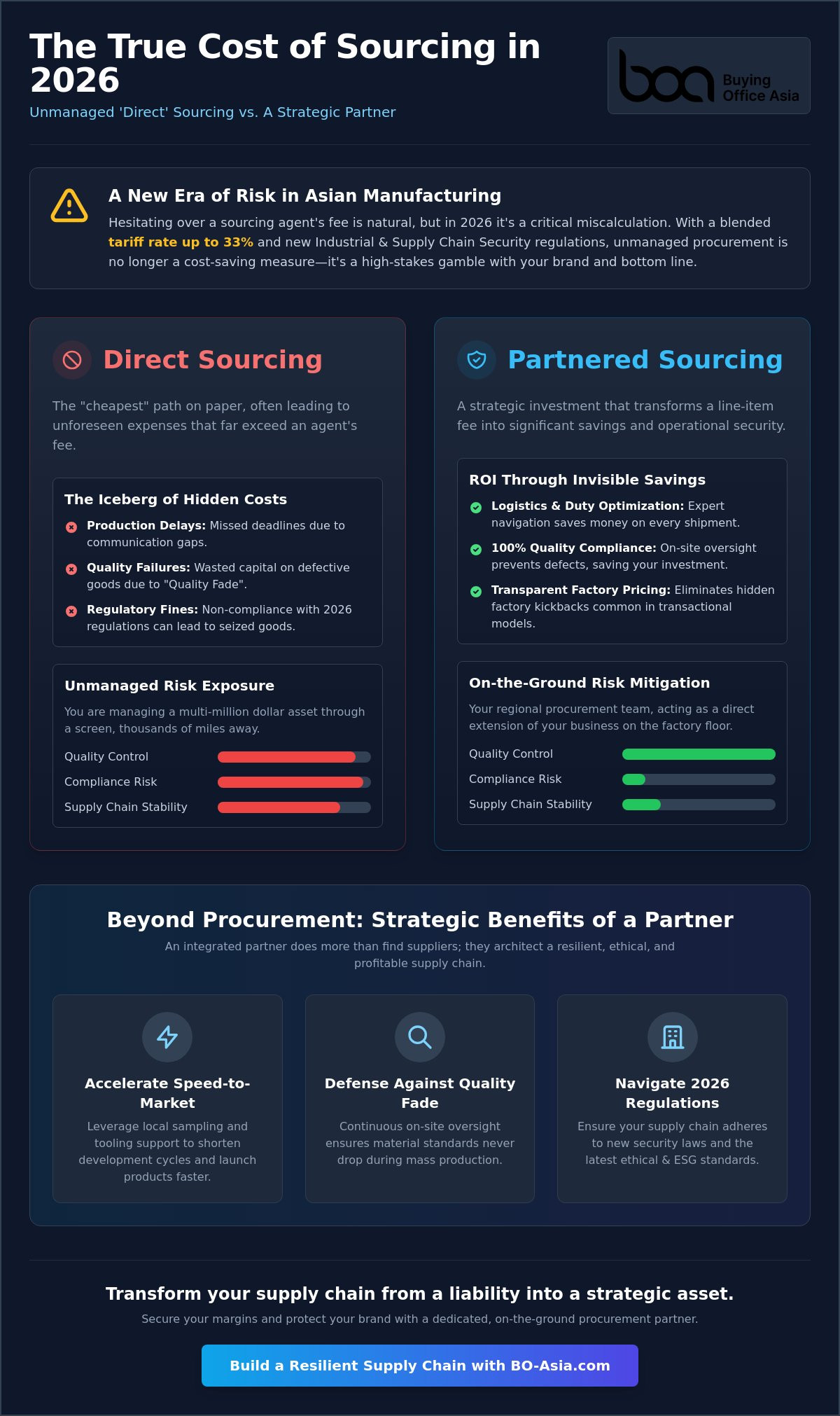
Strategic sourcing is about more than just negotiating unit prices. It's about building a supply chain that is resilient, compliant, and defensible. One of the greatest risks of sourcing from China without an agent is the vulnerability of your intellectual property. Without a partner who manages your proprietary custom tooling on-site, you lose control over who uses your molds and when. Protecting these assets requires more than a contract; it requires physical presence and regular audits to ensure your designs remain your own.
A professional partner also acts as a catalyst for product development. Local sampling and tooling support significantly accelerate your speed-to-market. When you have an integrated team managing the iteration process, you avoid the months of back-and-forth typical of remote procurement. This efficiency doesn't just save time; it captures market share that your competitors lose to delays. We ensure your development cycle is lean and your proprietary technology is secure.
The regulatory environment in 2026 has shifted from voluntary guidelines to mandatory compliance. Factory audits are now a legal requirement for many Western brands under new supply chain security regulations that treat procurement as a matter of national security. You can review Buying Office Asia’s ESG commitment to see how we align with these modern standards. The financial cost of non-compliance is staggering. Beyond immediate fines, the permanent damage to your brand reputation can be unrecoverable if unethical practices are discovered in an unmanaged supply chain.
We operate as a Helsinki-Hong Kong bridge, providing the security of European leadership combined with the operational speed of local Asian HQs. This structure eliminates the time-zone lag that often plagues international manufacturing. While freelance agents might offer low entry costs, they rarely provide the same level of accountability as dedicated Asia procurement teams. Our firm is founded on 100% transparency, ensuring you have a clear view of every transaction and factory interaction.
The risks of sourcing from China without an agent include a dangerous lack of accountability when things go wrong. By positioning ourselves as an integrated extension of your team, we provide a defense against operational setbacks and brand risks. We offer the same level of oversight usually reserved for major enterprises, ensuring your growth is built on a stable foundation. If you're ready to secure your supply chain with a professional oversight team, get in touch with our procurement experts today.
Profitability isn't found in the lowest quote; it's found in the most secure supply chain. If you're managing high-volume production or non-negotiable quality standards, the verdict is clear. An integrated partner isn't a luxury or an added expense. It's a fundamental insurance policy against the volatility of the 2026 manufacturing landscape. The risks of sourcing from China without an agent have evolved from simple quality concerns into complex legal and financial liabilities that require professional, on-site management.
The standard for global trade has shifted. The era of the transactional intermediary is ending, replaced by the integrated procurement office. This model moves away from hidden margins and toward a transparent, partnership-based approach where your success is the primary metric. By transitioning to this level of oversight, you eliminate the "black box" of unmanaged sourcing and gain a sophisticated defense against operational setbacks. It's time to view your procurement strategy as the foundation of your bottom line rather than a cost center to be minimized.
Choosing the right partner requires a rigorous vetting process. You need to look beyond surface-level promises and demand evidence of regional expertise. Start by asking for case studies that demonstrate a history of successful outcomes in your specific industry. A reputable partner should provide a clear view of their verified supplier networks and be willing to prove their physical presence in key manufacturing hubs.
Transparency is the most critical factor in this relationship. You must verify that the fee structure is fixed and that there are no hidden factory commissions that could bias supplier selection. Additionally, ensure they have the technical depth to handle OEM/ODM contract manufacturing. Managing custom designs and proprietary tooling requires a level of engineering oversight that simple trading companies cannot provide. If a potential partner can't show you how they protect your intellectual property, they aren't equipped to handle your growth.
Transitioning from a DIY sourcing model to a professionally managed office is a strategic move that pays dividends in both capital and peace of mind. This shift allows you to focus on scaling your brand while we handle the complexities of factory audits, logistics, and quality defense. We invite you to move beyond the risks of sourcing from China without an agent and experience the stability of a truly integrated procurement team.
Sourcing is not just a cost center; it's the foundation of your long-term profitability. By securing your supply chain now, you're building a resilient business capable of navigating the challenges of 2026 and beyond. If you're ready to see the real-world impact of professional management on your margins, consult with Buying Office Asia to audit your current landed costs and identify hidden savings opportunities.
The true ROI of a sourcing partner isn't found in a simple fee comparison. It's measured by your ability to eliminate the risks of sourcing from China without an agent, such as quality fade, unauthorized subcontracting, and the hidden tax of unmanaged logistics. By prioritizing 100% transparency and factory-direct pricing, you transform your procurement from a cost center into a strategic advantage that fuels long-term growth. Professional oversight ensures that your capital is protected and your brand reputation remains beyond reproach.
Buying Office Asia brings over 15 years of experience in end-to-end Asian procurement directly to your team. As a European-managed firm with offices in Helsinki and Hong Kong, we provide the physical proximity and technical rigor necessary to navigate the complex regulatory environment of 2026. We don't just find suppliers; we architect resilient supply chains and build defenses against operational volatility. It's time to stop guessing and start calculating your actual landed costs with precision.
Consult with Buying Office Asia to audit your supply chain costs and discover how professional oversight can stabilize your bottom line. We look forward to helping you secure a more profitable and predictable future for your manufacturing operations.
Industry standards in 2026 typically involve a commission between 3% and 10% of the total order value. For smaller projects under $2,000, many agents charge a fixed fee ranging from $300 to $2,000. These visible costs function as an insurance premium against the risks of sourcing from China without an agent, where hidden production errors can easily exceed 30% of your total investment. Professional firms prioritize transparency to ensure these fees are offset by negotiated savings.
Direct sourcing through B2B platforms often costs more due to hidden markups from trading companies posing as factories. These intermediaries frequently add 15% to 25% to the unit price to cover their own overhead. By using a professional partner for factory-direct negotiations, you bypass these parasitic layers and secure the actual manufacturing floor price. This approach captures margins that are typically lost to unmanaged digital middlemen.
A sourcing agent is often a transactional freelancer who finds vendors, while a procurement company acts as an integrated extension of your own team. Procurement firms provide a sophisticated office structure, European management, and a dedicated regional presence. This integrated model moves beyond simple matchmaking to provide end-to-end supply chain architecture. We focus on long-term financial health and operational security rather than one-off transactional interactions.
Professional procurement is essential if your project involves custom tooling or non-negotiable quality standards, regardless of volume. The risks of sourcing from China without an agent are highest when technical specifications are complex, as a single batch failure can bankrupt a small operation. However, for low-value, off-the-shelf items where quality is a secondary concern, the overhead of professional management may not be financially viable for your bottom line.
You can eliminate the risk of kickbacks by choosing a partner that operates on a 100% transparency model with fixed fee structures. Integrated procurement offices align their success with your savings, removing the incentive for hidden factory commissions. Always demand audit rights and clear visibility into the factory-direct pricing. This professional rigor ensures that every supplier selection is based on performance and cost-efficiency rather than obscured incentives.
A professional partner utilizes on-site quality control to catch defects before the goods leave the factory floor. If an issue is identified, the partner manages the corrective action plan or factory rework at the source. This prevents you from paying for faulty inventory and shipping it across the globe. Catching errors during mass production oversight is the only way to eliminate the "hidden tax" of returns and brand damage.
Local teams reduce expenses by consolidating goods from multiple suppliers into a single Full Container Load (FCL). Shipping individual LCL orders is a significant waste of capital that many remote buyers overlook. On-site logistics management also ensures that all documentation is accurate before the vessel departs. This proactive oversight prevents expensive customs delays and storage fees that occur when unmanaged shipments arrive with incorrect paperwork.
Yes, professional procurement teams manage HTS code classification and regulatory compliance to navigate complex tariff layers. With blended effective tariff rates reaching up to 33% in 2026, accurate documentation is vital for protecting your margins. We ensure your supply chain adheres to the latest import licensing requirements and maritime codes. This level of oversight prevents overpayment of duties and ensures your goods clear customs without operational setbacks.

If your current sourcing agent claims their services are free, you're likely paying a hidden tax of 10% to 30% through inflated unit prices and factory kickbacks. This lack of transparency doesn't just erode your margins; it creates a dangerous barrier between you and the factory floor. Finding a re...

A perfect golden sample is often the most dangerous document in your supply chain. If a prototype is handcrafted by a master technician rather than built using scalable factory processes, your sample development phase isn't a success; it's a liability. This gap between a one-off masterpiece and a hi...

Scaling production to millions of units isn't a purchasing task; it's a high-stakes risk management discipline where a single percent of quality fade can liquidate your annual margin. You likely understand that the leap from mid-scale orders to massive procurement runs often exposes cracks in even t...