

What if the first clear sign of a production problem arrives after the goods are packed? Manufacturing risk management in Asia works best when controls are connected from the start, not left to a final inspection or occasional supplier update. You need visibility into factory activity, early warning when specifications or schedules shift, and clear ownership of corrective action.
A standalone inspection can provide a useful snapshot, but it cannot replace supplier vetting, production follow-up, and coordinated issue resolution across the order. When procurement, quality checks, and delivery planning are linked, you have more opportunities to catch deviations while there is still time to respond.
This article sets out a practical process for managing risk from supplier selection through shipment. You’ll learn how to define requirements, assess suppliers, establish quality checkpoints, monitor progress, respond to changes, and coordinate documentation and delivery. The aim is not to promise a risk-free order, but to give you clearer evidence, earlier decisions, and a more accountable path from approved specifications to finished goods.
• Map potential failures across supplier capability, specifications, sampling, production, quality, packaging, and delivery to see where controls are needed.
• Prioritize risks by potential impact and likelihood, then assign an owner and a review point to each significant risk.
• Match each control to the decision it supports. Supplier checks, sample approval, in-process inspections, final inspections, and shipment coordination each reveal different things.
• Use clear specifications, approved samples, and version control to reduce misunderstandings when materials, tolerances, artwork, or production plans change.
• Effective manufacturing risk management in Asia connects procurement, factory follow-up, documented findings, and corrective actions across the order.
Manufacturing risk management in Asia is the ongoing work of identifying, prioritizing, controlling, and reviewing threats to production outcomes. The goal is not to eliminate every risk. It is to reduce avoidable exposure and make issues visible while there is still time to respond. Follow risk from supplier capability and specifications through samples, production, quality checks, packaging, and delivery.
A control at one stage cannot cover every later handoff. A supplier may have the right equipment but misunderstand a drawing. An approved sample may no longer reflect the product if an unapproved change is made on the production line. A useful framework follows the principles of risk management: identify what could happen, assess its consequences, select controls, and review whether those controls remain effective.
Asia is not one manufacturing or regulatory environment. Capabilities, production processes, and requirements vary by country, product, intended use, and destination market. Assess the actual supplier, product specification, and sales destination rather than treating experience in one market as proof that the same assumptions apply elsewhere.
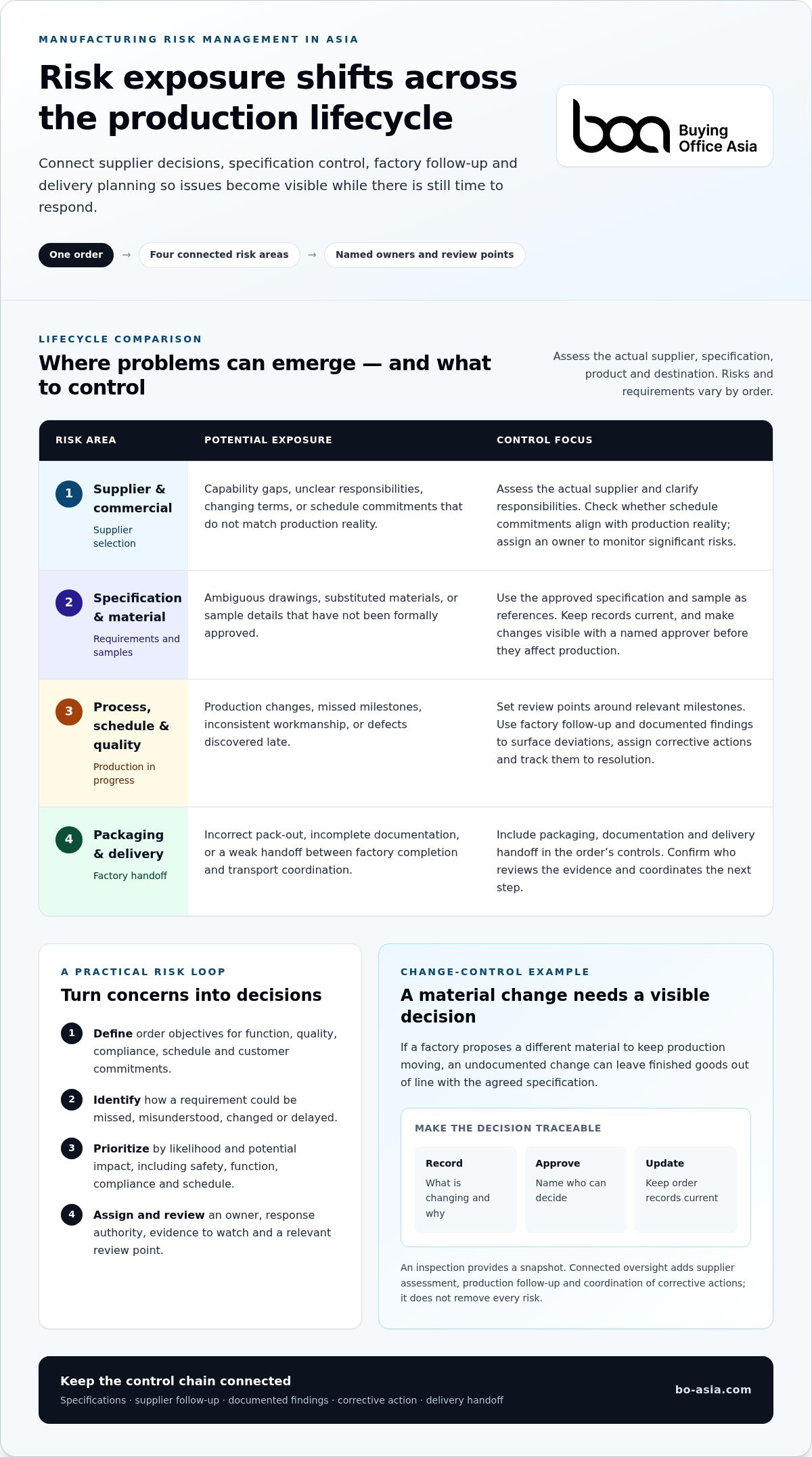
Group risks by where they arise and what they could affect:
capability gaps, unclear responsibilities, changing terms, or schedule commitments that do not match production reality.
ambiguous drawings, substituted materials, or sample details that have not been formally approved.
production changes, missed milestones, inconsistent workmanship, or defects found late.
incorrect pack-out, incomplete documentation, or a weak handoff between factory completion and transport coordination.
Distinguish commercial exposure, such as rework or delayed delivery, from product-safety, compliance, and reputational exposure. These risks can overlap, but the response may differ. Product requirements depend on the item and its destination. Do not assume that a process or approval in one country applies across Asia.
Hypothetical example: A factory proposes a different material to keep production moving, but no one records the change or obtains approval. Finished goods may then depart from the agreed specification. A change-control step, with a named approver and updated records, makes the decision visible before the change spreads through the order.
When factory updates arrive late, production can advance before a buyer sees a deviation. Clear records, local follow-up, and named decision owners help surface an issue while options remain open: pause production, approve a documented change, or correct the process. That visibility supports stronger sourcing and procurement in Asia. BOA’s on-the-ground manufacturing support connects factory follow-up with client decisions, without implying that oversight removes all risk.
For each significant risk, record what evidence to watch, who reviews it, who can approve a change, and how corrective actions will be tracked. This creates a practical chain of accountability from the first supplier discussion to shipment handover.
A useful risk assessment turns broad concerns into decisions, owners, and review points. For manufacturing risk management in Asia, start with the product requirements, manufacturing process, project milestones, and destination markets. A risk that matters for one product or sales destination may not carry the same weight for another. Tailor the assessment to the order rather than relying on a generic checklist.
Record what the order must achieve for product function, quality, compliance, schedule, and customer commitments. Use the approved specification and purchase order as the reference.
Consider how a requirement could be missed, misunderstood, changed, or delayed at each relevant production stage.
Ask how plausible the issue is and what it could affect, including safety, function, consistency, compliance, schedule, and customer commitments.
Name who monitors the risk, who acts if it arises, and who has authority to approve a change or escalation.
Revisit open risks at relevant milestones and whenever new information changes the assumptions behind a control.
Not every issue needs the same attention. Prioritize risks that could affect safety, compliance, essential product function, or a critical customer commitment. Routine issues still need owners and follow-up, but they should not distract from exposures with serious consequences or limited response options.
Keep one working register linked to the purchase order, current specification, and production milestones. For each entry, state the risk and its cause, potential impact, owner, prevention step, evidence or trigger to watch, response action, status, and next review date. Use plain language and concrete references, such as a sample approval or a scheduled production stage, so the factory and buyer can act on the same record.
Agree on escalation rules before production advances. Define what evidence requires a pause, who can authorize a deviation, and who must be informed. The supplier can report an issue and propose corrective action. Your designated buyer or product owner retains approval authority for changes to requirements. Record decisions and revised documents in the register to avoid competing versions.
Judge each risk in context. A small variation may be routine for one product but serious if it affects function, safety, regulatory obligations, or a customer-facing deadline. Supplier due diligence helps establish whether stated capabilities match the product and process. BOA’s supplier vetting and capability checks can inform that assessment. Reconsider the exposure whenever materials, tooling, process steps, or subcontracting arrangements change.
Make reassessment an explicit trigger, not an informal judgment. For example, a proposed material substitution should prompt a review of the specification, sample, required approvals, and downstream milestones before work proceeds. A risk register is useful only if changes update the controls and decision owners, not just the status label.
For support turning supplier and production risks into assigned controls, discuss your manufacturing requirements with BOA.
Each control answers a different question. Supplier vetting assesses capability before commitment. Sample approval sets an agreed product reference. Inspections assess specified conditions at a particular point. Production oversight connects findings to decisions and follow-up. Choose controls according to the exposure you need to manage, rather than expecting one check to cover the whole order.
| Control | Timing | What it can reveal | What it cannot establish |
|---|---|---|---|
| Supplier vetting | Before appointment and as circumstances change | Whether stated capabilities and processes appear suited to the order | That every production run will meet requirements |
| Sample approval | Before mass production | Whether a sample reflects agreed materials, appearance, construction, and function | That production will match it without further controls |
| In-process inspection | During production | Visible issues within the work and process at the inspection point | Conditions outside the defined scope or what happens afterward |
| Final inspection | After production, before shipment handover | Findings from agreed checks on sampled finished goods and packaging | Every unit’s condition or later delivery outcomes |
| Shipment coordination | As goods are prepared for dispatch | Whether agreed handover details and documents are being coordinated | Product quality beyond completed checks |
An inspection establishes what was observed within its agreed scope, at a defined location and time, on the items examined. It cannot guarantee every unit or cover events outside that snapshot. A standalone inspection can start from one inspector-day, with same-day reporting under BOA’s service model. Before booking, confirm the product scope, factory access, inspection location, sampling or tests, and timing, since each affects what the findings can support.
Use a standalone inspection for a defined check, such as comparing goods with an approved Golden Sample or reviewing packaging before handover. BOA provides on-site quality control and inspection support scoped around the order’s requirements. Standalone inspections are also an option when you need a focused, documented view of production.
Ongoing oversight connects the approved sample and written specification to production follow-up, inspection findings, supplier responses, and corrective-action verification. When a finding needs action, assign an owner and deadline, document the agreed fix, then verify it before closing the issue.
A standalone inspection provides a focused checkpoint. Coordinated oversight adds supplier management, production follow-up, and corrective-action coordination across the order, giving your team a clearer path from evidence to action without removing every risk.
Turn requirements into checkpoints that factory teams and buyers can apply consistently. Drawings, material descriptions, tolerances, artwork files, and packaging instructions should point to the same approved product version. Define acceptable variation with tolerances where it matters. Use controlled file names or revision records to help prevent outdated artwork or specifications from reaching production.
Written change approval keeps production aligned: no material, tooling, process, artwork, or subcontracting change should proceed until its impact is documented and the authorized decision-maker approves it. This matters especially when a change affects the approved sample, cost, schedule, product function, or destination-market requirements.
Set acceptance criteria before production, using the written specification and agreed Golden Sample as references. Check that suppliers can identify the current revision and that approved artwork is protected from unauthorized use or circulation. BOA’s custom product development and tooling coordination connects design requirements with production planning.
Match checks to the product. For a figurine, define how to assess paint coverage and consistency. For a board game, verify component counts, assembly, and pack-out against the approved configuration. For a collector’s box, specify relevant materials, artwork placement, and packaging condition. Tooling decisions also affect the balance between upfront development and unit production, so record the approved tool, process, and any agreed revisions.
For gaming merchandise, intended use matters. Promotional items, toys, collectibles, and products intended for food contact or electrical use may have different considerations. Age grading, small parts, licensed artwork approval, and applicable testing depend on the product and destination. Do not assume a promotional label alone determines the requirements.
Use a staged control sequence so that an issue found at one checkpoint has a defined next step:
approve specifications, materials, artwork, sample, packaging, and current document revisions.
record the deviation, reason, proposed action, affected units or stages, and approval decision before proceeding.
compare findings with agreed criteria and document evidence, including the affected area or items within the inspection scope.
assign an owner and deadline, state the required fix, and record evidence that the action was completed and verified.
align production status, packing readiness, order details, required documents, and transport coordination responsibilities.
Keep the handoff visible. Confirm who releases the goods, who supplies each document, and who coordinates the next transport step. This closes the gap between factory completion and delivery planning without confusing logistics coordination with operating the carrier.
BOA coordinates specifications, production controls, and delivery handoffs as part of its sourcing and procurement support. Contact BOA about your manufacturing project to discuss the controls your order needs.
A risk process only works if someone can connect factory activity to timely decisions. BOA’s Hong Kong operations and European leadership bridge on-the-ground supplier follow-up with clear communication to clients. That local presence supports practical visibility. Transparent sharing of factory prices, documents, and communications also helps you understand the basis for decisions and maintain ownership of the order.
The value comes from connecting controls, not treating each as a separate transaction. Sourcing and procurement support can bring supplier selection, product requirements, and commercial terms into the same working process. A dedicated Asia sourcing team can help coordinate factory communication, production follow-up, and the information your internal decision-makers need.
At the outset, align the order requirements with supplier capability, the approved sample, production milestones, and inspection criteria. As work progresses, track updates against those references. If a finding or proposed change requires a decision, document the evidence, identify the approver, and communicate the outcome to the relevant factory and client contacts.
Hypothetical example: During production of a multi-component tabletop product, a check identifies that an assembly instruction may be causing inconsistent pack-outs. An oversight partner can document the finding, coordinate the supplier’s proposed correction, route any specification decision to the client, and record verification before closing the action. The point is accountability: a report should lead to an owned next step, not sit in an inbox.
This connected approach also helps prevent conflicting instructions. Keep the current specification, approved artwork, sample reference, decisions, and inspection findings accessible to the people managing the order. BOA coordinates procurement, supplier management, production oversight, quality checks, and logistics planning while keeping the client informed. This does not remove every risk or replace the client’s authority over product and commercial decisions.
A scoped standalone inspection can suit a defined information need, such as assessing a specified stage or comparing sampled goods with approved criteria. It gives you evidence from that inspection’s agreed scope and timing. If your main exposure spans supplier suitability, changing production conditions, quality follow-up, and delivery coordination, broader lifecycle support can connect those controls and carry actions forward.
To decide what level fits, identify the unresolved question first: Is it supplier capability, conformity to the sample, production progress, corrective-action closure, or shipment readiness? Then consider whether you need a point-in-time finding or ongoing coordination across several stages. This makes the support plan proportionate to the actual risk rather than driven by a generic checklist.
For manufacturing risk management in Asia, local execution and transparent reporting help turn a control plan into decisions your team can act on. Discuss your manufacturing risk controls with BOA, including the product, current production stage, and areas where you need clearer oversight.
Risk controls are most useful when they shape the next decision, not just document the last one. Choose an upcoming supplier review, sample approval, production milestone, or shipment handoff and define what evidence your team needs before moving forward. That gives manufacturing risk management in Asia a practical starting point: a clear checkpoint, a named decision-maker, and a documented response if expectations are not met.
Buying Office Asia’s founders bring over 20 years of experience managing Asian production. Support can be tailored to the project stage and exposure, from a defined inspection need to coordinated supplier vetting, production oversight, inspections, and logistics coordination. No control removes every uncertainty, but clear ownership and timely information can help your team respond with fewer surprises.
Share the product, current production stage, and main concern to identify a practical next step for your order. Discuss your manufacturing risk controls with BOA.
No. The goal of manufacturing risk management in Asia is not to promise a flawless outcome, but to prepare for plausible disruptions. For a key order, decide in advance who can pause a release, what information they need, and how a delay or product deviation will be communicated to your customer. A response plan turns an unexpected event into a managed decision, rather than leaving teams to negotiate authority under pressure.
Usually not on its own. An inspection can inform a decision, but the result needs a defined consequence: release, hold, rework, or another agreed action. Set that decision path before the visit, including who reviews the report and who authorizes shipment release. This helps prevent a useful finding from becoming a document that arrives without an owner or a clear operational next step.
There is no single review frequency for every order. Set review points around decisions that can change exposure, such as approving a sample or releasing a production stage. Match the cadence to the project’s pace, and make one person responsible for bringing current information to the review. Include the people who can authorize changes, so the meeting can resolve open decisions instead of only recording them.
Include enough detail to connect a concern to an action: its cause and potential impact, an accountable owner, a likelihood assessment, the preventive control, a warning trigger, the response, status, and review date. Link each entry to the relevant order, specification revision, or milestone. For example, reference a specific production stage rather than writing “check quality.” A concise, traceable record is easier to use in supplier discussions.
No. AQL sampling supports a decision about a defined lot under an agreed inspection plan. It does not establish the condition of every unit. Agree on the lot being assessed, the applicable acceptance criteria, and how findings will affect release before inspection begins. Then use the result within that decision process. If it prompts a hold or corrective action, record how the affected goods will be handled before shipment proceeds.
Start by mapping each product variant to its intended use and destination, since merchandise in one order may not share the same risk profile. Keep licensed-artwork approvals tied to the exact production files, and reconcile component lists with the approved pack-out so missing pieces are easier to identify. For each item, determine whether its use, age group, or materials raise additional market-specific considerations. Do not assume one product label resolves those questions.

What if the lowest unit quote isn’t the lowest-cost way to make your board game? Board game manufacturing costs depend on more than the number of boxes ordered. Component materials, custom tooling, assembly, packaging and delivery scope can all change what a quote covers, making headline prices diff...

What if the factory’s lowest quote isn’t the lowest-cost option? A lower unit price can hide differences in materials, tooling, packaging, quality checks or production terms. Understanding how sourcing agents negotiate factory prices starts with making those differences visible, not simply asking a...

A factory audit can look reassuring while leaving a critical question unanswered: will the same materials, processes and controls be used for your production run? Responsible toy manufacturing in China requires more than reviewing a certificate. You need to understand factory conditions, subcontract...