


Your next manufacturing hub shouldn't be a gamble on the lowest bidder. In 2026, the real prize is a stable, high-tech environment that shields your brand from the volatility of traditional markets. Deciding where to pivot requires a cold, hard look at the manufacturing in Thailand pros and cons, especially as regional competition intensifies and global trade protectionism rises.
You've likely seen your margins squeezed by rising costs in China or felt the anxiety of losing oversight in remote factories. The fear of quality fade is a valid concern when your reputation is on the line. We'll provide the financial clarity you need to decide if Thailand's infrastructure justifies its position in your supply chain strategy. This briefing covers the latest 2026 Board of Investment incentives, the impact of the 400 baht daily minimum wage in Bangkok, and a strategic roadmap for maintaining on-site quality control. By the end of this analysis, you'll understand how to leverage Thailand's 20% corporate tax rate and its shift toward high-value green manufacturing to secure your 2026 production goals.
• Understand why Thailand has emerged as a critical "China Plus One" destination for global brands seeking to stabilize their 2026 supply chain operations.
• Evaluate the manufacturing in Thailand pros and cons by weighing world-class logistics infrastructure against the rising costs of specialized technical labor.
• Identify common operational risks, such as language barriers in mid-tier management, and learn how to mitigate them through rigorous supplier vetting and audits.
• Discover a roadmap for executing mass production that prioritizes factory-direct price negotiations to eliminate the hidden markups of traditional intermediaries.
• Learn how an integrated on-site procurement team provides the transparency needed to protect your financial health and product quality in a complex market.
The 2026 supply chain landscape is defined by a flight to stability. As Western enterprises refine their "China Plus One" strategies, they're no longer looking for temporary backups; they're seeking permanent, resilient hubs. Thailand has secured its position as the second-largest economy in Southeast Asia by offering exactly that. The Economy of Thailand now relies on a manufacturing sector that contributes approximately 25% to the national GDP. This isn't a recent fluke. It's the result of decades of industrial development and a strategic pivot toward high-value production.
When you weigh the manufacturing in Thailand pros and cons, the most immediate advantage is the country's mature trade infrastructure. Regional trade agreements, specifically the Regional Comprehensive Economic Partnership (RCEP), have streamlined Thai exports. These frameworks reduce the administrative friction that often plagues international procurement. For brands looking to scale, Thailand represents a sophisticated middle ground between the low-cost, high-risk environments of emerging markets and the expensive, saturated markets of the West. It's a powerhouse that balances cost with capability.
Thailand maintains a neutral trade status that serves as a vital defense for US and EU importers. Unlike other regions where trade wars can trigger sudden tariff hikes, Thailand's diplomatic posture remains consistent. This stability translates to predictable landed costs. You won't have to worry about the 30% or 40% statutory ceilings on import duties being applied arbitrarily to your Thai-made goods. Instead, the focus remains on financial optimization and regulatory adherence. The long-term outlook for 2026 suggests that Thailand will continue to be a stabilizing force in the ASEAN region, offering a safe harbor for your capital and production cycles.
The days of Thailand being known primarily for simple textiles are over. Under the "Thailand 4.0" initiative, the nation has successfully transitioned into complex electronics, energy-efficient appliances, and automotive parts. This shift is physically anchored in the Eastern Economic Corridor (EEC). This special economic zone offers aggressive incentives for businesses focusing on advanced technology and green manufacturing. If your strategy involves OEM and ODM contract manufacturing, Thailand's upgraded factory capabilities provide the technical rigor you require. The workforce is skilled, with nearly 10% of the population employed in manufacturing. This ensures your production runs are managed by experienced hands. Balancing the manufacturing in Thailand pros and cons reveals that while labor costs are higher than in neighboring Vietnam, the technical expertise and infrastructure often yield a superior ROI for high-volume brands.
Thailand's industrial strength lies in its maturity. While some competitors focus solely on labor arbitrage, the real value here is a combination of technical literacy and legal security. When evaluating the manufacturing in Thailand pros and cons, the "pros" column is heavily weighted by a workforce that doesn't just assemble, but understands the technical specifications of high-volume production. This industrial literacy reduces the need for constant micro-management and lowers the risk of quality fade over time.
The U.S. State Department Investment Climate Statement highlights Thailand’s pro-investment policies and its role as a regional leader in industrial manufacturing. Beyond the skilled labor, you benefit from a legal environment that respects intellectual property (IP). Unlike some neighboring jurisdictions where IP risks remain high, Thailand offers a robust framework for protecting proprietary designs and custom tooling. This security is a non-negotiable asset for global brands that can't afford to have their innovations leaked to the open market. For brands shifting high-volume operations, our sourcing and procurement services ensure you capitalize on these regional advantages without the typical entry friction.
Success in international trade depends on how quickly you can move goods. Thailand's logistics network is centered around the deep-sea port of Laem Chabang and the industrial clusters surrounding Bangkok. These hubs connect your production lines directly to major global shipping lanes with high frequency and reliability. The digital and power infrastructure is equally stable, supporting the smart factory requirements of the 2026 market. You won't face the frequent power outages or bandwidth throttles that disrupt production in less developed hubs. The internal rail and road networks are optimized for the efficient transport of raw materials, ensuring that your supply chain remains lean and responsive to market shifts.
The Thailand Board of Investment (BOI) provides a level of financial optimization that few other nations can match. As of January 15, 2026, new investment promotion measures offer corporate income tax exemptions for up to 13 years for specific high-tech sectors. These incentives also include exemptions from import duties on machinery and essential raw materials. Setting up a foreign-owned manufacturing entity is a streamlined process compared to regional alternatives, especially if you're targeting the Eastern Economic Corridor (EEC). This government support extends to R&D and high-tech tooling development, allowing you to innovate locally while maintaining a standard 20% corporate tax rate on non-exempt profits. If you're ready to explore these incentives, reach out to our team for a detailed assessment of your specific category.
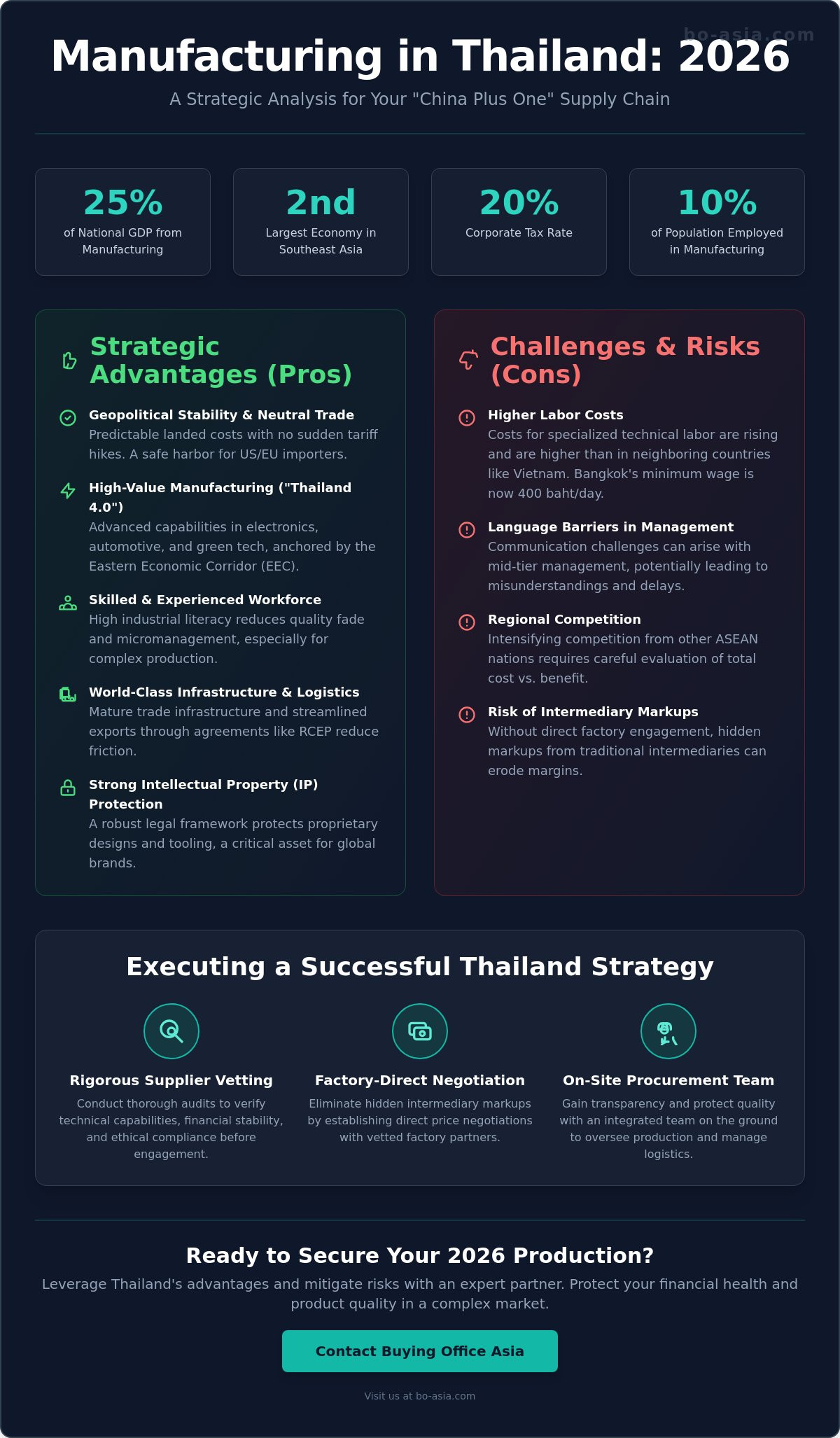
Every strategic expansion carries inherent risks. While the infrastructure is mature, a balanced analysis of manufacturing in Thailand pros and cons must address the operational friction that can erode your ROI. The Thai market in 2026 presents specific headwinds, including an aging population that tightens the supply of skilled technical labor. This demographic shift has contributed to rising wages; the daily minimum wage now ranges from 337 to 400 baht, with industrial hubs like Bangkok and Chonburi hitting the upper limit. For high-volume brands, these incremental labor costs require a strategy focused on efficiency rather than just raw labor arbitrage.
Beyond labor costs, the risk of "quality fade" remains a constant threat for unmanaged supply chains. This occurs when factory standards slowly decline over successive production runs to offset rising material costs. Without consistent on-site mass production oversight, your brand remains vulnerable to these subtle but damaging regressions. Protecting your brand requires a transition from remote management to a physical, regional presence that enforces your quality standards in real time.
Communication gaps in mid-tier factory management often lead to the most expensive delays. Thai business etiquette is rooted in indirectness and harmony, which differs significantly from the more direct communication styles found in Western or Chinese industrial cultures. In complex OEM projects, technical requirements can be lost in translation. A factory manager might signal agreement to avoid conflict, even if a specific tooling requirement is misunderstood. This lack of direct technical clarity is why remote management often fails. You need an integrated team that speaks the language of the factory floor and the language of your boardroom to ensure your specifications are executed without deviation.
Regulatory adherence in Thailand is becoming increasingly complex. The 2026 landscape is defined by stricter ESG requirements and environmental compliance standards. Navigating these nuances, alongside a standard 7% VAT and a more protectionist customs regime, demands local expertise. We've seen how challenges in Thai manufacturing, such as factory closures in less competitive sectors, can disrupt unvetted supply chains. Managing the "middleman" problem is equally critical. Local raw material sourcing often involves layers of intermediaries that obscure true costs. To maintain financial viability, rigorous supplier vetting and factory audits must be completed before any contracts are signed. This ensures your partners are not only capable of production but are also financially stable and ethically compliant.
Moving your production to Thailand requires more than a signature on a contract. It demands a structured four-step execution plan that addresses the manufacturing in Thailand pros and cons through direct action. Every decision in this roadmap is designed to capitalize on regional strengths while turning potential risks into managed advantages. In the 2026 landscape, you shouldn't settle for generalist manufacturers. Instead, the first phase involves identifying and vetting factories with specific niche expertise, particularly those within the Eastern Economic Corridor (EEC) that have specialized in high-value sectors like EV components or solar equipment. Rigorous supplier vetting ensures your partner has the financial health and technical tooling to sustain long-term production.
Perform deep-dive audits to verify machinery, labor conditions, and regulatory compliance.
Engage in factory-direct price negotiations. This eliminates the 10-15% markups often hidden by third-party sourcing agents.
Establish clear Acceptable Quality Levels (AQL) and maintain on-site quality control and inspections throughout the run.
Navigate the 2026 customs landscape, where all imports are subject to a 7% VAT regardless of value, to ensure maximum shipping efficiency.
A dedicated Asia procurement team is essential for brands that value accountability over convenience. There's a fundamental difference between a sourcing agent, who often works on commission from the factory, and a procurement partner who acts as an extension of your own team. Physical proximity allows for real-time troubleshooting. If a production line stalls or a material defect is detected, our team resolves the issue on the factory floor before the goods ever hit the port of Laem Chabang. This proactive defense is your best protection against unforeseen expenses and brand risk.
Consistency in mass production is not a given; it's the result of constant oversight. We utilize standardized AQL inspections to catch deviations early in the cycle. Even if you aren't physically present, you can maintain control through detailed audit reports and live digital updates from the site. This level of transparency prevents the quality fade mentioned in previous sections. By implementing regular factory audits and mass production oversight, you ensure that the first unit off the line is as perfect as the ten-thousandth. If you're ready to secure your 2026 production roadmap, contact our team for a detailed consultation.
Navigating the manufacturing in Thailand pros and cons requires a partner that prioritizes your financial health over transactional volume. Buying Office Asia (BOA) functions as a stabilizing force, providing the high-level oversight usually reserved for major enterprises. Our methodology addresses the manufacturing in Thailand pros and cons by replacing uncertainty with documented performance history and 100% transparency. By establishing factory-direct relationships, we remove the obscured costs and inefficiencies inherent in traditional intermediary models. Our approach to OEM and ODM contract manufacturing ensures that your custom tooling and proprietary designs are protected by rigorous on-site management and legal adherence.
In 2026, global brands have seen that unmanaged diversification leads to quality fade and unforeseen expenses. We've successfully transitioned high-volume production lines from China to Thailand by focusing on measurable outcomes. Our case studies from the past year demonstrate that a structured roadmap, supported by on-the-ground audits, can reduce total procurement costs while increasing supply chain resilience. We don't just find suppliers; we develop them into long-term assets for your business.
BOA isn't a third-party service; we're an integrated extension of your own team. Headquartered in Bangkok, our team combines European management standards with deep local expertise and regional networks. This hybrid model allows us to enforce strict quality protocols while navigating the nuances of Thai business etiquette. You gain the benefit of our pricing and savings models, which are designed to deliver clear ROI through optimized logistics and negotiated factory-direct rates. We handle the technical translation and regulatory compliance, allowing you to focus on brand growth while we defend your margins.
Evaluating your current production for a move to Thailand is a strategic necessity in the 2026 trade climate. The shift toward high-value manufacturing in the Eastern Economic Corridor offers unique opportunities for brands in the electronics, automotive, and green energy sectors. Don't leave your supply chain to chance. We invite you to request a custom sourcing assessment to identify potential savings and risk mitigation strategies for your specific product line. Take control of your international production today. Book a consultation with our sourcing experts to build a secure, transparent, and profitable manufacturing hub in Thailand.
Navigating the manufacturing in Thailand pros and cons reveals that the country's real value lies in its industrial maturity and strategic incentives. Success in 2026 isn't just about finding a factory; it's about establishing a transparent, factory-direct supply chain that resists quality fade. By leveraging on-site oversight and technical expertise, you can transform Thailand into a high-performing hub for your global operations. The shift toward high-value manufacturing in the region offers a unique opportunity to stabilize your margins and protect your brand from geopolitical volatility.
As a European-managed firm with local offices in Bangkok, Buying Office Asia provides the regional defense your brand deserves. We offer 100% transparency and specialized expertise in complex OEM and ODM projects, ensuring your financial health is protected at every stage. It's time to move away from unmanaged risks and toward the steady confidence of a dedicated partner on the ground. Secure your supply chain with a dedicated Thailand procurement team and position your brand for sustainable growth in the ASEAN market. Your path to a more resilient future starts with a single strategic decision today.
Thailand's cost-effectiveness depends on your specific product category and the impact of international tariffs. While China maintains a deeper raw material ecosystem, Thailand's daily minimum wage of 337 to 400 baht is highly competitive for skilled labor. When you factor in the 2026 trade climate and the avoidance of high US tariffs on Chinese-made goods, Thailand often yields a superior total landed cost for electronics and automotive components. The financial viability of Thai production is further enhanced by BOI tax exemptions that can last up to 13 years.
Thailand is a global leader in high-value sectors that require technical precision and industrial literacy. The country's "Thailand 4.0" initiative has created a robust infrastructure for electric vehicle (EV) parts, solar equipment, and energy-efficient appliances. It's also a primary hub for hard disk drives and complex automotive assemblies. If your product requires strict regulatory adherence or advanced technical tooling, Thailand's mature industrial clusters provide a more stable environment than many emerging low-cost neighbors.
Reliable manufacturing partners are found through rigorous on-site vetting rather than digital directories. You should focus on factories located within the Eastern Economic Corridor (EEC) that have documented experience exporting to Western markets. Verification requires a physical audit of their machinery, labor standards, and financial health. Relying on an integrated procurement team with a regional presence ensures that you skip the intermediaries and negotiate directly with factory owners who have the actual capacity to meet your specifications.
Shipping from the deep-sea port of Laem Chabang typically takes 25 to 35 days for European destinations and 20 to 30 days for the US West Coast. These timelines are consistent due to Thailand's world-class logistics infrastructure and its strategic location on major global shipping lanes. You must account for the 2026 customs regulations, which apply a 7% VAT to all imported goods regardless of value. Maintaining a lean supply chain requires proactive logistics management to avoid bottlenecks at these major transit hubs.
Thai manufacturers often offer more flexible MOQs for specialized or high-value items than the massive scale required by China's largest factories. This flexibility is a significant factor when weighing the manufacturing in Thailand pros and cons for independent brands and mid-sized enterprises. It allows you to manage inventory more effectively and reduce capital tied up in stock. This willingness to accommodate smaller, high-quality runs makes Thailand an ideal partner for brands focused on product development and niche market penetration.
The BOI provides a protective framework that includes corporate income tax exemptions and the right to 100% foreign ownership. For promoted sectors, you can also receive exemptions from import duties on essential raw materials and machinery. These incentives are designed to lower your operational overhead and simplify the process of setting up a manufacturing entity. In 2026, these measures remain a cornerstone of Thailand's strategy to attract high-tech investment and stabilize the manufacturing sector's 25% contribution to the national GDP.
Remote management via digital platforms is a flawed strategy that exposes your brand to quality fade and communication gaps. While these sites are useful for initial research, they don't provide the accountability or technical oversight required for mass production. Success in the Thai market demands a physical presence to manage factory business etiquette and real-time production issues. Professional supply chain management requires an integrated team on the ground that acts as a defense against the risks of unmanaged sourcing.

The lowest freight quote can carry the highest operational risk if supplier readiness, documentation, and exception handling are left outside the plan. If you’re asking how to choose a freight forwarder for Asia, look beyond the headline rate. A smooth shipment depends on who coordinates each handof...
What if your signed OEM agreement protects the product on paper but leaves the factory unclear about what to make, when to deliver it, or how quality will be judged? That gap is where an oem manufacturing agreement china project can lose control: responsibilities blur between buyer, sourcing interme...

What if the safest payment deal isn’t the one that delays the most cash, but the one that releases it only when progress is verifiable? Payment terms negotiation with Asian suppliers is about balancing your working capital with the supplier’s need for confidence, not simply pushing for a smaller dep...