


Most procurement teams believe a successful China factory price negotiation is won by aggressive haggling at the boardroom table. In reality, demanding a lower unit cost without understanding a supplier's internal cost drivers is the fastest way to trigger quality fade and compromise your brand integrity. You've likely felt the anxiety of rising input costs, especially with China's Producer Price Index climbing 2.8 percent year-over-year in April 2026, yet you're often forced to negotiate in a vacuum. It's difficult to feel in control when you lack direct access to factory owners and transparent data on raw material fluctuations.
We understand that your goal isn't just a lower number; it's a financially viable and stable partnership. This guide provides a strategic roadmap to achieve factory-direct pricing without sacrificing the standards your customers expect. We'll demonstrate how on-the-ground cost deconstruction and technical transparency can dismantle opaque pricing structures. By the end of this article, you'll know how to leverage regional expertise to establish a transparent cost model, navigate the shifting complexities of the 15th Five-Year Plan, and secure a resilient supply chain that protects your bottom line.
• Master the cultural nuance of 'Mianzi' to transform price discussions into a collaborative optimization process rather than a transactional conflict.
• Implement a 'Should-Cost' analysis to benchmark raw material and labor expenses, allowing you to challenge factory quotes with technical precision.
• Use our 2026 checklist to conduct on-site audits and BOM deconstructions that prevent quality fade during your China factory price negotiation.
• Discover how to secure better margins by negotiating process-based leverage and payment terms that factories value more than immediate cash.
• Learn why physical proximity and regional presence serve as your ultimate defense against obscured intermediary costs and operational risks.
Successful China factory price negotiation is not a battle of wills; it's a collaborative exercise in cost engineering. Many importers approach the table with a "Grand Bazaar" mindset, assuming that aggressive pressure is the only way to move the needle. This adversarial approach often backfires. When you treat a manufacturer as an opponent, they respond by protecting their interests through hidden cost-cutting measures. Understanding The Psychology of China Factory Price Negotiation allows you to pivot from conflict to optimization. By framing the discussion as a search for shared efficiency, you position yourself as a sophisticated partner rather than a predatory buyer.
Preserving "Face" (Mianzi) is the most critical cultural lever in this process. If you force a factory owner into a corner where they must admit to overcharging or lose money to keep your business, you've already lost. They'll likely agree to your price to save face, then quietly recover their margin by using cheaper sub-components or reducing quality control steps. You must provide the owner with a "bridge" to a lower price. This is done by identifying technical efficiencies or volume commitments that justify the reduction without implying their original quote was dishonest.
We see many businesses fall into the "Middleman Trap" by negotiating with trading companies instead of the actual producers. Trading companies add a layer of obscured costs and often lack the technical authority to optimize manufacturing processes. It's a losing battle because their only way to lower the price is to squeeze their own commission or find an even cheaper, unvetted sub-factory. Real leverage comes from direct factory access, where you can discuss the Bill of Materials (BOM) with the people actually running the lines.
The 2026 manufacturing climate has shifted the power dynamic. With China's Producer Price Index rising 2.8% year-over-year in April 2026, factories are facing intense margin pressure from raw material surges. In this environment, they value stability and repeatability over high-margin single orders. If you can demonstrate that your product is easy to build and your orders are consistent, you become a "preferred" client. This status is often worth more to a factory owner than a few extra points of profit on a volatile project.
Manufacturers often use the phrase "that’s not how we do it" to shut down requests for transparency or specialized tooling. It’s a defensive reflex designed to maintain the status quo. Don't respond with emotion. Instead, counter with data. If a factory claims a process is impossible, present a technical breakdown of how similar components are handled in the same province. Distinguish between a genuine equipment limitation and a simple reluctance to change. When you show you understand their floor operations as well as they do, the "roadblock" usually disappears.
Haggling is an arbitrary demand for a lower final number. Strategic procurement is a deep dive into the BOM. Requesting a 10% discount without a technical reason is a recipe for quality fade; the factory will simply find 10% of the cost to remove from the product's durability. We focus on "Should-Cost" models that analyze raw material markets and labor rates. By validating costs through on-site factory audits, you build a foundation of trust. The factory realizes they can't hide behind opaque quotes, and you realize where the real manufacturing costs lie.
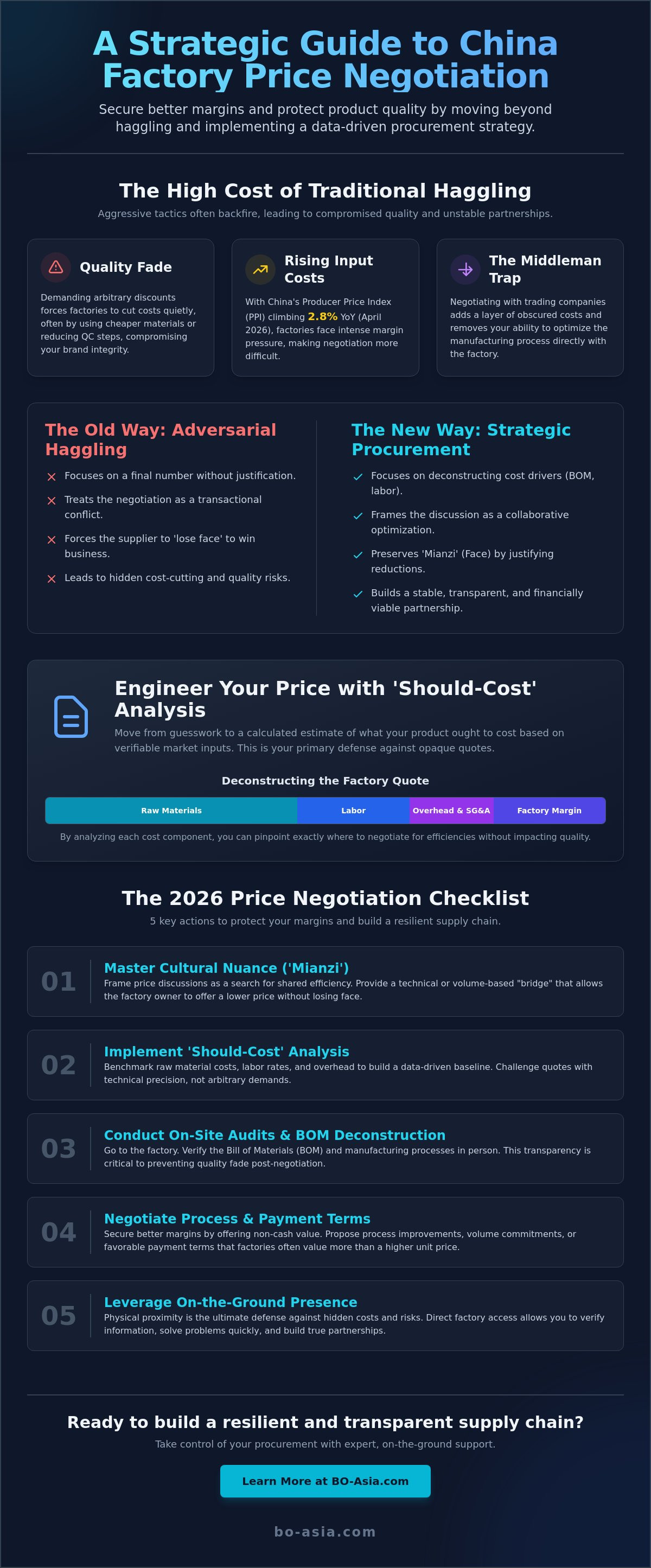
Professional procurement teams don't guess at prices. They engineer them. A 'Should-Cost' analysis is the empirical baseline for any professional negotiation, providing a calculated estimate of what a product ought to cost based on verifiable market inputs. By moving away from arbitrary discounts and toward technical transparency, you eliminate the guesswork that leads to "quality fade." This model deconstructs a quote into its core components: raw materials, labor, and overhead. In a market where the Raw Materials Purchase Price Index hit 63.70 in April 2026, having this data is your only defense during a China factory price negotiation.
Achieving a true factory-direct price requires removing the hidden 15 to 30 percent markup typically buried in quotes from trading companies or unmanaged agents. When you negotiate directly with the factory owner, you gain visibility into the actual production costs. This transparency is vital for long-term stability. As noted in the 10 Rules for Success in Chinese Negotiations, understanding the manufacturer's perspective is key. You aren't trying to bankrupt the supplier; you're ensuring that the price you pay reflects the actual value of the goods produced.
Your first step is to request a fully transparent Bill of Materials. A factory that refuses to provide a BOM is usually hiding a significant margin or a sub-standard material source. You must identify costs for every sub-component, from the primary raw materials to the protective packaging. Benchmarking raw material costs against global indices, such as the LME for metals, allows you to challenge factory quotes with precision. Use sampling support to verify that the materials listed in the BOM match the physical product. This prevents suppliers from quoting for high-grade polymers while actually using recycled alternatives. If you need assistance verifying these technical details, you can reach out to our technical team for a consultation.
Labor costs are no longer a mystery. As of April 2026, Shanghai's monthly minimum wage stands at RMB 2,740, providing a clear benchmark for first-tier manufacturing hubs. Using these regional data points, you can estimate whether a factory's labor quote is realistic or inflated. Beyond labor, you must account for the "Factory Margin." A sustainable profit for a well-run manufacturer typically falls between 10 and 15 percent. If a price seems too good to be true, it likely means the factory is sacrificing regulatory adherence or safety standards. You can learn how we manage factory-direct pricing to ensure your margins remain healthy without compromising the integrity of your supply chain.
Leverage in a China factory price negotiation is often misunderstood as a simple matter of order volume. While high-volume sourcing provides a baseline, "Process Leverage" offers a more sophisticated path to cost reduction. Manufacturers value orders that optimize their production flow and minimize downtime. If your product design is refined for mass production, you reduce the factory's operational risk. This efficiency is a powerful bargaining chip that can secure lower unit prices even when raw material markets are volatile. Between January 2025 and March 2026, the price of Neodymium increased by approximately 130 percent. In such a climate, showing a factory how to build your product faster and with less waste is more valuable than a slightly larger deposit.
Seasoned buyers know that Common Chinese Negotiation Tactics often involve using time as a weapon. You counter this by having a Dedicated Asia Procurement Team that maintains a constant presence on the factory floor. This on-the-ground accountability prevents the artificial delays often used to force concessions. When you have an integrated team acting as an extension of your business, you can pivot the conversation toward future product development pipelines. Offering a factory the "first look" at your next three years of custom tooling development creates a long-term incentive for them to maintain competitive pricing today.
Reducing SKU complexity is one of the most direct ways to lower your per-unit price. Factories thrive on repeatability. By standardizing components across your product line, you help the manufacturer achieve economies of scale within their own procurement. It's also vital to negotiate for "Tooling Ownership" from the outset. This ensures your long-term mobility and prevents a supplier from holding your molds hostage during future price reviews. This level of strategic planning is why the importance of supplier vetting in Asia can't be overstated; you must ensure your partner has the technical capacity to scale with you.
While 30/70 payment terms are the industry standard, they aren't your only option. Leveraging credit insurance through Sinosure can significantly lower a factory’s financial risk, which in turn allows them to offer you better pricing or extended credit terms. After a successful trial period, you should negotiate for "Open Account" terms. This improves your cash flow and signals a high level of trust that factories reward with priority production scheduling. Effective logistics management also plays a role. By optimizing your shipping frequency and container utilization, you can often offset the unavoidable production price increases caused by global commodity surges.
Execution is the bridge between a strategic plan and a profitable reality. While your China factory price negotiation may begin with psychological positioning and cost deconstruction, it's finalized through a rigorous verification process. In a market where regulatory changes, such as the elimination of the 9% VAT export rebate for solar products in April 2026, can suddenly shift a factory's overhead, you need a repeatable framework to protect your interests. This five-step checklist ensures that your negotiated savings don't vanish through hidden fees or quality compromises.
Conduct an on-site factory audit to verify actual production capacity and the age of machinery.
Request a line-item breakdown of the Bill of Materials (BOM) and direct labor costs.
Benchmark the quote against 3 to 5 vetted competitors using a professional sourcing company to ensure market alignment.
Draft a bilingual contract that ties the unit price to specific quality KPIs and material specifications.
Implement mass production oversight to ensure the factory doesn't swap components after the contract is signed.
You can't negotiate effectively with a ghost. It's vital to verify the identity of the actual factory owner versus an export agent who adds an invisible markup. During an on-site audit, ask to see the original business license and the factory's electricity bills for the last six months. These documents reveal the true scale of operations and whether the equipment you're shown is actually running. If you want to eliminate the risk of hiring a middleman masquerading as a manufacturer, you can explore our factory audit services to get a clear picture of your supplier's health.
A handshake means very little in a complex international supply chain. You must include specific clauses that prevent "Price Creep," where a factory attempts to raise costs mid-production due to "unforeseen" material hikes. A bilingual contract is the only way to enforce negotiated terms because it provides a legally recognized baseline for both your team and the factory's local management. Link your final 70 percent payment directly to an independent quality inspection report. This creates a financial incentive for the factory to maintain the standards you've established. If you're ready to secure your supply chain with professional oversight, contact our procurement experts today to begin your audit process.
Digital communication has transformed global trade, yet it remains a poor substitute for a physical presence at the factory gate. The most successful China factory price negotiation isn't conducted via email; it's finalized through face-to-face engagement. We provide what we call the 'Helsinki-Hong Kong' advantage. This model combines European-level management standards and professional rigor with local, on-the-ground execution. By positioning ourselves as an integrated extension of your team, we remove the "us versus them" dynamic that often plagues international manufacturing. You gain the steady confidence of an established expert who understands both your brand's high-level requirements and the factory's operational realities.
Physical proximity is your strongest defense against communication lag. In a complex market, a delay of 24 hours in a crisis negotiation can lead to missed shipping windows or unmanaged cost spikes. When our team is on-site, we identify production bottlenecks and material substitutions in real-time. This level of oversight is usually reserved for major global enterprises, but our model makes it accessible to independent business owners. You aren't just hiring a service; you're securing a stabilizing force in a market where geopolitical events and raw material surges, like the 130 percent increase in Neodymium prices recently, can otherwise derail your financial viability.
Traditional importers often operate on a "black box" model, where they apply a 100 percent markup to the factory-direct price to cover their own overhead and risks. This approach obscures the true cost of manufacturing and leaves you with zero leverage when prices rise. We reject this inefficient model. By utilizing our transparent pricing model, you reclaim those hidden margins. Our clients frequently see significant ROI by moving away from unmanaged agents and toward direct negotiation. When you see exactly what the factory is charging for labor and materials, you can make informed decisions about where to optimize your spend.
While some advisors suggest reactive legal battles to protect your interests, we believe in proactive defense. On-site quality control and mass production oversight prevent the need for expensive litigation after a shipment arrives. A dedicated sourcing team that speaks the local language and understands regional business culture can spot a "quality fade" before the first unit leaves the line. This hands-on approach ensures that the terms you negotiated are the terms you receive. If you are ready to move beyond transactional interactions and build a resilient, high-volume supply chain, contact Buying Office Asia to start your price optimization today.
Achieving a sustainable China factory price negotiation result requires moving beyond simple haggling and embracing technical transparency. By deconstructing your Bill of Materials and establishing an on-site presence, you eliminate the hidden markups of intermediaries and protect your brand from quality fade. The shift from transactional bargaining to strategic cost engineering is what separates elite enterprises from those struggling with opaque supply chains and unforeseen expenses.
As a European-managed firm with over 15 years of operational history in Asia, we provide the regional expertise and networks necessary to stabilize your procurement. We operate with 100 percent transparency and no hidden markups, ensuring that on-site quality control is an integrated part of your production oversight rather than a reactive measure. This hands-on approach provides the security and financial viability your business needs to scale with confidence in a complex global market.
Secure Factory-Direct Pricing with BOA’s On-the-Ground Experts and transform your manufacturing from a source of operational anxiety into a primary competitive advantage. Your path to a more resilient and profitable supply chain begins with a data-driven partnership.
Yes, blind pressure on pricing often triggers "quality fade." When a manufacturer's margin is squeezed below a sustainable level, they'll substitute sub-components or reduce inspection frequency to recover costs. To avoid this, your China factory price negotiation should focus on cost deconstruction. By identifying specific manufacturing efficiencies, you can lower the unit price without compromising the structural integrity or safety standards of your final product.
Transparency is the only way to verify a factory-direct quote. You must request a detailed breakdown of the Bill of Materials and compare it against current regional labor benchmarks. If a factory's overhead seems disproportionately high compared to the municipal minimum wage standards in first-tier cities, you're likely paying for an unmanaged agent's hidden commission. Validating these costs through on-site audits ensures you aren't subsidizing an inefficient middleman.
Request a technical justification that references specific market data or regulatory changes. For example, the elimination of the 9% VAT export rebate for certain products in early 2026 is a legitimate cost driver. If the data doesn't align with their request, propose non-monetary concessions. You might consolidate orders to improve their production efficiency or offer more favorable payment terms to offset their immediate financial anxieties.
Finalize all critical terms with the factory owner or a senior manager. While sales representatives manage daily communication, they rarely have the authority to approve significant margin reductions. Building a direct relationship with the owner establishes the "Mianzi" necessary for a long-term partnership. It ensures that your quality standards and pricing agreements are viewed as a top-level priority rather than a transactional task for the sales department.
Volume is a strong starting point, but production efficiency is a more sophisticated lever. Factories value orders that are easy to repeat without frequent line changes. By standardizing your custom tooling and reducing SKU complexity, you lower the factory's operational risk. This China factory price negotiation strategy allows you to secure lower prices by proving that your business is more profitable for them to manage than high-maintenance clients.
Execute a bilingual NNN agreement before sharing any sensitive BOM data or technical drawings. It's equally important to secure "Tooling Ownership" in your contract to prevent your molds from being used for other clients. Proactive on-site oversight is your best defense. Having a dedicated team present during production runs ensures that your proprietary processes remain protected and are not shared with unauthorized sub-contractors or third-party entities.
A dedicated procurement team generates ROI by removing the hidden markups typical of traditional importers. They identify the true cost of manufacturing through on-site audits and raw material benchmarking. Beyond direct savings, they mitigate the risk of quality drops that lead to expensive recalls or brand damage. The value lies in moving from an unmanaged, high-risk supply chain to a transparent, factory-direct partnership that protects your financial health.

What if the first clear sign of a production problem arrives after the goods are packed? Manufacturing risk management in Asia works best when controls are connected from the start, not left to a final inspection or occasional supplier update. You need visibility into factory activity, early warning...

What if the lowest unit quote isn’t the lowest-cost way to make your board game? Board game manufacturing costs depend on more than the number of boxes ordered. Component materials, custom tooling, assembly, packaging and delivery scope can all change what a quote covers, making headline prices diff...

What if the factory’s lowest quote isn’t the lowest-cost option? A lower unit price can hide differences in materials, tooling, packaging, quality checks or production terms. Understanding how sourcing agents negotiate factory prices starts with making those differences visible, not simply asking a...