


What if the "minimum" in your factory's Minimum Order Quantity was actually a calculated negotiation lever rather than an immovable production wall? You likely feel the weight of capital trapped in slow-moving inventory and the mounting warehouse costs of stock you didn't want to buy in the first place. It's a risk that leads to product obsolescence, especially as the 2026 manufacturing sector shifts toward high-value, data-driven production under the 15th Five-Year Plan. This strategic guide provides the blueprint for negotiating MOQs with Chinese factories to secure lower volumes without sacrificing factory-direct pricing or quality.
You'll learn how to leverage China's current focus on industrial efficiency to your advantage while protecting your margins. We'll explore how a dedicated on-the-ground presence can verify genuine constraints versus mere tactics, allowing you to optimize cash flow and build a scalable partnership. We'll cover the specific mechanics of premium pricing for lower volumes, split-shipment strategies, and the role of regional expertise in securing terms that protect your financial health. This approach moves you away from unmanaged risk and toward the steady confidence of a seasoned industry insider.
• Learn how the 2026 shift toward agile supply chains and micro-factory setups allows for smaller, more frequent production runs.
• Discover why the real bottleneck often lies with sub-tier suppliers and how negotiating MOQs with Chinese factories requires addressing these component-level constraints.
• Use the "Phased Order" and "Standard Material" strategies to maintain factory-direct pricing while reducing your initial capital commitment.
• Amortize custom tooling costs into your unit price to avoid massive upfront volumes when launching new, specialized products.
• Understand how an on-the-ground presence in Hong Kong and Mainland China leverages local relationships to bypass rigid factory rules that remote buyers can't influence.
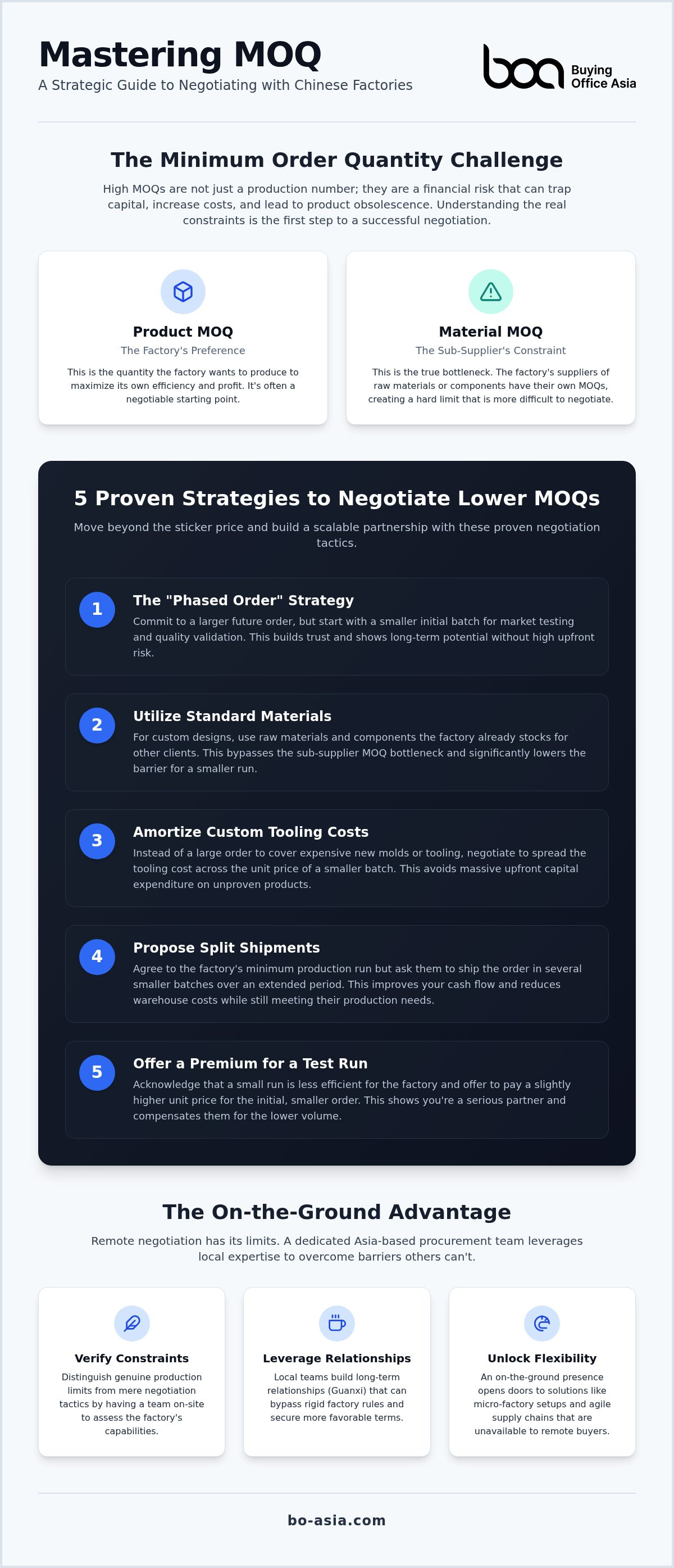
Minimum Order Quantity (MOQ) represents the lowest volume of units a supplier is willing to manufacture in a single production run. In the context of 2026, this metric has evolved from a rigid barrier into a dynamic variable. China's industrial policy, guided by the 15th Five-Year Plan, now prioritizes efficiency and data-driven innovation over raw capacity. This shift has birthed "Micro-Factory" setups and agile supply chains that allow for greater flexibility than ever before. Successfully negotiating MOQs with Chinese factories starts with recognizing that these numbers aren't arbitrary; they're often dictated by the factory's own material suppliers. You must distinguish between the Product MOQ, which is the factory's preference, and the Material MOQ, which is their actual hard constraint.
A high MOQ does more than just fill your warehouse; it drains your liquidity. When you commit to excessive volumes, you're essentially gambling on market demand. Calculating the hidden cost of "Dead Stock" reveals that warehouse storage and insurance can erode your margins significantly over time. Beyond storage, massive initial batches increase your exposure to quality issues. If a defect exists, it's multiplied across thousands of units before you've even tested the first one in your local market. This imbalance is why sophisticated procurement teams analyze the Economic Order Quantity (EOQ) to find the ideal point where ordering costs and carrying costs align. The opportunity cost of capital tied up in slow-turning inventory prevents you from reinvesting in new product lines or scaling your marketing efforts. You aren't just buying products; you're managing financial risk.
Your strategy changes depending on whether you're sourcing off-the-shelf goods or developing proprietary designs. Standard products typically have lower MOQs because the factory already stocks the raw materials and components for multiple clients. However, when you move into OEM manufacturing, requirements naturally rise to cover the setup costs and custom tooling. In 2026, "Market Testing" batches have become the new standard for savvy buyers. Instead of a full production launch, you negotiate a smaller pilot run to validate quality and consumer interest. This protects your brand while establishing a baseline for future growth. Understanding the difference between a product's MOQ and the underlying material MOQ is the key to identifying where a factory has room to move and where they're genuinely constrained by their own sub-tier suppliers. Using standard materials for custom designs is often the fastest way to lower these barriers.
When you encounter a rigid MOQ, it's rarely a sign of factory stubbornness. Most manufacturers operate at the center of a complex web of sub-tier suppliers. If your factory produces electronic devices, they must source specialized chips, plastic casings, and custom wiring from third parties. These sub-tier suppliers have their own minimum batch sizes that must be met. If a plastic injection molder requires a 5,000-unit run to justify starting their machines, your primary factory cannot realistically offer you 500 units without incurring a massive financial loss. Understanding these dependencies is critical when negotiating with Chinese suppliers.
Production line efficiency also dictates these volumes. Every new production run requires "set-up time," which involves cleaning machines, calibrating equipment, and training staff on your specific product. For a factory, small runs are often loss-leaders. They spend more on the transition than they earn from the sale. Additionally, labor constraints play a significant role. In regions like Shanghai, where the monthly minimum wage reached RMB 2,740 in August 2026, factories must ensure their production lines remain active to retain skilled workers. Long, steady runs provide the stability workers demand. For new, unproven buyers, factories also apply a "Risk Premium." They set high MOQs to ensure the partnership is worth the initial investment of time and resources. If you want to bypass these barriers, you can consult with a procurement expert to verify the factory's claims.
Machine calibration and tooling changes carry a fixed cost regardless of the order size. The math is simple: the first 1,000 units are always the most expensive because they absorb the entirety of the setup overhead. As volume increases, these costs are distributed, lowering the per-unit price. When negotiating MOQs with Chinese factories, you need to know exactly what these setup costs entail. Our dedicated Asia procurement teams audit these operational expenses on-site. By verifying machine run-times and labor allocation, we identify the exact point where a production run becomes profitable for the factory. This data-driven approach removes the guesswork from your procurement strategy.
Negotiating MOQs with Chinese factories requires a shift from a transactional mindset to a strategic partnership. You aren't simply asking for a favor; you're proposing a more efficient production model that mitigates risk for both parties. In the 2026 manufacturing landscape, where data-driven efficiency is paramount, factories are increasingly open to flexibility if you can demonstrate a clear roadmap for growth. By applying the following five strategies, you can secure the volumes you need without compromising on the per-unit cost or the integrity of your product.
Commit to a total annual volume, such as 10,000 units, but negotiate for monthly releases of 800 units. This provides the factory with the security of a long-term contract while protecting your cash flow from massive upfront inventory costs.
Most material bottlenecks occur because of custom colors or unique alloys. By using the factory’s existing stock materials, you bypass their sub-tier supplier minimums. When sourcing goods and suppliers in China, always request a list of materials currently in high-rotation on their production floor.
Negotiate a paid "trial run" of 100 to 200 units at a slightly higher price point. If the quality meets your standards, agree that the price premium paid for the trial will be credited toward your first full-scale order.
Trade your payment terms for volume flexibility. A factory may accept a 30% lower MOQ if you offer a 50% deposit instead of the standard 30%, as this improves their immediate liquidity.
Ask your factory when they're next producing a similar item for another client. By aligning your production with an existing run, you eliminate the "set-up time" costs that usually justify high MOQs.
A Letter of Intent (LOI) is a powerful tool for building trust without the immediate capital drain of a massive deposit. It signals to the factory that you're a serious partner with a documented growth strategy. This professional approach often allows you to secure terms that are usually reserved for much larger enterprises. It's essential that your factory direct price negotiations include specific volume scaling clauses. These clauses should outline exactly how your MOQs will decrease or your pricing will improve as your order frequency increases over the next 12 to 24 months.
Customization is the primary driver of high MOQs. To lower the barrier to entry for your first batch, consider reducing the number of custom colors or unique components. Choosing between ODM vs OEM models can also help; using a factory's existing ODM template significantly reduces the need for custom tooling and setup. Packaging is another hidden MOQ driver. Using generic, high-quality boxes with custom stickers for your first 500 units can bypass the 3,000-unit minimum often required for custom-printed corrugated cardboard.
High-volume sourcing demands a strategic pivot in how you approach volume commitments. When your project involves proprietary designs and custom moulds, the factory's financial risk profile changes significantly. Manufacturers typically demand higher MOQs to justify the engineering hours and machine downtime required for specialized setups. Successfully negotiating MOQs with Chinese factories in this context requires you to address their capital expenditure concerns directly while protecting your own liquidity. You aren't just buying units; you're managing an industrial investment.
In high-volume environments, the cost of tooling is the primary barrier to flexible order sizes. Factories often use high MOQs as a safety net to ensure they recoup the cost of mould fabrication. You can counter this by proposing a "Tooling Amortization" model. Tooling amortization protects buyer cash flow by spreading the capital cost of moulds across the unit price of the first production runs rather than requiring a massive upfront payment. This model allows you to start with lower initial volumes while the factory remains confident in their eventual ROI.
Strategic buyers also negotiate "Tooling Ownership" as a primary lever for future flexibility. If you legally own the moulds and have the right to move them to another facility, your current factory has a strong incentive to remain competitive on MOQs. Without this leverage, you're effectively "locked in," and the factory can dictate terms with little fear of losing your business. Establishing these rights during the initial contract phase is essential for long-term supply chain security.
Managing a diverse product line often leads to fragmented inventory and excessive capital tie-up. To solve this, you should negotiate an "Aggregate MOQ" that covers multiple product variations. Instead of meeting a 3,000-unit minimum for a single SKU, you can propose a 3,000-unit total across five different colorways or styles. This is particularly effective when products share internal components or standardized housing. Our logistics and shipping management team then consolidates these smaller batches into full containers to maintain operational efficiency.
Seasonality also plays a critical role in MOQ fluctuations. During peak periods like the lead-up to Chinese New Year, factories often raise their minimums to prioritize high-margin, easy-to-run orders. You can mitigate this risk by establishing "Buffer Stock" agreements. By committing to raw material purchases in advance, you ensure the factory has the components ready for your smaller, off-peak runs. If you're planning a complex launch with custom requirements, contact our procurement team to design a tooling and volume strategy that scales with your growth.
Negotiating MOQs with Chinese factories is often viewed as a battle of numbers, but it's actually a battle of information and presence. Email negotiation is a blunt instrument. It lacks the nuance required to navigate the cultural and operational complexities of the 2026 manufacturing landscape. When you rely solely on digital communication, you remain a generic entry in a factory's CRM. A physical presence in Hong Kong and Mainland China changes the power dynamic, moving your brand from a digital request to a physical priority. This proximity allows for the steady confidence that comes from knowing exactly what is happening on the factory floor.
In Chinese business culture, the concept of "Face" (Mianzi) remains a tangible currency. Local relationships allow for concessions that a remote buyer will never secure. A factory owner is far more likely to reduce an MOQ for a partner they meet for tea than for a name on a screen. By acting as an integrated extension of your own team, Buying Office Asia leverages these regional networks to bypass rigid rules. We provide 100% transparency into the factory's cost structure. When you see the actual cost of raw materials and labor, you can identify exactly where the MOQ can be trimmed without eroding the factory's necessary margins.
Is a factory genuinely constrained by a sub-tier supplier, or are they simply prioritizing a larger client's production run? Without boots on the ground, you have no way to verify their claims. Our team conducts on-site audits to determine the truth behind volume requirements. Through rigorous supplier vetting, we identify manufacturers with flexible production lines that are designed for agile scaling. This local expertise also prevents "Quality Fade." Factories often attempt to recover lost margins by using cheaper components when they agree to lower MOQs. Our on-site inspectors ensure that a reduction in volume never results in a reduction in quality.
Successful procurement requires moving away from transactional vendor relationships toward long-term partnerships. When a factory views you as a partner rather than a one-off buyer, they become invested in your growth. This shift in perspective is the most effective way to secure sustainable volume flexibility. The ROI of professional procurement is visible in your bottom line through improved cash flow and reduced inventory risk. You can see documented evidence of this in our savings and efficiency case studies. This elite level of oversight, once reserved for major enterprises, is now accessible to independent business owners who prioritize financial health. To secure your supply chain, contact Buying Office Asia to discuss a tailored 2026 sourcing strategy that protects your capital.
Mastering the art of negotiating MOQs with Chinese factories is the difference between a stagnant warehouse and a fluid, profitable operation. By dismantling sub-tier supplier barriers and applying data-driven strategies like tooling amortization, you protect your cash flow and ensure long-term scalability. You've seen how 2026 industrial shifts favor those who treat manufacturing as a partnership rather than a transaction. The goal is to move away from unmanaged risk and toward a steady, predictable supply chain that grows alongside your business.
Achieving these results requires more than just remote communication; it demands an insider's perspective. Our European-managed firm provides 100% transparency and a permanent on-the-ground presence in Hong Kong to eliminate hidden costs and secure factory-direct pricing without middlemen. We function as a protective extension of your own team, ensuring that quality remains high even as order volumes decrease. This elite level of oversight provides the security you need to navigate a complex global market.
Take the next step toward a more resilient and financially viable manufacturing model. Partner with a Dedicated Asia Procurement Team for Your 2026 Sourcing Strategy to eliminate the operational setbacks of unmanaged sourcing. Your growth is our priority.
Paying a higher unit price for a lower MOQ is a strategic move to preserve liquidity. Industry professionals often consider a premium of 8% to 15% over the bulk price as a fair trade-off. This approach reduces the risk of product obsolescence and eliminates high warehouse storage costs for slow-moving stock. It's an investment in financial flexibility that protects your business from the dangers of over-leveraging on unproven inventory.
A Material MOQ is the minimum volume of raw materials, such as custom dyes or specialized alloys, that a factory must purchase from its sub-tier suppliers. This often functions as the true hard constraint in production. If your design requires a unique component that only comes in large batches, the factory cannot lower your order volume without incurring a loss. Standardizing your materials is the fastest way to bypass these sub-tier bottlenecks.
Verifying if a factory's MOQ claims are genuine requires an on-the-ground presence. Remote buyers often face inflated numbers that serve as a negotiation tactic rather than a real constraint. A dedicated Asia procurement team can audit the factory's production schedules and sub-tier supplier invoices to uncover the truth. This transparency ensures you aren't paying a premium for a "ghost" constraint that doesn't actually exist in the factory's operational reality.
You should avoid disclosing your total budget during the early stages of a negotiation. Focus instead on your projected annual volume and your specific quality requirements. Revealing your budget gives the factory a target to hit, which can lead to obscured costs or inflated per-unit pricing. By keeping the discussion focused on production mechanics and volume scaling, you maintain the leverage needed for successful factory-direct price negotiations.
Pushing for an exceptionally low MOQ can lead to "Quality Fade" if the factory feels the order isn't profitable. Some manufacturers might use leftover materials from other clients or rush the production process to clear the line. To prevent this, you must implement on-site quality control and inspections during the run. This oversight ensures the factory adheres to your ethical and regulatory standards, regardless of the order size.
A sourcing partner provides the regional expertise and networks that individual buyers lack. When negotiating MOQs with Chinese factories, our team leverages long-term relationships and the concept of "Face" to secure concessions. We act as an integrated extension of your team, providing the elite oversight usually reserved for major enterprises. This proximity allows us to verify factory claims and secure terms that are impossible to achieve through email alone.
Seasonality significantly impacts a factory's willingness to be flexible. During peak periods like the lead-up to Chinese New Year, factories prioritize high-margin, high-volume orders and rarely negotiate minimums. Conversely, during slower months, they may lower MOQs to keep their production lines active and retain skilled workers. Timing your order to coincide with these lulls is a practical way to optimize your procurement strategy and improve your financial health.

What if the first clear sign of a production problem arrives after the goods are packed? Manufacturing risk management in Asia works best when controls are connected from the start, not left to a final inspection or occasional supplier update. You need visibility into factory activity, early warning...

What if the lowest unit quote isn’t the lowest-cost way to make your board game? Board game manufacturing costs depend on more than the number of boxes ordered. Component materials, custom tooling, assembly, packaging and delivery scope can all change what a quote covers, making headline prices diff...

What if the factory’s lowest quote isn’t the lowest-cost option? A lower unit price can hide differences in materials, tooling, packaging, quality checks or production terms. Understanding how sourcing agents negotiate factory prices starts with making those differences visible, not simply asking a...