


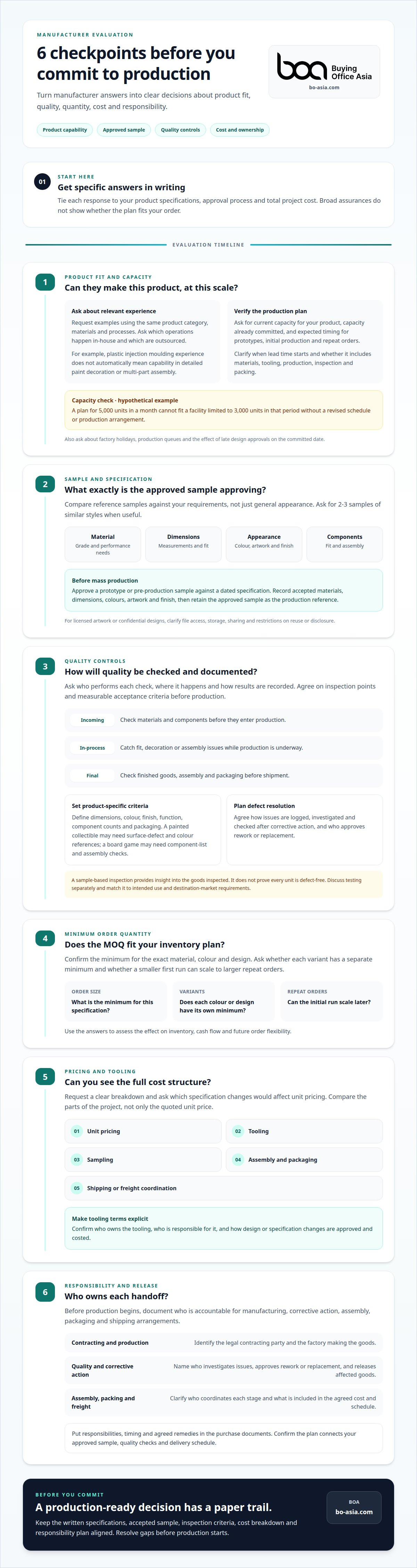
Before approving samples or production, get clear, written answers about the manufacturer’s relevant experience, quality controls, minimum order quantity, pricing, tooling, assembly, and shipping arrangements. The most useful questions to ask a manufacturer tie each answer to your product specifications, approval process, and total project cost, helping you spot gaps before they become production problems.
A promising sample is only one part of the decision. Confirm how the approved sample will guide production, how inspections and corrective actions are handled, what changes affect the unit price, and who is responsible for tooling, component assembly, packaging, and freight coordination.
This article gives you a practical checklist for evaluating these details before you commit. Learn what to ask about product experience and materials, how to assess quality beyond the sample, and how order minimums and tooling choices affect financial planning. You’ll also see how to clarify assembly and shipping responsibilities, helping you move from sample approval to production with fewer costly surprises.
• Match the manufacturer’s product experience, materials, equipment, and production capacity to your specifications and delivery plan.
• Look beyond the approved sample: clarify inspection stages, how defects are investigated, and how production quality is documented.
• Understand how the minimum order quantity affects inventory, cash flow, and your ability to scale future orders.
• Request a clear cost breakdown that separates unit pricing, tooling, sampling, assembly, packaging, and shipping.
• Document who owns tooling, approves design changes, coordinates assembly, and handles shipping before production begins.
Ask for examples involving the same product category, materials, and production processes. A factory experienced in plastic injection moulding may not have the skills or equipment for detailed paint decoration or multi-part assembly. Ask which operations happen in-house and which are outsourced. If your product combines rigid plastic parts, printed packaging, and hand assembly, map each stage to the facility responsible for it.
Request references or examples of comparable work, including how production issues were resolved. You can also ask whether the manufacturer can provide 2-3 reference samples of similar styles. Compare these against your specifications for material, dimensions, finish, and component fit. For materials with specific performance needs, such as chemical resistance or outdoor exposure, discuss the relevant material grades and planned testing. Ask which certifications apply to the product and intended market, and request the supporting documentation.
Capacity needs a clear time period and order quantity. Ask for current production capacity for your product, the capacity already committed to other orders, and the expected schedule for prototypes, initial production, and repeat orders. As a hypothetical example, a factory producing 50 pieces per week would need a different plan to deliver 5,000 pieces than one with higher available capacity. Likewise, a hypothetical plan for 5,000 units in a month cannot fit a facility limited to 3,000 units in that period without a revised schedule or production arrangement.
Ask when the lead-time clock starts, what milestones it includes, and what could change the delivery date. As a hypothetical example, one manufacturer may quote 6 to 12 weeks from deposit, but that is not a universal production timeline. Confirm whether the schedule includes material purchasing, tooling, production, inspection, and packing. Ask how factory holidays, production queues, and late design approvals affect the committed date.
Clarify the minimum order quantity for the exact material, colour, and design. Ask whether a smaller first run can scale to larger repeat orders and whether each variant has a separate minimum. This helps align the factory’s setup and material requirements with your inventory plan.
Before mass production, approve a prototype or pre-production sample against a dated specification. Record the accepted materials, dimensions, colours, artwork, and finish, then keep the approved sample as the production reference. For licensed artwork or confidential designs, ask who can access the files, how they’re stored and shared, and what confidentiality terms apply. Limit access to project personnel and document restrictions on reuse or disclosure.
These questions to ask a manufacturer should lead to specific answers, not broad assurances. Use the responses to connect product experience, available capacity, sample approval, and the delivery plan before committing to production.
Ask who performs each quality check, where it takes place, and how results are recorded. A factory may inspect incoming materials, monitor production, check final assembly, and examine finished goods before shipment. Ask for inspection records or testing reports relevant to your product rather than relying on a general description of the process.
Clarify whether you’re contracting directly with the factory or through an agent. An agent may coordinate production without owning the facility, so identify the legal contracting party, the factory making your goods, and who is accountable for corrective action. Request factory references and arrange an audit when production risk, complexity, or site access makes direct observation valuable. Supplier vetting can help establish who controls production and quality records.
Ask which quality system or certifications the factory holds and whether they cover the relevant site and activity. ISO 9001 is a widely used quality-management certification example, while ISO 14001 concerns environmental management. Neither certificate alone proves that your product will meet its specification. Review the certificate’s scope and validity, then ask how the factory applies its procedures to your product and records deviations.
Agree on inspection points before production begins. Incoming checks can catch incorrect components; in-process checks can reveal fit or decoration issues before they spread; final inspection can assess finished goods, packaging, and assembly. Set measurable acceptance criteria for dimensions, colour, finish, function, component counts, and packaging. For a painted collectible, define acceptable surface defects and colour references. For a board game, verify the component list and assembly instructions.
Discuss testing separately from visual inspection. Identify which product functions or materials need testing, what method will be used, and when results must be available. Testing should reflect intended use and destination-market requirements. A sample-based inspection gives insight into the goods inspected, not proof that every unit is defect-free.
Quality control also requires a defect-resolution plan. Ask how issues are photographed, logged, assigned a root cause, and checked after corrective action. Define who approves rework or replacement, how affected goods are separated, and what evidence is required before release. Put responsibility, timing, and agreed remedies in the purchase documents. A manufacturing partner should explain how recurring defects lead to process changes, not just sorting.
BOA offers standalone inspections, which can start from one inspector-day with same-day reporting. To discuss a standalone inspection, contact BOA about on-site quality inspection support. For broader production oversight, contact BOA to discuss coordinating supplier management, production follow-up, and corrective action.
A minimum order quantity (MOQ) is the smallest quantity a manufacturer will accept for one order. Ask for the MOQ that applies to your specific product, material, colour, and design. A quoted threshold may apply per style, per colour, or across the full order. These distinctions affect how much stock you must commit to each variant.
Ask how the factory calculates its minimum and whether different configurations change it. For example, a hypothetical manufacturer might list an MOQ of 75 units per style per colour. That structure could require separate commitments for several colours, even when the combined order seems substantial. Request the MOQ breakdown by variant and include it in the quotation, so planning starts with the actual supply commitment.
Compare the manufacturer’s MOQ with your realistic demand, storage capacity, and cash-flow plan. For example, a hypothetical brand ordering 100 pieces may find a 1,000-unit minimum unsuitable. In another hypothetical scenario, a factory requiring two thousand pieces may be a poor fit for a buyer needing twenty. A larger order can create a lower unit price, yet unsold inventory ties up capital and adds storage pressure. The useful comparison is total project exposure, not unit price alone.
Ask for unit pricing at relevant order quantities, including any price breaks and their conditions. Confirm whether each break depends on one design, one colour, or the total combined volume. Ask what changes between price tiers, such as material purchasing, setup, or production planning. Don’t assume that doubling the quantity halves the unit price. Request a written quotation showing quantity, unit price, included components, and separately charged costs.
MOQ and payment terms affect each other. A larger order commitment can increase the deposit and balance due, putting more cash at risk before the goods are sold. Ask when each payment is due and whether terms differ by order size. Clarify whether a repeat order uses the same MOQ or requires a new production commitment. This matters if sales begin with one variant and later shift to another.
For a first run, ask whether the manufacturer can support a smaller quantity or staged production. Some factories set minimums based on material purchasing, colour setup, or production efficiency. A smaller run may therefore carry a higher unit price, while a larger run may improve pricing but leave excess stock. Compare both options with expected demand and your capacity to fund and store the order.
Before choosing a manufacturing partner, document the agreed MOQ, variant rules, price breaks, and payment schedule. Ask what happens if the design, material, or order mix changes after approval. Clear terms help prevent a low headline price from disguising a quantity commitment that doesn’t fit your business plan.
Ask for a written quotation that identifies unit price, order quantity, currency, and included services. Compare the same product specification and order volume across suppliers. Domestic manufacturing may simplify communication or delivery, while overseas sourcing may offer different production options. Neither location guarantees lower total cost, better quality, or faster lead times; these depend on the product, factory capacity, quality controls, and delivery plan.
Request prices at relevant volume levels and ask what determines each price break. The unit price may change with material availability, production setup, order mix, or packaging. Clarify whether a quoted discount applies to one design or combines several variants. If a supplier’s quote depends on an assumption, such as one colour or standard packaging, record that condition alongside the price.
Build a like-for-like cost comparison. Separate product costs from sampling, tooling, packaging, inspection, and freight coordination. Ask which items are included and which are quoted separately. A lower unit price can still mean a higher project commitment if setup or packaging costs are excluded. Record every assumption so changes to materials, artwork, or order volume don’t quietly distort the comparison.
For overseas orders, estimate landed cost rather than judging the factory price alone. Shipping, packaging dimensions, shipment terms, destination, and product classification can affect the final amount. Import duties and other charges vary by product and destination. Ask for packaging specifications and a clear breakdown of freight-related responsibilities, then use those details to prepare a realistic total-cost estimate.
Payment terms affect cash flow and production exposure. Ask what deposit is required, when the balance is due, which currencies are accepted, and whether bank charges or currency conversion affect payment. Some manufacturers request full payment upfront; others require a deposit followed by final payment before shipment. Put each payment milestone and its trigger in the written agreement.
Negotiate contract terms alongside payment. Attach the approved product specification and sample reference, then define how changes affect price and schedule. State the inspection and acceptance process, how defects are documented, and what remedy applies to nonconforming goods. Clarify ownership of tooling and artwork where relevant. These terms link payment to agreed deliverables, not vague assurances.
Ask how long the quotation remains valid and what could change it. Material availability, currency, order quantity, and shipping arrangements may affect a revised offer. Set a written approval step for any price adjustment, and keep the quotation, purchase order, specification, and payment schedule aligned. This creates a transparent commercial record before production begins.
Ask the manufacturer to separate recurring unit costs from one-time development and tooling charges. For injection-moulded parts, tooling creates the mould used to produce the component. The upfront investment, expected production volume, design complexity, and ownership terms all affect whether this process suits your growth plan. Compare the tooling charge and unit price together, not as isolated figures.
Clarify who owns each tool, where it will be stored, and which products it can make. Ask whether the mould can be moved to another factory, who pays for maintenance, and how wear or damage is handled. Put these terms in the contract. If a supplier’s quote assumes one mould cavity, material, or finish, record that assumption because changing it may affect capacity and unit pricing.
Sampling and approval are key checkpoints before production. Ask whether the tooling quote includes trial runs, sample revisions, and production approval. Compare the final pre-production sample with the approved specifications before authorizing mass production. For a multi-part collectible, confirm that parts fit together and paint details match the approved reference. Record tolerances and decoration standards so quality control has clear criteria.
Assembly can shift costs and responsibilities between suppliers. Ask which components arrive ready to assemble, who performs assembly, and whether it’s included in the unit price. For a board game, confirm who collates the cards, boards, tokens, and instructions, then checks the complete set. Define packaging requirements too, including inserts, labels, carton configuration, and protection for fragile components. A written packing specification reduces ambiguity at the factory handoff.
Shipping quotes need clear assumptions. Ask which party books transport, what shipment terms apply, and where responsibility transfers. Confirm carton dimensions, gross weight, destination, and whether the quotation covers freight coordination or other charges. Import duties and taxes depend on the product and destination, so calculate them separately using the applicable classification and current destination rules. Don’t treat a factory-gate price as the delivered cost.
These decisions connect tooling, assembly, packaging, and freight across the supply chain. During a supplier meeting, ask for one itemized cost model covering setup, unit production, assembly, packing, and shipping responsibilities. Then compare that model at your minimum order and expected growth volumes. If a lower unit price requires more tooling or a larger commitment, weigh the full cash exposure against forecast demand.
For support coordinating custom tooling, assembly, and shipment planning, discuss your manufacturing requirements.
Buying Office Asia supports sourcing, procurement, and production coordination. Its team can help assess factories and align specifications with production capabilities, helping you address supply-chain risks before production begins.
With sourcing and procurement support, you can coordinate supplier selection, order requirements, and production planning. For larger programs, the team can help assess manufacturer capacity against your requirements. A dedicated Asia procurement team also supports communication and follow-up across manufacturing, giving your business clearer visibility as samples move toward production.
Contact Buying Office Asia to discuss your manufacturing requirements and the support your project needs.
Use your questions to ask a manufacturer as the starting point for a working production brief. Record approved decisions, responsible contacts, and change approvals in one place, so your team has a consistent reference from development through repeat orders. This turns a useful supplier discussion into an operating process your business can build on.
Buying Office Asia supports this next step with End-to-End Sourcing & Procurement, high-volume sourcing and procurement, and a Dedicated Asia Procurement Team. The right support depends on your sourcing needs and the level of coordination your production plan requires.
If you’re preparing to develop a product or move an approved sample toward production, contact Buying Office Asia to discuss your requirements. A clear plan gives your team a practical foundation for moving forward with greater control.
Ask how production teams receive the current product specification and how outdated versions are withdrawn. This document-control step matters when a late artwork, material, or component change occurs. For example, if a board-game component changes after initial approval, the assembly team needs the correct version before packing starts. Clear version control helps prevent work from continuing against superseded instructions.
There is no single lead time for every product or order. Start with the date your goods need to be available, then plan backward from launch or campaign commitments. Leave room for freight variability or a production restart if output needs correction. For seasonal products, align the arrival window with marketing and sales plans before placing the order.
Payment terms are agreed between the buyer and manufacturer, so review them as part of the commercial agreement. Alongside the payment schedule, establish a control for changes to bank details: verify any new account information through a trusted, separate communication channel before sending funds. This safeguard can help protect the transaction from invoice fraud without changing the agreed commercial terms.
The minimum varies by manufacturer and product setup. Beyond the initial order, ask how unused materials or components will be handled if production requires purchasing more than the finished quantity. Agree whether those materials remain available for a future run, who owns them, and how storage is managed. This can affect the practicality of replenishing a product without repeating the same material commitment.
For a product with several components, assess capacity in finished, packed units rather than adding up component outputs. Assembly, collation, or packaging can become the limiting stage even when individual parts are ready. Ask how the manufacturer defines completed output and whether the quoted capacity includes final packing. This gives your team a clearer basis for planning the quantity ready to ship.
Experience should fit the product’s intended use, not just its appearance. A promotional display item, toy, collectible, food-contact product, or electrical product may involve different design and testing considerations. Share the intended users, age group, and destination markets, then discuss how those factors shape product development. Don’t assume an item is exempt from requirements simply because it is sold as merchandise.
Agree on a shared decision log for approvals, open issues, and changes. Record who made each decision, which document or sample it applies to, and when the team accepted it. This is especially useful when design, procurement, and production teams work across time zones. A clear record helps new team members understand the project’s current direction without relying on scattered email threads.
Ask whether a reference can speak to repeat production, not just prototype development. A customer who has reordered can offer useful perspective on how the manufacturer maintained consistency across runs and managed the working relationship. If direct introductions aren’t possible, request a project summary focused on repeat-order experience. This helps you judge whether the reference reflects the ongoing supply relationship your business needs.

Supplier coordination works best when everyone knows when decisions will be made, what can happen asynchronously, and which local time zone applies to each deadline. Managing different time zones with suppliers means setting a practical window for live discussions, documenting updates for people who...

A shipment can be ready to move and still be held at the border. The customs clearance process for imports determines whether goods can enter their destination market, which documents are reviewed, and what duties or fees may be due. The exact requirements depend on the goods and the country they’re...

Distance can turn a small production issue into a coordination problem. The benefits of having a team on the ground in Asia include closer alignment between regional operations and your wider business. Local presence can connect strategy with supplier activity, product decisions, and day-to-day coll...