


A factory audit can look reassuring while leaving a critical question unanswered: will the same materials, processes and controls be used for your production run? Responsible toy manufacturing in China requires more than reviewing a certificate. You need to understand factory conditions, subcontracting, product-specific risks and the controls that carry an approved sample through mass production.
Before committing, gather evidence that matches your product, its intended use, age group and destination market. This article gives you a practical framework to assess a supplier, choose material and production checkpoints, and check that testing and production controls fit your product. It also explains how prototypes, approved samples, inspections and corrective actions work together. An audit or inspection is a snapshot, not a guarantee of every unit. With a structured approach, you can make clearer supplier decisions and maintain oversight as production progresses.
• Assess responsible toy manufacturing in China through evidence of factory practices, product controls and supply-chain transparency, not marketing claims alone.
• Match audit and compliance records to the actual facility, product scope and production dates. Record gaps, owners and follow-up actions.
• Compare manufacturers on process capability, traceability and communication, as well as whether the facility fits your materials, decoration and assembly needs.
• Set written acceptance criteria for samples and production, including dimensions, tolerances, paint finish, components, assembly and packaging.
• Connect supplier vetting, sampling, production oversight and inspections to identify issues earlier. Treat each inspection as a snapshot, not a guarantee.
For international buyers, responsible toy manufacturing in China means checking how people, products and processes are managed, from supplier selection through production. A factory’s marketing language or a certificate viewed in isolation is not enough. Look for evidence that relates to the actual facility, product and production scope, and track any gaps through to follow-up.
A responsible supplier claim is credible only when records, observed practices and product controls provide evidence for the specific factory and order being assessed. A document may be genuine but cover a different site, process or product. Buying Office Asia’s OEM and ODM contract manufacturing support connects product development and supplier coordination with production oversight, helping keep these details aligned.
Assess four related areas separately. Ethical workplace practices concern how workers are treated. Safe production practices concern workplace conditions and process controls. Product safety concerns hazards associated with the item, while production quality concerns whether units match agreed specifications. Material records and production documents help connect these areas to the order.
Apply the same scrutiny to environmental claims. Ask which activity, facility and production scope the evidence covers. A general sustainability statement, standard or certificate does not automatically demonstrate ethical performance or environmental outcomes across every process. Match supporting records to the site and work involved, and note exclusions or unresolved questions.
A toy intended for children, an adult-oriented collectible and promotional merchandise may look similar, but intended use can change the risk assessment. Age group and destination market can also affect applicable product requirements, labels and tests. Define these factors before finalizing specifications or approving a sample. Do not assume one approval or test covers every market or use.
Identify product features that bring additional considerations. An item intended to contact food needs relevant food-contact checks, while an electrical feature needs checks appropriate to its design. Treat these as part of the product brief and evidence plan, not as ordinary toy components covered by a broad supplier assurance.
Before comparing suppliers, document the intended users and use, destination markets, materials and product features. Then ask whether the evidence refers to the actual manufacturing site and scope. This gives your team a clear basis for identifying what needs verification, without mistaking a supplier’s stated commitment for proof of day-to-day practice.
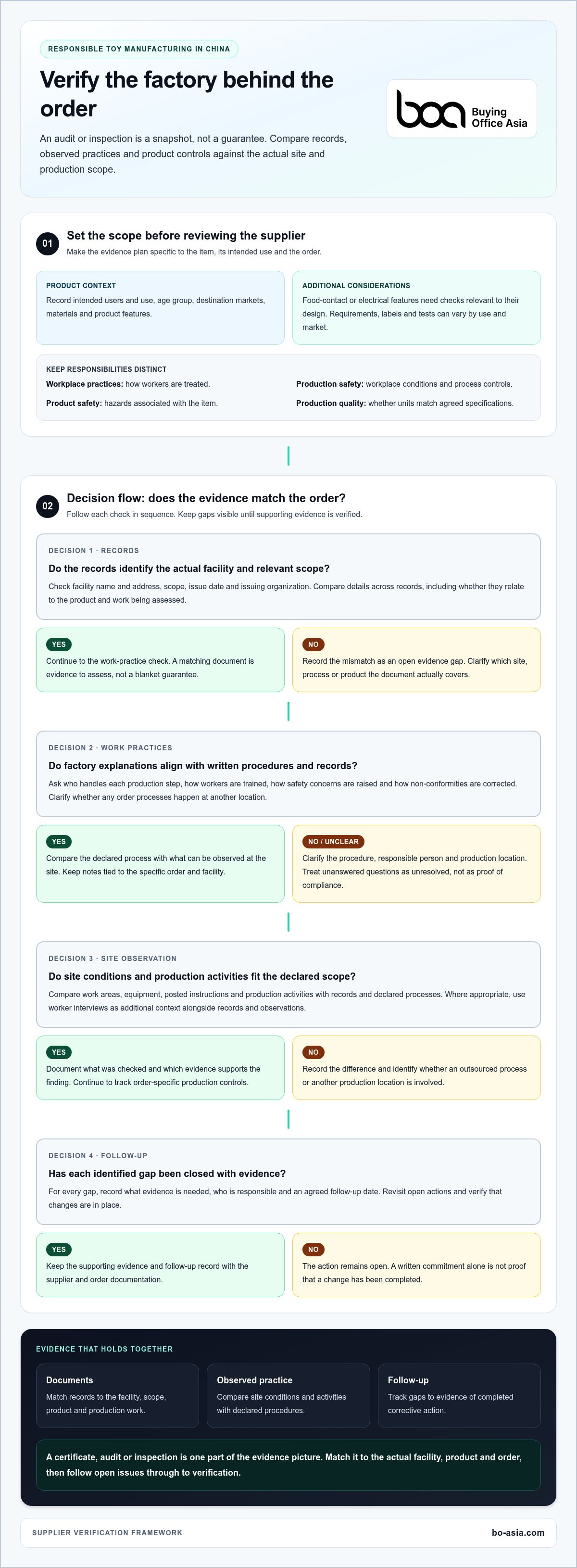
Use a staged review rather than treating a directory listing, audit report or certificate as a final verdict. At each step, test whether the factory’s claims match the site, people and processes involved in your order. Record evidence gaps and follow-up actions so they do not disappear between supplier selection and production.
Request relevant workplace policies, training records, working-hour records, environmental evidence and corrective-action documentation. Check the facility name and address, scope, issue date and issuing organization. Compare details across records. A report for another site or product may not support the claim being made.
Ask factory management who handles each production step, how workers are trained, how safety concerns are raised and how non-conformities are corrected. Compare the answers with written procedures. Clarify whether any processes for your order take place at another location.
During a factory visit or audit, compare work areas, equipment, posted instructions and production activities with the records and declared scope. Where appropriate, worker interviews can provide additional context. Treat interviews, records and observations as complementary evidence, not as a basis for broad conclusions from one comment or visit.
For each gap, document the evidence needed to close it, the person responsible and an agreed follow-up date. Revisit open actions and verify that changes are in place. A written commitment alone is not proof of completion.
Check whether documents describe day-to-day practice at the site producing your order. Compare the declared production location with the facility you visit and the processes actually used, including outsourced steps. If assembly or decoration happens elsewhere, records about the main factory alone may not describe the full production chain. Keep dated notes and identify which records support each finding.
A certificate is evidence to assess, not a blanket guarantee of ethical, safe or consistent production. Check its issuer, validity, facility and scope, then compare it with current site conditions and order-specific records. Product-safety documents also need to match the product and market. UL Solutions outlines China's mandatory toy safety standards, which are relevant to toys in the China market. For products destined for other markets, check the applicable official sources.
Make the evidence specific to the claim. For recycled or traceable materials, review records that connect the material to the product. For waste handling, energy or emissions claims, ask which facility and production scope the evidence covers. OECD due-diligence principles and International Labour Organization guidance can help structure questions about responsible business conduct and working conditions. These are frameworks, not substitutes for applicable law.
Buying Office Asia’s on-the-ground supplier vetting and factory audits can connect document review with site observations and follow-up. Discuss factory verification support when you need a structured view of supplier practices and open corrective actions.
A factory may pass an audit and still be a poor fit for your product. Compare each supplier against the actual specification and production route, then check whether the evidence applies to the facility and processes your order will use. The key question is not just “Does it have a certificate?” but “Can it make this product consistently, with controls we can verify?”
Use the same criteria for every candidate so that polished presentations do not outweigh relevant evidence. A practical comparison can include:
Facility fit: Does the identified site perform the required production steps, or will work be subcontracted elsewhere?
Process capability: Do the factory’s materials, moulding, painting or other decoration, component handling, assembly and packaging processes fit your product?
Traceability: Can records connect material inputs, approved specifications and production batches to the order?
Evidence quality: Are audit records, samples and production documents current, specific and consistent with the stated scope?
Communication: Does the supplier explain process changes, raise issues promptly and provide clear corrective-action records?
Use the comparison to identify gaps for follow-up, rather than treating a single score as certainty. A supplier with relevant capability and transparent records may be a better operational fit than one with broader claims but little evidence for your product. A structured supplier assessment in Asia can help organize this factory-level review.
Check that the factory’s stated scope covers the product’s real construction. A detailed figurine, for example, may involve moulded parts, painted details and multi-part assembly. Confirm which site performs each step, then compare its process controls with your material and decoration requirements. If a process is outsourced, include that location in your assessment instead of assuming the main factory controls it directly.
Compare prototype and golden-sample approval records with the latest product specification. The approved reference should reflect the current design, materials, colours, component count and assembly method. For licensed artwork, check that files are controlled, access is limited to relevant work and production references use the approved version. These steps help protect consistency and confidential intellectual property.
Compare each audit or inspection by date, facility, scope, findings and corrective-action status. An audit describes conditions observed within its scope and timeframe; it does not prove that future batches will follow the same practices. A workplace assessment, product test and production inspection answer different questions, so do not treat one as a substitute for another.
Read sampling results carefully. AQL-based sampling can help assess a lot against agreed criteria, but it does not establish that every unit is defect-free. Compare findings with the approved sample and written specifications, then track recurring issues and corrective actions across production. This supports responsible toy manufacturing in China without treating a certificate as a substitute for ongoing oversight.
Clear checkpoints turn responsible toy manufacturing in China into an order-specific process. Put requirements in writing, agree who approves changes and keep records linking production decisions to the final goods. Use this sequence with your supplier and production team.
Define intended use, age group and destination market first. Then document materials, component count, finish and packaging. These choices affect product risk, process selection and applicable checks. Discuss tooling and unit-cost trade-offs against expected order needs: tooling can support a custom design, but evaluate the investment and production approach together rather than judging by unit cost alone. Buying Office Asia’s OEM and ODM manufacturing support connects development, sampling and tooling coordination with production planning.
Specify material types, dimensions and tolerances, colours, paint or decoration requirements, components, assembly, intended use and packaging. Identify destination markets and the product evidence required for those markets.
Record which facility handles each step, from moulding and decoration to assembly and packing. Note any subcontracted process and how changes to the agreed scope will be approved.
Check that the sample reflects the current specification, including finish, component count and assembly. Keep a dated, identifiable reference and written approval before authorizing mass production. Document and approve any revised reference if the design or materials change.
Agree checks for incoming materials, first production, decoration, assembly and packing. Compare output with written criteria at each stage. For paint, define acceptable colour and finish; for assembly, specify the expected components and fit.
Set inspection timing, location, sampling method and criteria in advance. Record observations against the approved specification, with photos or other evidence where useful. Include the lot identifier and inspection date in the report so findings remain traceable to the goods assessed.
Log each issue, affected process, responsible owner and agreed corrective action. Hold affected goods or production where needed while the issue is assessed. Verify corrective-action evidence and record approval before closing the finding.
Check packaging against approved requirements, including components, protection and shipping marks. Reconcile packed goods with inspection records and shipping documents. Coordinate dispatch only after open quality issues have a documented disposition.
Make the checklist operational by assigning an owner and evidence record to every checkpoint. Production follow-up can help resolve specification questions while work is underway, rather than waiting until final inspection. Keep approved samples, change approvals, inspection findings and corrective-action records together so your team can trace decisions through shipment.
For help connecting sampling, production checks and corrective-action follow-up, contact Buying Office Asia about production oversight.
Responsible toy manufacturing in China calls for connected decisions, not isolated checks. Buying Office Asia supports international businesses with supplier vetting, factory audits, product development and sampling, production oversight and quality inspections. Connecting these activities helps align supplier scope, approved specifications and production follow-up as an order progresses. This provides a clearer basis for managing risk, but no audit or oversight model can guarantee defect-free output.
A standalone inspection answers a focused question about sampled goods and conditions at a particular time. It can be useful when you already manage the supplier and need a production snapshot. BOA inspections can start from one inspector-day and include same-day reporting. Define product scope, factory access, inspection location, sampling or tests and timing so the findings are relevant to the decision you need to make.
Ongoing oversight connects prevention with production follow-up. Supplier assessment establishes who is making the product and which processes are involved. Sampling and specification control create an agreed reference, while production checks can identify deviations as work progresses. If an issue arises, corrective-action coordination documents the response and follows up on evidence before the issue is closed. This joined-up approach complements focused inspections rather than making them less useful.
For buyers who need wider support, sourcing and procurement can connect supplier selection with manufacturing coordination. Local presence in Asia also supports direct factory communication and practical production follow-up, particularly when specifications, samples or corrective actions need discussion with the people managing the work.
To scope support, prepare the product type, intended use, destination market, production stage and main concerns. A detailed toy, collectible figurine and promotional item can raise different questions, so include relevant materials, components, decoration and existing product documentation. If you need an inspection, identify the factory and the specific decision it should support.
if you need connected supplier vetting, sampling, production follow-up and corrective-action coordination.
if you need a time-specific assessment of goods or production conditions, with the scope and inspection plan defined in advance.
Share your product and production requirements with Buying Office Asia to discuss the appropriate support. Discuss responsible toy sourcing and production oversight, or ask about a standalone inspection for a specific production checkpoint.
Before committing, turn your most important concern into a decision your team can verify. You might need to resolve uncertainty about a material, agree who can approve a production change or set a clear point for reviewing corrective actions. A focused next step keeps responsible toy manufacturing in China grounded in evidence and accountable decisions, rather than assumptions made under schedule pressure.
You do not need to solve every supply-chain question at once. Start with the product or production stage where uncertainty could have the greatest effect on safety, quality or delivery. Define what evidence would give your team confidence to proceed and who will track any remaining actions.
Discuss responsible toy sourcing and production oversight with Buying Office Asia to identify a practical path for your project. Set the checkpoints and owners your team needs to manage production with greater control.
No. A certificate alone cannot establish responsible toy manufacturing in China. Keep certificates in a controlled supplier file, note the facility and scope they cover, and review their validity before relying on them for a new order. Treat the file as a working procurement record, not a substitute for project-specific checks.
Include worker perspectives as part of your assessment, not just management’s account of factory procedures. Where interviews are appropriate, arrange them so workers can speak privately and without supervisors answering on their behalf. Use neutral, open questions about how workers do their jobs and raise concerns. Keep interview notes confidential, avoid identifying individuals unnecessarily and treat comments as leads to understand, not proof of a factory-wide condition.
No. Requirements vary by destination and product. Maintain a product-market matrix recording which version is intended for each market, who reviewed the applicable requirements and when the source was checked. Revisit it if you add a market, change the intended user or modify a feature. This helps prevent an approval or label decision for one version from carrying over to another by assumption.
Alongside product and production checks, define who may approve a design change, authorize rework and release goods for dispatch. Record those roles by name or job function, along with a document revision identifier. This helps prevent conflicting instructions when teams change or a supplier raises an urgent production question. Keep the approved version accessible to everyone responsible for the order.
No. A sampled inspection cannot assure every unit. Before goods are ready to dispatch, decide who receives an adverse finding and who can pause release while its implications are assessed. Agree how the affected lot will be handled, such as further evaluation or rework, and record the decision. This gives the inspection report a clear owner and next action.
Choose the model that fits the management work your team can own. A standalone inspection can address a defined checkpoint; coordinated oversight connects decisions across the order. Before starting, identify who will receive updates, resolve supplier questions, approve specification changes and act on findings. Clear internal ownership helps bridge the inspection result and the next production decision, whichever level of support you select.

A final inspection can show you what came off the production line, but it can’t change the decisions that shaped it. That’s the key distinction in standalone quality inspections vs procurement services: one checks product output at a defined point, while the other can coordinate work across supplier...

A factory quote is not a shipment plan. Sourcing products from China to USA involves more than finding a manufacturer and agreeing on a unit price. Unclear specifications, samples that differ from production, or overlooked packaging and freight details can put quality and commercial viability at ris...

Trade Assurance can help protect a transaction, but it can’t prevent a delayed or defective order from disrupting your production schedule. When a claim doesn’t resolve the problem as expected, you still need to manage cash flow, customer commitments, and the next steps in your supply chain.If you’r...