


A final inspection can show you what came off the production line, but it can’t change the decisions that shaped it. That’s the key distinction in standalone quality inspections vs procurement services: one checks product output at a defined point, while the other can coordinate work across suppliers and production. If you’re weighing a one-off check against ongoing oversight, consider what could go wrong and how much capacity your team has to manage it.
A standalone inspection can be a practical intervention when you have a clear product specification, an established supplier and a specific concern to verify. It can start from one inspector-day, with same-day reporting, but it remains a snapshot, not a guarantee of every unit’s quality. Comprehensive procurement support adds earlier prevention, supplier management, production follow-up and corrective-action coordination. The right checkpoints depend on production complexity, product risks and your team’s capacity. Custom figurines, injection-moulded products, collector boxes and board games, for example, call for different checks depending on their materials, components and intended use.
• Choose a standalone inspection when you need a focused check and have clear product requirements, factory access and acceptance criteria.
• Compare standalone quality inspections vs procurement services by identifying who will manage supplier communication, production follow-up and corrective actions.
• Before arranging support, document the specification, approved sample, tolerances, inspection stage and responsibility for resolving findings.
• Match the level of support to product complexity, production risks and the time your team can commit to oversight.
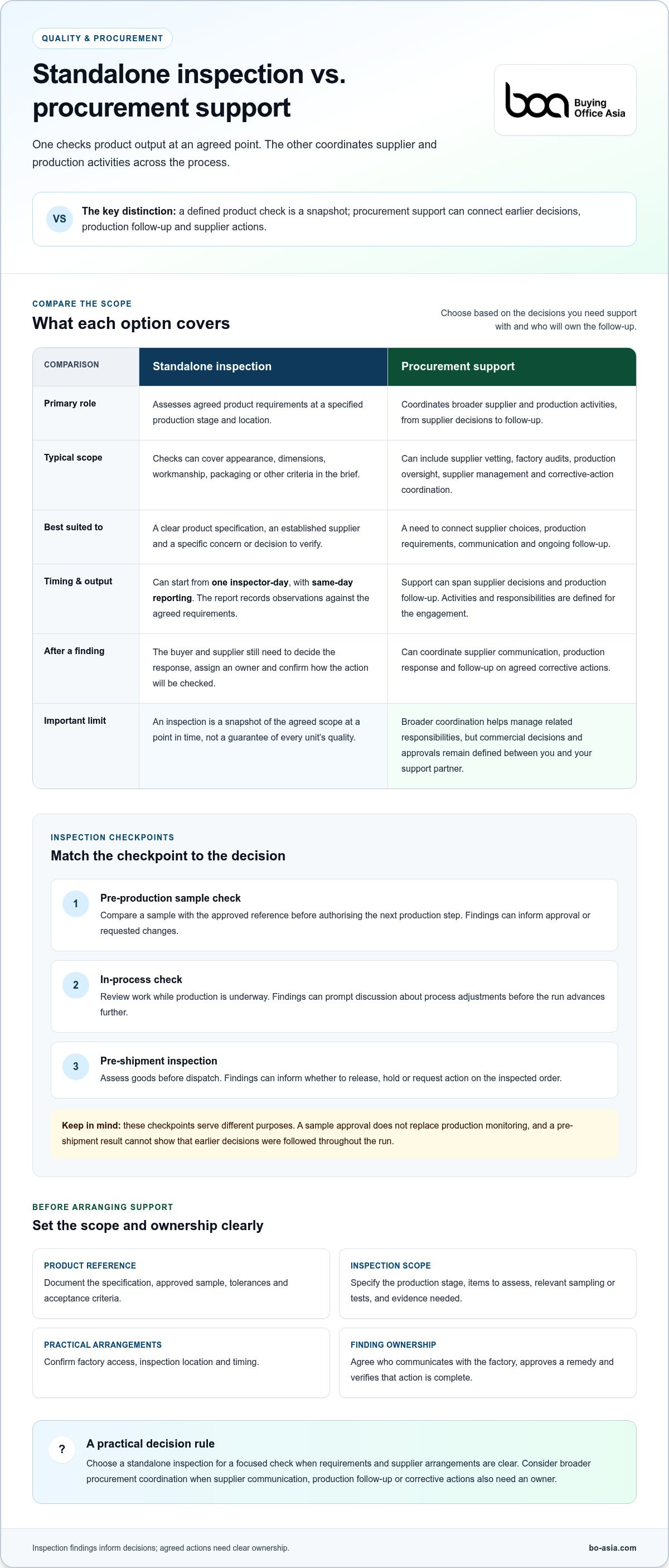
Do you need a defined product check, or ongoing coordination across suppliers and production? A standalone inspection is an on-site assessment with an agreed scope, location and production stage. Procurement support coordinates a broader set of activities, from supplier decisions to production follow-up. Your choice depends on where you need support and who will own the related decisions.
An inspection checks agreed requirements at a specified point. These might cover appearance, dimensions, workmanship, packaging or other product criteria. Before the visit, define what the inspector will assess and what evidence your team needs to make its next decision. Buying Office Asia provides standalone inspections that can start from one inspector-day, with same-day reporting.
A clear brief ties the check to an agreed reference, such as a product specification, approved sample or acceptance criteria. It should also identify the items and production stage in scope, along with relevant sampling or tests. For example, you might focus on packaging condition and assembly rather than treat the visit as a general review of every production process.
This option suits buyers with an established supplier relationship and a specific decision to make. The inspection report records what was observed against the agreed requirements, helping your team determine the appropriate next step.
Procurement covers a wider set of activities than checking product output. The overview of Procurement describes the broader process of acquiring goods and services. In manufacturing, supplier vetting, factory audits, negotiation, production oversight and supplier management address different parts of the buying process.
Coordinating these activities connects supplier selection with production requirements and follow-up. Supplier vetting helps inform who makes the product; approved specifications and samples guide production; and supplier management keeps communication and agreed changes on track. This broader remit helps manage related responsibilities, while commercial decisions and approvals remain defined between you and your support partner.
Consider a custom figurine with multiple components and painted details. A defined inspection can assess specified features, such as dimensions or decoration, against an approved reference. But unresolved supplier choices, tooling decisions or changing requirements sit beyond that inspection’s scope. Coordinated procurement support can connect those decisions with production activities. If the supplier and process are established and you need a specific product check, a standalone inspection may be appropriate. BOA’s sourcing and procurement support coordinates supplier and production activities for businesses that need that continuity.
A quality issue becomes manageable when a finding is connected to a decision and a responsible person. A practical sequence is: agree the requirement, select a production checkpoint, record any gap, assign a response and verify the agreed action. An inspection supports the evidence-gathering step. Prevention and production follow-up help keep requirements and supplier actions connected before and after that check.
Identifying a nonconformity doesn’t determine its cause, remedy or disposition. The buyer and supplier still need to decide what action is appropriate, who owns it and how the change will be confirmed. Without that handoff, a report can document a problem while production continues without an agreed response.
Choose the checkpoint according to the decision you need to make:
Compare a sample with the approved reference before authorising the next production step. Findings can inform whether to approve it or request changes.
Review work while production is underway. Findings can prompt a discussion about process adjustments before the run advances further.
Assess goods before dispatch. Findings can inform whether to release, hold or request action on the inspected order.
These checkpoints serve different purposes. Sample approval doesn’t replace production monitoring, and a pre-shipment result can’t show that earlier decisions were followed throughout the run. If a specification, material or process changes, identify whether the change requires a new approval or further inspection.
Make findings easy to discuss and resolve. A useful record connects the requirement to the observed result and includes relevant evidence, such as notes or photographs, along with the affected item or sample. It should also identify the inspection method or check that produced the finding. This gives the supplier and buyer a shared basis for deciding what to do next.
Keep the steps distinct: the inspection report records the finding; the supplier proposes or carries out a response; and follow-up checks whether the agreed action addressed the issue. Depending on the situation, verification could involve reviewing revised output or arranging another inspection. Record who will approve the remedy, communicate it to the factory and confirm completion. Clear ownership helps prevent corrective actions from becoming informal requests with no closeout.
If you need help defining an inspection scope or coordinating supplier follow-up, discuss your production requirements with Buying Office Asia.
The practical difference isn’t whether an inspection is useful. It’s whether you need evidence from a defined checkpoint or coordination across the production process. In standalone quality inspections vs procurement services, the right scope depends on production complexity, how often decisions arise and your team’s capacity to manage suppliers and follow-up.
Scope: A standalone inspection checks agreed criteria at a defined stage. Procurement support can also cover supplier vetting, negotiations, production oversight and supplier management.
Timing: An inspection takes place at a scheduled point. Coordinated oversight can connect decisions from supplier selection through production checkpoints.
Supplier contact: For a standalone booking, you generally retain the wider buyer-supplier relationship. With procurement support, supplier communication can be coordinated as part of the agreed work.
Follow-up: An inspection report records findings. Broader support can connect those findings to supplier communication, corrective actions and subsequent production follow-up.
Buyer workload: A scoped inspection requires you to provide requirements and decide what to do with the report. Ongoing support can take on agreed coordination tasks, while your team retains its decision-making responsibilities.
A one-off check may fit a defined order with a stable specification, an accessible factory and a specific inspection objective. It gives you on-site visibility while your team continues to manage supplier communication, production decisions and responses to findings. Before booking, define the product scope, factory access, inspection location, sampling or tests, and timing so the check answers a clear question.
This route is less suited to resolving an unclear specification or managing a series of production changes. The report informs your next decision, but your team remains responsible for acting on it and agreeing any follow-up with the supplier.
Multiple suppliers, evolving specifications or complex production can make responsibilities harder to track. A tabletop game with components produced or finished through separate processes, for example, needs coordination around approved versions, component counts, assembly and packaging. A decorated collectible may require attention to tooling, surface finish and paint consistency. A change in one area can affect the others.
Ongoing supplier management and production follow-up connect checkpoints, keep requirements visible and coordinate responses as issues emerge. This broader scope brings continuity, but responsibilities and decision authority still need to be clear. If your internal team already manages suppliers effectively and needs only a specific output check, a standalone inspection may be proportionate. If coordination gaps create risk across production, end-to-end sourcing and procurement support can bring related work into one managed process.
Define the product and the decisions your team needs to make before choosing a service. A structured scope avoids a common mismatch: commissioning an inspection when the underlying issue is unclear requirements, or arranging broad oversight when you need only a specific check.
Describe what is being manufactured, where it will be sold and how it will be used. For gaming merchandise, distinguish promotional items from toys or collectibles. Intended use, age group, small parts and destination can affect relevant checks or testing considerations.
Are the specification, approved or golden sample, tolerances, artwork and acceptance criteria documented? If not, settle the reference first. For licensed artwork, use the approved files and identify which version the factory should follow.
List the materials and processes, then identify critical checkpoints. For figurines or injection-moulded products, specify material, tooling, dimensions and decoration or paint consistency. For board games, record component counts, print quality, assembly and packaging requirements. Note where a change in one component could affect another.
Is your immediate need to assess a finished sample, monitor production or coordinate several suppliers? A defined output check may suit the first need. Changing specifications, linked processes or recurring production decisions may call for ongoing coordination.
Decide who will communicate findings, approve corrective action and verify revised output. For an inspection, define the product scope, factory access, inspection location, sampling or tests, and timing. For broader support, set out which supplier and production tasks are coordinated and which approvals remain with your team.
These questions turn the choice between standalone quality inspections vs procurement services into a practical assessment of risk, frequency and internal capacity. If your team already controls requirements and supplier communication, a clearly bounded inspection can fill a specific visibility gap. If your team is stretched across supplier selection, production changes and follow-up, coordinated procurement support may cover more of the work that creates exposure.
Keep the scope tied to evidence and responsibilities, not just a service label. An inspection brief should point to the exact approved reference and acceptance criteria. An oversight plan should identify who owns each decision and how changes are communicated across suppliers, production and packaging. For products with multiple materials, components or decoration steps, this clarity helps prevent one checkpoint from being mistaken for control of the entire order.
Use this framework to identify the right level of support for your production. Discuss your inspection or procurement scope with Buying Office Asia.
Buying Office Asia supports businesses through standalone on-site inspections and end-to-end sourcing and procurement. A standalone booking focuses on an agreed product, production stage and set of checks. Broader support connects supplier and production activities when multiple decisions or responsibilities need coordination. The right scope depends on what your team needs assessed and what it needs help managing.
For a standalone inspection, make the brief practical for the factory and useful to your team. Define which goods are in scope, which reference materials apply and how findings should be documented. Align the visit with the production stage and the decision you need to make afterward.
Share the approved specification and sample, applicable tolerances, acceptance criteria, artwork and packaging requirements. Confirm the product scope, factory access, inspection location, sampling or tests, and timing. If a feature is critical, such as print alignment or component inclusion, state it in the brief rather than relying on a general visual review.
Decide in advance how findings will guide your next step. Your team may need to discuss a discrepancy with the supplier, request a correction or determine whether further verification is appropriate. Clear responsibility for those decisions helps turn the report into a useful input.
When supplier selection, production requirements and corrective actions are linked, a final inspection alone may not cover all the work involved. Supplier vetting informs early decisions, while production oversight and supplier management help maintain coordination as the order progresses. BOA’s end-to-end approach connects these activities with quality checkpoints and follow-up, with approval responsibilities agreed for each project.
BOA combines Hong Kong operations with European leadership in Helsinki, supporting communication between Asian manufacturing activity and international business teams. A dedicated Asia procurement team can coordinate supplier and production work alongside your internal capacity. For projects that need this wider scope, end-to-end sourcing and procurement support links supplier management with production oversight and corrective-action coordination.
Choose the route that fits your production need, then define the scope and responsibilities clearly. Discuss your inspection or procurement requirements with Buying Office Asia.
Before your next order moves forward, decide which responsibilities your team can own and where it needs added visibility. A useful brief identifies the decision you’re trying to make, the evidence that will support it and who will act if findings raise concerns. That clarity turns the choice between standalone quality inspections vs procurement services into a scope built around your production risks, not a default service package.
Think beyond the inspection date. Consider whether your next production change, supplier question or corrective action has a clear owner. If those responsibilities are defined internally, a targeted check may fit. If they cross suppliers or production stages, coordinated support can help keep decisions connected while your team retains approval authority.
Discuss your inspection or procurement requirements with Buying Office Asia. A clear starting scope can help you move into production with better visibility and a deliberate plan for managing risk.
Yes. Buying Office Asia provides standalone inspections independently of its sourcing and procurement support. If you’ve already selected a supplier and arranged production, you can define a focused inspection brief without transferring supplier management. The choice between standalone quality inspections vs procurement services depends on the support you need, not a requirement to use both. Provide the product requirements and coordinate factory access so the inspection has a clear purpose.
One inspector-day means one inspector’s working day is allocated to the inspection. It doesn’t mean every unit will be checked or that a particular quantity can be covered. Product variety, factory layout, inspection tasks and the sampling approach affect what can be assessed in that time. Define the product scope and checks in advance so the allocated inspection effort focuses on the most important requirements.
No. AQL sampling assesses a batch using a defined sample and acceptance criteria; it doesn’t verify every unit. The result informs a decision about the inspected batch, not a guarantee that all products are defect-free. Agree the sampling method and defect classifications before inspection, and consider whether critical features need separate checks beyond the sampled visual or workmanship review.
The report gives you documented evidence to discuss with the supplier, but it doesn’t resolve the issue by itself. Compare each finding with the agreed requirement, identify which inspected goods are affected and ask the supplier to propose an action. Before approving a remedy, clarify whether it applies to affected items or continuing production, then decide how to verify the change before goods proceed.
Yes. A board-game check may need to account for different versions or bundled components, not just the appearance of one item. For a collectible, surface finish and decoration may be more important to acceptance. Gaming products should also be considered in light of intended use, age group, small parts and destination market. Requirements vary, so don’t assume promotional merchandise is automatically exempt from applicable checks.
No. Same-day reporting means the inspection findings can be documented and shared that day; it doesn’t mean the supplier has corrected the issue. Corrective action may require the supplier to review the evidence, agree on a response, make changes and provide revised output for verification. Set expectations separately for the report, supplier response and any follow-up check, since each is a distinct step with its own timing.

A factory audit can look reassuring while leaving a critical question unanswered: will the same materials, processes and controls be used for your production run? Responsible toy manufacturing in China requires more than reviewing a certificate. You need to understand factory conditions, subcontract...

A factory quote is not a shipment plan. Sourcing products from China to USA involves more than finding a manufacturer and agreeing on a unit price. Unclear specifications, samples that differ from production, or overlooked packaging and freight details can put quality and commercial viability at ris...

Trade Assurance can help protect a transaction, but it can’t prevent a delayed or defective order from disrupting your production schedule. When a claim doesn’t resolve the problem as expected, you still need to manage cash flow, customer commitments, and the next steps in your supply chain.If you’r...